
Why Embedded Engineers Need Strong C Programming Skills | Complete Guide
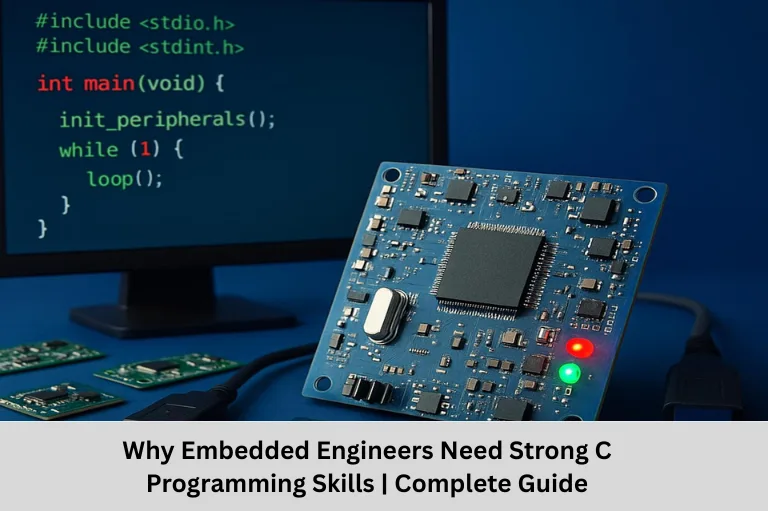
Learn why C programming is essential for embedded engineers. Explore benefits, applications, career opportunities, and how ETDA prepares students with practical embedded systems training.
- Why Embedded Engineers Need Strong C Programming Skills | Complete Guide
-
Why Embedded Engineers Need Strong C Programming Skills
- What is C Programming?
- Why C Programming is the Foundation of Embedded Systems
- Why Embedded Engineers Must Learn C Programming
- Core C Programming Concepts Every Embedded Engineer Should Know
- How C Programming is Used in Embedded Systems
- Industries That Depend on C Programming
- Why Companies Prefer Engineers with Strong C Skills
- Common Mistakes Students Make While Learning C
- How ETDA Helps Students Build Strong C Programming Skills
- Career Opportunities After Learning C Programming
-
Frequently Asked Questions (FAQs)
- Why is C programming important for embedded systems?
- Is C better than Python for embedded programming?
- Can I learn Embedded C without knowing C?
- Which microcontrollers use C programming?
- Do embedded companies ask C programming questions in interviews?
- How long does it take to learn C programming?
- Does ETDA provide C programming training?
- Conclusion
Why Embedded Engineers Need Strong C Programming Skills
The embedded systems industry is growing rapidly, driven by innovations in Internet of Things(IoT), automotive electronics, industrial automation, robotics, consumer electronics, healthcare devices, and smart appliances. Behind every successful embedded product is efficient software that directly controls hardware—and the programming language that powers most of these systems is C Programming.
Although modern programming languages like Python, Java, and C++ have gained popularity, C remains the backbone of embedded systems development. Almost every microcontroller, firmware application, real-time operating system (RTOS), and device driver is developed using C. This is because C provides developers with complete control over hardware while maintaining excellent performance and efficient memory usage.
If you are an engineering student or aspiring embedded systems engineer, mastering C programming is one of the smartest career decisions you can make. Companies hiring Embedded Software Engineers, Firmware Engineers, IoT Developers, and Automotive Engineers consider strong C programming skills a fundamental requirement.
Embedded Tech Development Academy (ETDA) provides industry-oriented training in C Programming, Embedded C, ARM Cortex-M, LPC1768, STM32, RTOS, IoT, and Automotive Embedded Systems with assured placement support. Through hands-on projects and practical learning, ETDA helps students develop the programming skills required to succeed in the embedded industry.
In this guide, you’ll learn why C programming is essential for embedded engineers, how it is used in real-world applications, and why every engineering student should master it.
What is C Programming?
C is a powerful, general-purpose programming language developed to create efficient and high-performance software. It provides low-level access to memory and hardware while maintaining a simple and structured syntax.
Unlike high-level languages that hide hardware details, C allows developers to interact directly with system resources. This capability makes it the preferred language for embedded systems development.
Why C is Different from Other Programming Languages
C offers:
- Direct Memory Access
- Pointer Support
- Fast Execution Speed
- Low Memory Usage
- Hardware-Level Programming
These features are critical for embedded applications where performance and efficiency matter.
Why C Programming is the Foundation of Embedded Systems
Every embedded device contains software called firmware.
Firmware is responsible for controlling:
- Microcontrollers
- Sensors
- Displays
- Motors
- Communication Modules
- Memory Devices
Most firmware is written using C.
Without C programming, embedded systems development would be significantly more difficult.
Why Embedded Engineers Must Learn C Programming
Learning C programming provides several advantages for embedded engineers.
Direct Hardware Access
One of the biggest reasons C dominates embedded systems is its ability to communicate directly with hardware.
Register-Level Programming
Embedded engineers frequently work with:
- GPIO Registers
- Timer Registers
- ADC Registers
- UART Registers
- SPI Registers
- I2C Registers
C allows developers to manipulate these registers efficiently.
This direct control is essential for embedded applications.
High Performance
Embedded systems often have strict timing requirements.
Examples include:
- Automotive Airbag Systems
- Medical Devices
- Industrial Controllers
C programs execute quickly because they compile directly into machine code with very little overhead.
This makes C ideal for real-time systems.
Efficient Memory Usage
Most embedded devices have limited memory resources.
For example:
- 32 KB RAM
- 64 KB Flash
- 128 KB Memory
C allows engineers to optimize memory usage effectively.
Efficient memory management results in:
- Faster Systems
- Lower Power Consumption
- Better Performance
Portability
C programs can be adapted across different microcontrollers with minimal modifications.
Popular platforms include:
- ARM Cortex-M
- STM32
- LPC1768
- AVR
- PIC
- ESP32
Learning C makes it easier to work with different embedded platforms.
Core C Programming Concepts Every Embedded Engineer Should Know
Variables and Data Types
Embedded software uses different data types depending on memory requirements.
Examples include:
- int
- char
- float
- unsigned int
Selecting appropriate data types improves system efficiency.
Functions
Functions improve:
- Code Reusability
- Readability
- Modular Design
Large embedded projects rely heavily on modular programming.
Pointers
Pointers are among the most important concepts in embedded programming.
Applications
- Register Access
- Memory Mapping
- Peripheral Control
- Dynamic Memory Management
Strong pointer knowledge is essential for firmware development.
Bitwise Operators
Bitwise operations allow engineers to manipulate hardware registers efficiently.
Common operators include:
- AND (&)
- OR (|)
- XOR (^)
- NOT (~)
- Left Shift (<<)
- Right Shift (>>)
These operations are frequently used in embedded applications.
Structures
Structures organize related data into a single unit.
Applications include:
- Sensor Information
- Device Configuration
- Communication Packets
Structures improve code organization.
How C Programming is Used in Embedded Systems
C programming is used throughout embedded product development.
GPIO Programming
GPIO enables communication with external devices.
Applications
- LED Blinking
- Switch Detection
- Relay Control
- Motor Activation
GPIO programming is often the first project students learn.
Sensor Interfacing
Sensors provide real-world data.
Examples include:
- Temperature Sensors
- Pressure Sensors
- Motion Sensors
- Gas Sensors
C programming processes sensor information efficiently.
Communication Protocols
Embedded devices communicate using protocols such as:
UART
Serial communication.
SPI
High-speed peripheral communication.
I2C
Communication with multiple devices.
CAN
Automotive communication protocol.
C programming enables developers to implement these interfaces.
Interrupt Programming
Interrupts allow systems to respond immediately to external events.
Applications include:
- Button Press Detection
- Sensor Events
- Communication Reception
Interrupt handling is primarily implemented in C.
Industries That Depend on C Programming
C programming is used in almost every embedded domain.
Automotive Industry
Applications include:
- Engine Control Units (ECUs)
- Airbag Systems
- Anti-lock Braking Systems (ABS)
- Electric Vehicle Controllers
Consumer Electronics
Examples include:
- Washing Machines
- Smart TVs
- Digital Cameras
- Air Conditioners
Healthcare
Medical devices rely on C programming for:
- ECG Machines
- Patient Monitors
- Infusion Pumps
- Portable Diagnostic Equipment
Industrial Automation
Applications include:
- PLC Systems
- Robotics
- Manufacturing Equipment
- Factory Automation
Internet of Things (IoT)
IoT devices use C for:
- Sensor Control
- Device Communication
- Edge Processing
- Power Management
Why Companies Prefer Engineers with Strong C Skills
Most embedded companies evaluate C programming during technical interviews.
They look for engineers who understand:
- Memory Management
- Pointers
- Arrays
- Structures
- Bit Manipulation
- Functions
- Embedded Logic
Strong C programming demonstrates a candidate’s ability to solve hardware-oriented problems efficiently.
Common Mistakes Students Make While Learning C
Memorizing Syntax
Understanding programming logic is more important than memorizing keywords.
Ignoring Pointers
Many beginners avoid pointers because they seem difficult. However, pointers are fundamental in embedded programming.
Avoiding Practical Coding
Reading books alone is not enough. Students should write programs daily and implement real embedded projects.
How ETDA Helps Students Build Strong C Programming Skills
Embedded Tech Development Academy (ETDA) focuses on practical learning instead of theory alone.
Comprehensive Curriculum
Students learn:
C Programming Fundamentals
Building a strong programming base.
Advanced C Concepts
Pointers, structures, memory management, and file handling.
Embedded C
Programming microcontrollers and hardware interfaces.
ARM Cortex-M & LPC1768
Industry-standard embedded platforms.
STM32 Development
Hands-on firmware development.
RTOS and IoT
Developing real-time and connected embedded systems.
Hands-On Project Experience
Students develop projects such as:
- Smart Home Automation
- Industrial Monitoring Systems
- Sensor-Based Applications
- IoT Devices
- Automotive Embedded Projects
These projects strengthen programming and debugging skills.
Assured Placement Support
ETDA provides:
- Resume Building
- Technical Interview Preparation
- Mock Interviews
- Aptitude Training
- Placement Assistance
This helps students confidently prepare for embedded engineering careers.
Career Opportunities After Learning C Programming
Strong C programming skills open doors to various engineering roles.
Embedded Software Engineer
Develops firmware for embedded devices.
Firmware Engineer
Creates low-level software for hardware platforms.
IoT Developer
Builds intelligent connected devices.
Automotive Embedded Engineer
Works on automotive electronics and control systems.
Embedded Test Engineer
Tests and validates embedded products.
As embedded technologies continue to grow, engineers with strong C programming skills remain in high demand.
Frequently Asked Questions (FAQs)
Why is C programming important for embedded systems?
C provides direct hardware access, efficient memory management, and high performance, making it ideal for embedded systems.
Is C better than Python for embedded programming?
Yes. While Python is useful for scripting and automation, C is preferred for firmware development because it offers better speed, memory efficiency, and hardware control.
Can I learn Embedded C without knowing C?
No. A solid understanding of C programming is essential before learning Embedded C.
Which microcontrollers use C programming?
ARM Cortex-M, LPC1768, STM32, AVR, PIC, MSP430, and ESP32 are commonly programmed using C.
Do embedded companies ask C programming questions in interviews?
Yes. Most embedded engineering interviews include questions on C programming, pointers, memory management, bitwise operations, and embedded concepts.
How long does it take to learn C programming?
With consistent practice, most students can build a strong foundation in C programming within two to three months.
Does ETDA provide C programming training?
Yes. ETDA offers practical training in C Programming, Embedded C, ARM Cortex-M, LPC1768, STM32, RTOS, IoT, and Automotive Embedded Systems with assured placement support.
Conclusion
C programming is the backbone of embedded systems development and remains one of the most valuable skills for aspiring embedded engineers. Its ability to provide direct hardware access, efficient memory management, and high-performance execution makes it the preferred language for firmware development across industries.
Whether you’re working on microcontrollers, IoT devices, automotive electronics, industrial automation, or medical equipment, strong C programming skills are essential for building reliable and efficient embedded solutions. Learning C not only strengthens your programming foundation but also makes it easier to master advanced topics such as Embedded C, ARM Cortex-M, RTOS, and IoT.
Embedded Tech Development Academy (ETDA) helps engineering students develop these critical skills through practical training, real-time projects, expert mentorship, and industry-oriented learning. With comprehensive courses in C Programming, Embedded C, ARM Cortex-M, LPC1768, STM32, RTOS, IoT, and Automotive Embedded Systems, along with assured placement support, ETDA prepares students to confidently launch successful careers in the fast-growing embedded systems industry.
Author: ETDA Trainers
Experience: 10+ Years of Industry Experience in Embedded Systems, IoT, and Embedded C Programming