
Why Most Bugs in C++ Are Actually Design Bugs | Modern C++
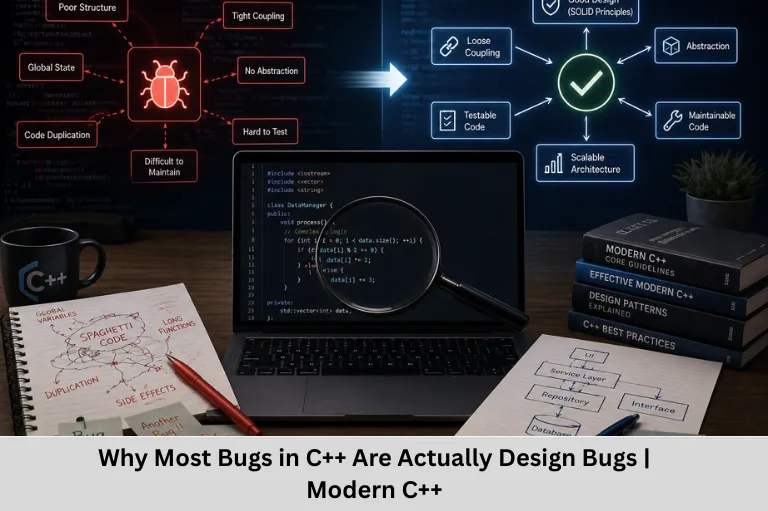
Understand why C++ memory bugs, lifetime errors, ownership issues, inheritance problems, and undefined behavior are often caused by poor software design. Embedded Tech Development Academy (ETDA).
- Why Most Bugs in C++ Are Actually Design Bugs | Modern C++
-
Why Most Bugs in C++ Are Actually Design Bugs
- Introduction
- The Illusion: “The Compiler Let Me Do It”
- Bug Type #1 — Confusion About Ownership
- Bug Type #2 — Lifetime Mismatch
- Bug Type #3 — Using Inheritance for the Wrong Reason
- Bug Type #4 — Overly Complex Constructors
- Bug Type #5 — Implicit Behavior Everywhere
- Bug Type #6 — Performance-First Design
- Why These Bugs Appear Less Obviously in Other Languages
- Modern C++ Is a Design Language
- How Design Prevents C++ Bugs
- Design Bugs in Embedded C++
- A Practical Design Checklist for C++ Developers
- The Role of Code Reviews in Preventing Design Bugs
- Building Reliable C++ Software Through Better Design
- Conclusion
Why Most Bugs in C++ Are Actually Design Bugs
Introduction
C++ is one of the most powerful programming languages used for embedded systems, operating systems, automotive software, game engines, robotics, high-performance applications, and systems programming. Its combination of low-level hardware control and high-level abstraction gives developers enormous flexibility. However, that flexibility also creates responsibility: the programmer must make important decisions about memory ownership, object lifetime, resource management, copying, inheritance, exception safety, and performance.
Many difficult C++ bugs are therefore not caused by syntax errors. They originate much earlier, during the software design stage. A compiler can verify many language rules, but it cannot automatically determine whether a particular object should be owned by one component, shared by several components, or remain alive for a specific period. Similarly, a compiler may accept a pointer or reference that becomes invalid later because the underlying object’s lifetime has ended.
This is why problems such as memory leaks, dangling pointers, double deletion, segmentation faults, undefined behavior, object slicing, accidental copies, race conditions, and resource-management failures can often be traced back to design decisions.
Modern C++ provides mechanisms such as std::unique_ptr, std::shared_ptr, RAII, move semantics, const correctness, smart resource wrappers, and the Rule of Zero to help developers express intent more clearly. These are not merely language features; they are tools for creating safer software architectures.
For developers learning C++ programming for embedded systems, understanding this design perspective is particularly important. Embedded applications frequently operate with constrained memory, deterministic timing requirements, hardware resources, and long product lifetimes. A poor ownership or lifetime model can become a difficult firmware defect.
Embedded Tech Development Academy (ETDA) emphasizes practical programming concepts that connect C/C++, embedded firmware, memory management, debugging, and system-level design. For learners searching for a Top Embedded Training Institute in Bangalore, understanding these design principles can provide a stronger foundation for developing reliable embedded software. Embedded Tech Development Academy (ETDA) also provides assured placement support, helping learners prepare for practical technical roles.
LSI Keywords Covered in This Article
Important related terms include C++ memory management, C++ object lifetime, smart pointers in C++, RAII in C++, C++ ownership, dangling pointers, undefined behavior, C++ design patterns, Rule of Zero, Rule of Five, move semantics, C++ resource management, inheritance vs composition, C++ debugging, embedded C++, and modern C++ programming.
The Illusion: “The Compiler Let Me Do It”
C++ gives developers significant control over how software behaves.
A programmer can:
- Allocate and release memory.
- Control object lifetime.
- Create custom copy and move operations.
- Override operators.
- Build inheritance hierarchies.
- Use templates.
- Control memory layout.
- Optimize performance.
- Interface directly with hardware.
- Manage operating-system and hardware resources.
The compiler checks whether the code follows the language rules, but it cannot understand every architectural intention behind the code.
Consider:
Foo* createFoo()
{
    return new Foo();
}
The code can compile successfully.
But an important design question remains:
Who owns the returned Foo object?
Is the caller responsible for deleting it?
Does another component own it?
Is ownership transferred?
Is it intentionally leaked?
The compiler cannot answer that question from this interface alone.
This illustrates the difference between syntactic correctness and design correctness.
Why Design Errors Become Runtime Bugs
A design mistake may not fail immediately.
For example:
Foo* foo = createFoo();The program might continue working for thousands of operations before the ownership problem causes:
- A memory leak
- Double deletion
- Use-after-free
- Resource exhaustion
- Heap fragmentation
The visible crash occurs later, while the actual mistake happened when the ownership model was designed.
Bug Type #1 — Confusion About Ownership
Ownership is one of the most important concepts in C++ resource management.
Every dynamically allocated resource should have a clearly defined owner.
The Ownership Question
Whenever a raw pointer is passed between components, ask:
- Who owns the object?
- Who destroys it?
- Can ownership change?
- Can multiple objects own it?
- Can the object outlive its creator?
- Is the pointer merely observing an object?
If these questions do not have clear answers, the interface is difficult to reason about.
Raw Pointer vs Smart Pointer
A raw pointer:
Foo* foo;does not communicate ownership.
A smart pointer can express intent more clearly:
std::unique_ptr<Foo> foo;std::unique_ptr normally represents exclusive ownership.
If shared ownership is genuinely required:
std::shared_ptr<Foo> foo;can express that relationship.
However, shared_ptr should not automatically replace every raw pointer. Shared ownership has additional cost and complexity.
Prefer Explicit Ownership
A strong C++ design distinguishes between:
- Owning pointers
- Non-owning pointers
- References
- Values
- Shared resources
For example:
void process(const Foo& foo);communicates that the function operates on an existing object without taking ownership.
This is a design improvement because the interface communicates intent.
Design Principle
Ownership should be visible in the API whenever possible.
When ownership is explicit, many memory-management bugs become harder to create.
Bug Type #2 — Lifetime Mismatch
C++ has strict object-lifetime rules.
An object exists only within its valid lifetime. A pointer or reference does not extend that lifetime merely because it still contains an address.
Consider:
const char* getName()
{
    std::string name = "Alex";
    return name.c_str();
}
The returned pointer refers to memory associated with the local std::string.
When the function returns, name is destroyed.
The pointer therefore becomes invalid.
The Real Problem
The problem is not that std::string is unsafe.
The problem is that the interface returns a reference to something whose lifetime has already ended.
A safer design is:
std::string getName()
{
    return "Alex";
}
The function returns a value whose lifetime can be managed by the caller.
Lifetime Should Follow the API Contract
Good interfaces make lifetime relationships obvious.
Developers should carefully distinguish:
- Owning objects
- Temporary objects
- Local objects
- Static objects
- References
- Views
- Iterators
- Non-owning pointers
Embedded Systems Perspective
Lifetime errors are especially problematic in embedded firmware because debugging tools and memory resources can be limited. A dangling pointer may corrupt unrelated memory and produce an apparently random hardware or software failure.
Bug Type #3 — Using Inheritance for the Wrong Reason
Inheritance is powerful, but it is frequently used simply because one class appears to be a convenient place to reuse code.
Consider:
class FileLogger : public Logger
{
};

class NetworkLogger : public Logger
{
};
This may be correct if FileLogger and NetworkLogger genuinely satisfy the intended Logger abstraction.
But inheritance can create problems when the relationship is not properly designed.
Common Inheritance Problems
Poorly designed inheritance can lead to:
- Missing virtual destructors
- Object slicing
- Incorrect polymorphic behavior
- Fragile base classes
- Unexpected overrides
- Tight coupling
- Difficult maintenance
Virtual Destructor
If a class is intended to be used polymorphically, its destructor generally needs to be virtual:
class Logger
{
public:
    virtual ~Logger() = default;
};
Otherwise, deleting a derived object through an inappropriate base pointer can result in undefined behavior.
Composition vs Inheritance
Composition often provides a cleaner design:
class Logger
{
    OutputDevice output;
};
Instead of asking:
“Is this class a type of that class?”
ask:
“Does this class contain or use that component?”
Design Principle
Use inheritance to model a genuine substitutable relationship, not merely to reuse implementation.
Bug Type #4 — Overly Complex Constructors
Constructors establish the initial state and invariants of an object.
A constructor that performs too many unrelated operations can make an object difficult to create and maintain.
For example, a constructor that simultaneously:
- Allocates resources
- Opens files
- Starts threads
- Configures hardware
- Performs network operations
- Executes complex business logic
- Throws multiple types of exceptions
can create complicated failure paths.
Why This Becomes a Design Problem
Suppose a constructor performs five operations and the fourth operation fails.
The object was never fully constructed, but several resources may already have been acquired.
Modern C++ can handle many such cases safely through RAII, but the overall design can still become unnecessarily complicated.
RAII and Resource Management
RAII means Resource Acquisition Is Initialization.
Resources are associated with object lifetime.
For example:
std::unique_ptr<Foo> foo = std::make_unique<Foo>();When foo goes out of scope, the associated resource is automatically released.
RAII can be applied to:
- Memory
- File handles
- Mutexes
- Sockets
- Hardware resources
- Database connections
Rule of Zero
A strong modern C++ design attempts to avoid manually implementing special member functions whenever standard resource-managing types can handle the resource.
This is commonly associated with the Rule of Zero.
Bug Type #5 — Implicit Behavior Everywhere
C++ provides many implicit operations.
These include:
- Copy construction
- Copy assignment
- Move construction
- Move assignment
- Type conversions
- Temporary object creation
These features are useful, but they can become dangerous when the class’s resource semantics are not properly designed.
Consider:
class Buffer
{
public:
    char* data;
};
If the class owns dynamically allocated memory and uses the compiler-generated copy constructor, copying the object may copy only the pointer.
Two objects can then refer to the same allocation.
Shallow Copy Problem
Conceptually:
Buffer A ----\
              ---> same memory
Buffer B ----/
If both objects believe they own that memory, destruction can produce a double-release problem.
Better Resource Ownership
Use an owning type such as:
std::vector<char> data;or:
std::unique_ptr<char[]> data;depending on the actual requirements.
Rule of Five
When a class directly manages a resource, developers may need to consider:
- Destructor
- Copy constructor
- Copy assignment operator
- Move constructor
- Move assignment operator
However, the better architectural solution is often to use an existing RAII type and follow the Rule of Zero.
Bug Type #6 — Performance-First Design
Performance matters in C++, especially in:
- Embedded systems
- Automotive applications
- Real-time systems
- Robotics
- High-frequency software
- Operating systems
But optimizing before establishing a correct design can create fragile software.
Common Performance-First Mistakes
Developers may:
- Pass raw pointers everywhere
- Avoid abstractions without measurement
- Duplicate logic
- Inline everything
- Remove safety checks
- Use manual memory management unnecessarily
The resulting program may be fast but difficult to understand and maintain.
Measure Before Optimizing
A better sequence is:
Design → Implement → Measure → Profile → Optimize
Instead of:
Guess → Optimize → Debug
Zero-Cost Abstractions
Modern C++ is designed around abstractions that can, when appropriately used, provide high-level expressiveness without requiring unnecessary runtime overhead.
Examples include:
- Templates
- Iterators
std::arraystd::span- RAII wrappers
- Compile-time computation
Performance Principle
A clean architecture should be the starting point for optimization, not the thing sacrificed before optimization begins.
Why These Bugs Appear Less Obviously in Other Languages
Languages with garbage collection or stronger runtime memory-management mechanisms can automatically handle some classes of memory problems.
For example, garbage collection can remove the need for explicit deallocation in many situations.
However, this does not mean that poor design disappears.
Poor design can still result in:
- Excessive memory consumption
- Retained objects
- Incorrect ownership models
- Performance problems
- Race conditions
- Incorrect business logic
C++ simply exposes more of the underlying resource-management decisions to the developer.
C++ Makes Resource Semantics Visible
C++ developers must reason about:
- Who owns resources?
- When resources are released?
- Whether copying is valid?
- Whether moving is valid?
- Whether references remain valid?
- Whether an object is polymorphic?
This responsibility is challenging, but it also provides precise control.
Modern C++ Is a Design Language
Modern C++ is not merely about writing complicated syntax.
Its important features can be viewed as ways of communicating programmer intent.
std::unique_ptr
Communicates exclusive ownership.
std::unique_ptr<Device> device;std::shared_ptr
Communicates shared ownership when shared lifetime is actually required.
std::shared_ptr<Device> device;const Correctness
const communicates that a particular operation should not modify an object through that interface.
void print(const Device& device);Value Semantics
Sometimes the best design is simply to return and store objects by value.
Device createDevice();This can eliminate unnecessary ownership complexity.
RAII
RAII connects resource lifetime with object lifetime.
Together, these mechanisms make code easier to reason about because the program communicates its intended resource model directly.
How Design Prevents C++ Bugs
A useful design review should happen before debugging begins.
Question 1 — Who Owns What?
For every resource, identify:
- Owner
- Lifetime
- Transfer mechanism
- Cleanup responsibility
Question 2 — How Long Does It Live?
Determine whether the object is:
- Local
- Dynamic
- Static
- Shared
- Temporary
- Referenced by another object
Question 3 — What Can Change?
Use:
const- Encapsulation
- Private data
- Controlled interfaces
to make mutation explicit.
Question 4 — What Invariants Exist?
An invariant is a condition that should remain true for a valid object.
For example:
class Buffer
{
public:
    bool valid() const;
};
A well-designed class establishes and maintains its invariants consistently.
Question 5 — What Happens During Failure?
Consider:
- Allocation failure
- Exceptions
- Invalid input
- Resource acquisition failure
- Hardware failure
- Thread termination
- Communication failure
Designing failure behavior early reduces complicated recovery logic later.
Design Bugs in Embedded C++
C++ design principles become especially important in embedded applications.
An embedded system may have:
- Limited RAM
- Limited Flash
- Strict timing requirements
- Interrupt handlers
- Hardware registers
- DMA buffers
- Peripheral resources
- Real-time constraints
A poorly designed memory-management strategy can therefore have consequences beyond an application crash.
Embedded Resource Ownership
Consider a DMA buffer.
The firmware must know:
- Who owns the buffer?
- Who can modify it?
- When DMA can access it?
- When the CPU can access it?
- When it can be released or reused?
These are design questions before they become coding questions.
Deterministic Resource Management
Embedded firmware often benefits from predictable resource usage.
Developers should carefully evaluate:
- Dynamic allocation
- Fragmentation
- Stack usage
- Static allocation
- Object lifetime
- Interrupt safety
Practical Learning
At Embedded Tech Development Academy (ETDA), learners can study C/C++, embedded programming, memory management, ARM-based development, and firmware architecture through practical technical exercises. For students seeking a Top Embedded Training Institute in Bangalore, connecting modern C++ design principles with embedded hardware helps build stronger system-level programming skills. Embedded Tech Development Academy (ETDA) also provides assured placement support for eligible training programs.
A Practical Design Checklist for C++ Developers
Before finalizing a C++ component, ask:
Ownership
- Is ownership explicit?
- Can
unique_ptrrepresent ownership? - Is
shared_ptrgenuinely necessary?
Lifetime
- Can any reference become dangling?
- Can an object outlive the resource it references?
- Are returned references and pointers valid?
Copy and Move Semantics
- Is copying actually meaningful?
- Is moving supported?
- Should copying be disabled?
Resource Management
- Can RAII manage the resource?
- Can a standard library type replace manual allocation?
- Is manual
new/deletereally required?
Inheritance
- Is inheritance modeling a real abstraction?
- Is the base class designed for polymorphism?
- Would composition be simpler?
Performance
- Has the code actually been profiled?
- Is optimization based on measurement?
- Is a safety-oriented abstraction actually causing measurable overhead?
The Role of Code Reviews in Preventing Design Bugs
Code reviews should not focus exclusively on syntax.
A technically strong review should examine architecture and ownership.
Review Questions
A reviewer can ask:
- Who owns this object?
- Why is this pointer raw?
- Why is this class inheriting from that class?
- Can this object be copied safely?
- Can this reference become invalid?
- Why is this resource manually managed?
- Is this optimization supported by profiling data?
Design Review vs Bug Fixing
Fixing a crash may solve the immediate symptom.
Improving the design can prevent the same class of bug from appearing elsewhere.
This distinction is critical in large C++ codebases.
Building Reliable C++ Software Through Better Design
Good C++ programming is not about avoiding every powerful language feature.
It is about using the right feature for the right ownership, lifetime, abstraction, and performance requirement.
A strong design generally aims for:
- Explicit ownership
- Well-defined lifetimes
- Strong invariants
- RAII-based resource management
- Appropriate value semantics
- Minimal unnecessary inheritance
- Controlled copying
- Measured optimization
- Clear interfaces
This approach makes the compiler a partner in enforcing design decisions rather than simply a tool for detecting syntax mistakes.
FAQs
Why are so many C++ bugs related to design?
C++ gives programmers direct control over memory, object lifetime, ownership, copying, and resources. If these relationships are not designed clearly, the resulting implementation can produce undefined behavior, memory leaks, dangling pointers, and other runtime failures.
Do smart pointers eliminate all C++ memory bugs?
No. Smart pointers greatly improve ownership management, but they do not eliminate every possible bug. Incorrect use of shared_ptr, dangling non-owning references, cyclic ownership, data races, and incorrect object design can still cause problems.
Should raw pointers never be used in modern C++?
No. Raw pointers can be appropriate for non-owning observation, low-level interfaces, hardware access, and interoperability with C APIs. The important point is that a raw pointer should not ambiguously represent ownership.
Why is RAII important in C++?
RAII associates resource management with object lifetime. When the object leaves its valid scope, its destructor releases the associated resource. This makes cleanup more deterministic and reduces manual resource-management errors.
Is composition always better than inheritance?
No. Inheritance is appropriate when a genuine polymorphic relationship exists and the derived object can correctly substitute for the base abstraction. Composition is often preferable when the objective is simply to reuse functionality or combine components.
Conclusion
C++ is often described as difficult because it provides direct access to memory, object lifetime, resource management, templates, inheritance, and low-level optimization. But the deeper lesson is that these capabilities are not inherently problems. The real challenge is using them without a clearly defined software design.
A segmentation fault may appear to be a pointer problem, but the deeper issue could be unclear ownership. A double-free may appear to be a destructor problem, while the real cause is incorrect copy semantics. A dangling reference may appear to be a random runtime failure, while the actual mistake was an API that returned an object beyond its lifetime. Similarly, an inheritance-related defect can often be traced to choosing inheritance for code reuse rather than modeling a valid abstraction.
Modern C++ gives developers powerful design tools: RAII, smart pointers, move semantics, value semantics, const correctness, the Rule of Zero, templates, and strong type-based interfaces. When these features are used deliberately, C++ code becomes easier to reason about and significantly more predictable.
For embedded developers, this design mindset is even more important. Firmware often interacts directly with memory, peripherals, interrupts, DMA, communication buffers, and hardware resources. A well-designed C++ architecture can make these relationships explicit and reduce the possibility of resource-management and lifetime errors.
Embedded Tech Development Academy (ETDA) focuses on practical technical learning across embedded programming, C/C++, microcontrollers, firmware development, debugging, and system-level concepts. Students looking for a Top Embedded Training Institute in Bangalore can benefit from learning not only how to write C++ code, but also how to design reliable software before writing the implementation. Embedded Tech Development Academy (ETDA) also offers assured placement support, helping learners prepare for practical embedded software and firmware career opportunities.
Author: ETDA Trainers
Experience: 10+ Years of Industry Experience in Embedded Systems, IoT, and Embedded C Programming