
Wireless Communication: Types, Technologies, Applications & Future Trends
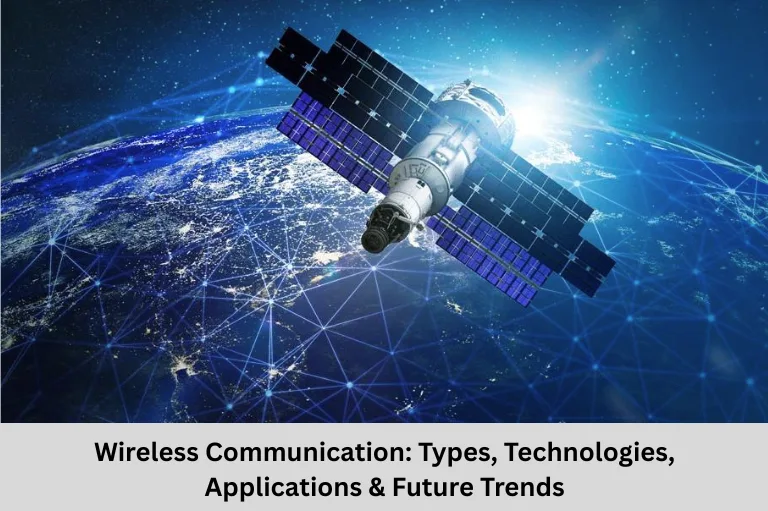
Learn the fundamentals of wireless communication, including RF, Wi-Fi, Bluetooth, 5G, satellite communication, Internet of Things (IoT), applications, challenges, and future wireless technologies.
- Wireless Communication: Types, Technologies, Applications & Future Trends
-
Introduction: Understanding Wireless Communication
- Fundamentals of Wireless Communication
- Key Components of Wireless Communication Systems
- Types of Wireless Communication
- Key Wireless Technologies
- Applications of Wireless Communication
- Challenges in Wireless Communication
- Future Trends in Wireless Communication
- Best Practices for Wireless System Design
- Frequently Asked Questions (FAQs)
- Conclusion
Introduction: Understanding Wireless Communication
Wireless communication has transformed the way people connect, communicate, and exchange information in today’s digital world. From making voice calls on smartphones and accessing high-speed internet through Wi-Fi to controlling smart home devices and enabling autonomous vehicles, wireless technology has become an integral part of modern life. Unlike traditional wired communication, wireless communication transmits data using electromagnetic waves, eliminating the need for physical cables while providing greater mobility, flexibility, and scalability.
The rapid growth of 5G networks, Internet of Things (IoT), artificial intelligence (AI), cloud computing, Industry 4.0, smart cities, wearable devices, satellite internet, and edge computing has significantly increased the demand for reliable and high-speed wireless communication systems. Whether it is Bluetooth, Wi-Fi, Zigbee, LoRaWAN, NFC, GPS, cellular communication, RF communication, microwave communication, optical wireless communication, or satellite communication, wireless technologies form the backbone of today’s connected ecosystem.
Understanding concepts such as radio frequency (RF), electromagnetic waves, antennas, wireless networking, modulation techniques, signal propagation, spectrum allocation, wireless protocols, mobile communication, network security, wireless sensor networks, communication engineering, Internet of Things (IoT) connectivity, and embedded wireless systems is essential for students, engineers, and technology professionals.
Wireless communication plays a crucial role in industries including consumer electronics, automotive, healthcare, aerospace, telecommunications, industrial automation, defense, robotics, renewable energy, agriculture, and smart manufacturing. As industries continue embracing digital transformation, skilled professionals with expertise in wireless technologies are increasingly in demand.
For aspiring embedded systems and electronics engineers, Embedded Tech Development Academy (ETDA) offers comprehensive industry-oriented training in embedded systems, Internet of Things (IoT), wireless communication, PCB design, microcontroller programming, ARM processors, STM32, Raspberry Pi, and real-time embedded projects. Embedded Tech Development Academy (ETDA)‘s hands-on learning approach enables students to gain practical experience in developing wireless-enabled embedded applications, preparing them for successful careers in embedded systems, communication engineering, and electronics design.
In this comprehensive guide, you’ll learn the fundamentals of wireless communication, its major technologies, applications, challenges, and future innovations that are shaping the connected world.
Fundamentals of Wireless Communication
Wireless communication is the process of transmitting information between devices using electromagnetic waves instead of physical cables.
Communication takes place through various frequency bands such as:
- Radio Frequency (RF)
- Microwaves
- Infrared (IR)
- Visible Light
- Millimeter Waves (mmWave)
Advantages of Wireless Communication
- High mobility
- Easy installation
- Reduced infrastructure cost
- Flexible deployment
- Scalability
- Supports remote connectivity
Key Components of Wireless Communication Systems
Every wireless communication system consists of several important components.
1. Transmitter
The transmitter converts digital or analog information into a modulated electromagnetic signal for transmission.
Functions
- Signal generation
- Modulation
- Power amplification
- Transmission through antenna
2. Communication Channel
The communication channel is the medium through which electromagnetic waves travel.
Examples include:
- Air
- Space
- Vacuum
3. Receiver
The receiver captures incoming signals and converts them back into useful information.
Functions include:
- Signal reception
- Demodulation
- Error detection
- Data recovery
4. Antenna
Antennas convert electrical signals into electromagnetic waves and vice versa.
Importance of Antennas
Efficient antenna design significantly improves wireless communication range, reliability, and signal quality.
Types of Wireless Communication
Several wireless communication technologies are used depending on the application.
Radio Frequency (RF) Communication
Applications include:
- AM/FM Radio
- Walkie-Talkies
- Wireless Sensors
- RFID Systems
Microwave Communication
Used in:
- Satellite Communication
- Point-to-Point Links
- 5G Networks
- Radar Systems
Infrared (IR) Communication
Common applications include:
- TV Remote Controls
- Short-Range Data Transfer
- Consumer Electronics
Optical Wireless Communication
Examples include:
- Li-Fi
- Free Space Optical (FSO) Communication
- Laser Communication
Key Wireless Technologies
1. Cellular Networks
Evolution of Cellular Communication
| Generation | Features |
|---|---|
| 1G | Analog Voice Communication |
| 2G | Digital Voice, SMS |
| 3G | Mobile Internet |
| 4G LTE | High-Speed Broadband, VoLTE |
| 5G | Ultra-Low Latency, Massive IoT, Multi-Gigabit Speeds |
| 6G (Future) | AI-Driven Networks, Terahertz Communication |
2. Wi-Fi (IEEE 802.11)
Wi-Fi Standards
| Standard | Features |
|---|---|
| Wi-Fi 4 | Up to 600 Mbps |
| Wi-Fi 5 | Gigabit Wireless |
| Wi-Fi 6 | Higher Efficiency |
| Wi-Fi 7 | Multi-Gigabit Performance |
3. Bluetooth & NFC
Bluetooth enables:
- Audio streaming
- Smart wearables
- Wireless peripherals
- IoT devices
NFC enables:
- Contactless payments
- Device pairing
- Secure authentication
4. Satellite Communication
Examples include:
- GPS Navigation
- Satellite Television
- Remote Internet Access
- Starlink Networks
5. IoT & Machine-to-Machine (M2M) Communication
Technologies include:
- Zigbee
- LoRaWAN
- NB-IoT
- Sigfox
These protocols support low-power wireless communication for smart devices.
Applications of Wireless Communication
Wireless communication powers countless modern applications.
Consumer Electronics
- Smartphones
- Tablets
- Laptops
- Smart TVs
Smart Homes & Smart Cities
- Smart lighting
- Home automation
- Smart meters
- Surveillance systems
Healthcare
- Remote patient monitoring
- Wearable health devices
- Wireless medical sensors
Automotive
- Vehicle-to-Vehicle (V2V)
- Autonomous driving
- Connected vehicles
- Navigation systems
Industrial Automation
- Wireless sensors
- Remote monitoring
- Factory automation
- Predictive maintenance
Defense & Aerospace
- Radar systems
- Secure communication
- Satellite communication
- Military surveillance
Challenges in Wireless Communication
Wireless communication also faces several technical challenges.
Major Challenges
- Limited spectrum availability
- Electromagnetic interference
- Signal attenuation
- Multipath fading
- Network congestion
- Security threats
- High power consumption
- Latency in real-time applications
Engineering Challenge
Designing wireless systems requires balancing speed, coverage, power efficiency, reliability, and security.
Future Trends in Wireless Communication
Emerging technologies are transforming wireless communication.
1. 6G Networks
Expected features include:
- Terahertz communication
- AI-native networking
- Ultra-low latency
- Intelligent connectivity
2. Quantum Communication
Provides highly secure communication through quantum cryptography.
3. Edge Computing & AI
Combines local processing with wireless networks to reduce latency.
4. AR, VR & Holographic Communication
Future wireless networks will support immersive digital experiences.
5. Green Wireless Technologies
Future networks focus on:
- Energy efficiency
- Sustainable infrastructure
- Low-power IoT communication
Best Practices for Wireless System Design
Design Recommendations
- Choose the appropriate wireless protocol.
- Optimize antenna placement.
- Reduce RF interference.
- Implement robust encryption.
- Minimize power consumption.
- Follow spectrum regulations.
- Perform wireless range testing.
- Design for scalability and future upgrades.
Frequently Asked Questions (FAQs)
What is wireless communication?
Wireless communication is the transmission of data between devices using electromagnetic waves such as radio frequencies, microwaves, infrared, or visible light, without the need for physical cables.
What are the main types of wireless communication?
The primary types include Radio Frequency (RF) communication, Microwave communication, Infrared (IR) communication, Optical Wireless Communication, Cellular Networks, Wi-Fi, Bluetooth, NFC, Satellite Communication, and IoT communication technologies.
What is the difference between Wi-Fi and Bluetooth?
Wi-Fi is designed for high-speed internet access and local area networking over longer distances, while Bluetooth is intended for short-range, low-power communication between devices such as headphones, keyboards, wearables, and IoT sensors.
What are the major applications of wireless communication?
Wireless communication is widely used in mobile phones, Wi-Fi networks, IoT devices, healthcare, industrial automation, smart homes, automotive systems, satellite communication, defense, robotics, and consumer electronics.
Why is wireless communication important for embedded systems?
Wireless communication enables embedded systems to exchange data remotely, support IoT connectivity, enable real-time monitoring, reduce wiring complexity, improve scalability, and facilitate smart automation across industries.
Conclusion
Wireless communication has become the driving force behind today’s digital society, enabling seamless connectivity across billions of devices worldwide. By understanding concepts such as radio frequency (RF), wireless networking, electromagnetic wave propagation, antennas, signal modulation, wireless protocols, Wi-Fi, Bluetooth, cellular communication, Internet of Things (IoT) connectivity, satellite communication, edge computing, spectrum management, network security, and communication engineering, engineers can build innovative and reliable communication systems for the future.
From smartphones, wearable devices, autonomous vehicles, industrial automation, healthcare systems, aerospace applications, smart cities, defense technologies, renewable energy, and Internet of Things (IoT) ecosystems to next-generation 5G and future 6G networks, wireless communication continues to revolutionize how people and machines interact. As demand grows for faster, more secure, and energy-efficient networks, professionals skilled in wireless technologies will play a vital role in shaping tomorrow’s connected world.
At Embedded Tech Development Academy (ETDA), students receive practical training in embedded systems, Internet of Things (IoT), wireless communication, ARM processors, STM32, Raspberry Pi, PCB design, embedded C programming, and real-time embedded projects. Through hands-on laboratories and industry-focused learning, Embedded Tech Development Academy (ETDA) equips aspiring engineers with the technical expertise required to design modern wireless-enabled embedded systems and build successful careers in electronics, communication engineering, semiconductor industries, and automation.
Whether you’re an engineering student, electronics enthusiast, or aspiring embedded systems developer, mastering wireless communication technologies is an essential step toward developing the intelligent, connected, and innovative electronic systems of the future.
Author: ETDA Trainers
Experience: 10+ Years of Industry Experience in Embedded Systems, IoT, and Embedded C Programming