
Wireless Communication: Technologies, Applications & Future
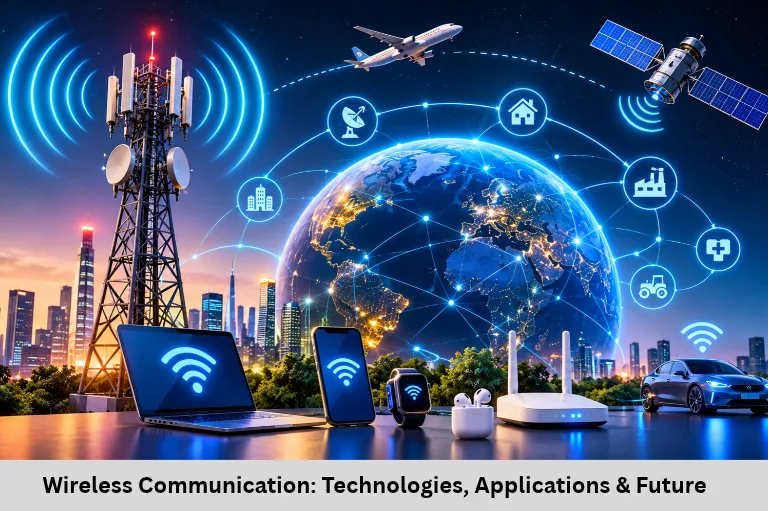
Explore wireless communication fundamentals, RF technology, Wi-Fi, Bluetooth, 5G, Internet of Things (IoT) protocols, applications, challenges, and future trends. Embedded Tech Development Academy (ETDA).
- Wireless Communication: Technologies, Applications & Future
-
Wireless Communication: The Backbone of Modern Connectivity
- Introduction to Wireless Communication
- Fundamentals of Wireless Communication
- Types of Wireless Communication
- Major Wireless Communication Technologies
- Applications of Wireless Communication
- Challenges in Wireless Communication
- Future Trends in Wireless Communication
- Frequently Asked Questions
- Conclusion
Wireless Communication: The Backbone of Modern Connectivity
Introduction to Wireless Communication
Wireless communication has transformed modern technology by enabling information exchange without physical cables. From smartphones and Wi-Fi networks to satellite navigation, industrial automation, and smart devices, wireless communication supports connectivity across personal, commercial, and industrial environments. It allows electronic systems to transmit voice, data, images, and control information using electromagnetic waves.
In modern Embedded Systems and Internet of Things (IoT), wireless communication is essential for connecting microcontrollers, sensors, actuators, gateways, and cloud platforms. Technologies such as Bluetooth, Wi-Fi, Zigbee, LoRaWAN, cellular networks, and Near Field Communication (NFC) provide different communication ranges, data rates, power consumption levels, and network capabilities. These technologies support applications such as wireless sensor networks, smart homes, healthcare monitoring, connected vehicles, and industrial Internet of Things (IoT).
Understanding wireless communication requires knowledge of radio frequency (RF) propagation, modulation, demodulation, antennas, bandwidth, signal strength, interference, and communication protocols. These concepts are important for engineers designing reliable wireless products and connected electronic systems.
Embedded Tech Development Academy (ETDA) focuses on practical technical learning related to microcontrollers, communication protocols, and embedded development. As a Top Embedded Training Institute in Bangalore, Embedded Tech Development Academy (ETDA) helps learners understand wireless technologies used in Embedded Systems and Internet of Things (IoT), with assured placement support for career preparation.
Fundamentals of Wireless Communication
Wireless communication transfers information through electromagnetic waves instead of electrical signals carried by physical cables. Depending on the application, transmission may use radio frequencies, microwaves, infrared radiation, or visible light.
Basic Components of a Wireless Communication System
A typical wireless communication system contains four important components:
Transmitter: Converts information into a suitable electrical signal and modulates it onto a carrier.
Channel: The propagation medium through which electromagnetic waves travel.
Receiver: Captures the signal, demodulates it, and reconstructs the transmitted information.
Antennas: Convert electrical signals into electromagnetic waves and receive incoming waves.
Modulation and Demodulation
Modulation changes a carrier signal according to the information being transmitted. Common techniques include Amplitude Modulation (AM), Frequency Modulation (FM), Phase Modulation (PM), and digital modulation methods such as QPSK and QAM.
Demodulation is the receiver-side process of recovering information from the modulated signal. These operations enable efficient transmission over wireless channels.
Types of Wireless Communication
Radio Frequency Communication
RF communication uses radio waves for transmitting information over different distances. AM/FM broadcasting, walkie-talkies, wireless sensors, and many Internet of Things (IoT) devices operate using RF signals.
Microwave Communication
Microwave communication uses higher-frequency electromagnetic waves and is widely used in satellite links, point-to-point communication, radar, and cellular networks.
Infrared Communication
Infrared communication uses infrared radiation for short-range data transmission. Television remote controls and certain optical communication systems use infrared signals.
Optical Wireless Communication
Optical wireless communication uses visible light or other optical wavelengths to transfer information. Li-Fi and free-space optical communication are examples of technologies using optical transmission.
Major Wireless Communication Technologies
Cellular Networks: 1G to 5G
Cellular communication has evolved through several generations.
| Generation | Major Characteristics |
|---|---|
| 1G | Analog voice communication |
| 2G | Digital voice, SMS, GSM, and CDMA |
| 3G | Mobile internet using UMTS and HSPA |
| 4G LTE | Broadband internet, video streaming, and VoLTE |
| 5G | Higher capacity, improved latency, and massive device connectivity |
Understanding 5G Technology
5G supports enhanced mobile broadband, improved network capacity, and communication for large numbers of connected devices. Under suitable conditions, 5G can achieve very high data rates, including theoretical peak targets approaching 20 Gbps. Actual performance depends on spectrum, network configuration, and deployment conditions.
5G is important for connected vehicles, industrial automation, smart infrastructure, and advanced Internet of Things (IoT) applications.
Wi-Fi Communication
Wi-Fi is based on IEEE 802.11 wireless networking standards.
Wi-Fi 4 (802.11n): Supports operation in 2.4 GHz and 5 GHz bands.
Wi-Fi 5 (802.11ac): Improves throughput, mainly in the 5 GHz band.
Wi-Fi 6 (802.11ax): Improves efficiency and performance in crowded environments.
Wi-Fi 7 (802.11be): Introduces features supporting higher throughput and lower latency.
Wi-Fi is widely used in computers, smart devices, wireless gateways, and connected Embedded Systems.
Bluetooth and NFC
Bluetooth supports short-range wireless communication for audio devices, wearable electronics, and embedded peripherals. Bluetooth Low Energy (BLE) is particularly useful for battery-powered sensors and Internet of Things (IoT) products.
Near Field Communication (NFC) operates over very short distances and supports contactless payments, access control, identification, and secure device pairing.
Satellite Communication
Satellite communication enables connectivity over large geographical areas, including locations where terrestrial networks are unavailable.
GPS provides positioning and navigation services, while Low Earth Orbit (LEO) satellite systems can provide broadband internet connectivity.
IoT and Machine-to-Machine Communication
Wireless technologies designed for Internet of Things (IoT) include:
Zigbee: Low-power mesh networking for smart-home and industrial devices.
LoRaWAN: Long-range communication with low power consumption.
NB-IoT: Cellular technology designed for low-power, wide-area connectivity.
BLE: Short-range communication for sensors and wearable devices.
These technologies allow Embedded Systems and Internet of Things (IoT) products to exchange sensor readings, control commands, and monitoring information.
Applications of Wireless Communication
Mobile and Internet Connectivity
Smartphones, laptops, tablets, and wireless routers use cellular and Wi-Fi technologies for internet access, voice communication, and multimedia streaming.
Smart Homes and Industrial Automation
Wireless sensors, smart meters, lighting controllers, and automation systems use communication protocols to monitor and control equipment. Industrial wireless networks support monitoring and selected control applications.
Healthcare and Automotive Systems
Wireless medical devices support patient monitoring and data transmission. Automotive wireless technologies enable vehicle connectivity, navigation, telematics, and vehicle-to-vehicle communication.
Wireless Connectivity in Embedded Products
Microcontrollers can communicate with wireless modules through UART, SPI, or other interfaces. Firmware configures the module, processes incoming packets, and manages application data.
Example Embedded Application
A temperature-monitoring node can use a microcontroller, temperature sensor, BLE module, and mobile application. Firmware collects sensor data and transmits it wirelessly for monitoring.
Challenges in Wireless Communication
Wireless communication faces several technical challenges:
Spectrum scarcity: Limited frequency bands must be shared efficiently.
Interference: Other transmitters and environmental noise can degrade signals.
Security: Encryption and authentication are needed to protect wireless data.
Power consumption: Battery-operated Internet of Things (IoT) devices require energy-efficient communication.
Latency: Time-sensitive applications require predictable communication delays.
Signal propagation: Obstacles, distance, and multipath fading affect signal quality.
Engineers address these challenges using antenna design, channel selection, coding, retransmission mechanisms, encryption, and power management.
Future Trends in Wireless Communication
Emerging technologies are expected to improve wireless connectivity and system intelligence.
6G Networks
Research into 6G explores higher-frequency communication, including terahertz technologies, intelligent network management, and advanced sensing capabilities.
AI-Driven Wireless Networks
Artificial intelligence can help optimise network resources, detect interference, improve traffic management, and support adaptive communication.
Edge Computing and Wireless IoT
Edge computing processes data closer to connected devices, reducing unnecessary cloud communication and potentially improving response time.
Sustainable Wireless Technology
Energy-efficient protocols, improved semiconductor designs, and intelligent power management can reduce the energy consumption of wireless networks and connected devices.
Frequently Asked Questions
What is wireless communication?
Wireless communication is the transmission of information through electromagnetic waves without using physical communication cables.
What are the main components of a wireless communication system?
The main components are the transmitter, communication channel, receiver, and antennas.
What is the difference between Wi-Fi and Bluetooth?
Wi-Fi is mainly used for wireless networking and higher-data-rate communication, while Bluetooth is designed for short-range communication between devices and peripherals.
Which wireless technologies are used in IoT?
Common technologies include BLE, Zigbee, LoRaWAN, NB-IoT, Wi-Fi, and cellular communication.
What are the major challenges in wireless communication?
Important challenges include interference, spectrum limitations, signal attenuation, security threats, power consumption, and latency.
What is the future of wireless communication?
Future wireless communication includes 6G research, AI-driven networks, advanced satellite connectivity, edge computing, and energy-efficient communication technologies.
Conclusion
Wireless communication is a fundamental technology behind modern digital connectivity. From RF transmission and modulation to Wi-Fi, Bluetooth, cellular networks, satellite communication, and low-power Internet of Things (IoT) protocols, wireless technologies enable information exchange across diverse electronic systems.
Understanding antennas, signal propagation, modulation, bandwidth, interference, and network protocols helps engineers design reliable communication solutions. These concepts are increasingly important in Embedded Systems and Internet of Things (IoT), including industrial automation, connected healthcare, smart homes, automotive electronics, and wireless sensor networks.
Embedded Tech Development Academy (ETDA) supports technical learning in embedded programming, communication interfaces, and industry-relevant technologies. As a Top Embedded Training Institute in Bangalore, Embedded Tech Development Academy (ETDA) helps learners build knowledge applicable to wireless-enabled Embedded Systems and Internet of Things (IoT) development and provides assured placement support to assist with career preparation.
Author: ETDA Trainers
Experience: 10+ Years of Industry Experience in Embedded Systems, IoT, and Embedded C Programming