
8051 Microcontroller Programming Using Embedded C: Complete Guide | ETDA
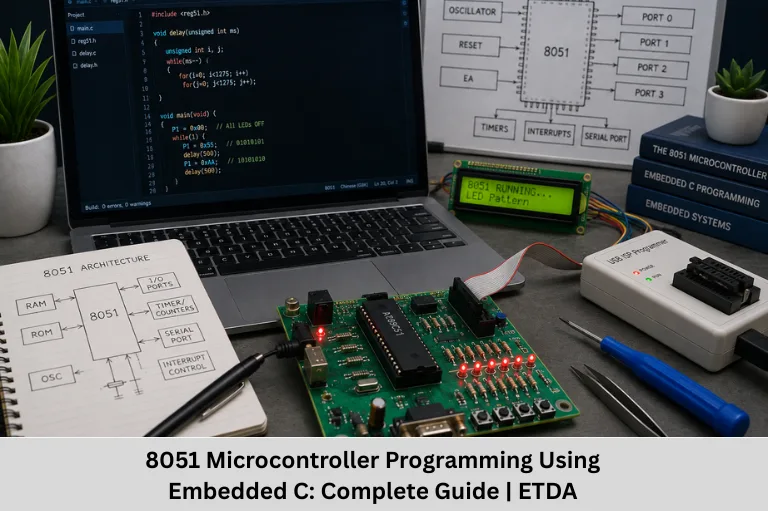
Learn 8051 microcontroller programming using Embedded C, including architecture, GPIO, timers, interrupts, UART, interfacing, programming examples, and applications. Embedded Tech Development Academy (ETDA).
- 8051 Microcontroller Programming Using Embedded C: Complete Guide | ETDA
-
8051 Microcontroller Programming Using Embedded C
- What Is the 8051 Microcontroller?
- 8051 Memory Organization
- Embedded C Programming for 8051
- GPIO Programming in 8051
- Delay Generation in 8051
- 8051 Timers and Counters
- Interrupt Programming in 8051
- UART Serial Communication in 8051
- 8051 Interfacing Techniques
- ADC and 8051-Based Systems
- 8051 Embedded C Programming Tools
- Practical 8051 Projects Using Embedded C
- 8051 vs Modern Microcontrollers
- Career Scope of 8051 and Embedded C
-
Why Choose ETDA for Embedded C Training?
- Technical Curriculum
- FAQs
- What is 8051 microcontroller programming?
- Why is Embedded C used for 8051?
- Is 8051 still useful for learning embedded systems?
- Can I learn 8051 without knowing C?
- What projects can be developed using 8051?
- Should I learn ARM after 8051?
- Does ETDA provide placement support?
- Why choose ETDA for Embedded C and microcontroller training?
- Conclusion
8051 Microcontroller Programming Using Embedded C
The 8051 microcontroller is one of the most widely studied microcontrollers in embedded systems education. Although modern products often use advanced ARM-based microcontrollers, the 8051 remains valuable for understanding fundamental concepts such as GPIO programming, timers, interrupts, serial communication, memory organization, and register-level programming.
For engineering students beginning their embedded journey, learning 8051 microcontroller programming using Embedded C provides a practical introduction to the relationship between software and hardware. Students can write C programs, configure microcontroller registers, interface LEDs and switches, generate delays, communicate through UART, and respond to external events.
For learners searching for a Top Embedded Training Institute in Bangalore, Embedded Tech Development Academy (ETDA) provides practical embedded systems training covering C, Embedded C, microcontrollers, ARM, communication protocols, RTOS, debugging, and real-world projects, along with assured placement support.
This technical guide explains the 8051 architecture, Embedded C programming concepts, peripherals, programming examples, interfacing techniques, applications, and career relevance.
What Is the 8051 Microcontroller?
The 8051 is an 8-bit microcontroller family originally associated with Intel. It became popular because of its simple architecture and rich set of peripherals for learning and control applications.
A traditional 8051 implementation commonly includes:
- 8-bit CPU
- Program memory
- Data memory
- GPIO ports
- Timers/counters
- Serial communication
- Interrupt system
- Oscillator/clock circuitry
Basic 8051 Architecture
The 8051 architecture consists of several functional blocks.
Important Internal Components
Key components include:
- ALU
- Accumulator
- B register
- Program Counter
- Stack Pointer
- Program Status Word
- Data Pointer
- RAM
- ROM/Flash depending on device variant
- Four GPIO ports
- Timers
- UART
- Interrupt controller
Why Learn 8051?
The 8051 is useful for learning fundamental embedded concepts without the complexity of advanced microcontrollers.
It helps students understand:
- Registers
- Memory
- GPIO
- Timers
- Interrupts
- Serial communication
- Hardware interfacing
- Embedded C
8051 Memory Organization
Understanding memory is essential when programming the 8051.
Program Memory
Program memory stores the firmware instructions executed by the microcontroller.
Modern 8051 variants may use Flash memory for program storage.
Data Memory
The 8051 has internal RAM areas used for variables, registers, and temporary data.
Special Function Registers
Special Function Registers, or SFRs, control important microcontroller operations.
Examples include registers associated with:
- GPIO
- Timers
- UART
- Interrupts
- CPU status
Register-Level Programming
Embedded C programs interact with hardware by configuring these registers.
A developer therefore needs to understand the microcontroller’s datasheet and register definitions.
Embedded C Programming for 8051
Embedded C combines the standard C programming language with microcontroller-specific hardware operations.
Basic Program Structure
A simple 8051 Embedded C program may look like:
The header file provides definitions for registers and hardware resources supported by the particular 8051 compiler/device.
Variables in 8051 Programming
Embedded applications commonly use fixed-width or appropriately sized data types.
Why Data Types Matter
The 8051 is an 8-bit architecture, so developers should consider memory usage and processing requirements when selecting data types.
GPIO Programming in 8051
GPIO is one of the first peripherals beginners usually learn.
The traditional 8051 provides four commonly referenced ports:
- Port 0
- Port 1
- Port 2
- Port 3
LED Interfacing
An LED can be connected to a GPIO pin through an appropriate resistor and circuit configuration.
A simplified program could be:
The exact electrical behavior depends on how the LED is connected.
GPIO Output
GPIO outputs can control:
- LEDs
- Buzzers
- Relays through driver circuits
- Digital control signals
GPIO Input
GPIO inputs can read:
- Push buttons
- Switches
- Digital sensors
When reading an input, engineers must also consider pull-ups, signal levels, and switch debouncing.
Delay Generation in 8051
Timing delays are frequently used in beginner-level 8051 applications.
Software Delay
A simple delay can be implemented using loops.
However, software loops are not ideal for precise timing.
Why Clock Frequency Matters
The duration of instructions depends on the microcontroller clock and device architecture.
Therefore, a delay loop that works at one clock frequency may produce a different delay at another frequency.
Hardware Timers
For accurate timing, 8051 timers should be used instead of relying solely on software loops.
8051 Timers and Counters
Timers are important for generating accurate delays and measuring events.
Timer Modes
Traditional 8051 devices commonly provide Timer 0 and Timer 1 with configurable operating modes.
Depending on the device, modes can support:
- 16-bit timer operation
- 8-bit auto-reload
- Other device-specific configurations
Timer Programming
A typical timer configuration involves:
- Selecting the timer mode.
- Loading timer registers.
- Starting the timer.
- Monitoring overflow or enabling an interrupt.
- Stopping or reloading the timer.
Timer Applications
Timers can be used for:
- Periodic delays
- Event counting
- Baud-rate generation
- Periodic interrupts
- Time measurement
Interrupt Programming in 8051
Interrupts allow the 8051 to respond to events without continuously polling every peripheral.
What Is an Interrupt?
An interrupt temporarily changes normal program execution so that the processor can handle an urgent event.
The basic flow is:
Event → Interrupt Request → ISR → Return to Main Program
Common 8051 Interrupt Sources
Traditional 8051 devices commonly provide interrupt sources associated with:
- External interrupt 0
- Timer 0
- External interrupt 1
- Timer 1
- Serial communication
The exact interrupt structure can vary between 8051 derivatives.
Interrupt Service Routine
A compiler-specific ISR declaration is generally used to associate a function with an interrupt vector.
A simplified conceptual example is:
The exact syntax depends on the compiler being used.
UART Serial Communication in 8051
The 8051 includes a serial interface that can be configured for UART-style asynchronous communication.
UART Signals
Basic UART communication generally uses:
- TX
- RX
- GND
Baud Rate
Baud rate represents the signaling rate used for serial communication.
Common values include:
- 9600
- 19200
- 38400
- 115200
The actual supported rate depends on the system clock and UART configuration.
UART Applications
8051 UART communication can be used for:
- PC communication
- Debugging
- GPS modules
- Bluetooth modules
- Serial displays
- Communication with other controllers
8051 Interfacing Techniques
One of the most useful aspects of 8051 training is learning how to connect external devices.
Switch Interfacing
A push button can be connected to a GPIO input.
The firmware reads the input and performs an action.
For example:
Button Press → GPIO Input → Embedded C → LED Output
LCD Interfacing
Character LCDs are commonly used in educational 8051 projects.
An LCD interface may require:
- Data lines
- Register Select
- Read/Write
- Enable
Sensor Interfacing
Sensors can be connected directly or through external interface circuits depending on whether they produce digital or analog signals.
For analog sensors, an external ADC may be required on traditional 8051 devices that do not include an internal ADC.
ADC and 8051-Based Systems
A traditional 8051 does not necessarily include a built-in ADC, depending on the specific derivative.
External ADC Interfacing
An external ADC can convert an analog sensor voltage into digital data that the 8051 can process.
The general flow is:
Analog Sensor → ADC → 8051 → Processing → Output
ADC Applications
This approach can be used for:
- Temperature monitoring
- Light sensing
- Pressure measurement
- Battery monitoring
Why Datasheets Matter
The ADC interface, timing requirements, resolution, and communication method depend on the specific ADC device being used.
8051 Embedded C Programming Tools
Developers need software and hardware tools to build and test firmware.
Compiler
An 8051-compatible C compiler converts Embedded C source code into machine instructions.
Common development environments may include compiler-specific IDEs and toolchains.
Programmer and Debugger
A programmer transfers firmware into the microcontroller’s non-volatile memory.
Depending on the specific 8051 derivative, debugging may use device-specific interfaces.
Simulation and Testing
Simulation tools can help beginners understand program behavior before moving to physical hardware. However, actual hardware testing remains important because electrical behavior cannot always be reproduced perfectly in simulation.
Practical 8051 Projects Using Embedded C
Projects provide an effective way to develop embedded programming skills.
Beginner Projects
Examples include:
- LED blinking
- LED pattern controller
- Push-button counter
- Buzzer controller
- Digital dice
Intermediate Projects
Students can build:
- LCD-based temperature monitor
- Digital clock
- Keypad interface
- UART communication system
- Password-based access system
Advanced Projects
More advanced projects can combine:
- Sensors
- LCD
- UART
- Timers
- Interrupts
- External memory
- Motor control
What Projects Teach
Project-based learning develops:
- Embedded C programming
- Register configuration
- Hardware interfacing
- Debugging
- Timing analysis
- Datasheet reading
- Problem-solving
8051 vs Modern Microcontrollers
Although the 8051 is useful for learning, modern embedded products often use more advanced architectures.
8051
Typical characteristics include:
- 8-bit architecture
- Simple peripheral model
- Beginner-friendly architecture
- Useful for fundamental embedded concepts
ARM Cortex-M
Modern Cortex-M microcontrollers generally provide:
- Higher performance
- 32-bit architecture
- Advanced timers
- More memory
- Rich peripheral sets
- Advanced interrupt handling
Why Learn Both?
8051 teaches the fundamentals, while ARM-based microcontrollers expose students to modern embedded development.
A Practical Learning Path
A useful progression is:
C → 8051 → Embedded C → ARM Cortex-M → STM32 → RTOS → Embedded Linux/IoT
Career Scope of 8051 and Embedded C
Learning 8051 alone is usually not enough for a modern embedded career, but it provides valuable fundamentals.
Skills to Build After 8051
Students should progress toward:
- ARM Cortex-M
- STM32
- Embedded C
- C++
- Data Structures
- UART
- SPI
- I2C
- CAN
- RTOS
- Debugging
Potential Career Roles
With broader embedded skills, learners can target roles such as:
- Embedded Software Engineer
- Firmware Engineer
- Automotive Embedded Engineer
- Internet of Things (IoT) Embedded Developer
- Hardware-Firmware Integration Engineer
Importance of Practical Experience
Employers typically value the ability to write, debug, and explain embedded code rather than simply knowing theoretical definitions.
Why Choose ETDA for Embedded C Training?
Embedded Tech Development Academy (ETDA) focuses on developing practical embedded engineering skills from programming fundamentals through advanced technologies.
Technical Curriculum
Training can include:
- C Programming
- Embedded C
- 8051
- ARM Cortex-M
- STM32
- LPC1768
- Data Structures
- GPIO
- Timers
- ADC
- PWM
- UART
- SPI
- I2C
- CAN
- RTOS
- Embedded Linux
- Internet of Things (IoT)
Hands-On Learning
Students can practice microcontroller programming, peripheral configuration, communication protocols, hardware interfacing, and debugging through practical exercises and projects.
Assured Placement Support
Embedded Tech Development Academy (ETDA) also provides assured placement support, including:
- Technical interview preparation
- Resume preparation
- Coding practice
- Mock interviews
- Aptitude preparation
- HR interview preparation
- Career guidance
FAQs
What is 8051 microcontroller programming?
8051 programming involves writing firmware to control the microcontroller’s GPIO, timers, interrupts, serial interface, and other available peripherals.
Why is Embedded C used for 8051?
Embedded C provides the programming features of C while allowing developers to access microcontroller registers, memory, ports, timers, and other hardware resources.
Is 8051 still useful for learning embedded systems?
Yes. The 8051 provides a relatively simple architecture for learning fundamental concepts such as registers, GPIO, timers, interrupts, serial communication, and hardware interfacing.
Can I learn 8051 without knowing C?
Basic C knowledge is strongly recommended. Students should understand variables, functions, loops, arrays, pointers, structures, and bitwise operations before moving into Embedded C.
What projects can be developed using 8051?
Common projects include LED controllers, digital clocks, LCD interfaces, keypad systems, temperature monitors, UART communication systems, and sensor-based applications.
Should I learn ARM after 8051?
Yes. After understanding 8051 fundamentals, learning ARM Cortex-M and platforms such as STM32 can help students transition toward modern embedded development.
Does ETDA provide placement support?
Yes. Embedded Tech Development Academy (ETDA) provides assured placement support, including technical interview preparation, coding practice, resume guidance, mock interviews, aptitude preparation, and career guidance.
Why choose ETDA for Embedded C and microcontroller training?
Embedded Tech Development Academy (ETDA) combines C, Embedded C, 8051, ARM, STM32, LPC1768, peripherals, communication protocols, RTOS, Embedded Linux, Internet of Things (IoT), debugging, and practical projects, making it an option for learners looking for a Top Embedded Training Institute in Bangalore.
Conclusion
8051 microcontroller programming using Embedded C is an excellent way to understand the fundamentals of embedded development. It introduces important concepts such as GPIO programming, timers, interrupts, UART communication, memory, registers, and hardware interfacing.
For students searching for a Top Embedded Training Institute in Bangalore, Embedded Tech Development Academy (ETDA) provides a broader learning path that can progress from C and 8051 fundamentals to ARM, STM32, communication protocols, RTOS, Embedded Linux, Internet of Things (IoT), debugging, and practical projects, along with assured placement support.
When selecting a Top Embedded Training Institute in Bangalore, students should look beyond basic programming lessons and evaluate whether the program provides hands-on hardware exposure, practical projects, debugging experience, and industry-relevant technologies.
Learning 8051 can establish a strong foundation, but learners should continue toward modern microcontrollers and advanced embedded technologies to build a competitive career in firmware, automotive electronics, Internet of Things (IoT), robotics, and industrial embedded systems
Author: ETDA Trainers
Experience: 10+ Years of Industry Experience in Embedded Systems, IoT, and Embedded C Programming