
ARM Cortex-M3 Registers and Operating Modes Explained
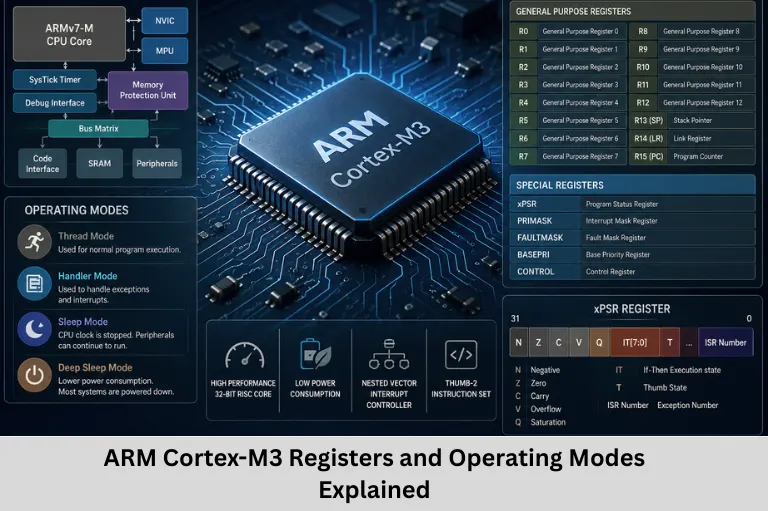
Learn ARM Cortex-M3 processor registers, xPSR, CONTROL, NVIC, operating modes, privilege levels, stack pointers, and memory-mapped access. Embedded Tech Development Academy (ETDA).
- ARM Cortex-M3 Registers and Operating Modes Explained
-
ARM Cortex-M3 Processor Registers and Operating Modes
- Introduction to ARM Cortex-M3 Registers and Operating Modes
- What Are Processor Registers?
- Total Registers in ARM Cortex-M3
- General-Purpose Registers R0-R12
- Special Registers in Cortex-M3
- Program Status Register – xPSR
- CONTROL Register
- System Control and Special Function Registers
- Floating-Point Registers and Cortex-M3
- Operating Modes in ARM Cortex-M3
- Privilege Levels in Cortex-M3
- Thread Mode vs Handler Mode
- Memory-Mapped Register Access
- Why Learn ARM Cortex-M3 Registers?
- Practical Importance of Cortex-M3 Operating Modes
- Career Relevance of ARM Cortex-M3 Knowledge
- Conclusion
ARM Cortex-M3 Processor Registers and Operating Modes
Introduction to ARM Cortex-M3 Registers and Operating Modes
The ARM Cortex-M3 processor is widely used in embedded systems where efficient processing, predictable interrupt handling, low-power operation, and real-time performance are important. At the center of the processor’s operation are its registers, which provide extremely fast storage for data, addresses, status information, and processor-control information.
Understanding ARM Cortex-M3 registers is essential for students and embedded engineers who want to work with ARM microcontrollers, embedded C programming, interrupt handling, NVIC, processor modes, stack management, and low-level embedded system programming. Registers such as R0-R12, Stack Pointer (SP), Link Register (LR), Program Counter (PC), xPSR, and CONTROL directly influence how instructions are executed.
The Cortex-M3 also provides Thread Mode and Handler Mode, along with privileged and unprivileged execution states. These features allow embedded software to separate normal application execution from interrupt and exception processing. This is particularly important in real-time embedded systems, where the processor must respond quickly and reliably to external events.
For learners looking to build practical knowledge of ARM architecture, Embedded Tech Development Academy (ETDA) provides an environment focused on embedded systems concepts, microcontroller programming, and hands-on technical learning. Students aiming for a career in embedded development can also explore training pathways associated with the Top Embedded Training Institute in Bangalore, particularly when learning topics such as ARM Cortex-M architecture, embedded C, RTOS concepts, and microcontroller interfacing.
In this guide, we will explore the major Cortex-M3 processor registers, their functions, operating modes, privilege levels, and memory-mapped register access.
What Are Processor Registers?
A processor register is a small, high-speed storage location inside the CPU. Unlike external memory, registers can be accessed very quickly by the processor during instruction execution.
In an embedded processor such as the Cortex-M3, registers are used for:
- Temporary data storage
- Arithmetic and logical operations
- Address calculations
- Function calls and returns
- Stack management
- Program execution
- Interrupt and exception management
- Processor configuration
- Status monitoring
Understanding registers gives developers a clearer picture of what happens inside a microcontroller when an embedded C program is compiled and executed.
Why Are Cortex-M3 Registers Important?
Registers are especially important in embedded systems because applications frequently require:
- Fast interrupt response
- Deterministic execution
- Efficient memory usage
- Direct hardware control
- Low-level debugging
- Real-time processing
A strong understanding of registers also helps engineers interpret startup code, interrupt service routines, assembly instructions, and debugger register windows.
Total Registers in ARM Cortex-M3
The provided material describes the Cortex-M3 register organization as including general-purpose and special registers, status registers, CONTROL, and system control/special-function registers.
The main register groups discussed are:
- R0-R15 general-purpose and special registers
- xPSR status register
- CONTROL register
- System Control and Special Function Registers
- NVIC-related registers
- Optional floating-point registers when an FPU is present
Important: The Cortex-M3 itself does not include an FPU. Therefore, the S0-S31 floating-point registers listed in the source material apply to Cortex-M processors with an appropriate optional FPU, rather than the standard Cortex-M3.
General-Purpose Registers R0-R12
The Cortex-M3 provides 13 general-purpose registers, R0 through R12.
R0-R3
R0-R3 are commonly used for:
- Function arguments
- Return values
- Temporary calculations
- Intermediate data
These registers are heavily used during function calls and normal program execution.
R4-R11
R4-R11 provide additional general-purpose storage.
They are commonly used for:
- Local data
- Intermediate calculations
- Persistent values across function calls
R12
R12 is often used as a temporary or intra-procedure scratch register.
Because registers are much faster to access than external memory, effective register usage contributes to efficient embedded software execution.
Special Registers in Cortex-M3
The special registers are directly associated with program execution and processor control.
Stack Pointer – SP/R13
The Stack Pointer (SP) points to the current top of the stack.
The Cortex-M3 supports two stack pointers:
- Main Stack Pointer (MSP)
- Process Stack Pointer (PSP)
Main Stack Pointer (MSP)
The MSP is primarily associated with:
- Reset/startup execution
- Exception handling
- Handler Mode
- Privileged system-level operation
Process Stack Pointer (PSP)
The PSP can be used for application or process-level execution, particularly when software requires separation between system and application con
Why Stack Management Matters
The stack is essential for:
- Function calls
- Local variables
- Saving registers
- Exception handling
- Nested function execution
- Context management
Poor stack management can result in difficult-to-debug embedded software failures.
Link Register – LR/R14
The Link Register (LR) stores return-address information during function calls.
For example, when a subroutine is called using a branch-with-link operation, the return information is placed in LR. The processor can later use this information to return to the calling code.
The LR also plays an important role during exception entry and return.
Program Counter – PC/R15
The Program Counter (PC) contains the address associated with the instruction currently being executed or fetched according to the processor’s execution pipeline.
The PC changes as instructions execute and can also be modified by branch instructions.
It is essential for:
- Sequential instruction execution
- Conditional branches
- Function calls
- Loops
- Exception handling
Program Status Register – xPSR
The xPSR provides status information associated with processor execution.
It combines three logical status registers:
- APSR – Application Program Status Register
- IPSR – Interrupt Program Status Register
- EPSR – Execution Program Status Register
Application Program Status Register – APSR
The APSR contains condition flags used by instructions and conditional execution.
Important flags include:
- N – Negative
- Z – Zero
- C – Carry
- V – Overflow
These flags help the processor determine the result of arithmetic and logical operations.
Interrupt Program Status Register – IPSR
The IPSR indicates the exception currently being handled.
This is useful when the processor is executing an interrupt service routine or another exception handler.
Execution Program Status Register – EPSR
The EPSR contains execution-state information used by the processor.
Together, APSR, IPSR, and EPSR provide important information about the processor’s current execution state.
CONTROL Register
The CONTROL register is important for managing processor privilege and stack selection.
It determines:
- The processor’s privilege level in Thread Mode
- Which stack pointer is selected in Thread Mode
CONTROL Register Functions
The source material identifies two important CONTROL bits:
| Bit | Function |
|---|---|
| Bit 0 | Stack selection |
| Bit 1 | Privilege level |
Conceptually:
- CONTROL[0] = 0: MSP selected
- CONTROL[0] = 1: PSP selected
- CONTROL[1] = 0: Privileged
- CONTROL[1] = 1: Unprivileged
The exact behavior depends on the processor’s current execution mode.
System Control and Special Function Registers
Cortex-M3 provides several system-level registers for configuring and monitoring processor behavior.
Vector Table Offset Register – VTOR
The VTOR contains the base address of the interrupt vector table.
It allows the vector table to be located at an appropriate memory address.
Interrupt Control and State Register – ICSR
The ICSR provides information and control related to:
- Interrupt status
- Exception state
- Pending exceptions
It is useful when managing and debugging interrupt behavior.
System Control Register – SCR
The System Control Register (SCR) controls aspects of processor sleep behavior.
This is particularly relevant to low-power embedded systems.
Configuration and Control Register – CCR
The CCR configures selected processor behaviors and system-level features.
NVIC Registers
The Nested Vectored Interrupt Controller (NVIC) is one of the most important Cortex-M features for real-time embedded applications.
NVIC registers support:
- Interrupt enable/disable
- Interrupt pending status
- Interrupt priority
- Exception management
This allows embedded software to respond quickly to hardware events.
Software Trigger Interrupt Register – STIR
The STIR can be used by software to generate an interrupt.
This can be useful for testing interrupt handling or triggering software-controlled interrupt events.
Floating-Point Registers and Cortex-M3
The source material mentions S0-S31 floating-point registers if an FPU is enabled.
However, the standard ARM Cortex-M3 does not contain a floating-point unit. Therefore, floating-point register sets such as S0-S31 are associated with Cortex-M processor variants that include an FPU, rather than the Cortex-M3 itself.
For Cortex-M3 development, floating-point calculations are generally handled through software/compiler support rather than a hardware floating-point register set.
Operating Modes in ARM Cortex-M3
The Cortex-M3 uses two primary operating modes:
- Thread Mode
- Handler Mode
These modes help separate normal application execution from exception and interrupt processing.
Thread Mode
Thread Mode is the normal execution mode for application code.
It can operate with:
- Privileged access
- Unprivileged access
After reset, the processor begins execution in Thread Mode with privileged access.
Handler Mode
Handler Mode is entered when the processor handles an exception or interrupt.
It is always executed with privileged access.
Examples include:
- External interrupts
- System exceptions
- Fault handlers
- Other processor-generated exceptions
Privilege Levels in Cortex-M3
The Cortex-M3 supports two privilege levels:
Privileged Level
Privileged execution provides greater access to processor resources and system-control functionality.
It is typically used by:
- Operating-system kernels
- System software
- Exception handlers
- Hardware-control code
Unprivileged Level
Unprivileged execution provides restricted access.
It can be useful for separating application software from sensitive system resources.
This separation can improve software organization and contribute to system robustness.
Thread Mode vs Handler Mode
| Feature | Thread Mode | Handler Mode |
|---|---|---|
| Purpose | Normal application execution | Interrupt/exception handling |
| Privilege | Privileged or unprivileged | Always privileged |
| Stack | MSP or PSP | MSP |
| Typical use | Application code | ISR/exception handler |
Understanding this distinction is important when developing ARM Cortex-M3 embedded applications, particularly those involving interrupts and real-time systems.
Memory-Mapped Register Access
Many Cortex-M3 system and peripheral registers are accessed through memory-mapped addresses.
This means software can interact with hardware registers using memory access instructions.
Why Memory-Mapped Access Is Important
Memory-mapped registers allow embedded software to:
- Configure peripherals
- Read hardware status
- Control GPIO
- Configure timers
- Manage communication peripherals
- Control interrupt behavior
For example, embedded C programs commonly access microcontroller peripheral registers through structures and predefined addresses supplied by the device header files.
Register-Level Programming
Register-level programming gives developers direct control over hardware.
It is especially valuable for understanding:
- GPIO configuration
- UART initialization
- Timer configuration
- Interrupt setup
- Peripheral clock control
Role in Embedded C Development
Understanding registers makes it easier to move from high-level embedded C programming toward low-level microcontroller programming and ARM processor architecture.
This practical knowledge is highly relevant to students preparing for embedded software development roles. Training at Embedded Tech Development Academy (ETDA) can help learners connect processor architecture concepts with hands-on microcontroller programming.
Why Learn ARM Cortex-M3 Registers?
A strong understanding of Cortex-M3 registers helps engineers understand what happens beneath the application code.
It is useful for:
- Embedded C programming
- ARM assembly programming
- Interrupt programming
- RTOS fundamentals
- Microcontroller debugging
- Peripheral programming
- Exception handling
- Real-time system development
For engineering students, learning these concepts alongside practical projects can make the transition from academic theory to embedded development more effective.
Practical Importance of Cortex-M3 Operating Modes
Operating modes are not merely theoretical concepts. They influence how embedded applications handle interrupts, exceptions, and application execution.
Consider a temperature-monitoring system. The application may execute in Thread Mode while a timer or sensor interrupt temporarily moves the processor into Handler Mode. After the interrupt service routine completes, the processor returns to the interrupted application.
This model enables efficient real-time embedded system design where urgent events can receive immediate processor attention.
Career Relevance of ARM Cortex-M3 Knowledge
ARM Cortex-M architecture is an important foundation for embedded development. Engineers working with microcontrollers need to understand processor registers, interrupts, memory organization, peripheral control, and real-time execution.
A practical learning path can include:
- C programming fundamentals
- Embedded C programming
- ARM Cortex-M architecture
- Cortex-M registers and interrupts
- GPIO and peripheral interfacing
- UART, SPI, and I2C
- Timers and PWM
- RTOS fundamentals
- Debugging and testing
- Embedded projects
For learners pursuing an embedded career, Embedded Tech Development Academy (ETDA) can be positioned as a practical learning destination for developing these foundational skills. Choosing a Top Embedded Training Institute in Bangalore can also provide exposure to structured training, hands-on microcontroller development, and industry-oriented embedded concepts.
FAQs
What are the main registers in ARM Cortex-M3?
The main registers include R0-R12 general-purpose registers, R13/SP, R14/LR, R15/PC, xPSR, CONTROL, and various system-control and interrupt-related registers.
What is the difference between MSP and PSP?
The Main Stack Pointer (MSP) is used for system-level and exception handling, while the Process Stack Pointer (PSP) can be used for application-level execution in Thread Mode.
What is the difference between Thread Mode and Handler Mode?
Thread Mode is used for normal application execution. Handler Mode is entered to process interrupts and exceptions and always operates with privileged access.
What is the purpose of the CONTROL register?
The CONTROL register manages privilege and stack selection in Thread Mode. It helps determine whether execution uses privileged or unprivileged access and whether MSP or PSP is selected.
Why are Cortex-M3 registers important for embedded engineers?
Registers provide direct insight into processor operation and are essential for understanding embedded C, interrupts, ARM architecture, peripheral programming, debugging, and real-time embedded systems.
Conclusion
Understanding ARM Cortex-M3 processor registers and operating modes is one of the most important steps toward mastering ARM-based embedded systems. Registers such as R0-R12, SP, LR, PC, xPSR, and CONTROL form the foundation of processor-level execution, while system registers such as VTOR, ICSR, SCR, CCR, and NVIC registers support interrupt management and processor control.
The distinction between Thread Mode and Handler Mode, along with privileged and unprivileged execution, is equally important for designing reliable and responsive embedded applications. These concepts become particularly valuable when working with interrupts, real-time applications, RTOS-based systems, and low-level microcontroller programming.
The knowledge also connects directly with practical areas such as ARM Cortex-M programming, embedded C, microcontroller architecture, interrupt handling, NVIC programming, peripheral interfacing, real-time systems, and embedded software development. These LSI concepts together provide a strong foundation for engineers entering the embedded domain.
For students who want to turn processor-architecture knowledge into practical skills, Embedded Tech Development Academy (ETDA) can help bridge the gap between theoretical learning and hands-on embedded development. If you are looking for a Top Embedded Training Institute in Bangalore, developing a strong foundation in ARM Cortex-M architecture, registers, interrupts, and embedded C can be an important step toward building a career in embedded systems.
Author: ETDA Trainers
Experience: 10+ Years of Industry Experience in Embedded Systems, IoT, and Embedded C Programming