
ARM vs STM32: Which Microcontroller Should You Learn First? | Complete Beginner's Guide
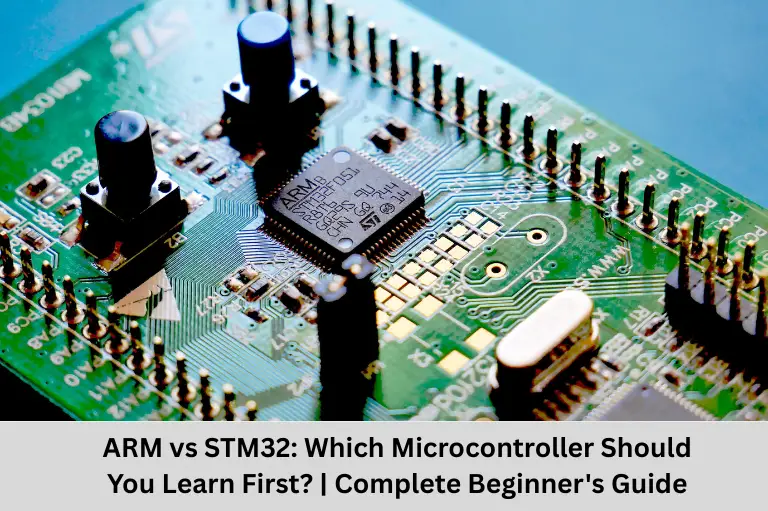
Confused between ARM and STM32? Learn the key differences, architecture, applications, career benefits, and discover which microcontroller platform beginners should learn first.
- ARM vs STM32: Which Microcontroller Should You Learn First? | Complete Beginner's Guide
-
ARM vs STM32: Which Microcontroller Should You Learn First?
- Understanding the Basics: ARM and STM32 Are Not Competitors
- What is ARM?
- What is STM32?
- Why STM32 is Popular Among Embedded Engineers
- ARM vs STM32: Key Differences
- What Should Beginners Learn First?
- Recommended Learning Path
- Career Benefits of Learning ARM and STM32
- Industries That Use ARM and STM32
- How ETDA Helps Students Learn ARM and STM3
- Common Mistakes Beginners Make
- Frequently Asked Questions (FAQs)
- Conclusion
ARM vs STM32: Which Microcontroller Should You Learn First?
If you’re planning a career in Embedded Systems, you’ve probably come across two terms repeatedly: ARM and STM32. Beginners often get confused and ask questions such as:
- Is ARM a microcontroller?
- What is STM32?
- Should I learn ARM first or STM32 first?
- Which one is preferred by industries?
- Which platform offers better career opportunities?
The confusion is understandable because ARM and STM32 are closely related, yet they are not the same thing.
As the demand for Embedded Systems, IoT, Automotive Electronics, Robotics, and Industrial Automation continues to grow, learning the right microcontroller platform can significantly impact your career. Choosing the correct learning path not only helps you understand embedded concepts faster but also increases your chances of securing core engineering jobs.
At Embedded Tech Development Academy (ETDA), one of the leading embedded systems training institutes in Bangalore, students are often guided through both ARM architecture and STM32 development platforms as part of a structured learning roadmap. Understanding the relationship between these technologies helps students become industry-ready embedded engineers.
In this guide, we’ll explore ARM and STM32 in detail, compare their features, discuss their applications, and help you decide which one you should learn first.
Understanding the Basics: ARM and STM32 Are Not Competitors
One of the biggest misconceptions among beginners is that ARM and STM32 are competing technologies.
In reality:
ARM is an architecture.
STM32 is a family of microcontrollers built using ARM architecture.
Think of it this way:
- ARM = Engine Design
- STM32 = Vehicle Built Using That Engine
Understanding this distinction is essential before comparing them.
What is ARM?
ARM stands for Advanced RISC Machine.
It is a processor architecture developed by ARM Holdings and used by semiconductor companies worldwide.
Instead of manufacturing chips directly, ARM designs processor cores and licenses them to companies such as:
- STMicroelectronics
- NXP
- Texas Instruments
- Microchip
- Nordic Semiconductor
- Renesas
These companies then build microcontrollers and processors based on ARM cores.
Popular ARM Cortex Families
ARM offers different processor families designed for specific applications.
ARM Cortex-M
Used in:
- Embedded Systems
- IoT Devices
- Industrial Automation
- Consumer Electronics
ARM Cortex-A
Used in:
- Smartphones
- Tablets
- Embedded Linux Systems
ARM Cortex-R
Used in:
- Automotive Systems
- Safety-Critical Applications
For embedded beginners, Cortex-M is the most important family.
What is STM32?
STM32 is a family of 32-bit microcontrollers developed by STMicroelectronics.
These microcontrollers are built using ARM Cortex-M processor cores and are widely used in commercial embedded products.
STM32 combines:
- ARM Processing Power
- Memory
- Communication Interfaces
- Timers
- ADCs
- GPIOs
- Embedded Peripherals
All within a single chip.
Today, STM32 is one of the most popular microcontroller families in the embedded industry.
Why STM32 is Popular Among Embedded Engineers
STM32 has become a preferred platform for learning and product development.
Wide Industry Adoption
STM32 is used in:
- Consumer Electronics
- Medical Devices
- Automotive Systems
- Industrial Automation
- Smart Home Devices
- IoT Applications
Excellent Development Tools
Developers benefit from:
- STM32CubeIDE
- STM32CubeMX
- Comprehensive Documentation
- Extensive Community Support
These tools simplify development and accelerate learning.
Rich Peripheral Support
STM32 microcontrollers include:
- UART
- SPI
- I2C
- CAN
- USB
- Ethernet
- ADC
- PWM
This makes them ideal for practical embedded projects.
ARM vs STM32: Key Differences
The easiest way to compare them is to understand that one is an architecture and the other is a product family.
| Feature | ARM | STM32 |
|---|---|---|
| Type | Processor Architecture | Microcontroller Family |
| Developed By | ARM Holdings | STMicroelectronics |
| Purpose | Provides CPU Core Design | Complete Embedded Solution |
| Hardware Components | Processor Core Only | CPU + Memory + Peripherals |
| Learning Focus | Architecture Concepts | Practical Development |
| Industry Usage | Used Across Multiple Platforms | Specific Product Family |
| Beginner Friendliness | Moderate | High |
What Should Beginners Learn First?
This is where most students need guidance.
Option 1: Learn ARM Architecture First
Advantages:
- Understand processor fundamentals
- Learn CPU operation
- Understand memory models
- Study registers and instruction sets
Challenges:
- Mostly theoretical initially
- Limited hands-on implementation
- Can feel overwhelming for beginners
Option 2: Learn STM32 First
Advantages:
- Immediate practical exposure
- Hands-on programming
- Real hardware interaction
- Easier understanding of embedded concepts
Challenges:
- Some ARM architecture concepts may initially seem abstract
Recommended Learning Path
For most students, the ideal approach is:
Step 1 – Learn Basic Electronics
Understand:
- Resistors
- Capacitors
- Digital Logic
- Circuit Fundamentals
Step 2 – Learn C Programming
Master:
- Variables
- Functions
- Arrays
- Structures
- Pointers
C programming is the foundation of embedded development.
Step 3 – Learn ARM Cortex-M Concepts
Study:
- CPU Architecture
- Registers
- Interrupts
- Memory Organization
Step 4 – Start STM32 Programming
Apply ARM concepts practically through:
- GPIO Programming
- UART Communication
- Timers
- ADC
- Interrupt Handling
This sequence provides the best balance between theory and practical skills.
Career Benefits of Learning ARM and STM32
Embedded companies rarely hire candidates based solely on theoretical knowledge. They seek engineers who understand both architecture and implementation.
Why ARM Knowledge Matters
-
ARM powers:
- Billions of Embedded Devices
- Smartphones
- Automotive Controllers
- Industrial Equipment
Understanding ARM architecture improves technical depth.
Why STM32 Skills Matter
STM32 development provides practical experience with:
- Hardware Interfacing
- Embedded Programming
- Debugging
- Communication Protocols
These skills are highly valued by employers.
Industries That Use ARM and STM32
Automotive Industry
Applications include:
- Engine Control Units
- Battery Management Systems
- Advanced Driver Assistance Systems
IoT Industry
Used in:
- Smart Home Devices
- Smart Meters
- Wearables
Medical Electronics
Examples include:
- Monitoring Equipment
- Diagnostic Systems
- Portable Medical Devices
Industrial Automation
Applications include:
- PLC Controllers
- Robotics
- Process Monitoring Systems
How ETDA Helps Students Learn ARM and STM3
At Embedded Tech Development Academy (ETDA), students are trained using an industry-oriented approach that combines ARM architecture concepts with practical STM32 development.
Comprehensive Embedded Training
Students learn:
C Programming
Strong programming fundamentals are essential for understanding embedded systems, enabling developers to write efficient, reliable, and maintainable code for real-world applications.
Embedded C
Microcontroller-oriented coding focuses on developing software that directly interacts with hardware, enabling efficient control of peripherals, memory, and embedded system functions.
ARM Cortex-M Architecture
Industry-standard processor concepts provide a strong foundation in modern embedded systems, helping developers understand processor architecture, instruction execution, memory management, and system performance.
STM32 Development
Practical embedded application development involves designing, programming, testing, and deploying real-world embedded systems that interact with hardware to perform specific tasks efficiently and reliably.
Communication Protocols
UART, SPI, I2C, and CAN are widely used communication protocols in embedded systems, enabling reliable data exchange between microcontrollers, sensors, peripherals, and other electronic devices.
RTOS
Real-time application development involves creating embedded systems that can respond to events and process data within strict time constraints, ensuring reliable and predictable performance.
IoT Integration
Building connected smart devices involves developing IoT-enabled systems that communicate, collect data, and perform intelligent functions through network connectivity and embedded technologies.
Real-Time Project Experience
Students work on practical projects such as:
- Home Automation Systems
- Smart Monitoring Solutions
- IoT Applications
- Industrial Automation Projects
These projects enhance technical skills and improve employability.
Placement Assistance
ETDA provides:
- Resume Building
- Mock Interviews
- Technical Assessments
- Career Guidance
- Placement Support
This helps students confidently transition into embedded industry roles.
Common Mistakes Beginners Make
Treating ARM and STM32 as Competitors
STM32 is built on ARM Cortex processor cores, so learning both together provides a strong understanding of processor architecture and practical embedded system development.
Skipping C Programming
Strong C programming skills are essential for embedded development, as C provides efficient hardware control, low-level system access, and high-performance code execution.
Focusing Only on Theory
Practical implementation is equally important, as hands-on experience helps reinforce theoretical concepts and develops the skills needed to build real-world embedded applications.
Ignoring Communication Protocols
Communication protocols are critical in real-world projects, as they enable reliable data exchange between microcontrollers, sensors, peripherals, and other connected devices.
Frequently Asked Questions (FAQs)
Is ARM a microcontroller?
No. ARM is a processor architecture used by many microcontroller manufacturers.
Is STM32 based on ARM?
Yes. STM32 microcontrollers use ARM Cortex-M processor cores.
Which is better for beginners: ARM or STM32?
STM32 is generally easier for beginners because it offers hands-on learning while introducing ARM concepts practically.
Do companies use STM32 in real products?
Yes. STM32 is widely used in automotive, industrial, medical, and IoT applications.
Should I learn ARM before STM32?
Learning basic ARM concepts first is helpful, but practical STM32 development should follow quickly.
Does ETDA teach both ARM and STM32?
Yes. ETDA provides comprehensive training covering ARM Cortex-M architecture, STM32 programming, Embedded C, RTOS, and IoT technologies.
Is STM32 enough to get an embedded job?
STM32 skills combined with C programming, communication protocols, RTOS, and project experience significantly improve job opportunities.
Conclusion
When comparing ARM and STM32, it is important to remember that they are not competing technologies. ARM provides the processor architecture, while STM32 is a microcontroller family built using ARM Cortex-M cores. For beginners, the most effective learning approach is to understand ARM fundamentals and then apply those concepts through hands-on STM32 development.
This combination provides both theoretical understanding and practical experience, making you more attractive to employers in the embedded systems industry.
Embedded Tech Development Academy (ETDA) helps students master ARM Cortex-M architecture and STM32 programming through structured training, practical labs, real-time projects, and placement-focused learning. With guidance from industry experts and exposure to real-world embedded applications, ETDA equips students with the skills required to build successful careers in Embedded Systems, Internet of Things (IoT), Automotive Electronics, and Industrial Automation.
Author: ETDA Trainers
Experience: 10+ Years of Industry Experience in Embedded Systems, IoT, and Embedded C Programming