
Arrays vs Linked Lists: Differences, Uses & Examples
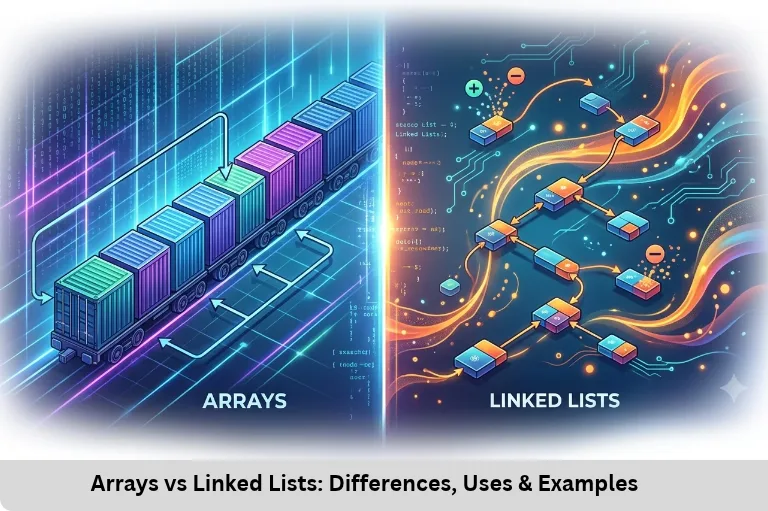
Understand arrays vs linked lists, memory allocation, time complexity, C programming examples, and applications in Embedded Systems and Internet of Things (IoT). Embedded Tech Development Academy (ETDA).
- Arrays vs Linked Lists: Differences, Uses & Examples
-
Arrays vs Linked Lists: Which Data Structure Should You Use?
- What Is an Array?
- What Is a Linked List?
- Arrays vs Linked Lists: Key Differences
- Time Complexity Comparison
- Applications in Embedded Systems and IoT
- Which Data Structure Should You Choose?
- Learn Data Structures at Embedded Tech Development Academy
-
Frequently Asked Questions
- What is the main difference between arrays and linked lists?
- Which is faster, an array or a linked list?
- Why are linked lists used instead of arrays?
- Are arrays better for Embedded Systems?
- Can linked lists be implemented in Embedded C?
- Where can students learn Embedded C and data structures in Bangalore?
- Conclusion
Arrays vs Linked Lists: Which Data Structure Should You Use?
Arrays and linked lists are two fundamental data structures used in programming, Embedded Systems, and Internet of Things (IoT) development. Both store collections of data, but they differ significantly in memory organization, element access, insertion, deletion, and performance. Understanding these differences helps programmers select the right data structure for specific application requirements.
For engineering students learning Embedded C, choosing between arrays and linked lists is an important programming skill. Arrays are frequently used for sensor readings, lookup tables, and communication buffers, while linked lists support dynamic memory organization. Students exploring the Top Embedded Training Institute in Bangalore can strengthen these concepts through practical programming and industry-oriented learning at Embedded Tech Development Academy (ETDA).
What Is an Array?
An array is a linear data structure that stores multiple elements of the same data type in contiguous memory locations. Each element is accessed using an index, which starts from zero in C programming.
Arrays provide direct access to individual elements without traversing previous elements. This makes them suitable for applications requiring predictable memory usage and frequent indexed access.
Array Example in C
#include <stdio.h>

int main()
{
    int temperature[4] = {25, 28, 30, 32};

    printf("%d", temperature[2]);

    return 0;
}
The output is 30 because the third element is located at index 2. Arrays are commonly used to store temperature readings, ADC values, sensor samples, and configuration parameters.
Advantages of Arrays
Fast random access using indexes.
Simple implementation and debugging.
Efficient memory usage without storing pointers.
Good cache locality because elements occupy contiguous memory.
Suitable for fixed-size datasets and predictable memory requirements.
Limitations of Arrays
Arrays generally have fixed capacity when declared with a specific size. Inserting or deleting elements in the middle may require shifting other elements.
Dynamic arrays can resize, but resizing may involve allocating new memory and copying existing elements. Therefore, programmers must consider capacity and memory requirements carefully.
What Is a Linked List?
A linked list is a linear data structure consisting of nodes. Each node contains data and one or more pointers that connect it to other nodes.
Unlike arrays, linked-list nodes do not need to occupy contiguous memory locations. Memory can be allocated dynamically as new nodes are created.
Linked List Example in C
#include <stdio.h>
#include <stdlib.h>

struct Node
{
    int data;
    struct Node *next;
};

int main()
{
    struct Node *head =
        malloc(sizeof(struct Node));

    if(head == NULL)
        return 1;

    head->data = 100;
    head->next = NULL;

    printf("%d", head->data);

    free(head);
    return 0;
}
This example creates a single linked-list node dynamically. The data member stores information, while next points to the next node.
Advantages of Linked Lists
Dynamic memory allocation supports flexible growth.
Insertion and deletion can be efficient when the required node position is known.
No need for contiguous memory allocation.
Useful for implementing queues, stacks, and other dynamic structures.
Limitations of Linked Lists
Linked lists require additional memory for storing pointers. Accessing a particular element requires sequential traversal, which can increase processing time.
Dynamic allocation may also introduce fragmentation and unpredictable allocation delays. These factors are important when designing memory-constrained embedded applications.
Arrays vs Linked Lists: Key Differences
| Feature | Array | Linked List |
|---|---|---|
| Memory allocation | Contiguous | Non-contiguous |
| Element access | O(1) by index | O(n) traversal |
| Insertion at beginning | O(n) | O(1) with head pointer |
| Deletion at beginning | O(n) shifting | O(1) |
| Memory overhead | Low | Additional pointer storage |
| Cache locality | Generally better | Generally poorer |
| Size | Fixed or resizable | Dynamically allocated |
| Implementation | Simpler | Requires pointer handling |
The complexity values assume conventional implementations. In linked lists, insertion or deletion is O(1) only when the relevant node or position is already available; finding that position may require O(n) traversal.
Time Complexity Comparison
Time complexity helps programmers evaluate how efficiently arrays and linked lists perform different operations.
Array Complexity
Access by index: O(1).
Searching an unsorted array: O(n).
Insertion at the beginning: O(n).
Deletion from the middle: O(n).
Arrays are efficient when applications frequently access elements using indexes.
Linked List Complexity
Accessing the nth element: O(n).
Searching: O(n).
Insertion at the beginning: O(1).
Deletion at the beginning: O(1).
Linked lists are useful when frequent insertions and deletions occur at known positions. However, traversal remains necessary for locating elements.
Applications in Embedded Systems and IoT
Arrays and linked lists are extensively used in Embedded Systems and Internet of Things (IoT) applications. The correct choice depends on hardware limitations, processing requirements, memory availability, and data-management patterns.
Arrays in Embedded Applications
Arrays are commonly used for storing ADC samples, sensor readings, calibration values, and communication packets.
For example, an STM32 microcontroller may collect multiple temperature readings in an array before calculating an average. Arrays also support efficient lookup tables for PWM control, signal processing, and motor-control algorithms.
Linked Lists in Embedded Applications
Linked lists can manage dynamically created objects, device records, and variable-length collections.
They are useful in certain communication-management systems and software components requiring frequent insertion or deletion. However, embedded developers should carefully evaluate heap fragmentation, execution predictability, and memory availability before using dynamic allocation.
Which Data Structure Should You Choose?
Selecting arrays or linked lists depends on the application rather than simply choosing the more flexible structure.
Choose Arrays When
Frequent indexed access is required.
Data size is predictable.
Memory efficiency is important.
Processing speed and cache locality matter.
Firmware requires deterministic memory allocation.
Choose Linked Lists When
Data size changes frequently.
Frequent insertion and deletion are required.
Contiguous memory allocation is difficult.
Nodes can be accessed directly during modifications.
Additional pointer memory and allocation complexity are acceptable.
Practical Embedded C Decision
In many microcontroller applications, arrays or statically allocated circular buffers are preferred because they offer predictable memory usage and execution behavior.
Linked lists can still be useful when flexibility is necessary, but dynamic memory allocation should be designed carefully, especially in real-time firmware.
Programming Practice for Students
Students should implement both arrays and linked lists in C, measure operation complexity, inspect memory usage, and test boundary conditions. This practical comparison develops pointer understanding, debugging skills, and efficient programming habits.
Learn Data Structures at Embedded Tech Development Academy
Understanding arrays and linked lists helps engineering students build strong foundations in Embedded C, firmware development, and Internet of Things (IoT) programming.
Embedded Tech Development Academy (ETDA) focuses on practical technical learning involving Embedded C, microcontrollers, communication protocols, and industry-oriented projects. Students can connect data structures with real applications such as sensor processing, UART communication, and embedded software development.
The Top Embedded Training Institute in Bangalore should help students understand not only programming syntax but also memory organization, debugging, and hardware interaction. Embedded Tech Development Academy (ETDA) supports aspiring engineers through practical training and assured placement support, helping them prepare for technical interviews and entry-level embedded development opportunities.
Frequently Asked Questions
What is the main difference between arrays and linked lists?
Arrays store elements in contiguous memory locations and provide indexed access. Linked lists store nodes separately and connect them through pointers.
Which is faster, an array or a linked list?
Arrays are generally faster for indexed access because they provide O(1) access. Linked lists require O(n) traversal to access a particular position.
Why are linked lists used instead of arrays?
Linked lists support flexible memory allocation and efficient insertion or deletion when the relevant node is available, without shifting multiple elements.
Are arrays better for Embedded Systems?
Arrays are often preferred in embedded applications because they provide predictable memory usage, efficient access, and good cache locality.
Can linked lists be implemented in Embedded C?
Yes. Linked lists can be implemented using structures and pointers in Embedded C. Developers must manage allocation, pointer validity, and memory safety carefully.
Where can students learn Embedded C and data structures in Bangalore?
Embedded Tech Development Academy (ETDA) offers industry-oriented technical training, practical programming exposure, and assured placement support for students interested in Embedded Systems and Internet of Things (IoT) careers.
Conclusion
Arrays and linked lists are important data structures with different advantages. Arrays provide fast indexed access, better cache locality, and predictable memory organization, whereas linked lists offer flexible insertion and deletion when node positions are known.
For Embedded Systems and Internet of Things (IoT) developers, selecting the right data structure improves firmware efficiency, memory utilization, and software reliability. Students should practice both structures using Embedded C and understand their time and space complexity.
Embedded Tech Development Academy (ETDA) helps learners strengthen programming fundamentals through technical training, practical projects, and assured placement support. Choosing the Top Embedded Training Institute in Bangalore can help engineering students develop the skills needed for Embedded C, Internet of Things (IoT), and firmware development careers.
Author: ETDA Trainers
Experience: 10+ Years of Industry Experience in Embedded Systems, IoT, and Embedded C Programming