
Automotive Embedded Systems: ECU, Safety & Applications
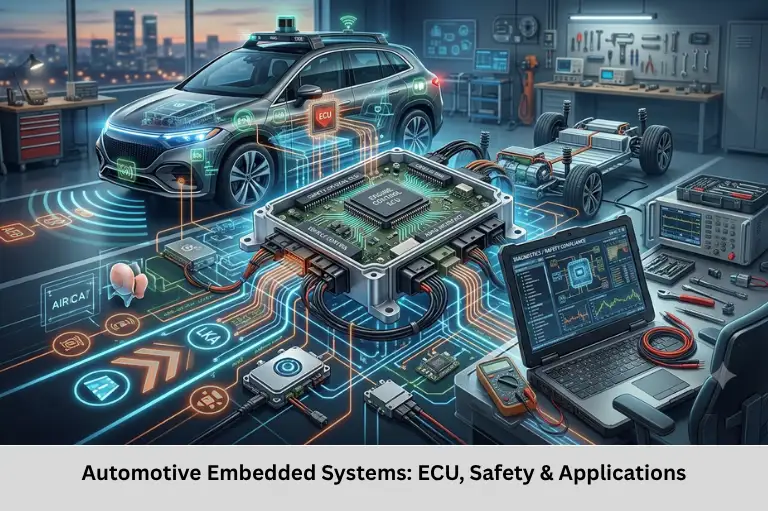
Learn automotive embedded systems, ECU architecture, engine management, airbag control, real-time requirements, ADAS, and automotive career opportunities. Embedded Tech Development Academy (ETDA).
- Automotive Embedded Systems: ECU, Safety & Applications
-
Introduction to Automotive Embedded Systems
- What Is an Automotive Embedded System?
- General Features of Automotive Embedded Systems
- Energy Efficiency and Emission Control
- Classification of Automotive Embedded Systems
- Example 1 — Engine Management System
- Example 2 — Airbag Control System
- Example 3 — Car Navigation System
- Future Scope and Automotive Embedded Careers
- Frequently Asked Questions
- Conclusion
Introduction to Automotive Embedded Systems
Automotive embedded systems are specialized computer systems integrated into vehicles to monitor operating conditions, process sensor data, and control electronic and mechanical functions. Modern automobiles use embedded technology for engine management, transmission control, braking, steering, airbags, navigation, infotainment, and advanced driver-assistance systems (ADAS). These systems combine microcontrollers, electronic control units (ECUs), sensors, actuators, firmware, communication networks, and real-time control algorithms.
An automotive embedded system must process inputs accurately and produce outputs within defined timing limits. For example, an engine control unit calculates fuel injection timing using crankshaft position and engine-speed information, while an airbag controller evaluates crash-sensor signals to determine whether deployment is necessary. Such applications require dependable software, fault detection, functional safety, and extensive verification.
As vehicles become more connected, electrified, and automated, technologies such as AUTOSAR, Embedded C, CAN bus, LIN, automotive Ethernet, real-time operating systems (RTOS), electric vehicle control, and ADAS are increasingly important. Engineers entering this field need knowledge of microcontrollers, automotive communication protocols, control systems, and safety-oriented software development.
For aspiring engineers, Embedded Tech Development Academy (ETDA) offers a learning pathway focused on practical embedded technology. Students researching the Top Embedded Training Institute in Bangalore can look for hands-on training in microcontroller programming, automotive protocols, and real-time applications. With industry-oriented learning and assured placement support, Embedded Tech Development Academy (ETDA) aims to help learners prepare for technical roles related to embedded and automotive software development.
What Is an Automotive Embedded System?
An automotive embedded system is a dedicated computing system installed in a vehicle to perform a specific monitoring, control, communication, or safety function. Its main computing component is often an Electronic Control Unit (ECU), which executes firmware and interacts with sensors and actuators.
A vehicle may contain separate ECUs for engine management, transmission, braking, body electronics, airbags, battery management, and infotainment. The exact number depends on vehicle design, features, and electronic architecture. As an example of increasing automotive complexity, the Lexus LS 460, introduced in 2006, was widely associated with extensive electronic control functionality.
Main Components of Automotive Embedded Systems
ECU or microcontroller: Executes control algorithms and firmware.
Sensors: Measure parameters such as temperature, speed, pressure, position, and acceleration.
Actuators: Control motors, injectors, valves, relays, and other mechanisms.
Communication networks: Exchange information between ECUs.
Software: Implements monitoring, diagnostics, control logic, and fault handling.
Power management: Maintains suitable electrical operation under changing vehicle conditions.
General Features of Automotive Embedded Systems
Energy Efficiency and Emission Control
Engine and powertrain controllers optimize fuel injection, ignition timing, air-fuel ratio, and other parameters to improve efficiency and help control emissions. Hybrid and electric vehicles also require battery, motor, and power-conversion control.
Safety and Reliability
Automotive electronics support active safety features, such as electronic stability control, and passive safety features, such as airbags and seat-belt pretensioners. Reliable operation requires fault detection, diagnostics, testing, and appropriate responses to failures.
Real-Time Operation
Control decisions must be completed before application-specific deadlines. A late output may be ineffective or unsafe, even if its calculated value is correct. Engineers therefore consider interrupt latency, task scheduling, execution time, and communication delays.
Cost and Weight Constraints
Automotive systems must balance processing capability, memory, wiring, energy consumption, packaging, and manufacturing cost. Different ECUs require different hardware and software architectures depending on their responsibilities.
Classification of Automotive Embedded Systems
Powertrain and Chassis Control
Powertrain systems manage engine operation, automatic transmission, hybrid propulsion, electric motors, and battery-related functions. Chassis systems control steering, braking, suspension, and vehicle dynamics.
Body Electronics
Body electronics manage instrument panels, door locks, windows, lighting, seats, climate control, and keyless entry. Airbag and seat-belt control systems provide dedicated occupant-protection functions.
Multimedia and Infotainment
Infotainment systems support audio, navigation, displays, connectivity, rear-view cameras, traffic information, and user interaction. They often use more powerful processors and operating systems than simple control ECUs.
Integrated Driver Assistance Systems
Integrated systems combine information from multiple sensors and ECUs to support functions such as parking assistance, lane-keeping assistance, pre-crash warning, and electronic stability control.
Automotive Communication Networks
ECUs communicate using in-vehicle networks such as Controller Area Network (CAN), Local Interconnect Network (LIN), and automotive Ethernet. CAN is widely used for robust control messages, LIN is commonly used for lower-cost body electronics, and automotive Ethernet supports higher-bandwidth communication needs.
Network Design Considerations
Engineers must consider message priority, bus load, latency, error detection, network topology, and fault handling. Communication timing can directly affect the behavior of distributed control functions.
Example 1 — Engine Management System
Components and Function
An engine management system controls engine operation using an ECU, multiple sensors, and actuators. Typical inputs include the crankshaft position sensor, airflow or manifold-pressure sensor, intake-air temperature sensor, throttle-position sensor, and coolant-temperature sensor.
Based on these inputs, the ECU calculates fuel injection quantity and ignition timing. It then commands fuel injectors, ignition coils, and other actuators according to the engine’s operating conditions.
Real-Time Requirements
At 6,000 revolutions per minute (RPM), a four-stroke engine’s crankshaft completes one revolution in 10 milliseconds and two revolutions in 20 milliseconds. The required control timing depends on engine design and the particular operation. Ignition events may need microsecond-level timing precision.
Deadline and Safety Management
Fuel injection calculations must finish before the relevant injection event, and ignition calculations must be ready before the scheduled spark. Computing a value too early does not necessarily improve control if the system must coordinate the output with the current crankshaft position.
Fault Detection
If an ignition coil or spark plug fails, the engine controller may detect misfire conditions and adjust or disable fuel injection to the affected cylinder, depending on the fault and engine strategy. This can help reduce the risk of catalytic-converter damage and unsafe operating conditions.
Example 2 — Airbag Control System
Collision Detection and Deployment
An airbag control unit receives data from accelerometers and other crash-related sensors. Its control algorithm evaluates the measured deceleration and crash characteristics to determine whether an airbag or other restraint should deploy.
Real-Time and Safety Constraints
Airbag deployment decisions must occur within very short, carefully validated time windows. The exact timing depends on the crash scenario, vehicle design, and restraint system; some descriptions use a range of approximately 10–20 milliseconds as an illustrative target.
Fault-Tolerant Design
Airbag systems require extensive safety analysis, diagnostics, electrical protection, and validation. Simply applying a generic fail-safe strategy is not sufficient because an incorrect deployment or failure to deploy can both have serious consequences.
Safety-Critical Engineering
Engineers must evaluate sensor plausibility, power integrity, diagnostic coverage, software behavior, and hardware failures. Automotive functional-safety processes commonly use ISO 26262 as a framework for managing hazards and reducing risk.
Example 3 — Car Navigation System
Positioning and Route Guidance
A car navigation system estimates the vehicle’s position using Global Navigation Satellite System (GNSS) data, including GPS, and may combine it with gyroscope, wheel-speed, or inertial sensor measurements. The estimated position is displayed on a digital map.
Additional Functions
Navigation software calculates routes, provides turn-by-turn instructions, and may display traffic information, road restrictions, and estimated arrival times. Connectivity can supply updated map and traffic data.
Sensor Fusion
Combining satellite positioning with inertial and vehicle data can improve position estimation when satellite reception is weak, such as in tunnels or urban environments.
Embedded Processing Requirements
The system must manage sensor updates, map data, communication, display rendering, and route calculations while balancing memory usage and processing performance.
Future Scope and Automotive Embedded Careers
Automotive technology is evolving through electric vehicles, connected cars, software-defined vehicle architectures, ADAS, automated driving, and intelligent battery management. These developments increase the need for engineers who understand embedded firmware, microcontrollers, automotive networks, real-time software, testing, and functional safety.
Possible career paths include:
Automotive Embedded Software Engineer
ECU Firmware Developer
Automotive Control Systems Engineer
Automotive Electrical and Electronics Engineer
Automotive Functional Safety Engineer
Automotive Research and Development Engineer
ADAS Software and Validation Engineer
Embedded Tech Development Academy (ETDA) encourages learners to build relevant programming and embedded engineering skills. Students evaluating the Top Embedded Training Institute in Bangalore should examine practical projects involving Embedded C, CAN communication, sensor integration, debugging, and control algorithms. Technical training combined with assured placement support can help learners prepare for entry-level engineering opportunities.
Frequently Asked Questions
What is an automotive embedded system?
It is a dedicated computer system installed in a vehicle to monitor inputs and control functions such as engine operation, braking, airbags, navigation, and infotainment.
What is an ECU in a car?
An Electronic Control Unit is an electronic controller that processes sensor inputs and executes software to manage a particular vehicle function or group of functions.
Why are real-time systems important in automotive electronics?
Automotive controllers must complete critical calculations and produce outputs within defined deadlines. Missing a deadline can affect engine performance, braking, restraint deployment, or other time-sensitive functions.
Which communication protocols are used in automotive embedded systems?
Common technologies include CAN, LIN, and automotive Ethernet. The choice depends on bandwidth, cost, timing, reliability, and the function being implemented.
What skills are required for an automotive embedded engineer?
Important skills include Embedded C, microcontroller architecture, CAN and LIN communication, sensor and actuator interfacing, real-time systems, debugging, software testing, and familiarity with automotive functional-safety principles.
Conclusion
Automotive embedded systems are fundamental to modern vehicle operation. ECUs combine microcontrollers, sensors, actuators, firmware, and in-vehicle communication networks to support powertrain control, chassis management, body electronics, infotainment, navigation, and safety functions. These systems must satisfy strict requirements for timing, reliability, diagnostics, energy efficiency, cost, and functional safety.
Engine management illustrates how sensor readings, fuel injection calculations, ignition timing, and fault detection work together under real-time constraints. Airbag controllers demonstrate the need for validated safety-critical decisions, while navigation systems combine satellite positioning, sensor fusion, mapping, and route computation. Emerging technologies such as electric vehicle control, automotive Ethernet, AUTOSAR, ADAS, and software-defined vehicles are expanding the technical scope of automotive embedded engineering.
For aspiring professionals, Embedded Tech Development Academy (ETDA) provides a learning pathway for developing embedded programming and hardware-integration skills. Those searching for the Top Embedded Training Institute in Bangalore should prioritize hands-on microcontroller projects, automotive communication protocols, debugging, and real-time application development. Practical learning combined with assured placement support can help students work toward automotive software and electronics roles.
As vehicle architectures become more connected and software-intensive, engineers with strong foundations in Embedded C, ECU development, CAN communication, RTOS concepts, and functional safety will be well positioned to pursue opportunities across automotive engineering. Embedded Tech Development Academy (ETDA) can support this technical learning journey, while learners comparing the Top Embedded Training Institute in Bangalore should assess project depth and industry relevance. With focused preparation and assured placement support, aspiring engineers can build a foundation for careers in automotive embedded software, control systems, testing, and research and development.
Author: ETDA Trainers
Experience: 10+ Years of Industry Experience in Embedded Systems, IoT, and Embedded C Programming