
Automotive Embedded Systems: Components, ECUs, Applications & Careers
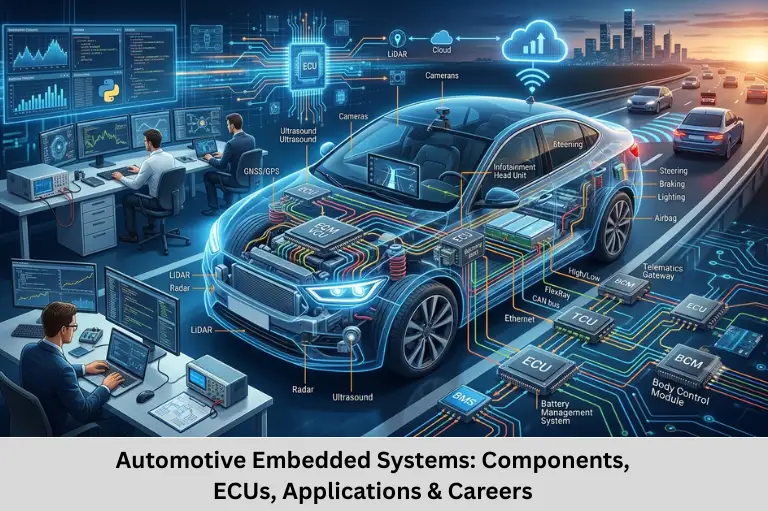
Learn automotive embedded systems, ECUs, real-time control, sensors, safety systems, applications, and career opportunities in automotive electronics.
- Automotive Embedded Systems: Components, ECUs, Applications & Careers
-
Introduction to Automotive Embedded Systems
- What Are Automotive Embedded Systems?
- General Features of Automotive Embedded Systems
- Classification of Automotive Embedded Systems
- Example of an Automotive Embedded System – Engine Management
- Basic Functions of Engine Management
- Safety Requirements in Engine Management
- Example – Airbag Control System
- Example – Car Navigation System
- Automotive Embedded Communication Networks
- Automotive Embedded Systems and Functional Safety
- Why Automotive Embedded Systems Are Important
- Future Scope of Embedded Systems in Automobiles
-
Skills Needed for an Automotive Embedded Systems Career
- Programming Skills
- Hardware Skills
- FAQs
- What is an automotive embedded system?
- What is an ECU in an automobile?
- What programming language is commonly used in automotive embedded systems?
- What communication protocols should an automotive embedded engineer learn?
- What is the career scope of automotive embedded systems?
- Conclusion
Introduction to Automotive Embedded Systems
What Are Automotive Embedded Systems?
Modern automobiles are no longer purely mechanical machines. They are sophisticated electronic systems that combine microcontrollers, sensors, actuators, embedded software, communication networks, control algorithms, and real-time operating principles to deliver safety, performance, comfort, and efficiency. From engine control and braking to airbags, infotainment, navigation, and advanced driver assistance, embedded technology is now at the heart of almost every modern vehicle.
An embedded systems is a computer-based system designed to perform a dedicated function within a larger product or machine. Unlike general-purpose computers, embedded systems are optimized for specific tasks and are often subject to strict requirements related to timing, reliability, power consumption, size, and cost.
An automotive embedded system is an embedded computing system installed inside a vehicle to monitor, control, and manage specific automotive functions. The computer responsible for these functions is commonly called an Electronic Control Unit (ECU). A modern vehicle can contain numerous ECUs working together through in-vehicle communication networks.
Automotive embedded systems are responsible for tasks such as engine management, transmission control, electronic braking, steering assistance, airbag deployment, climate control, lighting, body electronics, infotainment, navigation, parking assistance, and driver assistance systems.
A well-known example demonstrating the increasing complexity of automotive electronics is the Lexus LS 460, introduced in the mid-2000s. Depending on configuration and features, the vehicle incorporated a large number of electronic control units and extensive embedded software. This illustrates how dramatically automobiles have evolved from mechanically dominated systems into software-intensive cyber-physical platforms.
The growing adoption of automotive electronics, embedded C, ARM microcontrollers, AUTOSAR, CAN, LIN, FlexRay, automotive Ethernet, functional safety, real-time systems, and ADAS technologies has created significant opportunities for engineers interested in embedded systems and automotive software development.
For students and professionals planning a career in this field, practical knowledge is essential. Embedded Tech Development Academy (ETDA) focuses on hands-on embedded systems learning, including microcontrollers, embedded C, communication protocols, real-time concepts, and project-based development. Learners searching for the Top Embedded Training Institute in Bangalore can explore Embedded Tech Development Academy (ETDA)‘s industry-oriented training approach, which also emphasizes career preparation and placement support.
General Features of Automotive Embedded Systems
Automotive embedded systems have different requirements from many consumer electronics because vehicle systems must operate reliably under changing environmental and electrical conditions.
Major Objectives of Automotive ECUs
Automotive ECUs are developed to support:
- Energy efficiency and reduced emissions
- Active and passive safety
- Passenger comfort
- Convenience features
- Entertainment and connectivity
- Vehicle performance
- Cost and weight optimization
- Reliability and maintainability
In-Vehicle Communication
The numerous ECUs in a vehicle need to exchange information. They are therefore connected through automotive communication networks such as:
- CAN
- LIN
- FlexRay
- Automotive Ethernet
- MOST in selected legacy infotainment applications
Key Automotive Embedded Requirements
Automotive embedded systems generally require:
- High reliability
- Deterministic real-time behavior
- Functional safety
- Fault detection and handling
- Low power consumption
- Electromagnetic compatibility
- Long operating life
- Strict cost constraints
- Automotive-grade hardware and software
Classification of Automotive Embedded Systems
Automotive embedded systems can broadly be classified according to the vehicle functions they control.
Powertrain and Chassis Control
Powertrain systems manage the generation and transmission of vehicle power.
Examples include:
- Engine control
- Automatic transmission control
- Hybrid powertrain control
- Electric vehicle motor control
- Battery management
- Steering control
- Brake control
- Suspension control
Body Electronics
Body electronics manage features related to the vehicle body and passenger convenience.
Examples include:
- Instrument cluster
- Keyless entry
- Door control
- Power windows
- Lighting
- Seat control
- Central locking
- Airbag systems
- Seat-belt systems
Multimedia and Infotainment
Modern vehicles increasingly function as connected digital platforms.
Applications include:
- Car audio
- Navigation
- Traffic information
- Multimedia systems
- Rear-view and display systems
- Connectivity services
- Electronic toll collection
Integrated Safety and Assistance Systems
These systems combine information from multiple sensors and ECUs to support vehicle safety.
Examples include:
- Electronic stability control
- Pre-crash safety
- Parking assistance
- Lane-keeping assistance
- Blind-spot monitoring
- Collision warning
- Adaptive cruise control
Example of an Automotive Embedded System – Engine Management
An engine management system is one of the classic examples of a real-time automotive embedded systems.
Main Components
A typical engine management system contains:
Control Computer
The ECU receives sensor information, executes control algorithms, and generates commands for the actuators.
Sensors
Important engine sensors can include:
- Crankshaft position sensor
- Camshaft position sensor
- Airflow or manifold-pressure sensor
- Intake air temperature sensor
- Throttle position sensor
- Engine coolant temperature sensor
- Oxygen sensor
Actuators
The ECU may control:
- Fuel injectors
- Ignition coils
- Electronic throttle
- Exhaust gas recirculation systems
- Variable valve timing mechanisms
Basic Functions of Engine Management
The engine ECU continuously collects information from sensors and calculates appropriate control commands.
Important functions include:
- Fuel injection control
- Ignition timing control
- Air-fuel mixture management
- Idle-speed control
- Emission control
- Engine diagnostics
- Torque management
Real-Time Engine Control
Automotive engine control demonstrates why deterministic timing is important in embedded systems.
For example, at a rotational speed of 6000 RPM, one revolution takes approximately:
60 / 6000 = 10 ms
Therefore, timing-dependent operations must be executed within very small time windows.
Timing Precision
The exact timing requirement depends on the engine architecture and control strategy. In high-speed engine management applications, ignition and injection events can require microsecond-level timing precision.
Why Real-Time Processing Matters
The ECU cannot simply calculate a control decision whenever it has spare processing time. The calculation must be completed before the physical event occurs.
For example:
- Fuel injection calculations must be completed before injection.
- Ignition timing calculations must be completed before the ignition event.
- Sensor data must be processed within the required control cycle.
Calculating the result too late can cause incorrect engine behavior, reduced performance, or safety problems.
Safety Requirements in Engine Management
Safety Requirements in Engine Management
Preventing Dangerous Conditions
For example, if the ECU detects a serious fault involving an ignition system, the control strategy may need to prevent fuel from being injected under certain conditions.
The exact response depends on the vehicle architecture, diagnostics, and safety strategy.
Fault Monitoring
Automotive ECUs can monitor:
- Sensor failures
- Actuator failures
- Communication errors
- Electrical faults
- Plausibility errors
- Timing abnormalities
Diagnostic Functions
Diagnostic information can be stored as fault codes and used during vehicle servicing and troubleshooting.
Example – Airbag Control System
An airbag control unit is another important example of a safety-critical automotive embedded systems.
Function of an Airbag Control System
The airbag control unit receives information from sensors such as:
- Accelerometers
- Crash sensors
- Pressure sensors in selected architectures
- Vehicle status information
The ECU processes this information to determine whether a crash event meets the criteria for deployment.
Real-Time Constraint
Airbag deployment decisions must occur extremely quickly after a qualifying crash event. The exact timing varies with the vehicle design and safety architecture.
Why Airbag Systems Are Safety-Critical
An incorrect deployment can cause injury, while failure to deploy during a qualifying crash can have severe consequences. Therefore, airbag systems require rigorous hardware, software, validation, diagnostics, and functional-safety processes.
Example – Car Navigation System
A navigation system demonstrates how embedded systems combine multiple technologies to provide useful information to the driver.
Position Determination
The system can use information from sources such as:
- GPS/GNSS
- Gyroscopes
- Accelerometers
- Vehicle speed
- Steering information
- Digital maps
Navigation Functions
Typical functions include:
- Current-position display
- Route calculation
- Turn-by-turn navigation
- Traffic information
- Estimated travel time
Sensor Fusion
Combining information from multiple sensors can improve positioning reliability, particularly when satellite signals are temporarily unavailable or degraded.
Automotive Embedded Communication Networks
The many ECUs inside a vehicle need reliable communication.
CAN – Controller Area Network
CAN is one of the most widely used automotive communication technologies.
It is commonly used for:
- Engine control
- Body electronics
- Chassis systems
- Diagnostics
- Sensor and actuator communication
LIN – Local Interconnect Network
LIN is generally used for simpler, lower-cost applications such as:
- Door controls
- Seat controls
- Mirrors
- Wipers
- Lighting
Automotive Ethernet
Automotive Ethernet supports higher-bandwidth applications and is increasingly important for:
- ADAS
- Cameras
- Infotainment
- Centralized computing
- Connected vehicle architectures
Why Communication Protocols Matter
A vehicle is essentially a network of interconnected embedded systems. Engineers must understand both individual ECUs and the communication mechanisms that allow them to operate as one integrated system.
Important Skills
Automotive embedded engineers commonly benefit from knowledge of:
- Embedded C
- C/C++
- Microcontrollers
- CAN
- LIN
- UART
- SPI
- I2C
- RTOS concepts
- Debugging
- Automotive diagnostics
- AUTOSAR fundamentals
- Functional safety concepts
Automotive Embedded Systems and Functional Safety
Automotive systems must account for the possibility of hardware and software failures.
Functional Safety
Functional safety focuses on reducing risks caused by malfunctioning electrical and electronic systems.
The automotive industry commonly uses the ISO 26262 functional-safety framework for safety-related electrical and electronic systems.
Safety-Oriented Development
Safety-oriented development can involve:
- Hazard analysis
- Risk assessment
- Safety requirements
- Fault analysis
- Diagnostic mechanisms
- Verification and validation
- Traceability
- Safety testing
Why Safety Knowledge Matters
Engineers working on safety-critical automotive applications need to understand that software correctness alone is not enough. The complete system must be designed and validated against potential faults and hazards.
Why Automotive Embedded Systems Are Important
Automotive embedded systems have transformed the vehicle from a primarily mechanical machine into a highly integrated electronic platform.
Major Benefits
They enable:
- Better fuel efficiency
- Reduced emissions
- Improved vehicle safety
- Better driving comfort
- Advanced diagnostics
- Automated vehicle functions
- Improved connectivity
- Intelligent driver assistance
The Shift Toward Software-Defined Vehicles
The automotive industry is increasingly moving toward architectures where software plays a central role in vehicle functionality.
This trend involves:
- Centralized computing
- Software-defined vehicles
- Over-the-air updates
- Connected cars
- Cloud integration
- AI-assisted functions
- Advanced driver assistance
Embedded Engineers in the Automotive Industry
As vehicles become more software-intensive, engineers with practical embedded programming, automotive communication, real-time systems, and debugging skills can find opportunities across automotive product development.
Future Scope of Embedded Systems in Automobiles
The demand for embedded systems expertise is growing as automobiles incorporate more electronic control, connectivity, automation, and intelligent features.
Automotive Control Systems Engineer
These engineers work on control algorithms, ECU behavior, sensors, actuators, and real-time control systems.
Automotive Software Engineer
Automotive software engineers develop embedded applications, drivers, middleware, diagnostics, and control software.
Automotive Electrical Engineer
These professionals work with vehicle electrical and electronic architectures, wiring, ECUs, power distribution, and integration.
Automotive Safety Systems Engineer
Safety engineers work on systems and software designed to meet stringent safety requirements.
Automotive Research and Development Engineer
R&D engineers explore new technologies involving:
- Electric vehicles
- Autonomous driving
- ADAS
- Vehicle connectivity
- Battery management
- Automotive AI
- New embedded architectures
Skills Needed for an Automotive Embedded Systems Career
Programming Skills
A strong foundation in:
- C programming
- Embedded C
- C++
- Data structures
- Pointers
- Memory management
is valuable for automotive embedded development.
Hardware Skills
Engineers should understand:
- Microcontrollers
- GPIO
- Timers
- ADC
- PWM
- Interrupts
- UART
- SPI
- I2C
- CAN
Software and Debugging Skills
Additional skills include:
- RTOS fundamentals
- Debugging
- Version control
- Unit testing
- Integration testing
- Static analysis
- Automotive diagnostics
Project-Based Learning
Building practical projects involving microcontrollers, CAN communication, sensors, actuators, and real-time control can help students convert theoretical concepts into usable engineering skills.
FAQs
What is an automotive embedded system?
An automotive embedded system is a dedicated computer-based system installed inside a vehicle to perform specific functions. Examples include engine control, airbag control, braking, transmission control, infotainment, and navigation systems.
What is an ECU in an automobile?
ECU stands for Electronic Control Unit. It is an embedded computing unit that receives information from sensors, processes it using software, and controls specific vehicle functions through actuators or communication networks.
What programming language is commonly used in automotive embedded systems?
C and Embedded C are widely used because they provide efficient control over memory and hardware resources. C++ is also used increasingly in various automotive software applications.
What communication protocols should an automotive embedded engineer learn?
Important technologies include CAN, LIN, UART, SPI, I2C, and Automotive Ethernet. CAN is particularly important for understanding communication between automotive ECUs.
What is the career scope of automotive embedded systems?
Automotive embedded systems offer career opportunities such as Automotive Embedded Software Engineer, ECU Developer, Automotive Control Systems Engineer, Automotive Safety Engineer, Automotive Electrical Engineer, AUTOSAR Developer, Diagnostics Engineer, and Automotive R&D Engineer. Knowledge of embedded programming, microcontrollers, communication protocols, real-time systems, and functional safety can help candidates prepare for these roles.
Conclusion
Automotive embedded systems have become the technological foundation of modern vehicles. From engine management and transmission control to airbags, braking systems, navigation, infotainment, ADAS, and electric vehicle control, embedded electronics are responsible for an enormous range of vehicle functions.
The examples of engine management, airbag control, and navigation systems clearly demonstrate the importance of real-time processing, sensor interfacing, actuator control, embedded C programming, ECU development, automotive communication protocols, diagnostics, and functional safety. Unlike ordinary computing applications, automotive systems often have strict timing, reliability, environmental, cost, and safety requirements. A small software or hardware failure can potentially affect vehicle performance or safety, which is why automotive embedded development requires disciplined engineering practices.
The future of automotive technology is closely connected with electric vehicles, autonomous driving, advanced driver assistance systems, connected cars, automotive Ethernet, software-defined vehicles, centralized computing, vehicle cybersecurity, and intelligent control systems. These developments are increasing the demand for engineers who understand both embedded hardware and software.
For students who want to enter this growing field, developing a strong foundation in Embedded C, microcontrollers, ARM architecture, CAN protocol, UART, SPI, I2C, RTOS, automotive diagnostics, AUTOSAR fundamentals, and functional safety can provide a valuable career foundation.
Embedded Tech Development Academy (ETDA) helps learners build practical embedded systems knowledge through hands-on training and project-oriented learning. For candidates looking for the Top Embedded Training Institute in Bangalore, Embedded Tech Development Academy (ETDA) offers industry-focused embedded training designed to develop practical technical skills and prepare learners for automotive and other embedded systems career opportunities, with placement support.
As automobiles continue evolving into connected and software-driven machines, automotive embedded systems will remain one of the most important areas of electronics and software engineering. Learning how ECUs, sensors, actuators, communication networks, and real-time software work together can help aspiring engineers prepare for the next generation of automotive technology.
Author: ETDA Trainers
Experience: 10+ Years of Industry Experience in Embedded Systems, IoT, and Embedded C Programming