
Best Embedded Institute in Bangalore | ETDA
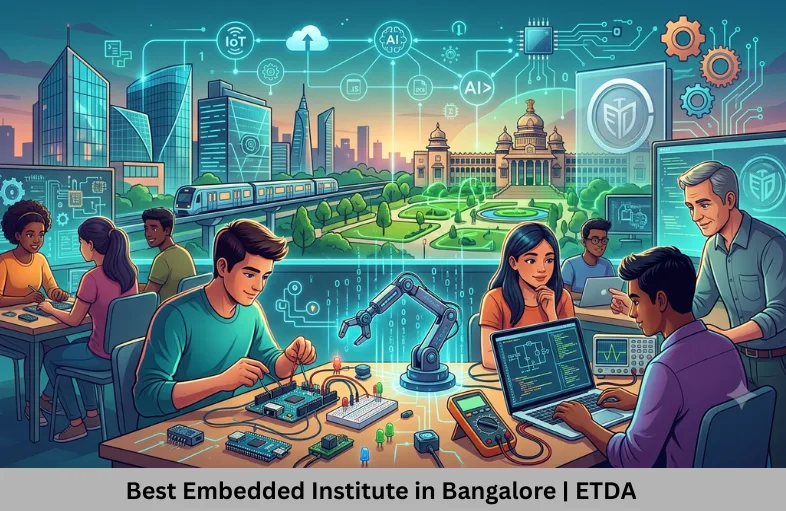
Explore Embedded Tech Development Academy (ETDA), a leading embedded institute in Bangalore offering practical Embedded C, microcontroller, RTOS, Embedded Linux and Internet of Things (IoT) training with assured placement support.
- Best Embedded Institute in Bangalore | ETDA
-
Best Embedded Institute in Bangalore – Build Your Engineering Career with ETDA
- Introduction
- Why Is Embedded Systems Training Important for Engineering Students?
- What Makes ETDA a Good Choice for Embedded Training in Bangalore?
- Hands-On Projects and Practical Learning at ETDA
- Internet of Things (IoT) and the Future of Embedded Technology
- Career Opportunities After Embedded Systems Training
-
Frequently Asked Questions
- Which is the best embedded institute in Bangalore for engineering students?
- What qualifications are required to learn embedded systems?
- Which programming language is important for embedded systems?
- Does embedded systems training include practical projects?
- What are the career opportunities after an embedded systems course?
- Does ETDA provide assured placement support?
- Conclusion
Best Embedded Institute in Bangalore – Build Your Engineering Career with ETDA
Introduction
The demand for skilled embedded engineers is increasing as industries adopt intelligent electronic devices, automotive technologies, robotics, industrial automation, and connected products. From vehicle control units and medical equipment to smart home appliances, embedded technology plays an important role in modern engineering. Students who understand programming, electronics, microcontrollers, and firmware development can explore several career opportunities in this growing industry.
However, becoming an embedded engineer requires more than theoretical knowledge. Students must learn how hardware and software interact, develop efficient firmware, configure microcontrollers, understand communication protocols, and troubleshoot real-time applications. Therefore, selecting the best embedded institute in Bangalore is an important decision for engineering graduates who want to enter this technical field.
Embedded Tech Development Academy (ETDA) focuses on developing industry-relevant technical skills through structured training, practical exercises, and project-oriented learning. Recognised as a Top Embedded Training Institute in Bangalore, Embedded Tech Development Academy (ETDA) helps students understand embedded systems, Embedded C, microcontrollers, Embedded Linux, RTOS, and the Internet of Things (IoT). With technical guidance, practical exposure, and assured placement support, students can work towards building a strong foundation for their embedded engineering careers.
Why Is Embedded Systems Training Important for Engineering Students?
Embedded systems are specialised computing systems designed to perform dedicated functions within electronic products. They combine hardware components, microcontrollers, memory, and firmware to control specific operations.
For example, an automotive electronic control unit (ECU) processes sensor information to manage engine performance and vehicle safety. Similarly, industrial controllers monitor machinery, process input signals, and control manufacturing operations.
The growth of the Internet of Things (IoT) has further expanded embedded technology applications. Connected devices use sensors, microcontrollers, and communication modules to collect and exchange information.
Some important application areas include:
Automotive electronics and electric vehicles.
Industrial automation and robotics.
Medical and healthcare equipment.
Consumer electronics and smart appliances.
Internet of Things (IoT) applications.
Semiconductor and firmware development.
Communication and networking devices.
A structured embedded systems course helps students understand these technologies and develop the practical skills required for engineering roles.
What Makes ETDA a Good Choice for Embedded Training in Bangalore?
Choosing a training institute requires evaluating its technical curriculum, practical exposure, teaching approach, and career support. Embedded Tech Development Academy (ETDA) focuses on helping students progress from programming fundamentals to advanced embedded development concepts.
1. Comprehensive Embedded C Programming
Embedded C is one of the most widely used programming languages in firmware development. It allows developers to write efficient programs that interact directly with microcontroller hardware.
Students need to understand variables, operators, control statements, functions, arrays, pointers, structures, unions, and storage classes. They should also learn bitwise operations, macros, preprocessor directives, and memory management.
For example, configuring a GPIO pin requires knowledge of register addresses and bit manipulation. Similarly, implementing an interrupt requires understanding how the processor responds to internal or external events.
Embedded Tech Development Academy (ETDA) focuses on strengthening programming fundamentals so students can understand how firmware interacts with embedded hardware and develop reliable applications.
2. Microcontroller Architecture and Interfacing
Microcontrollers form the foundation of many embedded systems applications. They integrate a processor, memory, timers, communication interfaces, and input/output peripherals into a single chip.
Students can explore platforms such as 8051, ARM Cortex-M, STM32, and LPC1768 to understand microcontroller architecture and peripheral programming.
Important practical concepts include:
GPIO configuration and digital input/output.
Timer and counter programming.
ADC and DAC interfacing.
PWM signal generation.
Interrupt configuration.
Sensor and actuator interfacing.
For instance, an ADC converts an analogue sensor voltage into a digital value that the microcontroller can process. PWM generates signals with adjustable duty cycles to control motor speed and LED brightness.
Embedded Tech Development Academy (ETDA)‘s practical-oriented learning approach helps students understand the relationship between electronic circuits and firmware development.
3. Learn UART, SPI, I2C, and CAN Communication Protocols
Communication protocols allow microcontrollers and peripheral devices to exchange information. They are essential in automotive electronics, industrial automation, and Internet of Things (IoT) applications.
UART: Universal Asynchronous Receiver Transmitter is used for serial communication between microcontrollers, computers, and communication modules.
SPI: Serial Peripheral Interface is a synchronous communication protocol commonly used with displays, memory devices, and sensors.
I2C: Inter-Integrated Circuit uses two communication lines, SDA and SCL, to connect multiple devices through a shared communication bus.
CAN: Controller Area Network is widely used in automotive applications for communication between electronic control units.
Learning these protocols helps students understand how different hardware components communicate within embedded systems.
4. Embedded Linux and Device Driver Development
Embedded Linux is used in advanced electronic products such as networking equipment, smart devices, industrial gateways, and multimedia systems. It provides operating system capabilities for applications that require process management, memory management, and hardware interaction.
Students should understand Linux commands, shell scripting, processes, threads, system calls, kernel modules, and device driver fundamentals.
Why Are Device Drivers Important?
Device drivers provide an interface between the operating system and hardware components. They allow applications to communicate with devices without directly controlling every hardware operation.
For example, a character device driver can provide an interface for applications to communicate with hardware peripherals through standard Linux file operations.
Practical Understanding of Driver Development
Students should understand device initialisation, resource management, interrupt handling, and hardware communication. Learning these concepts helps aspiring engineers understand how Linux-based embedded systems interact with physical devices.
Embedded Tech Development Academy (ETDA) introduces students to important embedded technologies that help build a foundation for advanced firmware and Linux development.
5. Real-Time Operating Systems (RTOS)
A Real-Time Operating System manages multiple tasks while ensuring that important operations are completed within their required time constraints. RTOS is widely used in automotive electronics, industrial automation, robotics, and medical equipment.
Students should learn task creation, scheduling, priority management, semaphores, mutexes, message queues, and inter-task communication.
For example, an automotive monitoring application may need to process sensor information, monitor system conditions, and communicate with other electronic control units. RTOS concepts help developers organise these operations efficiently.
Understanding RTOS improves students’ knowledge of multitasking and real-time embedded application development.
Hands-On Projects and Practical Learning at ETDA
Why Should Students Work on Embedded Projects?
Practical projects help students apply programming and electronics concepts to real-world engineering problems. Instead of learning individual topics separately, learners understand how complete embedded applications operate.
Embedded Tech Development Academy (ETDA) emphasises practical-oriented learning and project exposure to help students develop technical confidence.
Some useful project areas include:
1. Internet of Things (IoT)-Based Temperature Monitoring: Interface a temperature sensor with a microcontroller and transmit readings to a monitoring platform.
2. Smart Home Automation: Control electrical appliances using microcontrollers, sensors, and wireless communication technologies.
3. Automotive CAN Communication: Demonstrate communication between multiple electronic control units using the CAN protocol.
4. Motor Speed Control: Generate PWM signals to control motor speed and understand embedded control techniques.
5. Sensor-Based Monitoring System: Collect sensor information using ADC and display the processed data through an output interface.
Project Development Process
A successful embedded project involves identifying requirements, selecting suitable hardware, developing firmware, configuring communication interfaces, testing the application, and debugging errors.
Students should learn to analyse circuit connections, verify input and output signals, and identify software or hardware issues systematically.
Skills Students Develop Through Project Work
Project development improves programming logic, hardware debugging, circuit understanding, technical documentation, and problem-solving abilities. These skills also help students explain their technical knowledge during technical interviews.
Internet of Things (IoT) and the Future of Embedded Technology
The Internet of Things (IoT) connects physical devices through communication networks, enabling them to collect, process, and exchange information. IoT solutions combine embedded systems, sensors, microcontrollers, communication modules, and cloud platforms.
For example, a smart agriculture application can monitor soil moisture using sensors and transmit readings through a wireless communication module. A monitoring platform can display the collected information and help users make decisions.
Similarly, industrial Internet of Things (IoT) solutions can monitor machine performance, identify abnormal operating conditions, and improve production efficiency.
Students interested in Internet of Things (IoT) development should understand microcontroller programming, sensor interfacing, UART, SPI, I2C, wireless communication, and networking fundamentals.
Embedded Tech Development Academy (ETDA) helps students develop a technical foundation in embedded systems and related Internet of Things (IoT) technologies, preparing them to explore connected-device applications.
Career Opportunities After Embedded Systems Training
The embedded technology industry offers several opportunities for engineering graduates. Automotive companies require firmware developers, while industrial organisations need engineers who understand automation and microcontroller-based applications.
Potential career roles include:
Embedded Software Developer.
Firmware Development Engineer.
Embedded Linux Engineer.
Automotive Embedded Engineer.
Internet of Things (IoT) Application Developer.
Microcontroller Programming Engineer.
Hardware Testing and Validation Engineer.
Students should strengthen their knowledge of C programming, microcontroller architecture, communication protocols, operating systems, and debugging techniques to prepare for these opportunities.
How ETDA Supports Students in Career Preparation
Embedded Tech Development Academy (ETDA) focuses on technical development and career readiness through structured training, practical exercises, project exposure, and interview preparation.
Students can improve their understanding of embedded systems while learning how to approach technical problems systematically. The academy also provides assured placement support, helping students prepare for relevant employment opportunities.
Placement preparation should include programming practice, technical assessments, project explanations, communication skills, and interview participation. Consistent practice and practical knowledge can improve students’ confidence when applying for embedded engineering roles.
Frequently Asked Questions
Which is the best embedded institute in Bangalore for engineering students?
Students should compare institutes based on their technical curriculum, practical training, microcontroller exposure, project work, and placement assistance. Embedded Tech Development Academy (ETDA) offers industry-oriented embedded systems training and career support.
What qualifications are required to learn embedded systems?
Engineering graduates from ECE, EEE, Electrical, Electronics, Instrumentation, and related branches can consider embedded systems training. Basic programming and electronics knowledge can be helpful.
Which programming language is important for embedded systems?
Embedded C is one of the most widely used programming languages for microcontroller programming and firmware development. C++, Python, and assembly language are also useful in different embedded applications.
Does embedded systems training include practical projects?
Practical training can include microcontroller programming, sensor interfacing, ADC, PWM, UART, SPI, I2C, CAN communication, and IoT-based applications. Project work helps students understand hardware-software integration.
What are the career opportunities after an embedded systems course?
Students can explore opportunities as embedded software developers, firmware engineers, Embedded Linux developers, automotive embedded engineers, and IoT developers, depending on their technical skills and eligibility.
Does ETDA provide assured placement support?
Yes, Embedded Tech Development Academy (ETDA) provides assured placement support to help students prepare for employment opportunities. Students should actively participate in practical training, project development, technical assessments, and interview preparation to improve their job readiness.
Conclusion
Building a career in embedded technology requires more than theoretical knowledge. Students must develop strong programming fundamentals, understand microcontroller architecture, work with communication protocols, and gain practical experience in firmware development. Learning Embedded C, Embedded Linux, RTOS, and the Internet of Things (IoT) can help aspiring engineers prepare for different career opportunities.
Embedded Tech Development Academy (ETDA) focuses on industry-oriented technical training, hands-on learning, and project-based development to help students strengthen their engineering skills. Its emphasis on programming fundamentals, hardware interfacing, and advanced embedded technologies makes it a valuable option for students exploring embedded engineering careers.
With structured learning, technical guidance, practical exposure, and assured placement support, Embedded Tech Development Academy (ETDA) helps students work towards their professional goals. If you are searching for a Top Embedded Training Institute in Bangalore, consider Embedded Tech Development Academy (ETDA) to build a strong technical foundation and prepare for opportunities in the growing embedded systems industry.
Author: ETDA Trainers
Experience: 10+ Years of Industry Experience in Embedded Systems, IoT, and Embedded C Programming