
C Programming for Embedded Systems: Concepts, Applications & Career Scope | ETDA
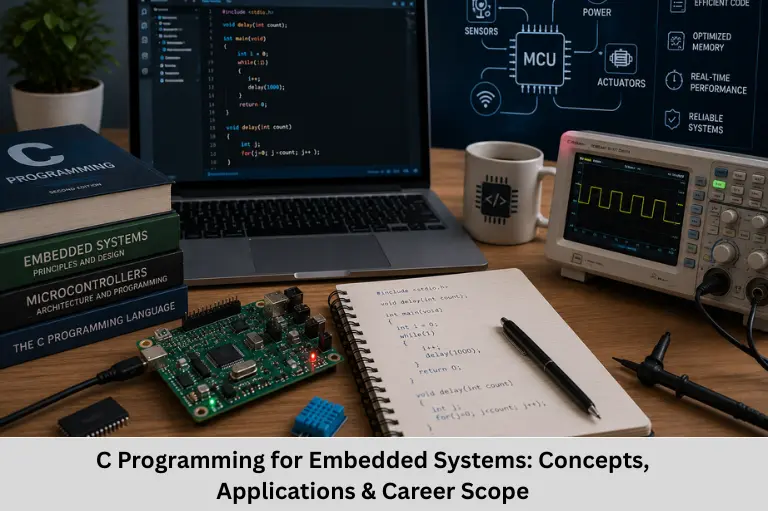
Learn C programming for embedded systems, including pointers, memory, bitwise operations, registers, peripherals, applications, projects, and career scope. Embedded Tech Development Academy (ETDA).
- C Programming for Embedded Systems: Concepts, Applications & Career Scope | ETDA
-
C Programming for Embedded Systems: Concepts, Applications & Career Scope
- Why Is C Programming Important in Embedded Systems?
- C Programming Concepts Required for Embedded Systems
- Pointers in Embedded C
- Arrays, Strings and Buffers
- Structures and Unions in Embedded Systems
- Bitwise Operations in Embedded Programming
- Memory Management in Embedded Systems
- Functions and Modular Embedded Code
- Volatile, Const and Static in Embedded C
- C Programming and Microcontroller Peripherals
- Interrupts and C Programming
- Applications of C Programming in Embedded Systems
- Practical C Projects for Embedded Learners
- Career Scope of C Programming in Embedded Systems
-
Why Learn Embedded C at ETDA?
- Technical Curriculum
- FAQs
- Why is C programming used in embedded systems?
- What C concepts are most important for embedded programming?
- Is Embedded C different from standard C?
- Can beginners learn C for embedded systems?
- Which communication protocols should an embedded C developer learn?
- What career opportunities are available after learning C for embedded systems?
- Does ETDA provide placement support?
- Why choose ETDA for C and embedded systems training?
- Conclusion
C Programming for Embedded Systems: Concepts, Applications & Career Scope
C programming is one of the most important technical foundations for embedded systems development. From automotive electronic control units and industrial controllers to Internet of Things (IoT) devices, medical equipment, robotics, and consumer electronics, C is widely used to develop firmware that interacts directly with hardware.
For engineering students and professionals planning to build a career in embedded systems, learning C is not simply about understanding syntax. Developers need to understand pointers, memory, arrays, structures, bitwise operations, storage classes, interrupts, hardware registers, data types, and low-level programming techniques.
Students searching for a Top Embedded Training Institute in Bangalore can consider Embedded Tech Development Academy (ETDA) for practical embedded systems training. Embedded Tech Development Academy (ETDA) focuses on C, Embedded C, microcontrollers, ARM architecture, communication protocols, RTOS, debugging, and project-based learning, along with assured placement support.
This guide explains the technical concepts of C programming for embedded systems, its applications, important skills, projects, and career opportunities.
Why Is C Programming Important in Embedded Systems?
Embedded systems typically operate with limited resources such as RAM, Flash memory, processing power, and energy. C provides developers with a balance between high-level programming capabilities and low-level hardware control.
Key Advantages of C in Embedded Development
C is widely used because it offers:
- Efficient execution
- Direct memory access
- Pointer support
- Bit-level manipulation
- Predictable behavior
- Low runtime overhead
- Portability across microcontrollers
- Access to hardware registers
C and Hardware Interaction
Embedded firmware frequently interacts with hardware registers.
A simplified example is:
Here, the program accesses a memory-mapped hardware address and modifies a specific bit.
Why Low-Level Control Matters
An embedded engineer may need to configure a GPIO pin, enable a peripheral clock, read an ADC value, configure a timer, or transmit data through UART. C provides the mechanisms required to perform these operations efficiently.
C Programming Concepts Required for Embedded Systems
A strong understanding of standard C is essential before moving into microcontroller programming.
Variables and Data Types
Common C data types include:
For embedded development, fixed-width types from <stdint.h> are often useful:
Why Fixed-Width Types Matter
Embedded systems often require precise control over data size.
For example:
This makes the intended data width explicit.
Choosing the Correct Data Type
Using an unnecessarily large data type can increase memory usage, while an inappropriate smaller type can cause overflow. Developers should select types based on range, memory requirements, and hardware interfaces.
Pointers in Embedded C
Pointers are among the most important concepts in embedded programming.
Understanding Pointers
A pointer stores the address of another variable.
Here, ptr contains the address of value.
Pointers are heavily used for:
- Memory access
- Arrays
- Buffers
- Structures
- Peripheral registers
- Dynamic data structures
- Function arguments
Pointer and Hardware Register Access
Memory-mapped peripherals can be accessed through pointers.
The volatile qualifier is important because the value at a hardware address can change independently of normal program execution.
Pointer Mistakes to Avoid
Incorrect pointer usage can cause serious embedded failures, including:
- Invalid memory access
- Hard faults
- Data corruption
- Buffer overruns
- Unexpected system resets
Therefore, pointer understanding is essential for reliable firmware.
Arrays, Strings and Buffers
Arrays store multiple elements of the same data type.
Arrays are frequently used for:
- Sensor data
- Communication buffers
- Lookup tables
- ADC samples
- Packet storage
Character Arrays
Strings are represented using character arrays.
Embedded applications may use strings for debugging, configuration, serial communication, and user interfaces.
Buffer Management
Communication protocols such as UART, SPI, I2C, and CAN often require buffers.
Poor buffer management can lead to:
- Buffer overflow
- Data corruption
- Packet loss
- Memory faults
Safe Embedded Programming
Developers should always consider buffer size, boundaries, input validation, and memory limitations when handling data.
Structures and Unions in Embedded Systems
Structures allow multiple related variables to be grouped together.
Structures
For example:
Structures are useful for representing:
- Sensor data
- Configuration parameters
- Device states
- Communication packets
- Peripheral information
Structures and Hardware Registers
Microcontroller register maps can sometimes be represented using structures, making related registers easier to access and organize.
Unions
Unions allow different variables to share the same memory location.
They can be useful when working with different interpretations of the same data, although they must be used carefully with respect to portability and language rules.
Bitwise Operations in Embedded Programming
Bitwise operations are fundamental to hardware programming.
Important Bitwise Operators
C provides:
&AND|OR^XOR~NOT<<Left shift>>Right shift
Setting a Bit
This sets bit 3.
Clearing a Bit
This clears bit 3.
Memory Management in Embedded Systems
Memory management is particularly important because embedded devices often have limited resources.
Types of Memory
I2C supports both write and read transactions.
I2C Write Operation
Typical microcontrollers contain:
- Flash
- SRAM
- EEPROM or other non-volatile memory, depending on the device
Stack and Heap
The stack commonly stores:
- Local variables
- Function call information
- Return addresses
The heap is used for dynamic memory allocation when supported and appropriate.
Why Dynamic Memory Requires Care
Functions such as malloc() and free() can introduce fragmentation and unpredictable allocation behavior in long-running embedded applications. Many safety- or timing-critical systems therefore minimize or avoid dynamic allocation after initialization.
Functions and Modular Embedded Code
Functions help developers divide firmware into manageable modules.
Example Function
The function provides a reusable operation for controlling an LED.
Benefits of Functions
Functions improve:
- Code readability
- Reusability
- Maintainability
- Testing
- Debugging
Modular Firmware Architecture
A larger embedded application can be divided into modules such as:
This structure makes firmware easier to maintain.
Volatile, Const and Static in Embedded C
Special C keywords are especially important in embedded programming.
Volatile
volatile informs the compiler that a value can change unexpectedly.
Typical examples include:
- Hardware registers
- Interrupt-related variables
- Memory-mapped peripherals
Const
const prevents unintended modification through a particular access path.
Static
static can control variable lifetime and visibility.
It is useful for maintaining state within functions or restricting file-level symbols.
Why These Keywords Matter
Correct use of these qualifiers helps developers express how variables are intended to behave and can prevent subtle firmware problems.
C Programming and Microcontroller Peripherals
C becomes particularly powerful when combined with microcontroller peripherals.
GPIO
C code can configure GPIO registers to:
- Read switches
- Control LEDs
- Drive digital outputs
Timers
Timers can generate:
- Periodic interrupts
- Delays
- PWM signals
- Event measurements
ADC
Firmware reads ADC registers to process analog sensor values.
UART, SPI and I2C
C-based drivers can configure these interfaces for communication with external devices.
CAN
CAN drivers allow embedded controllers to exchange messages in automotive and industrial systems.
Interrupts and C Programming
Interrupts allow embedded systems to react to hardware events.
Interrupt Service Routine
An ISR is executed when an interrupt occurs.
A simplified flow is:
Hardware Event → Interrupt → ISR → Process Event → Return
Interrupt Design
An ISR should generally be short and efficient.
Long-running operations inside an ISR can increase interrupt latency and affect other real-time activities.
C Skills Required for Interrupts
Developers should understand:
- Function pointers
volatile- Register configuration
- Interrupt vectors
- Bit manipulation
- Shared data
Applications of C Programming in Embedded Systems
C programming is used across many embedded domains.
Automotive Systems
Applications include:
- Engine control
- Body control modules
- Instrument clusters
- Battery management
- Vehicle communication
Industrial Automation
C is used in:
- Motor controllers
- PLC-related systems
- Industrial sensors
- Monitoring equipment
- Control systems
IoT Devices
C can power resource-constrained Internet of Things (IoT) devices that collect sensor data and communicate through wired or wireless interfaces.
Consumer and Medical Electronics
Embedded C is also used in appliances, wearable devices, monitoring equipment, smart devices, and other specialized electronic products.
Practical C Projects for Embedded Learners
Practical projects help convert C programming knowledge into embedded development skills.
Beginner Projects
Examples include:
- LED blinking
- Push-button controller
- Digital counter
- Traffic light controller
- UART terminal
Intermediate Projects
Students can build:
- Temperature monitoring system
- I2C sensor interface
- SPI display controller
- ADC data logger
- PWM motor controller
Advanced Projects
Advanced projects may combine:
- ARM microcontrollers
- RTOS
- CAN
- Internet of Things (IoT) connectivity
- Multiple sensors
- Communication protocols
What Projects Demonstrate
A strong embedded project demonstrates the ability to:
- Write firmware
- Configure peripherals
- Interface hardware
- Debug code
- Analyze communication
- Organize software modules
Career Scope of C Programming in Embedded Systems
C programming can provide a foundation for several technical career paths.
Embedded Software Engineer
Develops firmware for microcontroller-based products.
Firmware Engineer
Works on low-level software interacting directly with hardware.
Automotive Embedded Engineer
Develops software for ECUs, sensors, communication systems, and automotive controllers.
IoT Embedded Developer
Builds connected devices using microcontrollers, sensors, communication protocols, and networking technologies.
Embedded Linux Developer
Professionals can expand their C knowledge into Linux-based embedded development, device drivers, system programming, and networking.
Why Learn Embedded C at ETDA?
Embedded Tech Development Academy (ETDA) focuses on practical embedded systems education that connects C programming concepts with real hardware.
Technical Curriculum
Learners can develop skills in:
- C Programming
- Embedded C
- C++
- Data Structures
- ARM Cortex-M
- STM32
- LPC1768
- GPIO
- Timers
- ADC
- PWM
- UART
- SPI
- I2C
- CAN
- RTOS
- Embedded Linux
- Internet of Things (IoT)
Hands-On Learning
Practical exercises help learners understand how C programs interact with registers, peripherals, sensors, and communication interfaces.
Assured Placement Support
Embedded Tech Development Academy (ETDA) also provides assured placement support, including:
- Technical interview preparation
- Resume guidance
- C and Embedded C coding practice
- Mock interviews
- Aptitude preparation
- HR interview preparation
- Career guidance
FAQs
Why is C programming used in embedded systems?
C provides efficient execution, low-level memory access, pointer support, bit manipulation, and relatively low runtime overhead, making it suitable for microcontroller-based systems.
What C concepts are most important for embedded programming?
Pointers, arrays, structures, functions, bitwise operations, memory management, data types, volatile, static, and hardware register access are particularly important.
Is Embedded C different from standard C?
Embedded C is primarily C programming applied to embedded hardware. The language fundamentals remain C, but embedded development adds hardware-specific concepts such as registers, interrupts, peripherals, memory constraints, and microcontroller architecture.
Can beginners learn C for embedded systems?
Yes. Beginners should start with C fundamentals and gradually move to pointers, memory, bitwise operations, microcontrollers, peripherals, communication protocols, and practical projects.
Which communication protocols should an embedded C developer learn?
UART, SPI, I2C, and CAN are important protocols. Ethernet and wireless technologies can be added for connected and IoT applications.
What career opportunities are available after learning C for embedded systems?
Possible roles include Embedded Software Engineer, Firmware Engineer, Automotive Embedded Engineer, IoT Embedded Developer, Device Driver Developer, and Embedded Linux Developer.
Does ETDA provide placement support?
Yes. Embedded Tech Development Academy (ETDA) provides assured placement support, including technical interview preparation, coding practice, resume guidance, mock interviews, aptitude preparation, and career guidance.
Why choose ETDA for C and embedded systems training?
Embedded Tech Development Academy (ETDA) combines C and Embedded C programming with ARM, STM32, LPC1768, peripherals, communication protocols, RTOS, Embedded Linux, Internet of Things (IoT), debugging, and practical projects, making it an option for learners searching for a Top Embedded Training Institute in Bangalore.
Conclusion
C programming is much more than a prerequisite for embedded systems. It is a core engineering skill used to control hardware, manipulate registers, manage memory, implement peripheral drivers, process sensor data, and develop efficient firmware.
For students looking for a Top Embedded Training Institute in Bangalore, Embedded Tech Development Academy (ETDA) provides practical learning in C, Embedded C, ARM microcontrollers, communication protocols, RTOS, Embedded Linux, Internet of Things (IoT), debugging, and project development, supported by assured placement support.
The right approach is to learn C fundamentals first and then progress toward pointers, memory management, bitwise operations, hardware registers, interrupts, peripherals, drivers, and real-time programming. For anyone evaluating a Top Embedded Training Institute in Bangalore, hands-on practice and technical project experience should be major considerations.
With consistent practice, C programming can become the foundation for careers in firmware development, embedded software, automotive electronics, Internet of Things (IoT), industrial automation, robotics, and other embedded technology domains.
Author: ETDA Trainers
Experience: 10+ Years of Industry Experience in Embedded Systems, IoT, and Embedded C Programming