
Computer Vision on Embedded Systems: Guide & Applications
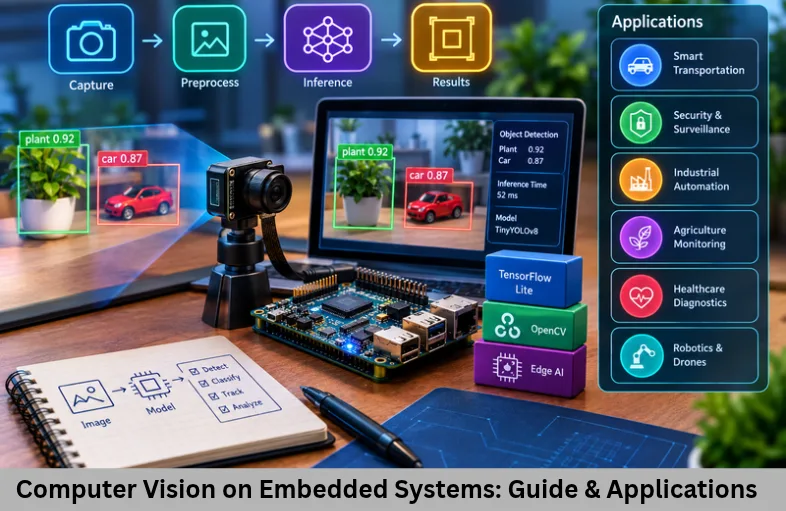
Explore embedded vision, image processing, Edge AI, TinyML, hardware platforms, OpenCV, TensorFlow Lite, real-time applications, and optimization techniques. Embedded Tech Development Academy (ETDA).
- Computer Vision on Embedded Systems: Guide & Applications
-
Computer Vision on Embedded Systems: Transforming Intelligent Devices
- Introduction
- What Is Computer Vision on Embedded Systems?
- How an Embedded Vision System Works
- Hardware Platforms for Embedded Vision
- Software Frameworks and Development Tools
- Real-World Applications of Embedded Vision
- Technical Challenges and Optimization
- Future Trends in Embedded Vision
- Frequently Asked Questions
- Conclusion
Computer Vision on Embedded Systems: Transforming Intelligent Devices
Introduction
Computer vision is an important technology in artificial intelligence that enables machines to interpret images and videos captured from their surroundings. Traditionally, computer vision algorithms required desktop computers, powerful GPUs, or cloud servers because image processing and deep learning demand considerable computing resources. Advances in embedded processors, AI accelerators, camera interfaces, and optimized neural networks now allow intelligent visual processing to run directly on compact electronic devices.
Computer vision on embedded systems, also called embedded vision, combines image acquisition, digital image processing, machine learning, and embedded hardware to perform tasks such as object detection, image classification, face recognition, motion tracking, and gesture recognition. Technologies such as Edge AI, TinyML, OpenCV, TensorFlow Lite, neural network quantization, and hardware acceleration make it possible to develop responsive, energy-efficient vision devices.
Embedded vision is transforming automotive electronics, industrial automation, medical devices, robotics, smart surveillance, and Internet of Things (IoT) applications. For learners exploring these technologies, Embedded Tech Development Academy (ETDA) provides a relevant learning context for developing embedded programming and hardware skills. Students searching for a Top Embedded Training Institute in Bangalore should look for practical exposure to microcontrollers, camera interfaces, computer vision algorithms, and AI model deployment. Technical training combined with assured placement support can help learners prepare for embedded software and Edge AI development roles.
What Is Computer Vision on Embedded Systems?
Embedded vision refers to implementing image-processing and visual-recognition algorithms on embedded platforms such as microcontrollers, microprocessors, and systems-on-chip (SoCs). A camera captures visual data, the processor analyzes the frames, and the firmware produces a decision or control output.
Embedded Vision Architecture
A typical embedded vision system contains:
Image sensor: Captures light and converts it into image data.
Processing unit: Runs image-processing operations and AI inference.
Memory: Stores frames, intermediate results, program code, and model parameters.
Firmware and software: Controls the camera, processes frames, and manages application logic.
Output interface: Sends results to a display, motor controller, network, or alarm.
Embedded Vision Versus Cloud Vision
Cloud-based vision transfers images to remote servers for processing, which can provide substantial computing resources but depends on network availability and introduces communication latency. Embedded vision processes images locally, reducing bandwidth usage and allowing faster responses when the hardware can meet the workload.
Why Local Processing Matters
Local inference can improve privacy and availability because raw images do not always need to leave the device. However, security, processing capacity, and model accuracy must still be considered during system design.
How an Embedded Vision System Works
Image Acquisition and Preprocessing
A camera interface, such as MIPI CSI-2, parallel DCMI, or a supported USB camera interface, transfers image data to the processor. The firmware configures resolution, frame rate, exposure, and pixel format.
Preprocessing may include resizing, color-space conversion, normalization, noise reduction, and cropping. These operations prepare the image for the selected algorithm while controlling memory consumption.
Feature Extraction and AI Inference
Traditional computer vision algorithms detect edges, corners, shapes, and textures. Deep learning models instead learn useful visual features from training data.
An object-detection model may identify pedestrians, vehicles, or manufacturing defects and return bounding boxes with confidence scores. Model performance depends on image quality, input resolution, hardware acceleration, and the complexity of the neural network.
Decision and Output
The application interprets the algorithm’s results and triggers an action, such as stopping a motor, displaying an alert, or recording an event. A real-time system must complete image acquisition, inference, and output handling within its required deadline.
Hardware Platforms for Embedded Vision
Raspberry Pi and NVIDIA Jetson
Raspberry Pi boards support camera modules and Linux-based computer vision software, making them suitable for prototyping and many moderate workloads. NVIDIA Jetson platforms provide GPU acceleration for more computationally demanding AI inference; the available performance depends on the specific model.
ESP32-CAM and STM32
ESP32-CAM is suitable for camera-enabled Internet of Things (IoT) projects and lightweight image-processing applications within its memory and processing limits. Selected STM32 microcontrollers support optimized machine-learning workloads, with capabilities varying by model and available memory.
Selecting the Right Hardware
Compare processing throughput, RAM, Flash, camera compatibility, power consumption, software support, and total system cost. A Linux-capable SoC may suit complex neural networks, while a microcontroller may be preferable for small models and strict power budgets.
Match the Platform to the Workload
Estimate frame-buffer size, model memory, intermediate tensor storage, and the required frame rate before selecting hardware. These calculations help prevent memory exhaustion and missed processing deadlines.
Software Frameworks and Development Tools
OpenCV
OpenCV provides image-processing functions, filtering, geometric transformations, feature detection, and tracking algorithms. It is commonly used for prototyping and can be deployed on supported embedded Linux platforms.
TensorFlow Lite and TinyML
TensorFlow Lite, now commonly referred to in its LiteRT ecosystem, supports lightweight model deployment on compatible devices. TensorFlow Lite for Microcontrollers targets constrained microcontroller environments with a limited runtime and carefully selected operators.
TinyML focuses on running machine-learning workloads on resource-constrained hardware. Quantization can reduce model size and computation, although accuracy should be validated after optimization.
Edge Impulse and YOLO
Edge Impulse provides workflows for preparing datasets, training models, and deploying embedded machine-learning applications. YOLO refers to a family of object-detection models designed for efficient object localization and classification, with hardware requirements depending on the model variant.
Real-World Applications of Embedded Vision
Automotive and Industrial Automation
Automotive vision supports lane detection, traffic-sign recognition, parking assistance, and driver monitoring. Safety-critical applications require rigorous validation, predictable response times, and appropriate fail-safe behavior.
In factories, embedded cameras identify surface defects, verify component placement, and guide robotic arms. Industrial inspection systems must handle changing illumination, motion blur, and variations between products.
Healthcare, Robotics, and Smart Surveillance
Medical and wearable devices can use vision to monitor movement or assist selected image-analysis tasks, subject to appropriate clinical validation and privacy safeguards. Robots use cameras for navigation, obstacle detection, and object manipulation. Smart surveillance systems can detect motion or recognized patterns locally, reducing the need to transmit continuous video.
Technical Challenges and Optimization
Memory, Processing, and Power Constraints
High-resolution frames consume significant RAM, while deep neural networks may require substantial compute resources. Developers can reduce resolution, process selected frames, reuse buffers, and choose smaller models to control resource usage.
Latency, Thermal Limits, and Accuracy
Measure end-to-end latency rather than inference time alone. Camera transfer, preprocessing, memory movement, inference, and output handling all contribute to response time. Monitor temperature and power under sustained workloads, and evaluate model accuracy against representative real-world data.
For students developing these skills, Embedded Tech Development Academy (ETDA) is relevant to broader embedded systems learning. Those comparing a Top Embedded Training Institute in Bangalore should examine hands-on work involving Embedded C/C++, camera interfaces, AI deployment, and debugging. Practical project experience and assured placement support can complement technical preparation for embedded vision roles.
Future Trends in Embedded Vision
Edge AI accelerators, efficient neural networks, improved image sensors, and optimized model runtimes are expanding the capabilities of embedded devices. Future systems will increasingly combine sensor fusion, computer vision, and TinyML to support intelligent robotics, smart manufacturing, traffic monitoring, and connected healthcare equipment.
Frequently Asked Questions
What is computer vision on embedded systems?
It is the implementation of image-processing and visual-recognition algorithms directly on embedded hardware to analyze camera data and produce decisions locally.
Which hardware is used for embedded vision?
Common platforms include Raspberry Pi, NVIDIA Jetson, ESP32-CAM, and supported STM32 microcontrollers. The right choice depends on processing requirements, memory, power, and model complexity.
What is the difference between embedded vision and Edge AI?
Embedded vision focuses on processing and interpreting visual data on a device. Edge AI is broader and includes machine-learning applications involving images, audio, sensor readings, and other data at or near the data source.
Which software tools are used for embedded vision?
Developers commonly use OpenCV, TensorFlow Lite or LiteRT, TensorFlow Lite for Microcontrollers, Edge Impulse, and supported YOLO implementations.
What are the main challenges in embedded vision?
Key challenges include limited RAM, processing capacity, power consumption, thermal management, camera bandwidth, inference latency, and maintaining model accuracy.
How can beginners start learning embedded vision?
Begin with C/C++ and basic image processing, then learn camera interfacing, image formats, and a suitable hardware platform. Next, deploy a small classification or object-detection model and measure memory usage, latency, and power consumption.
Conclusion
Computer vision on embedded systems brings visual intelligence directly to electronic devices by combining camera hardware, image processing, embedded programming, and AI inference. Understanding image acquisition, preprocessing, feature extraction, neural network deployment, memory management, and real-time performance is essential for building reliable embedded vision applications.
From automotive driver-assistance systems and industrial inspection to robotics and intelligent Internet of Things (IoT) devices, embedded vision continues to create opportunities for engineers who understand both hardware and software. Developers should select suitable platforms, optimize models for available resources, and validate latency, accuracy, power consumption, and thermal behavior on the target device. Embedded Tech Development Academy (ETDA) is relevant for learners building their embedded technology foundation, while a Top Embedded Training Institute in Bangalore should offer practical projects that connect microcontrollers, computer vision, and Edge AI. With structured learning and assured placement support, aspiring engineers can work toward the technical skills needed for embedded software and intelligent-device development.
Author: ETDA Trainers
Experience: 10+ Years of Industry Experience in Embedded Systems, IoT, and Embedded C Programming