
Control Systems Explained: Types, Components, Applications & PID Control | ETDA
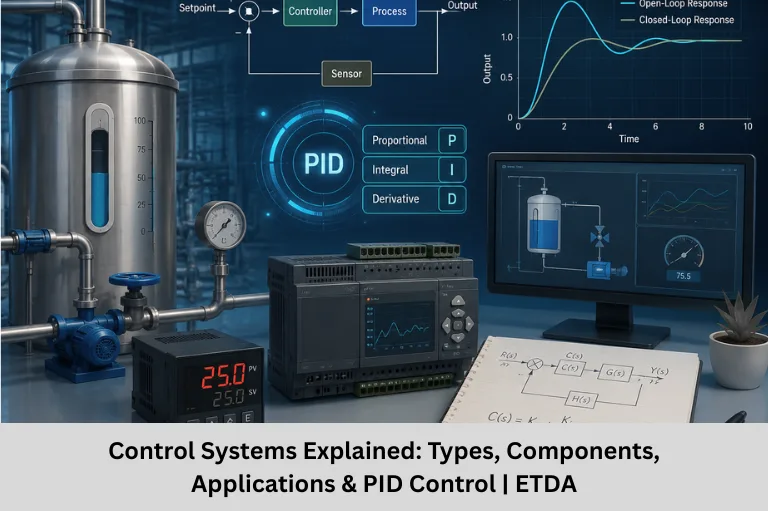
Learn Control Systems, including open-loop and closed-loop control, PID controllers, stability, feedback, and real-world applications. Master automation with Embedded Tech Development Academy (ETDA), the Top Embedded Training Institute in Bangalore.
- Control Systems Explained: Types, Components, Applications & PID Control | ETDA
- Control Systems: Engineering the Behaviour of Machines
Control Systems: Engineering the Behaviour of Machines
Introduction to Control Systems
Have you ever wondered how a car automatically maintains a constant speed on cruise control, how a drone remains stable while flying in strong winds, or how an industrial robot repeatedly performs highly precise tasks without human intervention? The answer lies in Control Systems—one of the most fundamental concepts in electrical, electronics, mechanical, aerospace, robotics, and embedded engineering.
A control system is a combination of hardware and software that monitors, regulates, and controls the behavior of a machine or process to achieve a desired output. By continuously comparing the actual output with the desired reference value, modern control systems automatically make adjustments that improve accuracy, stability, safety, and efficiency. From household appliances and autonomous vehicles to industrial automation and space exploration, control systems play an essential role in ensuring machines operate reliably under varying conditions.
Today’s intelligent technologies rely heavily on advanced control techniques integrated with embedded systems, industrial automation, Internet of Things (IoT), robotics, artificial intelligence (AI), machine learning, sensor fusion, mechatronics, programmable logic controllers (PLCs), SCADA systems, digital signal processing (DSP), real-time operating systems (RTOS), autonomous systems, motor control, servo drives, and cyber-physical systems. These technologies enable machines to make real-time decisions, adapt to environmental changes, and optimize performance with minimal human intervention.
For engineering students and professionals, understanding control systems is essential for careers in embedded systems, robotics, automotive electronics, aerospace engineering, industrial automation, renewable energy, and smart manufacturing. Concepts such as feedback control, stability analysis, transfer functions, PID controllers, and state-space modeling form the backbone of modern intelligent systems.
To help learners gain practical expertise, Embedded Tech Development Academy (ETDA) provides comprehensive industry-oriented training that combines theoretical concepts with real-time implementation. Recognized as the Top Embedded Training Institute in Bangalore, Embedded Tech Development Academy (ETDA) offers hands-on learning in embedded systems, microcontrollers, Internet of Things (IoT), robotics, automation, ARM processors, RTOS, and control system applications, preparing students for successful careers in today’s rapidly evolving technology landscape.
Why Control Systems Matter
Control systems are essential because they:
- Improve automation and operational efficiency
- Deliver accurate and repeatable performance
- Enhance system stability and reliability
- Reduce human intervention
- Increase safety in critical applications
- Optimize energy consumption
- Enable intelligent decision-making in autonomous systems
What Is a Control System?
A Control System is a system designed to manage, command, regulate, or direct the behavior of another device or process. It continuously monitors system performance and adjusts the input to produce the desired output.
Simply put:
A control system automatically makes machines behave exactly as intended.
Real-Life Examples of Control Systems
| Application | Control Task |
|---|---|
| Cruise Control | Maintains constant vehicle speed |
| Autopilot Systems | Keeps aircraft stable and on course |
| Thermostats | Regulates room temperature |
| Camera Gimbals | Stabilizes images and videos |
| Industrial Robotics | Performs precise manufacturing operations |
| Washing Machines | Controls water level and spin cycles |
| Elevators | Controls movement and positioning |
| Smart Irrigation | Automates water distribution |
Types of Control Systems
Open-Loop Control System
An Open-Loop Control System operates without using feedback.
Characteristics
- No output monitoring
- Simple design
- Low cost
- Faster operation
- Less accurate
Example
A microwave oven runs for a preset time regardless of whether the food has reached the desired temperature.
Closed-Loop Control System (Feedback System)
A Closed-Loop Control System continuously measures the output and compares it with the desired value.
Characteristics
- Uses feedback
- Automatically corrects errors
- High accuracy
- Improved stability
- Better disturbance rejection
Example
A thermostat measures room temperature and switches the heater ON or OFF to maintain the set temperature.
Key Components of a Control System
Input (Reference)
The desired value or target output.
Example:
22°C room temperature.
Controller
The decision-making unit that determines corrective action.
Example:
PID Controller.
Actuator
Converts the controller output into physical motion or action.
Examples:
- Electric Motor
- Hydraulic Cylinder
- Pneumatic Valve
Process (Plant)
The actual system being controlled.
Examples:
- Robot Arm
- Vehicle
- Industrial Furnace
- HVAC System
Sensor
Measures the actual output.
Examples:
- Temperature Sensor
- Pressure Sensor
- Encoder
- Accelerometer
Feedback
Returns measured output to the controller for comparison.
Important Control System Concepts
Feedback
Feedback allows the controller to detect errors, compare actual output with the desired output, and automatically adjust the system to improve accuracy, stability, and performance.
Stability
Response Time
The time required for a system’s output to reach the desired value after an input change, indicating how quickly and accurately the system responds to changes.
Transfer Function
A transfer function is a mathematical representation of the relationship between a system’s input and output in the Laplace domain. It is defined as the ratio of the output to the input with zero initial conditions.
PID Controller
PID controller is the most widely used industrial control algorithm, providing accurate, stable, and efficient control through proportional, integral, and derivative actions.
Proportional (P)
Proportional control responds to the present error by producing an output directly proportional to the current error signal.
Integral (I)
Integral control eliminates accumulated steady-state error by integrating the error over time and adjusting the control output accordingly.
Derivative (D)
Derivative control predicts future errors by responding to the error’s rate of change, improving stability and reducing overshoot.
Applications of Control Systems
| Industry | Applications |
|---|---|
| Automotive | ABS, Cruise Control, Electronic Stability Control |
| Aerospace | Autopilot, Flight Control, Missile Guidance |
| Manufacturing | CNC Machines, Conveyor Systems, Robotic Arms |
| Home Automation | Smart Lighting, HVAC, Smart Appliances |
| Healthcare | Infusion Pumps, Ventilators, Surgical Robots |
| Robotics & AI | Self-Balancing Robots, Autonomous Navigation |
| Renewable Energy | Wind Turbine Control, Solar Tracking Systems |
| Process Industries | Chemical Plants, Oil & Gas Automation |
Why Are Control Systems Important?
Major Benefits
- High precision and repeatability
- Increased productivity
- Reduced operational costs
- Improved safety
- Faster system response
- Better energy efficiency
- Continuous monitoring
- Real-time fault detection
- Intelligent automation
- Enhanced product quality
Future of Control Systems
Emerging Technologies
Modern control systems are evolving rapidly through:
- Artificial Intelligence (AI)
- Machine Learning
- Digital Twin Technology
- Industrial Internet of Things (IoT) (IIoT)
- Edge Computing
- Autonomous Vehicles
- Smart Factories
- Industry 4.0
- Collaborative Robots (Cobots)
- Adaptive and Predictive Control Algorithms
These innovations are enabling highly intelligent, self-learning, and autonomous systems capable of optimizing their own performance.
FAQs
What is a Control System?
A control system is an engineering system that regulates and controls the behavior of machines or processes by comparing the desired output with the actual output and making automatic adjustments when necessary.
What is the difference between an Open-Loop and Closed-Loop Control System?
An open-loop system operates without feedback and cannot correct errors automatically, while a closed-loop system uses feedback to continuously monitor output and improve accuracy and stability.
What is a PID Controller?
A PID (Proportional-Integral-Derivative) controller is a widely used control algorithm that minimizes system error by responding to present, past, and predicted future errors, providing precise and stable control.
Where are Control Systems used?
Control systems are used in automotive electronics, aerospace, robotics, industrial automation, healthcare equipment, renewable energy systems, consumer electronics, manufacturing, smart homes, and autonomous vehicles.
How can I build a career in Control Systems and Embedded Engineering?
Start by learning control theory, embedded C, microcontrollers, sensors, actuators, industrial automation, robotics, Internet of Things (IoT), and real-time operating systems. Embedded Tech Development Academy (ETDA), recognized as the Top Embedded Training Institute in Bangalore, provides practical, project-based training with placement support to help students develop industry-ready skills in control systems and embedded engineering.
Conclusion
Control Systems are the invisible intelligence behind modern engineering. They ensure that machines, vehicles, industrial equipment, robots, and smart devices operate safely, efficiently, and accurately in dynamic environments. Whether maintaining the speed of an electric vehicle, stabilizing a drone during flight, controlling industrial robots on a production line, or regulating temperatures in smart buildings, control systems are fundamental to today’s automation-driven world.
As industries embrace Industry 4.0, embedded systems, artificial intelligence, industrial Internet of Things (IoT), robotics, cyber-physical systems, autonomous vehicles, digital twins, smart manufacturing, PLC automation, motion control, servo systems, advanced sensors, real-time embedded computing, predictive maintenance, and intelligent process control, the demand for engineers with strong control system knowledge continues to grow across automotive, aerospace, healthcare, semiconductor, renewable energy, and industrial automation sectors.
Learning control systems not only builds a solid foundation in engineering principles but also opens opportunities in cutting-edge technologies shaping the future of automation and intelligent machines.
For students and professionals seeking practical, career-focused training, Embedded Tech Development Academy (ETDA) offers industry-oriented programs that combine theoretical concepts with real-time implementation through laboratory sessions and live projects. Recognized as the Top Embedded Training Institute in Bangalore, Embedded Tech Development Academy (ETDA) provides comprehensive training in embedded systems, ARM microcontrollers, RTOS, robotics, Internet of Things (IoT), industrial automation, and control systems, along with dedicated placement support to help learners become industry-ready.
By mastering control systems today, engineers can contribute to developing the next generation of autonomous machines, smart factories, intelligent transportation systems, and innovative embedded solutions that power tomorrow’s connected world.
Author: ETDA Trainers
Experience: 10+ Years of Industry Experience in Embedded Systems, IoT, and Embedded C Programming