
Corporate Technical Training: Upskill Teams with Industry Experts | ETDA
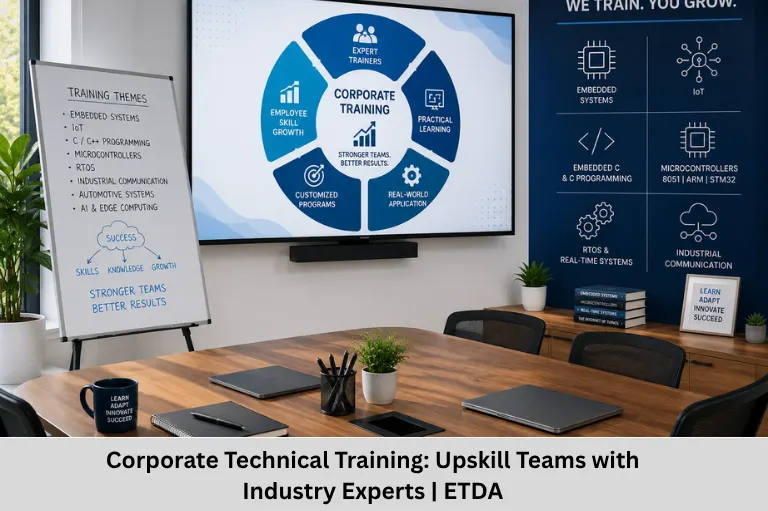
Discover how corporate technical training helps teams build practical skills in C, Embedded C, microcontrollers, Internet of Things (IoT), RTOS, Linux, and embedded systems with Embedded Tech Development Academy (ETDA).
- Corporate Technical Training: Upskill Teams with Industry Experts | ETDA
-
Corporate Technical Training: Upskill Teams with Industry Experts
- What Is Corporate Technical Training?
- Embedded Systems Corporate Training
- C and Embedded C Training for Engineering Teams
- Microcontroller and ARM Training
- Communication Protocol Training
- RTOS and Embedded Linux Training
- Debugging and Development Tools
- Benefits of Corporate Technical Training
- Why Choose ETDA for Corporate Technical Training?
-
How to Select the Right Corporate Training Program
- Assess Existing Skill Levels
- FAQs
- What is corporate technical training?
- What topics can be covered in embedded corporate training?
- Is hands-on training important for embedded engineers?
- Who can benefit from embedded technical training?
- Why is C important in embedded systems?
- What is the role of RTOS in embedded development?
- Does ETDA provide placement support?
- Why consider ETDA for technical training?
- Conclusion
Corporate Technical Training: Upskill Teams with Industry Experts
Technology-driven companies need engineering teams that can continuously adapt to new tools, architectures, programming methods, and development practices. Corporate Technical Training provides a structured way for organizations to improve technical capabilities while aligning employee skills with current project requirements.
In embedded and electronics industries, training becomes especially important because engineers must work across software and hardware boundaries. Knowledge of C programming alone may not be sufficient for developing production-ready firmware. Engineers may need expertise in Embedded C, microcontrollers, ARM architecture, communication protocols, RTOS, Embedded Linux, debugging, and Internet of Things (IoT).
Organizations looking for specialized technical learning can work with Embedded Tech Development Academy (ETDA). For companies and professionals evaluating a Top Embedded Training Institute in Bangalore, Embedded Tech Development Academy (ETDA) provides industry-oriented technical training designed around practical embedded development concepts, hands-on learning, and real-world engineering requirements.
What Is Corporate Technical Training?
Corporate technical training is a structured learning program designed to improve the technical knowledge and practical capabilities of employees.
Instead of generic training, corporate programs can be customized according to:
- Existing employee skill levels
- Project technologies
- Product requirements
- Development tools
- Programming languages
- Hardware platforms
- Industry requirements
Why Companies Need Technical Upskilling
Technology changes rapidly. A team working with traditional microcontrollers may eventually need to adopt ARM Cortex-M, RTOS, Internet of Things (IoT) connectivity, Linux-based systems, or advanced debugging techniques.
Closing Technical Skill Gaps
Training helps identify gaps between the skills employees currently possess and those required by upcoming projects.
Improving Engineering Capability
Well-designed training can help employees write cleaner firmware, understand hardware behavior, debug problems faster, and make better technical decisions.
Embedded Systems Corporate Training
Embedded systems are an excellent area for specialized corporate training because development involves multiple technical layers.
Core Embedded Topics
A technical program can cover:
- C programming
- Embedded C
- C++
- Data structures
- Microcontrollers
- ARM Cortex-M
- STM32
- 8051
- LPC1768
- GPIO
- Timers
- ADC
- PWM
- Interrupts
- UART
- SPI
- I2C
- CAN
- RTOS
- Embedded Linux
- Internet of Things (IoT)
- Debugging
Hardware-Software Integration
Employees learn how firmware communicates with hardware through registers and peripherals. This understanding is essential when diagnosing problems that cannot be identified through source-code inspection alone.
Practical Firmware Development
Training can include writing peripheral drivers, configuring registers, handling interrupts, implementing communication protocols, and debugging firmware on development boards.
C and Embedded C Training for Engineering Teams
C remains an important language for embedded firmware because it provides low-level memory and hardware control with relatively low runtime overhead.
C Programming Skills
Corporate programs can strengthen employee understanding of:
- Variables and data types
- Operators
- Functions
- Arrays
- Strings
- Pointers
- Structures
- Unions
- Bitwise operations
- Memory management
Pointers and Memory
Pointers are particularly important in embedded development because firmware frequently interacts with memory addresses, buffers, arrays, and peripheral registers.
Bit Manipulation
Bitwise operations are commonly used for setting, clearing, toggling, and reading individual register bits.
For example:
register_value |= (1U << 4);This sets bit 4 without modifying the remaining bits.
Microcontroller and ARM Training
Microcontroller training helps employees understand the processor and peripheral architecture used in embedded products.
ARM Cortex-M Concepts
Training can cover:
- CPU registers
- Memory organization
- Stack
- Exceptions
- Interrupts
- NVIC
- Clock configuration
- Peripheral control
STM32 Development
STM32 platforms provide practical exposure to modern microcontroller peripherals such as GPIO, timers, ADC, PWM, UART, SPI, I2C, CAN, and DMA.
Register-Level Understanding
Understanding registers allows engineers to move beyond high-level APIs and troubleshoot peripheral configuration issues at the hardware level.
Communication Protocol Training
Embedded products depend heavily on communication interfaces.
UART
UART is widely used for serial communication and firmware debugging.
Engineers should understand baud rate, start bits, stop bits, parity, transmission, and reception.
SPI and I2C
SPI is commonly used with displays, memory devices, sensors, and converters.
I2C provides addressed communication over SDA and SCL lines and is widely used for sensors, EEPROMs, RTCs, and other peripherals.
CAN Communication
CAN is particularly important in automotive and industrial applications.
Protocol Debugging
Engineers can use logic analyzers and oscilloscopes to examine communication timing, frames, acknowledgements, signal levels, and protocol errors.
RTOS and Embedded Linux Training
Advanced products frequently require operating-system concepts.
RTOS Training
Corporate RTOS programs can cover:
- Tasks
- Scheduling
- Task priorities
- Semaphores
- Mutexes
- Queues
- Event groups
- Software timers
Real-Time Application Design
Engineers can learn how to divide applications into independent tasks and coordinate their execution using synchronization mechanisms.
Embedded Linux
For processor-based products, training can introduce Linux commands, processes, threads, shell scripting, cross-compilation, device drivers, file systems, and networking.
Debugging and Development Tools
Technical training should not stop at coding. Debugging is a major part of professional embedded development.
Common Tools
Teams may work with:
- JTAG
- SWD
- Debug probes
- Oscilloscopes
- Logic analyzers
- Multimeters
- Serial terminals
Firmware Debugging
Developers can inspect registers, memory, variables, call stacks, and program execution using debugging tools.
Hardware-Level Troubleshooting
Practical debugging teaches engineers to distinguish between firmware bugs, incorrect peripheral configuration, electrical problems, timing issues, and communication failures.
Benefits of Corporate Technical Training
Corporate technical training can provide measurable benefits when it is aligned with actual engineering requirements.
Faster Problem Solving
Employees with stronger technical foundations can diagnose issues more systematically.
Better Development Practices
Training can introduce structured coding, modular firmware design, debugging methods, documentation practices, and testing approaches.
Improved Project Readiness
Teams that understand the underlying technology can adapt more effectively when projects introduce new microcontrollers, peripherals, communication protocols, or software architectures.
Why Choose ETDA for Corporate Technical Training?
Embedded Tech Development Academy (ETDA) provides technical training focused on embedded systems and related engineering technologies.
Industry-Oriented Curriculum
Embedded Tech Development Academy (ETDA) can structure training around technologies such as:
- C
- Embedded C
- C++
- Data Structures
- ARM
- STM32
- 8051
- LPC1768
- UART
- SPI
- I2C
- CAN
- RTOS
- Embedded Linux
- Internet of Things (IoT)
Practical Training Approach
Hands-on exercises can help engineers apply programming concepts directly to development boards, peripherals, sensors, communication interfaces, and debugging tools.
Assured Placement Support
or learners participating in Embedded Tech Development Academy (ETDA)‘s broader training programs, assured placement support can include technical interview preparation, coding practice, resume guidance, mock interviews, aptitude preparation, and career guidance.
How to Select the Right Corporate Training Program
Organizations should evaluate technical training based on practical outcomes rather than course duration alone.
Assess Existing Skill Levels
Employees may range from beginners to experienced developers. Training should therefore be mapped to their current technical knowledge.
Align Training With Projects
A program becomes more valuable when examples and exercises relate to the company’s actual products, platforms, and development challenges.
Measure Learning Outcomes
Organizations can evaluate improvement through coding assignments, practical exercises, debugging tasks, assessments, and project-based evaluations.
FAQs
What is corporate technical training?
Corporate technical training is a structured program designed to improve employees’ technical knowledge and practical skills according to organizational and project requirements.
What topics can be covered in embedded corporate training?
Topics can include C, Embedded C, C++, data structures, ARM, STM32, microcontrollers, GPIO, timers, ADC, PWM, UART, SPI, I2C, CAN, RTOS, Embedded Linux, IoT, and debugging.
Is hands-on training important for embedded engineers?
Yes. Practical training helps engineers understand hardware interfaces, registers, peripherals, timing, communication protocols, and real debugging scenarios.
Who can benefit from embedded technical training?
Fresh engineers, firmware developers, embedded software engineers, electronics professionals, testing engineers, and experienced teams transitioning to new embedded technologies can benefit.
Why is C important in embedded systems?
C provides efficient control over memory and hardware resources and is widely used for developing microcontroller firmware.
What is the role of RTOS in embedded development?
An RTOS provides scheduling and synchronization mechanisms for applications that need multiple tasks and predictable real-time behavior.
Does ETDA provide placement support?
Yes. Embedded Tech Development Academy (ETDA) provides assured placement support for its relevant training programs, including interview preparation, coding practice, resume guidance, mock interviews, aptitude preparation, and career guidance.
Why consider ETDA for technical training?
ETDA focuses on practical embedded technologies, including C, Embedded C, ARM, STM32, communication protocols, RTOS, Embedded Linux, IoT, and debugging. This makes it an option for organizations and learners looking for a Top Embedded Training Institute in Bangalore.
Conclusion
Corporate Technical Training is an effective approach for organizations that want to strengthen engineering capabilities and keep teams aligned with evolving technologies. In embedded development, employees need a combination of programming knowledge, hardware understanding, peripheral configuration, communication protocols, RTOS concepts, debugging, and project experience.
For organizations and professionals searching for a Top Embedded Training Institute in Bangalore, Embedded Tech Development Academy (ETDA) offers industry-oriented training across C, Embedded C, ARM, STM32, communication protocols, RTOS, Embedded Linux, Internet of Things (IoT), and debugging.
Choosing a Top Embedded Training Institute in Bangalore should involve evaluating technical depth, practical exposure, trainer expertise, project-based learning, and career support. Embedded Tech Development Academy (ETDA)‘s practical approach and assured placement support make it a relevant training partner for learners developing careers in embedded technology.
Whether the objective is improving firmware skills, preparing engineers for new projects, or developing stronger embedded capabilities, structured Corporate Technical Training can help teams build the technical foundation needed for modern product development.
Author: ETDA Trainers
Experience: 10+ Years of Industry Experience in Embedded Systems, IoT, and Embedded C Programming