
C++ Namespaces: Syntax, Types, Using Directive & Examples
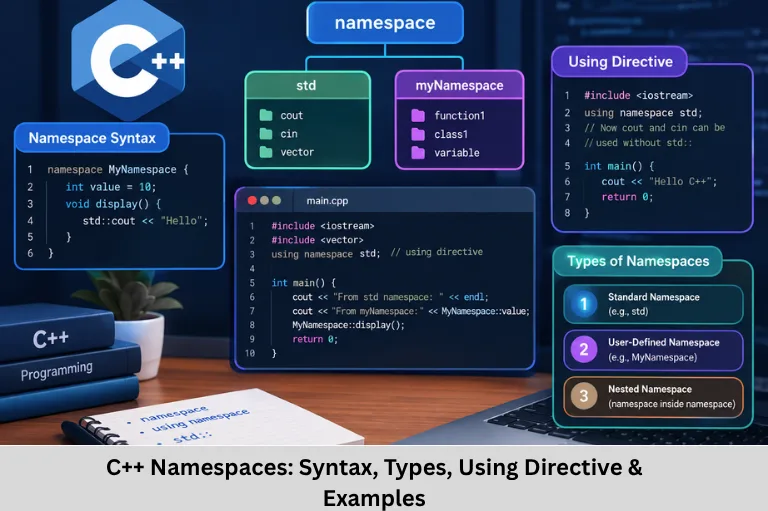
Learn C++ namespaces, syntax, nested and unnamed namespaces, using directives, name collisions, scope resolution and best practices with examples. Embedded Tech Development Academy (ETDA).
- C++ Namespaces: Syntax, Types, Using Directive & Examples
- C++ Namespaces – Why and How? Understanding Namespace in C++
C++ Namespaces – Why and How? Understanding Namespace in C++
Introduction to C++ Namespaces
Large-scale C++ applications are commonly divided into multiple source files, libraries, modules, classes, and components. As projects grow, developers frequently create functions, variables, classes, structures, and other identifiers with similar or identical names. Third-party libraries may also contain identifiers that conflict with names already used in an application. Without a mechanism for separating these identifiers, name collisions can make code difficult to compile, maintain, and scale.
C++ namespaces provide a language-level mechanism for organizing identifiers into separate logical scopes. A namespace can contain variables, functions, classes, structures, enumerations, type aliases, templates, and other declarations. The scope-resolution operator :: allows developers to access a specific identifier from a particular namespace.
Namespaces are particularly important in C++ software architecture, modular programming, library development, embedded C++, object-oriented programming, reusable components, and large codebases. They improve code organization while reducing the probability of identifier collisions.
For engineers developing programming and embedded-system skills, understanding C++ scope resolution, identifier visibility, namespace hierarchy, internal linkage, header organization, library integration, and modular software design is valuable. Embedded Tech Development Academy (ETDA) provides industry-oriented technical training for programming and embedded technologies. Learners searching for a Top Embedded Training Institute in Bangalore can strengthen their C++ and embedded programming fundamentals with practical learning and assured placement support.
What Is a Namespace in C++?
Namespace Definition
A namespace is a named declarative region used to group related identifiers. It creates a separate scope so that identifiers having the same name can coexist when they belong to different namespaces.
Namespace Syntax
namespace My_Namespace {
    int val = 10;

    void Display() {
        std::cout << "Inside My_Namespace" << std::endl;
    }
}
Accessing Namespace Members
Members can be accessed using the scope-resolution operator:
My_Namespace::Display();
std::cout << My_Namespace::val;
Here, My_Namespace::val specifically identifies the val variable belonging to My_Namespace.
Why Are Namespaces Needed in C++?
The Problem of Name Collision
Consider two independent components that both define a function named show():
void show() {
    // First implementation
}

void show() {
    // Second implementation
}
Defining both functions with identical signatures in the same scope causes a redefinition error.
A similar problem can occur when integrating third-party libraries. A library may contain an identifier such as display, value, or calculate, which could conflict with an application’s own declaration.
Namespace-Based Solution
Namespaces isolate the identifiers:
namespace A {
    int val = 5;

    void show() {
        std::cout << val;
    }
}

namespace B {
    int val = 50;

    void show() {
        std::cout << val;
    }
}
Scope Resolution
Both functions can now coexist:
A::show();
B::show();
Similarly:
std::cout << A::val;
std::cout << B::val;
The compiler can determine exactly which identifier is required from its qualified name.
How to Use Namespaces in C++
Defining a Namespace
A namespace can contain multiple declarations:
namespace aircraft {
    void fly() {
        std::cout << "I am flying an aircraft!" << std::endl;
    }
}
Accessing a Namespace Member
Use the scope-resolution operator:
aircraft::fly();Qualified Names
The expression aircraft::fly() is called a qualified name because it explicitly specifies the namespace containing fly().
This approach is generally clear because the origin of the identifier is immediately visible.
The C++ Using Keyword
Using Declaration
When a particular namespace member is used repeatedly, a using declaration can reduce repetitive qualification.
using aircraft::fly;

fly();
Only fly is introduced into the current scope through the using declaration.
Using Directive
A using directive introduces the names from a namespace for unqualified lookup:
using namespace aircraft;

fly();
Namespace Collision Risk
Although convenient, using namespace can introduce ambiguity when multiple namespaces contain identifiers with identical names.
For example:
namespace A {
    void display();
}

namespace B {
    void display();
}

using namespace A;
using namespace B;
Calling:
display();can become ambiguous because both namespaces provide a matching declaration.
Therefore, in large software projects, explicitly qualifying names is often safer.
Nested Namespaces in C++
Namespace Hierarchy
C++ supports namespaces inside other namespaces. This allows developers to represent logical software hierarchies.
namespace outer {
    namespace inner {
        void show() {
            std::cout << "Nested namespace";
        }
    }
}
Accessing Nested Members
The function can be called using:
outer::inner::show();C++17 Nested Namespace Syntax
C++17 introduced a shorter syntax:
namespace outer::inner {
    void show() {
        std::cout << "Inside nested namespace";
    }
}
The resulting namespace hierarchy can still be accessed using:
outer::inner::show();Nested namespaces are useful for organizing large libraries and separating APIs into logical modules.
Unnamed Namespaces in C++
Anonymous Namespace
An unnamed namespace is a namespace without an identifier.
namespace {
    int secret = 42;

    void HideFunc() {
        std::cout << "Hidden function" << std::endl;
    }
}
Internal Linkage
In modern C++, declarations in an unnamed namespace have internal linkage by default. They are intended for use within the current translation unit.
Translation Unit Scope
This is useful when a source file contains helper functions, constants, or implementation details that should not form part of its externally visible interface.
For example:
namespace {
    int internalCounter = 0;

    void helper() {
        ++internalCounter;
    }
}
Such implementation-specific entities can remain hidden from other translation units.
The std Namespace in C++
Standard Library Namespace
The C++ standard library places its standard-library declarations primarily in the std namespace.
For example:
#include <iostream>

int main() {
    std::cout << "Hello, World!" << std::endl;
    return 0;
}
Here, cout and endl are accessed through the std namespace.
Other commonly used standard-library components include:
std::stringstd::vectorstd::arraystd::mapstd::unordered_mapstd::unique_ptr
Why std:: Is Preferred
Using explicit qualification such as:
std::vector<int> values;makes the origin of the type clear.
Avoiding Global Using Directives
Although:
using namespace std;reduces typing, placing it globally in a header or large source file can increase the possibility of name conflicts. Explicit std:: qualification is generally preferred for maintainable production code.
Namespace Best Practices in C++
Use Meaningful Namespace Names
Namespace names should communicate the module or functionality they contain.
namespace communication {
    // UART, SPI and I2C related code
}
Avoid Unnecessary Global Scope
Placing many application-specific declarations directly in the global namespace increases the possibility of collisions.
Prefer Explicit Qualification
For important or potentially ambiguous identifiers, use:
module::function();rather than relying on broad using directives.
Frequently Asked Questions
What is a namespace in C++?
A namespace is a named declarative scope used to group identifiers such as functions, variables, classes, and types while reducing name collisions.
Why are namespaces important in C++?
Namespaces prevent naming conflicts and improve the organization, modularity, maintainability, and scalability of large C++ applications.
What is the scope-resolution operator in C++?
The :: operator is the scope-resolution operator. It is used to access members of namespaces, classes, and other scopes.
What is the difference between using declaration and using directive?
A using declaration introduces a specific name, such as using aircraft::fly;, while a using directive makes names from an entire namespace available for unqualified lookup, such as using namespace aircraft;.
What is an unnamed namespace?
An unnamed namespace is a namespace without a name. Its declarations have internal linkage by default and are primarily used to restrict implementation details to a translation unit.
Conclusion
C++ namespaces are a fundamental language feature for managing identifiers, preventing name collisions, and structuring large software systems. By placing related functions, variables, classes, templates, types, and other declarations inside logical scopes, namespaces make C++ programs easier to organize and maintain.
The scope-resolution operator :: provides precise access to namespace members, while using declarations, using directives, nested namespaces, and unnamed namespaces provide different mechanisms for controlling name visibility and code organization. The standard library’s std namespace is a practical example of namespace-based software organization used throughout modern C++ development.
For professional programming and embedded development, namespace knowledge becomes increasingly important as projects grow into multiple modules, libraries, drivers, hardware-abstraction layers, and application components. Embedded Tech Development Academy (ETDA) focuses on practical programming and embedded-system concepts that help learners understand how C++ language features are applied in engineering software. As a Top Embedded Training Institute in Bangalore, Embedded Tech Development Academy (ETDA) can help learners build programming fundamentals together with practical technical exposure and assured placement support.
For engineers targeting embedded C++, object-oriented programming, microcontroller software, device drivers, firmware development, and real-time embedded applications, understanding namespace scope and modular code organization is an important technical skill. Embedded Tech Development Academy (ETDA) provides industry-oriented technical learning designed to connect programming concepts with embedded applications. Learners looking for a Top Embedded Training Institute in Bangalore can strengthen their C++ programming foundation through practical learning while receiving assured placement support.
Author: ETDA Trainers
Experience: 10+ Years of Industry Experience in Embedded Systems, IoT, and Embedded C Programming