
Data Structures Explained: Types, Operations & Real-World Applications | ETDA
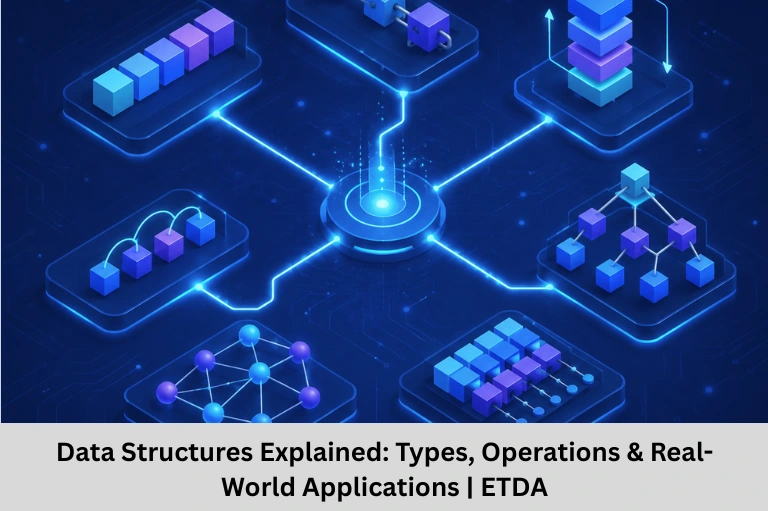
Learn data structures, their types, operations, and real-world applications. Discover why mastering data structures is essential for software and embedded systems careers.
- Data Structures Explained: Types, Operations & Real-World Applications | ETDA
-
Data Structures Explained: Types, Operations & Real-World Applications
- What Are Data Structures?
- Why Are Data Structures Important?
- Classification of Data Structures
- Types of Data Structures
- Common Operations Performed on Data Structures
- Real-World Applications of Data Structures
- Understanding Time Complexity
- Why Every Embedded Engineer Should Learn Data Structures
- Learn Data Structures with Embedded Tech Development Academy (ETDA)
-
Frequently Asked Questions (FAQs)
- What is a data structure in programming?
- Why are data structures important?
- What are the main types of data structures?
- Which data structure is best for embedded systems?
- Are data structures necessary for embedded systems jobs?
- How do data structures improve software performance?
- Can beginners learn data structures after C programming?
- Why should I learn data structures at ETDA?
- Conclusion
Data Structures Explained: Types, Operations & Real-World Applications
In today’s technology-driven world, software applications and embedded systems are expected to process massive amounts of data quickly and efficiently. Whether you’re building a mobile application, an operating system, an Internet of Things (IoT) device, or an embedded controller, choosing the right data structure can significantly impact performance, memory usage, and execution speed.
Data structures form the backbone of programming and computer science. They provide organized ways to store, access, and manipulate data efficiently. Every software engineer, embedded systems developer, and computer science student should have a solid understanding of data structures because they directly influence algorithm efficiency and system performance.
If you’re planning a career in software development or embedded systems, mastering data structures is one of the most valuable investments you can make. Students searching for the Top Embedded Training Institute in Bangalore often choose Embedded Tech Development Academy (ETDA) because it combines programming fundamentals, data structures, embedded systems, and hands-on project experience with assured placement support.
What Are Data Structures?
A data structure is a specialized way of organizing, storing, and managing data so it can be accessed and modified efficiently.
Imagine a library. Books arranged randomly would make finding a particular title difficult. However, when books are organized into categories and shelves, locating them becomes much easier. Data structures work in the same way—they organize data for faster processing.
Good data structures help developers:
- Improve application performance
- Reduce memory consumption
- Speed up searching and sorting
- Simplify data management
- Build scalable applications
They are used in nearly every software application, database, operating system, compiler, and embedded device.
Why Are Data Structures Important?
Choosing the correct data structure directly affects the efficiency of your application.
Faster Data Access
Efficient data structures reduce the time required to retrieve information.
Better Memory Utilization
Embedded systems often have limited RAM and storage. Optimized data structures help conserve valuable memory resources.
Improved Performance
Applications with efficient data structures respond faster and consume fewer system resources.
Simplified Code Maintenance
Well-designed data structures make programs easier to understand, modify, and debug.
Foundation for Algorithms
Algorithms rely heavily on data structures to solve problems efficiently.
Classification of Data Structures
Data structures can be broadly classified into two categories.
Primitive Data Structures
Primitive data structures are basic data types provided by programming languages.
Examples include:
- Integer
- Float
- Character
- Boolean
- Pointer
These serve as the building blocks for more complex data structures.
Non-Primitive Data Structures
These are advanced structures built using primitive data types.
Examples include:
- Arrays
- Linked Lists
- Stacks
- Queues
- Trees
- Graphs
- Hash Tables
They are widely used in software development and embedded programming.
Types of Data Structures
1. Arrays
Arrays store multiple elements of the same data type in contiguous memory locations.
Advantages
- Fast access using indexes
- Easy implementation
- Efficient memory allocation
Real-World Applications
Arrays are commonly used in:
- Image processing
- Sensor data storage
- Embedded firmware
- Mathematical computations
2. Linked Lists
Unlike arrays, linked lists store elements using nodes connected by pointers.
Each node contains:
- Data
- Address of the next node
Advantages
- Dynamic memory allocation
- Easy insertion
- Easy deletion
Applications
Linked lists are used in:
- Music playlists
- Browser history
- Memory management
- File systems
3. Stacks
A stack follows the Last In, First Out (LIFO) principle.
Imagine a stack of plates. The last plate placed on top is removed first.
Common Operations
- Push
- Pop
- Peek
Applications
Stacks are widely used for:
- Function calls
- Expression evaluation
- Undo operations
- Compiler design
4. Queues
Queues follow the First In, First Out (FIFO) principle.
Think of people waiting in a ticket line
Operations
- Enqueue
- Dequeue
- Front
- Rear
Applications
Queues are used in:
- Printer scheduling
- Task scheduling
- CPU scheduling
- Embedded real-time systems
- Network packet processing
5. Trees
Trees organize data in a hierarchical structure consisting of parent and child nodes.
Popular tree types include:
- Binary Tree
- Binary Search Tree (BST)
- AVL Tree
- B-Tree
Applications
Trees are used in:
- File systems
- Databases
- Search engines
- XML parsing
- Artificial Intelligence
6. Graphs
Graphs represent relationships between multiple objects.
They consist of:
- Vertices (Nodes)
- Edges (Connections)
Applications
Graphs are extensively used in:
- Google Maps
- Social media networks
- Flight navigation
- Network routing
- Recommendation systems
7. Hash Tables
Hash tables store data using key-value pairs.
They provide extremely fast searching and retrieval.
Applications
- Password storage
- Database indexing
- Caching
- Symbol tables
- Dictionaries
Common Operations Performed on Data Structures
Every data structure supports several basic operations.
Traversal
Visiting each element one by one.
Insertion
Adding new data.
Deletion
Removing existing data.
Searching
Finding a specific element efficiently.
Sorting
Arranging data in ascending or descending order.
Merging
Combining two or more data structures into one.
These operations form the basis of countless software and embedded applications.
Real-World Applications of Data Structures
Data structures are at the heart of modern software systems and embedded devices. They enable efficient data processing, optimize memory usage, and improve overall system performance. Whether you’re developing firmware for a microcontroller or building enterprise software, selecting the right data structure can make a significant difference.
Embedded Systems
Embedded systems often have limited memory and processing power, making efficient data structures essential.
Common Embedded Applications
- Sensor data collection
- Circular buffers for UART communication
- RTOS task scheduling
- Device driver implementation
- Memory management
- Interrupt handling
- Data logging systems
Example
In an Internet of Things (IoT) weather monitoring system, a queue stores incoming sensor readings before they are processed and transmitted to the cloud. This ensures smooth data flow without losing information, even during temporary communication delays.
Operating Systems
Operating systems use multiple data structures to manage resources effectively.
Examples include:
- Queues for process scheduling
- Trees for file systems
- Linked lists for memory allocation
- Hash tables for process lookup
- Stacks for function calls
Database Management Systems
Databases rely heavily on advanced data structures for fast searching and indexing.
Common examples include:
- B-Trees
- B+ Trees
- Hash Tables
- Graph structures
These enable databases to retrieve millions of records efficiently.
Web Browsers
Every modern web browser uses data structures internally.
Examples include:
- Stacks for Back and Forward navigation
- Trees for rendering HTML documents (DOM)
- Queues for network requests
- Hash tables for caching web resources
Artificial Intelligence and Machine Learning
AI applications process enormous datasets that require efficient organization.
Data structures support:
- Decision trees
- Graph-based neural networks
- Search algorithms
- Recommendation systems
- Knowledge graphs
Networking
Routers and switches use data structures to process packets efficiently.
Examples include:
- Queues for packet scheduling
- Graphs for routing algorithms
- Hash tables for address lookup
- Trees for network hierarchy
Understanding Time Complexity
Choosing the right data structure is only part of the solution. Developers also need to understand how efficiently operations are performed. This is measured using Time Complexity, commonly expressed with Big O notation.
Why Big O Matters
Big O helps developers estimate how an algorithm performs as the amount of data increases. Efficient algorithms save processing time and reduce resource consumption—both critical in embedded systems.
Common Time Complexities
| Operation | Typical Complexity |
|---|---|
| Access (Array) | O(1) |
| Linear Search | O(n) |
| Binary Search | O(log n) |
| Insertion (Linked List) | O(1) |
| Sorting (Efficient Algorithms) | O(n log n) |
Understanding these concepts helps developers build faster and more scalable applications.
Why Every Embedded Engineer Should Learn Data Structures
Many beginners assume that embedded systems only require knowledge of C programming and microcontrollers. In reality, companies expect engineers to solve complex programming problems using efficient data structures and algorithms.
Benefits for Embedded Developers
Learning data structures enables engineers to:
- Optimize memory usage
- Improve firmware performance
- Handle large datasets efficiently
- Design scalable embedded applications
- Reduce execution time
- Prepare for technical interviews
- Develop better problem-solving skills
Whether you’re developing firmware for an automotive ECU or an IoT gateway, strong data structure knowledge enhances both coding quality and system efficiency.
Learn Data Structures with Embedded Tech Development Academy (ETDA)
If you’re looking to build a successful career in software or embedded systems, quality training is just as important as learning the concepts. Many aspiring engineers searching for the Top Embedded Training Institute in Bangalore choose Embedded Tech Development Academy (ETDA) for its practical, industry-oriented approach.
ETDA focuses on helping students build strong programming fundamentals before advancing to embedded systems, ensuring they are ready for real-world development challenges.
Comprehensive Curriculum
At Embedded Tech Development Academy (ETDA), students gain hands-on experience with topics such as:
- C Programming
- C++ Programming
- Data Structures and Algorithms
- Embedded C
- ARM Cortex-M Microcontrollers
- STM32 Programming
- RTOS
- Embedded Linux
- Device Drivers
- Internet of Things (IoT) Fundamentals
- Git and Version Control
This curriculum is designed to match current industry requirements and hiring expectations.
Practical Learning Through Projects
Theory alone is not enough. ETDA emphasizes project-based learning, allowing students to apply concepts in real scenarios. Learners work on embedded applications involving microcontrollers, sensors, communication protocols, and automation systems, helping them build confidence and a strong technical portfolio.
Industry Mentorship
Experienced trainers provide personalized guidance, code reviews, debugging support, and interview preparation. Students benefit from practical insights into how embedded software is developed in professional environments.
Assured Placement Support
Embedded Tech Development Academy (ETDA) also offers assured placement support to help students transition into the workforce. Placement assistance includes:
- Resume preparation
- Aptitude and technical interview training
- Mock interviews
- Soft skills development
- Career counseling
- Job opportunities through hiring partners
This comprehensive support helps students become job-ready and increases their chances of securing rewarding roles in the embedded industry.
Frequently Asked Questions (FAQs)
What is a data structure in programming?
A data structure is a method of organizing and storing data so it can be accessed, modified, and processed efficiently.
Why are data structures important?
They improve application performance, optimize memory usage, simplify coding, and make algorithms more efficient.
What are the main types of data structures?
The primary types include arrays, linked lists, stacks, queues, trees, graphs, and hash tables.
Which data structure is best for embedded systems?
The best choice depends on the application. Arrays, queues, linked lists, and circular buffers are commonly used in embedded systems due to their efficiency and predictable behavior.
Are data structures necessary for embedded systems jobs?
Yes. Many companies assess data structures and algorithms during technical interviews because they are essential for writing efficient firmware and solving real-world programming challenges.
How do data structures improve software performance?
Efficient data structures reduce execution time, minimize memory consumption, and optimize searching, sorting, and data retrieval operations.
Can beginners learn data structures after C programming?
Absolutely. Once you understand the basics of C programming, learning data structures becomes much easier and forms a strong foundation for advanced programming concepts.
Why should I learn data structures at ETDA?
ETDA provides an industry-focused curriculum, experienced mentors, practical projects, modern development tools, interview preparation, and assured placement support, making it an excellent choice for aspiring software and embedded systems engineers.
Conclusion
Data structures are one of the most important foundations of computer science and embedded systems development. From arrays and linked lists to trees, graphs, and hash tables, each structure serves a unique purpose in organizing and processing data efficiently.
Mastering data structures not only improves programming skills but also enables developers to create faster, more reliable, and scalable applications. Whether you’re aiming for a career in software engineering, embedded systems, Internet of Things (IoT), robotics, or artificial intelligence, a strong understanding of data structures is essential.
To accelerate your learning journey, choose a training program that combines theory with hands-on practice. Embedded Tech Development Academy (ETDA) equips students with industry-relevant skills, real-time project experience, and assured placement support, helping them confidently launch successful careers in embedded systems and software development.
Author: ETDA Trainers
Experience: 10+ Years of Industry Experience in Embedded Systems, IoT, and Embedded C Programming