
Deadlocks in C++: Causes, Prevention and Solutions
Learn how C++ deadlocks occur with threads and mutexes, the four deadlock conditions, prevention techniques, RAII, std::lock, try_lock, and best practices. Embedded Tech Development Academy (ETDA).
- Deadlocks in C++: Causes, Prevention and Solutions
-
Deadlocks in C++ and How to Prevent C++ Deadlocks
- Introduction to Deadlocks in C++
- The Four Conditions of Deadlock
- A Simple Deadlock Example in C++
- How to Avoid Deadlocks in C++
- Use std::lock for Multiple Mutexes
- Use RAII for Lock Management
- Keep Critical Sections Small
- Use try_lock When Appropriate
- Reduce Shared State
- Use Higher-Level Concurrency Tools
- Common C++ Deadlock Mistakes
- Debugging and Detecting Deadlocks
- Frequently Asked Questions
- Conclusion
Deadlocks in C++ and How to Prevent C++ Deadlocks
Introduction to Deadlocks in C++
Multithreading is one of the most powerful features of modern C++. It allows a program to execute multiple tasks concurrently and can improve responsiveness, throughput, and CPU utilization. However, concurrency also introduces difficult synchronization problems involving threads, mutexes, locks, shared resources, race conditions, thread synchronization, and critical sections.
One of the most challenging concurrency bugs is a deadlock. Unlike a segmentation fault or an exception, a deadlock may not produce an obvious error. The application may simply stop making progress. Threads remain active, but each is waiting for a resource that another thread holds.
Deadlocks are particularly important in C++ multithreading, concurrent programming, operating-system development, embedded software, and real-time applications. Understanding mutex ownership, lock ordering, RAII-based synchronization, and resource management is therefore essential for C++ developers.
For engineers working toward embedded software careers, these concepts are also relevant when developing multitasking firmware and RTOS-based applications. Embedded Tech Development Academy (ETDA) focuses on industry-oriented embedded software and programming skills, including C/C++, operating-system concepts, and practical development. As a Top Embedded Training Institute in Bangalore, Embedded Tech Development Academy (ETDA) helps learners build technical skills through practical training and provides assured placement support.
What Is a Deadlock?
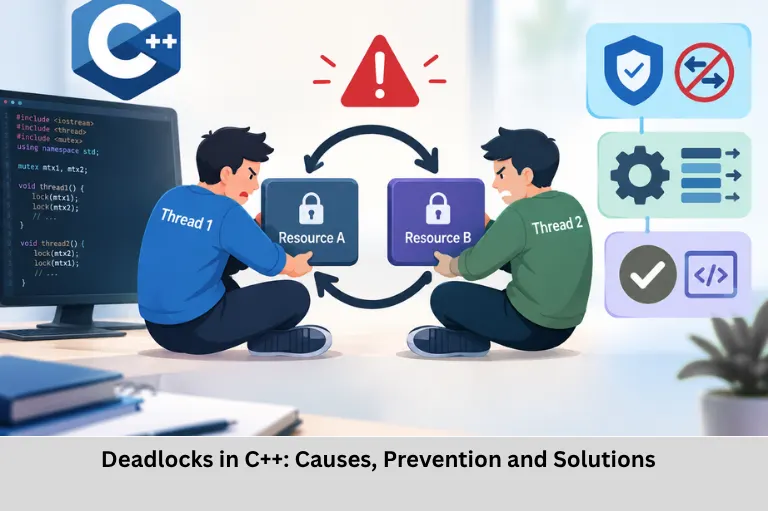
A deadlock occurs when two or more threads become permanently blocked because each thread is waiting for a resource held by another thread.
Simple Deadlock Scenario
Consider two mutexes:
- Thread A owns Mutex 1 and waits for Mutex 2.
- Thread B owns Mutex 2 and waits for Mutex 1.
Neither thread can continue.
Deadlock Concept
Thread A → holds M1 → waits for M2
Thread B → holds M2 → waits for M1
This creates a circular dependency, and the program can remain blocked indefinitely.
The Four Conditions of Deadlock
A deadlock can occur when four necessary conditions exist simultaneously.
Mutual Exclusion
A resource can be owned by only one thread at a time.
Example
If a std::mutex is locked by Thread A, Thread B cannot acquire the same mutex until Thread A releases it.
Hold and Wait
A thread holds one resource while waiting to acquire another resource.
No Preemption
A resource cannot normally be forcibly removed from a thread that owns it. The owning thread must release the resource.
Circular Wait
A circular chain of dependencies exists.
Breaking Deadlock Conditions
If at least one of these four conditions is prevented, a traditional deadlock cannot occur.
A Simple Deadlock Example in C++
Deadlocking Code
#include <iostream>
#include <thread>
#include <mutex>
#include <chrono>

std::mutex m1, m2;

void task1()
{
    m1.lock();

    std::this_thread::sleep_for(
        std::chrono::milliseconds(100));

    m2.lock();

    std::cout << "Task 1 running\n";

    m2.unlock();
    m1.unlock();
}

void task2()
{
    m2.lock();

    std::this_thread::sleep_for(
        std::chrono::milliseconds(100));

    m1.lock();

    std::cout << "Task 2 running\n";

    m1.unlock();
    m2.unlock();
}

int main()
{
    std::thread t1(task1);
    std::thread t2(task2);

    t1.join();
    t2.join();
}
What Goes Wrong?
Thread 1 Execution
Thread 1 executes:
m1.lock() → waits for m2
Thread 1 therefore owns m1.
Thread 2 Execution
Thread 2 executes:
m2.lock() → waits for m1
Thread 2 owns m2.
Result
Thread 1 cannot obtain m2 because Thread 2 owns it.
Thread 2 cannot obtain m1 because Thread 1 owns it.
Therefore:
Thread 1 waits for Thread 2 → Thread 2 waits for Thread 1
The application becomes deadlocked.
How to Avoid Deadlocks in C++
Always Lock Mutexes in a Consistent Order
One of the most effective deadlock-prevention techniques is to establish a global mutex locking order.
Correct Lock Ordering
Both threads should acquire the mutexes in exactly the same sequence:
void task1()
{
    m1.lock();
    m2.lock();

    std::cout << "Task 1 running\n";

    m2.unlock();
    m1.unlock();
}

void task2()
{
    m1.lock();
    m2.lock();

    std::cout << "Task 2 running\n";

    m2.unlock();
    m1.unlock();
}
Lock Ordering Rule
Choose one order and follow it everywhere.
For example:
m1 → m2 → m3
Never allow another function to acquire them as:
m3 → m2 → m1
Consistent ordering eliminates the circular-wait condition.
Use std::lock for Multiple Mutexes
Deadlock-Aware Multiple Mutex Locking
C++ provides std::lock() for acquiring multiple mutexes safely.
void safeTask()
{
    std::lock(m1, m2);

    std::lock_guard<std::mutex> lock1(
        m1, std::adopt_lock);

    std::lock_guard<std::mutex> lock2(
        m2, std::adopt_lock);

    std::cout << "Safe execution\n";
}
Why std::lock Helps
std::lock() is designed to acquire multiple mutexes without introducing the usual lock-order deadlock.
Important Implementation Principle
If acquiring all requested mutexes cannot proceed immediately, the locking operation coordinates the attempts rather than simply locking them sequentially in a way that creates circular waiting.
Use RAII for Lock Management
Why Manual lock() and unlock() Are Risky
Manual locking is error-prone:
m1.lock();

// critical section

m1.unlock();
If an exception occurs before unlock(), the mutex may remain locked.
std::lock_guard
RAII makes resource ownership automatic.
void safeTask()
{
    std::lock_guard<std::mutex> lock(m1);

    std::cout << "Critical section\n";
}
When lock goes out of scope, the mutex is automatically released.
std::unique_lock
std::unique_lock provides more flexibility than std::lock_guard.
It can be:
- Locked later
- Unlocked manually
- Moved between scopes
- Used with condition variables
RAII Benefits
- Automatic lock release
- Better exception safety
- Cleaner ownership semantics
- Reduced synchronization errors
Modern C++ Recommendation
Prefer RAII-based mutex management rather than manually calling lock() and unlock() whenever practical.
Keep Critical Sections Small
Why Lock Duration Matters
Holding a mutex for too long increases contention and can make deadlock-prone designs harder to reason about.
Avoid These Operations While Holding Locks
- File I/O
- Network operations
- Long computations
- Sleeping
- Calling unknown external functions
- Waiting for another synchronization primitive
Better Approach
{
    std::lock_guard<std::mutex> lock(m1);
    sharedData++;
}

// Non-critical work occurs here.
Core Principle
Acquire the lock as late as possible and release it as early as possible.
Use try_lock When Appropriate
Non-Blocking Mutex Acquisition
try_lock() allows a thread to attempt acquiring a mutex without waiting indefinitely.
if (m1.try_lock())
{
    if (m2.try_lock())
    {
        // Critical section

        m2.unlock();
    }

    m1.unlock();
}
When try_lock Can Help
It can be useful when an application can safely retry, defer, or abandon an operation rather than blocking indefinitely.
Caution
try_lock() does not automatically solve every synchronization problem. The surrounding retry logic must be designed carefully to prevent starvation, livelock, or repeated failed attempts.
Reduce Shared State
Why Shared State Increases Risk
Many concurrency problems originate from excessive shared mutable data.
The more shared resources a program has, the more synchronization relationships developers must maintain.
Techniques for Reducing Shared State
- Prefer immutable data where practical
- Use thread-local storage
- Pass data by value when appropriate
- Encapsulate shared resources
- Use message-passing mechanisms
- Minimize mutable global variables
Simple Design Principle
Less shared state → fewer locks → fewer opportunities for deadlock.
Use Higher-Level Concurrency Tools
Avoid Using Mutexes Everywhere
A mutex is not always the best synchronization mechanism.
Depending on the problem, C++ provides higher-level facilities such as:
std::futurestd::asyncstd::condition_variable- Thread pools
- Atomic operations
- Carefully designed lock-free structures
Choosing the Right Synchronization Mechanism
The synchronization method should match the problem. For example, a condition variable is useful when a thread needs to wait for a state change rather than repeatedly locking a mutex.
Design Before Coding
A clear concurrency model should be established before adding multiple mutexes to a system.
Common C++ Deadlock Mistakes
Inconsistent Mutex Ordering
Different functions acquiring the same mutexes in different orders is one of the most common causes of deadlock.
Calling External Functions While Holding a Lock
Hidden Lock Dependencies
An external or virtual function may internally acquire another mutex. This can create an unexpected circular dependency.
Mixing Manual Locking and RAII
Mixing lock()/unlock() with RAII objects can make ownership difficult to understand and maintain.
Ignoring Exception Safety
A failure or exception inside a critical section can prevent proper synchronization if locks are manually managed.
Overengineering Synchronization
Keep Locking Logic Understandable
If developers cannot clearly explain which thread owns which resource and in what order resources are acquired, the synchronization design should be reconsidered.
Debugging and Detecting Deadlocks
Recognizing Deadlock Symptoms
Common symptoms include:
- Application freezes
- Threads remain blocked
- CPU utilization may become unexpectedly low
join()never returns- Requests remain pending
- No crash or exception occurs
Debugging Strategy
Inspect Thread States
A debugger can help identify which threads are blocked and where they are waiting.
Review Lock Ownership
Trace:
- Which thread owns each mutex
- Which mutex each thread is waiting for
- The order in which locks are acquired
Build a Lock Dependency Graph
For complex systems, represent relationships as:
Thread A → Mutex B → Thread C → Mutex D → Thread A
A cycle in the dependency graph is a strong indication of a deadlock risk.
Frequently Asked Questions
What Is a Deadlock in C++?
A C++ deadlock occurs when two or more threads wait indefinitely for resources held by one another, preventing all involved threads from making progress.
What Causes Deadlocks in C++?
Deadlocks commonly result from inconsistent mutex ordering, multiple locks acquired simultaneously, excessive shared state, long critical sections, and hidden synchronization dependencies.
How Does std::lock Prevent Deadlocks?
std::lock() is designed to acquire multiple mutexes without producing the conventional deadlock caused by independently locking them in conflicting orders.
Is std::lock_guard Better Than Manual lock() and unlock()?
For normal scoped mutex ownership, std::lock_guard is generally safer because it automatically releases the mutex when the object leaves scope, including during exception unwinding.
What Is the Best Way to Prevent Deadlocks?
The most important practices are to maintain a consistent lock order, use RAII, keep critical sections small, minimize shared state, and carefully design synchronization dependencies.
Conclusion
Deadlocks in C++ are primarily concurrency design problems that can occur when multiple threads compete for shared resources. Unlike syntax or compilation errors, deadlocks often appear only during program execution, making proper synchronization and resource management essential for reliable multithreaded applications.
To prevent deadlocks, developers should follow a few important practices: acquire multiple locks in a consistent order, use RAII and standard C++ synchronization facilities, keep critical sections small, clearly define resource ownership, and minimize shared mutable data. Understanding mutexes, lock ordering, condition variables, atomic operIntertions, race conditions, and thread safety is essential for building stable concurrent software.
These concepts are especially important for embedded software engineers working with embedded Linux, RTOS-based systems, automotive applications, robotics, Internet of Things (IoT), firmware, and real-time systems. Poor synchronization can lead to blocking, race conditions, system instability, and unpredictable behavior.
At Embedded Tech Development Academy (ETDA), learners can strengthen their C/C++, C++, embedded programming, operating systems, RTOS, and practical project development skills through industry-oriented training and hands-on learning. As a Top Embedded Training Institute in Bangalore, Embedded Tech Development Academy (ETDA) focuses on practical technical skills and assured placement support to help students prepare for embedded software careers.
Ultimately, writing reliable concurrent C++ software requires disciplined synchronization, clear ownership, and thoughtful resource management. By applying proven deadlock-prevention techniques and following good concurrency practices, developers can build safer, more predictable, and more robust multithreaded systems.
Author: ETDA Trainers
Experience: 10+ Years of Industry Experience in Embedded Systems, IoT, and Embedded C Programming