
Edge-to-Cloud Integration for Embedded Devices | ETDA
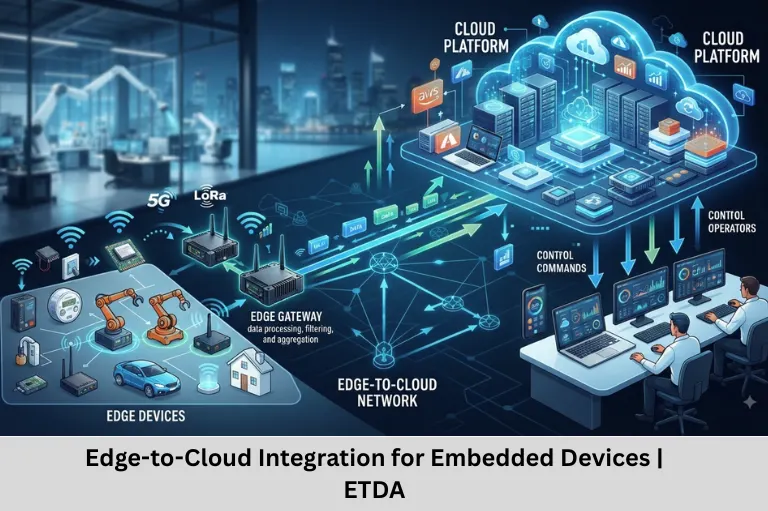
Learn edge-to-cloud integration for embedded devices, including Internet of Things(IoT) architecture, MQTT, device security, OTA updates, edge AI, digital twins, and design pitfalls. Embedded Tech Development Academy (ETDA).
- Edge-to-Cloud Integration for Embedded Devices | ETDA
-
Introduction to Edge-to-Cloud Integration
- Understanding Edge-to-Cloud Architecture
- Key Design Patterns for Edge-to-Cloud Integration
- 2. Asynchronous Communication Pattern
- Security-First Edge-to-Cloud Architecture
- Common Pitfalls in Edge-to-Cloud Integration
- Edge-to-Cloud Communication Protocols
- Designing Reliable Edge-to-Cloud Systems
-
Edge-to-Cloud Integration in 2028 and Beyond
- Edge AI
- Federated Learning
- Large-Scale Digital Twins
- Predictive Maintenance and Simulation
- Multi-Cloud Architectures
- Deterministic Industrial Networking
- The Future of Embedded and Cloud-Connected Systems
- FAQs
- What is edge-to-cloud integration?
- Why is edge-first processing important?
- Which protocols are commonly used for edge-to-cloud communication?
- Can an embedded device operate without cloud connectivity?
- What is the biggest security risk in edge-to-cloud systems?
- Conclusion
Introduction to Edge-to-Cloud Integration
Embedded systems have evolved significantly from standalone controllers into intelligent, connected devices capable of sensing, processing, communicating, and making decisions in real time. Today, edge-to-cloud integration plays an important role in applications ranging from industrial automation and smart manufacturing to automotive electronics, healthcare devices, energy management, smart cities, and large-scale Internet of Things(IoT) deployments.
An edge device can collect information from sensors, process data locally, and communicate selected information to a cloud platform for storage, analytics, artificial intelligence, monitoring, and remote device management. This combination of edge computing, cloud computing, Internet of Things(IoT) connectivity, embedded systems, device-to-cloud communication, real-time data processing, and remote device management allows organizations to build scalable and intelligent connected products.
However, successful edge-to-cloud architecture involves much more than simply connecting a microcontroller to the internet. Engineers must consider latency, bandwidth, power consumption, network reliability, cybersecurity, data privacy, scalability, firmware updates, device authentication, and real-time processing. A poorly designed architecture can make an embedded product unreliable, expensive to operate, difficult to maintain, or vulnerable to cyberattacks.
A good architecture distributes responsibilities intelligently. Time-critical operations should normally remain at the edge, while the cloud can handle resource-intensive analytics, long-term storage, machine learning workloads, fleet management, and centralized monitoring.
For students who want to build practical expertise in embedded systems, embedded C, ARM microcontrollers, Internet of Things(IoT), RTOS, communication protocols, cloud connectivity, and connected-device development, understanding edge-to-cloud architecture is increasingly valuable. Embedded Tech Development Academy (ETDA) provides practical, industry-oriented learning in these areas. As a Top Embedded Training Institute in Bangalore, Embedded Tech Development Academy (ETDA) focuses on hands-on projects and industry-relevant skills, along with assured placement support to help learners prepare for careers in embedded software, firmware, Internet of Things(IoT), automotive electronics, and connected-device development.
Understanding Edge-to-Cloud Architecture
Edge-to-cloud architecture generally consists of three major layers: the edge layer, gateway layer, and cloud layer. Each layer performs different responsibilities, and the overall system works effectively when these responsibilities are properly distributed.
1. Edge Layer
The edge layer contains embedded devices that interact directly with the physical environment.
Typical components include:
- Microcontrollers and microprocessors
- Sensors and actuators
- Embedded software
- Local data processing
- Real-time control systems
- Connectivity modules
The edge device should be capable of continuing essential operations even when cloud connectivity is temporarily unavailable.
Edge Processing Responsibilities
At the edge, devices can perform sensor acquisition, filtering, data validation, local calculations, control operations, event detection, and other time-sensitive tasks.
Why Local Processing Matters
Keeping critical processing close to the physical system helps reduce communication latency and allows the product to remain functional during temporary network interruptions.
2. Gateway Layer
A gateway is optional but useful when multiple embedded devices need to communicate with a cloud platform.
A gateway can provide:
- Protocol conversion
- Data aggregation
- Local storage
- Security functions
- Device management
- Network connectivity
Gateway-Based Communication
The gateway can collect information from multiple embedded devices and forward relevant information to cloud services.
When a Gateway Is Useful
Gateways are particularly useful when embedded devices have limited processing power, memory, networking capabilities, or when several local devices need to share a single cloud connection.
3. Cloud Layer
The cloud provides scalable computing and storage resources.
Typical cloud functions include:
- Data storage
- Analytics
- Machine learning
- Device provisioning
- Fleet management
- Monitoring dashboards
- Remote configuration
- Digital twins
Cloud-Based Intelligence
Cloud computing can process large quantities of historical information and provide centralized analytics across thousands of connected devices.
Balancing Edge and Cloud Responsibilities
A successful architecture does not make the edge or cloud responsible for everything. Instead, it assigns real-time and resource-sensitive tasks to the edge while using cloud infrastructure for scalable services.
Key Design Patterns for Edge-to-Cloud Integration
1. Edge-First Processing Pattern
The edge-first approach processes data locally before sending it to the cloud.
For example, an industrial vibration sensor might generate thousands of measurements per second. Instead of transmitting every sample, the embedded device can calculate useful features such as:
- Average vibration
- Peak vibration
- Frequency characteristics
- Abnormality indicators
Only meaningful information needs to be uploaded
Benefits of Edge Processing
Edge processing provides several advantages:
- Reduced bandwidth consumption
- Lower communication costs
- Reduced latency
- Lower power consumption
- Better privacy
- Continued operation during connectivity problems
Why Edge Processing Matters for IoT
This approach is particularly valuable for battery-powered Internet of Things(IoT) devices, industrial monitoring equipment, automotive systems, and real-time applications where sending every raw sensor sample would be inefficient.
2. Asynchronous Communication Pattern
Embedded systems should avoid blocking real-time tasks while waiting for cloud responses.
An asynchronous architecture can use:
- Event-driven programming
- Message queues
- Ring buffers
- Background communication tasks
- Interrupt-driven data collection
- Non-blocking network operations
Protocols such as MQTT and CoAP are commonly considered for constrained Internet of Things(IoT) applications, while HTTP/HTTPS may be appropriate where broader web compatibility is required.
Why Asynchronous Communication Matters
Suppose a motor controller waits several seconds for a cloud response. During that period, a safety-related task could be delayed.
Separating real-time control from cloud communication prevents this type of architectural failure.
Best Practices for Non-Blocking Communication
Communication tasks should operate independently from critical control tasks. Buffers, queues, RTOS tasks, and event-driven mechanisms can help prevent network operations from interfering with time-sensitive embedded operations.
3. Device Shadow Pattern
A device shadow maintains a cloud-side representation of the current or desired device state.
It can contain:
- Desired state
- Reported state
- Configuration parameters
- Connectivity information
For example, a cloud application could request:
Desired temperature = 24°C
The device receives the desired state when connectivity is available and reports its actual state back to the cloud
Advantages of Device Shadow Architecture
Device shadow architecture helps applications interact with devices that may temporarily disconnect.
Desired State and Reported State
The desired state represents what the cloud application wants the device to do, while the reported state represents the device’s actual condition. When connectivity returns, synchronization can occur.
4. Secure OTA Update Pattern
Over-the-air firmware updates are essential for products deployed in the field.
A secure OTA system should consider:
- Secure boot
- Firmware signing
- Firmware authentication
- Encrypted transport
- Version management
- Atomic updates
- Rollback support
- Anti-rollback protection where appropriate
Without OTA capability, manufacturers may have to physically access thousands of deployed devices to fix software defects or security vulnerabilities
Why Rollback Is Important
If a firmware update fails because of power loss or corrupted data, the device should have a reliable recovery mechanism.
Essential OTA Security Practices
A production-grade OTA process should verify firmware authenticity and integrity before installation and provide a recovery mechanism if the update cannot be completed successfully
5. Digital Twin Pattern
A digital twin is a software representation of a physical device or system.
It can maintain information such as:
- Device status
- Operating parameters
- Historical measurements
- Maintenance information
- Performance indicators
Digital twins can support:
- Predictive maintenance
- Failure analysis
- Simulation
- Performance optimization
- Remote diagnostics
For example, an industrial motor can continuously report temperature, vibration, current, and operating hours. A cloud-based digital twin can use this information to identify potential maintenance requirements.
Applications of Digital Twins
Digital twins can help engineers understand equipment behavior without directly interfering with physical systems.
Digital Twin Data and Monitoring
Sensor data, operating parameters, maintenance history, and performance indicators can be combined to provide a more complete view of the physical device.
Security-First Edge-to-Cloud Architecture
Security must be considered throughout the entire product lifecycle. An edge-to-cloud system involves hardware, firmware, communication networks, cloud services, credentials, and data, so weaknesses at any layer can create risks.
Essential Security Mechanisms
Hardware Root of Trust
Hardware security features can protect cryptographic keys and establish device identity.
Secure Key Storage and Device Identity
Sensitive credentials should be protected rather than stored as plain text in firmware.
Encrypted Communication
TLS can protect data transmitted between devices and cloud services.
Why TLS Matters
Encryption helps protect sensitive information while it travels across potentially untrusted networks.
Device Authentication
Every device should have a unique identity and an appropriate authentication mechanism.
Device Identity Management
A scalable Internet of Things(IoT) deployment needs a reliable way to identify and authenticate individual devices.
Authorization
Authentication determines who or what the device is, while authorization determines what that device is allowed to do.
Least-Privilege Access Control
Devices should receive only the permissions they actually require. A compromised device should therefore have limited ability to affect other systems.
Common Pitfalls in Edge-to-Cloud Integration
1. Streaming Raw Data Continuously
Sending every sensor sample directly to the cloud can create unnecessary network traffic.
Better Approach
Perform filtering, aggregation, compression, or event detection at the edge before transmission.
Edge Data Optimization
Instead of sending all sensor information, embedded software can identify significant changes and transmit only useful information.
2. Making the Cloud Responsible for Real-Time Control
Cloud platforms are excellent for analytics and large-scale management, but internet communication can introduce unpredictable latency.
Recommended Rule
Safety-critical and hard real-time control should remain local to the edge whenever possible.
The cloud can provide optimization, configuration, historical analysis, and higher-level decision support.
Keeping Safety-Critical Control at the Edge
3. Ignoring Network Failures
Wireless and internet connections can fail.
A robust embedded system should support:
- Offline operation
- Local data buffering
- Retry mechanisms
- Reconnection logic
- Store-and-forward communication
- Graceful degradation
Designing for Network Resilience
A temporary network outage should not necessarily cause the physical system to stop functioning.
Offline Operation and Data Recovery
Local queues and storage can preserve important information until connectivity is restored.
4. Overloading the Microcontroller
Small microcontrollers have limited:
- RAM
- Flash
- CPU performance
- Energy budget
Adding a large protocol stack, complex encryption, frequent cloud communication, and AI processing may exceed the device’s capabilities.
Solution
Possible approaches include:
- Hardware cryptographic acceleration
- More capable processors
- External gateways
- Edge computers
- Dedicated communication controllers
Managing MCU Resources Efficiently
Architecture should always be selected according to actual workload, memory, processing, communication, and power requirements.
5. Poor Scalability Planning
An architecture that works with ten devices may not work with ten thousand.
Large deployments require:
- Unique device identities
- Automated provisioning
- Certificate management
- Fleet monitoring
- Remote configuration
- Cloud-side load management
- Automated software updates
Scaling from Prototype to Production
Scalability should be considered during initial system design rather than after deployment.
Device Provisioning and Fleet Management
Large Internet of Things(IoT) deployments need automated mechanisms for registering devices, updating firmware, monitoring health, and managing configurations.
Edge-to-Cloud Communication Protocols
Choosing the Right Communication Protocol
Different applications require different communication protocols.
| Protocol | Typical Characteristics | Common Use |
|---|---|---|
| MQTT | Lightweight publish/subscribe | IoT telemetry |
| CoAP | Lightweight request/response | Constrained devices |
| HTTP/HTTPS | Web-friendly communication | APIs and cloud services |
| WebSocket | Persistent bidirectional communication | Real-time applications |
The best protocol depends on bandwidth, power, latency, security, interoperability, and application requirements.
MQTT, CoAP, and HTTP/HTTPS
MQTT is useful for lightweight messaging, CoAP is designed for constrained environments, and HTTP/HTTPS provides broad web compatibility.
Factors to Consider When Selecting a Protocol
Engineers should evaluate:
- Available bandwidth
- Device memory
- Processing capability
- Power consumption
- Required latency
- Security requirements
- Interoperability
- Cloud compatibility
Designing Reliable Edge-to-Cloud Systems
A robust design should follow several important principles.
Keep Real-Time Tasks Local
Motor control, safety monitoring, emergency shutdown, and similar operations should not depend entirely on cloud availability.
Buffer Important Data
Use local storage or queues to prevent data loss during temporary network failures.
Local Data Storage and Queuing
Buffering allows the embedded system to temporarily store important measurements and forward them after network connectivity returns.
Separate Application Tasks
Sensor acquisition, control, networking, logging, and cloud communication should be logically separated.
Monitor Device Health
Useful telemetry can include:
- CPU utilization
- Memory usage
- Temperature
- Battery level
- Network status
- Firmware version
- Error counts
Important Embedded Device Telemetry
Device-health information can help engineering teams identify performance problems and maintenance requirements.
Design for Recovery
Devices should be able to recover from:
- Network failures
- Power interruptions
- Failed updates
- Unexpected resets
- Invalid cloud commands
Handling System Failures
Recovery mechanisms should be considered during architecture and firmware design.
Building Resilient Embedded Devices
A resilient system should recover safely from expected failures rather than requiring manual intervention every time a problem occurs.
Edge-to-Cloud Integration in 2028 and Beyond
The future of connected embedded systems will increasingly combine edge intelligence with cloud-scale computing. Important developments include edge AI, federated learning, large-scale digital twins, multi-cloud architectures, and deterministic industrial networking.
Edge AI
Machine-learning models can increasingly run directly on embedded processors, reducing dependence on cloud inference.
On-Device Machine Learning
Running inference locally can reduce the amount of data that needs to be transmitted.
Benefits of Edge AI
Potential benefits include reduced latency, lower bandwidth requirements, and increased device autonomy.
Federated Learning
Devices can participate in model training without necessarily sending all raw data to a central server.
Privacy-Aware Machine Learning
Federated approaches can support distributed intelligence while reducing the need to centralize raw device data.
Distributed Intelligence at the Edge
Embedded devices can become increasingly capable of contributing to intelligent systems while performing more computation locally.
Large-Scale Digital Twins
Digital twins can provide increasingly detailed representations of industrial equipment, vehicles, buildings, and infrastructure.
Digital Twins for Industrial Systems
They can integrate real-time and historical data to enable effective monitoring, analysis, and informed decision-making.
Predictive Maintenance and Simulation
Digital twins can help organizations analyze equipment behavior and identify potential maintenance requirements.
Multi-Cloud Architectures
Organizations may use multiple cloud platforms for redundancy, regional requirements, cost optimization, or specialized services.
Cloud Redundancy and Flexibility
Managing Multiple Cloud Platforms
Engineers need appropriate identity, security, monitoring, and data-management strategies when multiple cloud environments are involved.
Deterministic Industrial Networking
Industrial systems will increasingly combine edge computing with high-performance and deterministic networking technologies.
Connected Industrial Embedded Systems
This combination helps enable more connected, efficient, scalable, and intelligent manufacturing and automation environments.
Real-Time Industrial Communication
Reliable communication is essential for applications where precise timing, consistent performance, and predictable system behavior are critical for effective and dependable operation.
The Future of Embedded and Cloud-Connected Systems
The future of embedded engineering is increasingly connected. Engineers who understand both low-level embedded development and edge-to-cloud architecture will be well positioned to design intelligent, secure, reliable, and connected products.
Building Industry-Ready Embedded Skills
Learning should combine theory with practical implementation, including microcontroller programming, communication protocols, networking, RTOS concepts, Internet of Things(IoT) connectivity, cloud integration, and real-world projects.
Career Opportunities in Embedded and IoT
Knowledge of edge-to-cloud systems can support career paths in areas such as:
- Embedded software development
- Firmware engineering
- Internet of Things(IoT) development
- Automotive embedded systems
- Edge computing
- Industrial automation
- Connected-device development
- Embedded networking
Final Takeaway for Aspiring Embedded Engineers
Learn Embedded Systems with ETDA
Edge-to-cloud integration brings together embedded systems, Internet of Things(IoT), networking, cybersecurity, cloud computing, firmware, and edge intelligence. Building practical knowledge across these areas can help aspiring engineers understand how modern connected products are designed and deployed.
For learners looking for practical embedded systems training in Bangalore, Embedded Tech Development Academy (ETDA) combines technical learning with project exposure and assured placement support, helping students prepare for industry-oriented embedded and IoT career opportunities.
FAQs
What is edge-to-cloud integration?
Edge-to-cloud integration connects embedded or edge devices with cloud platforms so that devices can exchange data, receive configurations, access analytics, and participate in centralized device management.
Why is edge-first processing important?
Edge-first processing allows data to be analyzed locally before transmission. It can reduce latency, bandwidth usage, power consumption, and cloud processing requirements while improving operation during network outages.
Which protocols are commonly used for edge-to-cloud communication?
MQTT, CoAP, HTTP, and HTTPS are commonly considered for IoT and edge-to-cloud communication. The appropriate protocol depends on factors such as device resources, power consumption, latency, security, and interoperability.
Can an embedded device operate without cloud connectivity?
Yes. A robust embedded system should be capable of performing essential local operations when the network or cloud is unavailable. Local buffering, retry mechanisms, autonomous control, and graceful recovery can improve system reliability.
What is the biggest security risk in edge-to-cloud systems?
Poor security architecture is one of the major risks. Weak device authentication, exposed credentials, insecure firmware updates, inadequate authorization, and unencrypted communication can expose devices and cloud services to attacks. Security should therefore be incorporated from hardware and firmware design through cloud deployment and maintenance.
Conclusion
Edge-to-cloud integration is becoming a fundamental capability in modern embedded engineering. Connecting an embedded device to a cloud platform is only the beginning; the real engineering challenge is designing an architecture that remains secure, reliable, scalable, power-efficient, responsive, and maintainable throughout the product lifecycle.
Successful systems intelligently divide responsibilities between the edge, gateway, and cloud. Edge computing handles time-sensitive processing, local control, filtering, and autonomous operation, while cloud computing provides large-scale storage, analytics, artificial intelligence, fleet management, and long-term insights. Technologies such as MQTT, CoAP, TLS, secure boot, OTA firmware updates, device shadows, digital twins, edge AI, Internet of Things(IoT) security, remote device management, embedded connectivity, and real-time data processing are becoming important building blocks for connected products.
Engineers must also avoid common problems such as continuous raw-data streaming, cloud-dependent control logic, inadequate cybersecurity, poor network-failure handling, excessive MCU workloads, and insufficient scalability planning.
For students and professionals who want to develop practical skills in embedded systems, embedded C, ARM microcontrollers, RTOS, Internet of Things(IoT), edge computing, cloud connectivity, communication protocols, firmware development, and connected-device development, hands-on learning is especially valuable.
Embedded Tech Development Academy (ETDA) provides industry-oriented training and practical project exposure to help learners understand how embedded devices interact with modern connected ecosystems. As a Top Embedded Training Institute in Bangalore, Embedded Tech Development Academy (ETDA) focuses on developing job-ready embedded engineering skills and offers assured placement support to help learners pursue opportunities in embedded software, firmware, Internet of Things(IoT), automotive electronics, and edge-computing domains.
Author: ETDA Trainers
Experience: 10+ Years of Industry Experience in Embedded Systems, IoT, and Embedded C Programming