
Electromagnetic Theory Explained: Maxwell’s Equations, EM Waves & Applications | ETDA
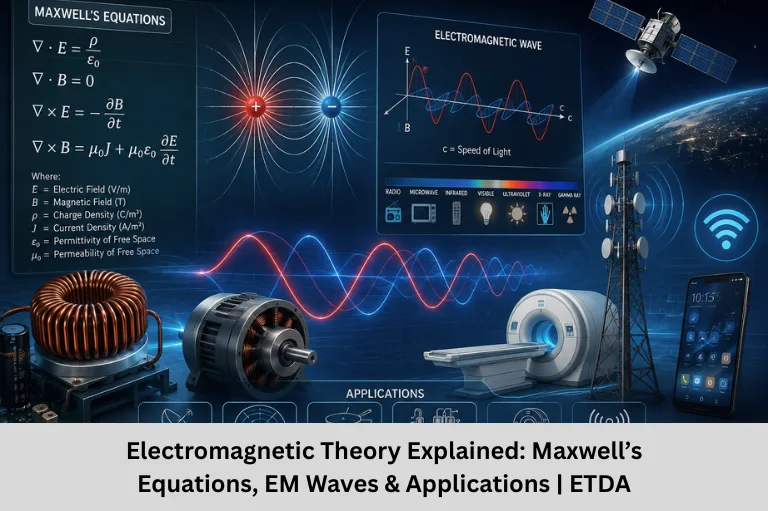
Learn Electromagnetic Theory, Maxwell’s Equations, electric and magnetic fields, EM waves, wave propagation, and real-world applications. Master core electrical engineering concepts with Embedded Tech Development Academy (ETDA), the Top Embedded Training Institute in Bangalore.
- Electromagnetic Theory Explained: Maxwell’s Equations, EM Waves & Applications | ETDA
-
Electromagnetic Theory: The Invisible Force Behind Modern Technology
- Introduction to Electromagnetic Theory
- What Is Electromagnetic Theory?
- Maxwell's Equations – The Foundation of Electromagnetic Theory
- Key Concepts in Electromagnetic Theory
- Real-World Applications of Electromagnetic Theory
- Why Should You Learn Electromagnetic Theory?
- Emerging Technologies Based on Electromagnetic Theory
- FAQs
- Conclusion
Electromagnetic Theory: The Invisible Force Behind Modern Technology
Introduction to Electromagnetic Theory
Electromagnetic Theory is one of the most fundamental pillars of modern physics and electrical engineering. Although electromagnetic fields are invisible to the human eye, they are responsible for powering and connecting nearly every technology we use today. From smartphones, Wi-Fi routers, and satellite communication to electric vehicles, MRI scanners, wireless charging, fiber-optic communication, and radar systems, electromagnetic theory explains how electric and magnetic fields interact to transfer energy and information across space.
At its core, electromagnetic theory describes the relationship between electric charges, magnetic fields, and electromagnetic waves. It provides the scientific foundation for understanding how electricity generates magnetism, how changing magnetic fields induce electric currents, and how electromagnetic waves propagate at the speed of light. These principles are essential for designing electrical machines, communication systems, antennas, sensors, embedded electronics, semiconductor devices, and modern wireless technologies.
Today, advancements in 5G communication, Internet of Things (IoT), embedded systems, robotics, industrial automation, artificial intelligence (AI), electric vehicles (EVs), renewable energy systems, RF engineering, microwave engineering, antenna design, electromagnetic compatibility (EMC), electromagnetic interference (EMI), wireless sensor networks, digital communication, satellite communication, fiber optics, photonics, radar systems, power electronics, and smart grids all depend on a strong understanding of electromagnetic theory.
For engineering students and professionals, mastering electromagnetic theory is a critical step toward building successful careers in electronics, electrical engineering, telecommunications, embedded systems, aerospace, automotive electronics, defense technologies, and semiconductor industries. It strengthens the ability to analyze electrical phenomena, design high-frequency circuits, optimize wireless communication systems, and solve real-world engineering challenges.
To bridge the gap between theoretical concepts and practical implementation, Embedded Tech Development Academy (ETDA) provides industry-focused training through hands-on projects, laboratory experiments, and real-time applications. Recognized as the Top Embedded Training Institute in Bangalore, Embedded Tech Development Academy (ETDA) equips students with practical skills in embedded systems, ARM microcontrollers, Internet of Things (IoT), communication protocols, electronics, and advanced engineering technologies, helping them become industry-ready professionals.
Why Electromagnetic Theory Matters
Electromagnetic theory is important because it:
- Forms the foundation of electrical and electronics engineering
- Enables wireless communication and networking
- Powers electric motors, generators, and transformers
- Supports modern communication technologies such as Wi-Fi, Bluetooth, and 5G
- Helps engineers design antennas and RF systems
- Explains the behavior of light and electromagnetic radiation
- Improves electromagnetic compatibility and signal integrity
- Drives innovations in healthcare, aerospace, defense, and renewable energy
What Is Electromagnetic Theory?
Electromagnetic Theory is the study of electric fields, magnetic fields, and their interactions that produce electromagnetic waves. It explains how electric charges create electric fields, how moving charges generate magnetic fields, and how changing electric and magnetic fields propagate through space as electromagnetic radiation.
Simply put:
Electromagnetic Theory explains how electricity, magnetism, and light are interconnected.
Maxwell's Equations – The Foundation of Electromagnetic Theory
Scottish physicist James Clerk Maxwell unified electricity and magnetism through four revolutionary equations that describe all classical electromagnetic phenomena.
1. Gauss's Law for Electricity
Mathematical Expression
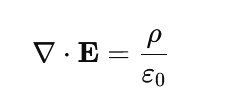
This law states that electric charges create electric fields, and the electric flux through a closed surface is proportional to the enclosed electric charge.
2. Gauss's Law for Magnetism
Mathematical Expression
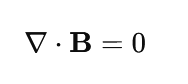
This law explains that magnetic monopoles do not exist; magnetic field lines always form continuous closed loops.
3. Faraday's Law of Electromagnetic Induction
Mathematical Expression
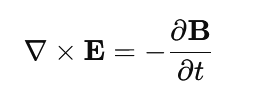
A changing magnetic field induces an electric field. This principle forms the basis of electric generators, transformers, and inductive charging systems.
4. Ampère-Maxwell Law
Mathematical Expression
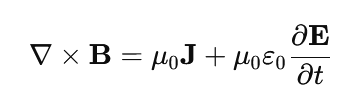
Electric currents and changing electric fields generate magnetic fields, forming the foundation of motors, electromagnets, and communication systems.
Key Concepts in Electromagnetic Theory
Electric Fields (E-Fields)
Electric fields are produced by electric charges and exert forces on other charged particles.
Characteristics
- Created by positive and negative charges
- Measured in volts per meter (V/m)
- Influence the movement of charged particles
- Stored in capacitors
Magnetic Fields (B-Fields)
Magnetic fields are produced by moving electric charges or electric currents.
Characteristics
- Generated by current-carrying conductors
- Measured in Tesla (T)
- Influence moving charges through the Lorentz force
- Stored in inductors
Electromagnetic Waves
Electromagnetic waves consist of oscillating electric and magnetic fields that travel together through space.
Properties
- Travel at the speed of light (≈ 3 × 10⁸ m/s)
- Do not require a material medium
- Carry both energy and information
- Include radio waves, microwaves, infrared, visible light, ultraviolet, X-rays, and gamma rays
Wave Propagation
Electromagnetic waves propagate with mutually perpendicular electric and magnetic fields.
Characteristics
- Electric field (E), magnetic field (B), and direction of propagation are perpendicular
- Carry energy through free space
- Enable wireless communication
Real-World Applications of Electromagnetic Theory
| Application | How It Works |
|---|---|
| Wireless Communication | Radio waves transmit voice and data. |
| Electric Motors | Magnetic fields produce mechanical motion. |
| Generators | Electromagnetic induction generates electricity. |
| Transformers | Transfer electrical energy using magnetic coupling. |
| MRI Systems | Use magnetic fields and radio frequency waves. |
| Fiber Optics | Light transmission enables high-speed communication. |
| Radar Systems | Detect objects using reflected electromagnetic waves. |
| Satellite Communication | Supports long-distance wireless transmission. |
| Wireless Charging | Magnetic induction transfers power without cables. |
| Renewable Energy | Wind turbines and generators operate using electromagnetic principles. |
Why Should You Learn Electromagnetic Theory?
Career Benefits
Understanding electromagnetic theory is essential for careers involving:
- Antenna Design
- RF and Microwave Engineering
- Embedded Systems
- High-Speed PCB Design
- Semiconductor Engineering
- Communication Engineering
- Fiber Optic Communication
- Power Electronics
- Electric Vehicle Technology
- Aerospace Systems
- Wireless Sensor Networks
- Electromagnetic Compatibility (EMC)
- Electromagnetic Interference (EMI)
- Industrial Automation
- Robotics
Emerging Technologies Based on Electromagnetic Theory
Future Innovations
Electromagnetic theory continues to drive innovations in:
- 6G Wireless Communication
- Internet of Things (IoT)
- Artificial Intelligence Hardware
- Smart Grids
- Electric Mobility
- Quantum Communication
- Terahertz Communication
- Autonomous Vehicles
- Smart Healthcare
- Space Exploration
- High-Speed Computing
- Photonic Integrated Circuits
FAQs
What is Electromagnetic Theory?
Electromagnetic Theory is the study of electric fields, magnetic fields, and electromagnetic waves. It explains how electricity and magnetism interact to produce energy transfer and wireless communication.
Why are Maxwell's Equations important?
Maxwell’s Equations describe the behavior of electric and magnetic fields and form the theoretical foundation for electrical engineering, communication systems, antenna design, optics, and modern electronics.
What are the applications of Electromagnetic Theory?
Electromagnetic Theory is widely used in wireless communication, electric motors, generators, transformers, radar systems, MRI scanners, satellite communication, fiber optics, embedded systems, RF engineering, and power electronics.
What is an Electromagnetic Wave?
An electromagnetic wave consists of oscillating electric and magnetic fields that travel through space at the speed of light without requiring a material medium. Examples include radio waves, microwaves, visible light, X-rays, and gamma rays.
How can I learn Electromagnetic Theory for engineering careers?
A strong understanding of mathematics, physics, circuit theory, and practical electronics is essential. Embedded Tech Development Academy (ETDA), recognized as the Top Embedded Training Institute in Bangalore, offers hands-on, industry-oriented training in embedded systems, communication technologies, IoT, ARM microcontrollers, and electronics, helping students develop practical skills for careers in electrical, electronics, and communication engineering.
Conclusion
Electromagnetic Theory is much more than an academic subject—it is the scientific foundation behind virtually every modern electrical and electronic technology. From generating electrical power and transmitting wireless signals to enabling medical imaging, satellite communication, electric vehicles, robotics, and smart cities, electromagnetic principles continue to shape the future of innovation.
As industries increasingly adopt 5G and 6G communication, embedded systems, industrial automation, artificial intelligence, Internet of Things (IoT), electric mobility, renewable energy, wireless charging, electromagnetic compatibility (EMC), high-frequency electronics, microwave engineering, RF circuit design, photonics, smart sensors, semiconductor technologies, autonomous systems, and Industry 4.0, professionals with strong knowledge of electromagnetic theory are becoming highly valuable across engineering sectors.
Learning concepts such as Maxwell’s Equations, electromagnetic wave propagation, electric and magnetic fields, electromagnetic induction, transmission lines, antenna systems, and RF engineering provides a strong technical foundation for solving complex engineering problems and developing next-generation technologies.
For students and professionals seeking industry-relevant practical training, Embedded Tech Development Academy (ETDA) offers comprehensive, project-based learning in embedded systems, electronics, communication protocols, ARM microcontrollers, Internet of Things (IoT), industrial automation, and advanced engineering technologies. Recognized as the Top Embedded Training Institute in Bangalore, Embedded Tech Development Academy (ETDA) combines classroom instruction with hands-on laboratory experience and placement-focused programs, enabling learners to build the practical skills required by today’s technology-driven industries.
By mastering electromagnetic theory today, engineers prepare themselves to design the intelligent communication systems, smart devices, renewable energy solutions, autonomous technologies, and advanced electronic systems that will define the future.
Author: ETDA Trainers
Experience: 10+ Years of Industry Experience in Embedded Systems, IoT, and Embedded C Programming