
Embedded AI Using ESP32: Projects and TinyML Guide
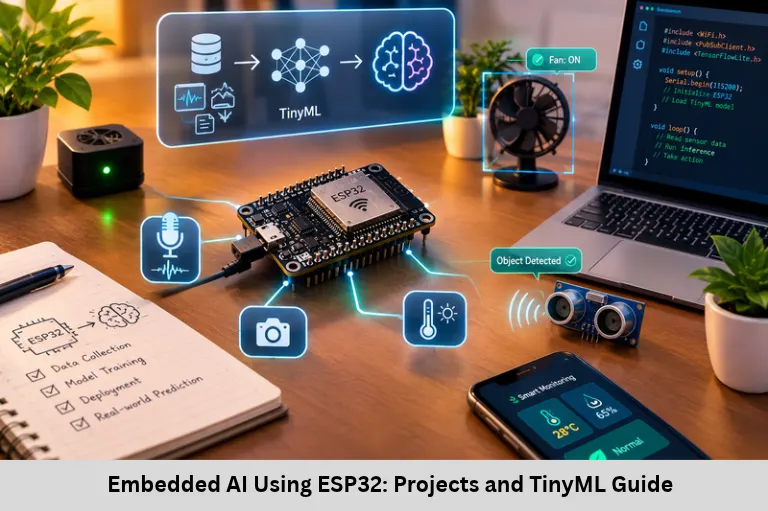
Learn Embedded AI using ESP32, TinyML, sensor integration, and AI projects. Explore practical skills and embedded systems training at Embedded Tech Development Academy (ETDA), Bangalore.
- Embedded AI Using ESP32: Projects and TinyML Guide
- Embedded AI Using ESP32: Complete Guide with Projects for Students
Embedded AI Using ESP32: Complete Guide with Projects for Students
Introduction to Embedded AI Using ESP32
Embedded Artificial Intelligence (Embedded AI) is transforming the way modern electronic devices collect data, recognize patterns, and make decisions. Traditional embedded systems execute predefined instructions, such as switching a relay, controlling a motor, or reading a temperature sensor. In contrast, AI-enabled embedded systems can analyze sensor inputs, identify patterns, classify events, and respond intelligently in real time. Technologies such as TinyML, edge AI, machine learning on microcontrollers, intelligent Internet of Things (IoT) devices, and real-time sensor processing are making this transformation possible.
The ESP32 is a popular platform for learning Embedded AI because it combines a microcontroller, wireless connectivity, peripheral interfaces, and sufficient computational resources for selected lightweight machine learning applications. Students can use it to develop sound classification systems, motion recognition devices, sensor-based anomaly detection, and intelligent home automation prototypes. However, the model size, available RAM, processing speed, and power budget must be considered before deployment.
Learning Embedded AI involves more than training a machine learning model. Developers must understand embedded C/C++, sensor interfacing, signal preprocessing, memory management, model quantization, and hardware debugging. These skills help bridge the gap between software-based AI experiments and practical electronic products.
At Embedded Tech Development Academy (ETDA), learners can build a foundation in embedded programming, microcontrollers, Internet of Things (IoT), and practical hardware development. Students exploring the Top Embedded Training Institute in Bangalore can look for hands-on projects, industry-relevant technical instruction, and assured placement support when comparing training options. A structured learning path helps aspiring engineers prepare for embedded firmware, Internet of Things (IoT) development, and edge AI applications.
Why ESP32 Is Suitable for Embedded AI
The ESP32 family offers microcontrollers with different processor configurations, memory capacities, peripheral features, and wireless capabilities. The exact specifications depend on the selected variant, so developers should verify the datasheet before choosing a board.
Processing and Wireless Connectivity
ESP32 devices can perform sensor acquisition, communication, and lightweight inference within a single embedded platform. Wi-Fi supports network connectivity, while Bluetooth or Bluetooth Low Energy is available on supported variants. These features are useful for remote monitoring and connected AI prototypes.
Peripheral Interfaces for Sensor Integration
ESP32 supports interfaces such as GPIO, ADC, I2C, SPI, UART, PWM, and timers, depending on the chip. These interfaces connect accelerometers, microphones, environmental sensors, displays, and output devices. For example, an I2C accelerometer can supply motion samples to a gesture-classification model.
Choosing the Correct ESP32 Board
Check available RAM, flash storage, clock speed, ADC characteristics, supported peripherals, and AI framework compatibility. Some ESP32 variants have additional vector instructions or AI-oriented acceleration features; these capabilities should not be assumed across every board.
Understanding TinyML and Model Deployment
TinyML enables machine learning inference on resource-constrained devices. A model is usually trained on a computer using collected and labelled data, then optimized and converted into a format suitable for embedded deployment.
The ESP32 receives input data, preprocesses it, executes the model, and produces a prediction. For example, a motion classifier might identify walking, running, or a particular hand gesture from accelerometer samples.
The TinyML Development Workflow
Data collection: Record sensor readings for each target class.
Preprocessing: Filter noise, normalize values, or divide continuous signals into fixed-size windows.
Model training: Train a suitable classification or regression model.
Optimization: Apply quantization, reduce model complexity, and check memory requirements.
Deployment: Integrate the model with ESP32 firmware.
Testing: Measure accuracy, inference time, memory usage, and power consumption on actual hardware.
Quantization and Resource Optimization
Quantization converts model parameters from higher-precision formats, such as 32-bit floating point, to lower-precision formats, often 8-bit integers when supported. This can reduce model storage and memory requirements and may improve inference speed. Developers must validate that quantization does not reduce accuracy beyond acceptable limits.
Skills and Tools Required
Students should understand C/C++, variables, functions, arrays, pointers, structures, and basic debugging. Python is useful for dataset preparation and model training, while basic mathematics and statistics help explain classification, accuracy, and model evaluation.
The Arduino IDE is a beginner-friendly option for ESP32 programming. ESP-IDF provides a more advanced development environment for firmware, drivers, and task management. Tools such as Edge Impulse and compatible TensorFlow Lite Micro workflows can support data collection, model training, optimization, and deployment, depending on the selected hardware and software versions.
Practical Embedded AI Projects for Students
Project 1 — Gesture Recognition Using an Accelerometer
Connect a compatible accelerometer through I2C or SPI and collect three-axis acceleration samples for different gestures. Label the data, train a classifier, and deploy it to the ESP32. The firmware can turn on an LED or transmit a command when the model recognizes a predefined gesture.
Technical concepts: sensor sampling, data windows, feature extraction, classification, and inference thresholds.
Project 2 — Sound or Clap Classification
Use a compatible microphone module to collect audio samples. Extract suitable audio features, such as spectral information or log-mel features, and train a small sound-classification model. The ESP32 can trigger an output when the target sound is detected.
A simple amplitude threshold can detect loud sounds, but it is not equivalent to AI-based sound classification. A trained model can distinguish selected sound categories if the dataset is sufficiently representative.
Project 3 — Intelligent Sensor Anomaly Detection
Collect temperature, vibration, or other sensor readings from a machine or prototype. Train a lightweight model to distinguish normal operation from selected abnormal patterns. When an anomaly is detected, the ESP32 can activate an indicator or send a Wi-Fi notification.
This project introduces predictive maintenance concepts, time-series analysis, and edge-based monitoring. It is an educational prototype, not a substitute for safety-certified industrial protection.
Testing and Evaluation
For every project, record prediction accuracy, false-positive rate, inference latency, RAM consumption, and flash usage. Test the model under different lighting, sound, movement, or environmental conditions as applicable. Use serial logs and repeatable test cases to identify hardware and software errors.
Common Challenges and Solutions
Limited RAM and flash storage can prevent larger models from running. Select compact architectures, reduce input dimensions where appropriate, and measure memory usage before deployment. Noisy sensor readings can reduce prediction accuracy, so use appropriate filtering, consistent sampling rates, and representative training data.
Another challenge is timing. Sensor acquisition, wireless communication, and inference may compete for processing time. On supported configurations, FreeRTOS tasks can separate these responsibilities, but task priorities, synchronization, stack sizes, and shared data must be designed carefully.
Wireless connectivity also increases energy consumption. Battery-operated projects may require sleep modes, efficient sampling, and less frequent transmissions. Developers should measure real power consumption instead of relying only on theoretical estimates.
Career Scope and Learning Path
Embedded AI skills are relevant to Internet of Things (IoT) products, wearable devices, smart agriculture, robotics, industrial monitoring, and automotive development. Students can strengthen their portfolios by documenting project architecture, circuit connections, datasets, model performance, firmware, and test results.
Embedded Tech Development Academy (ETDA) can be considered by learners seeking practical embedded systems education alongside AI and Internet of Things (IoT) project work. When comparing a Top Embedded Training Institute in Bangalore, evaluate trainer experience, laboratory access, project depth, debugging practice, and transparent placement processes. Ask providers to explain what their assured placement support includes, since support does not necessarily guarantee a job offer.
Frequently Asked Questions
What is Embedded AI using ESP32?
It is the implementation of lightweight machine learning inference on a compatible ESP32 microcontroller to classify sensor inputs or make local decisions without requiring cloud processing for every prediction.
Can every ESP32 board run AI models?
No. Model compatibility depends on the specific ESP32 variant, available RAM and flash, framework support, and computational requirements. Lightweight models are generally more suitable.
What is TinyML?
TinyML is the practice of deploying machine learning models on low-power, resource-constrained devices such as microcontrollers. It commonly uses compact models and optimization techniques such as quantization.
Which programming languages and tools should students learn?
Start with embedded C/C++ and an ESP32 development environment such as Arduino IDE. Python is useful for data preparation and model training, while Edge Impulse or compatible TensorFlow Lite Micro workflows can support deployment.
Which Embedded AI projects are suitable for beginners?
Gesture recognition, sound classification, and sensor-based anomaly detection are useful starter projects. Begin with simple sensor interfacing, then collect data, train a small model, deploy it, and evaluate its performance on the hardware.
Conclusion
Embedded AI using ESP32 gives students a practical introduction to TinyML, edge computing, sensor fusion, machine learning inference, and intelligent Internet of Things (IoT) development. By building gesture recognition, sound classification, and anomaly detection projects, learners can understand how trained models interact with real hardware under memory, timing, and power constraints. Strong knowledge of embedded C/C++, sensor interfaces, model optimization, and systematic testing provides a foundation for more advanced applications.
Embedded Tech Development Academy (ETDA) supports learners interested in connecting embedded programming with practical hardware projects. Students comparing the Top Embedded Training Institute in Bangalore should prioritize hands-on training, technically sound projects, experienced instruction, and clear career guidance. With consistent practice and suitable mentoring, learners can prepare for embedded firmware, Internet of Things (IoT), and edge AI roles while evaluating available assured placement support carefully. Building and documenting working prototypes is one of the most effective ways to demonstrate technical ability.
Author: ETDA Trainers
Experience: 10+ Years of Industry Experience in Embedded Systems, IoT, and Embedded C Programming