
Embedded C vs C Programming: Key Differences Explained | ETDA
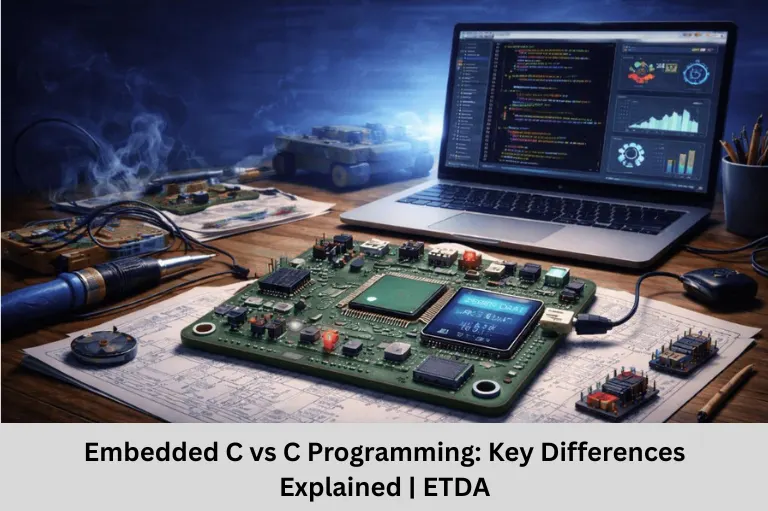
Learn the key differences between Embedded C and C Programming. Explore applications, career opportunities, and practical training with Embedded Tech Development Academy (ETDA).
- Embedded C vs C Programming: Key Differences Explained | ETDA
-
Embedded C vs C Programming: Key Differences Explained
- What is C Programming?
- What is Embedded C?
- Embedded C vs C Programming: Major Differences
- Embedded C vs C Programming Comparison Table
- Advantages of Learning Embedded C
- Career Opportunities After Learning Embedded C
- Why Companies Prefer Embedded C Developers
- Learn Embedded C at ETDA
- Assured Placement Support at ETDA
- Why Choose ETDA?
-
Frequently Asked Questions (FAQs)
- What is the main difference between C Programming and Embedded C?
- Is Embedded C different from the C language?
- Which is better for beginners, C or Embedded C?
- Why is Embedded C important in the embedded systems industry?
- What career opportunities are available after learning Embedded C?
- Does ETDA provide hands-on Embedded C training?
- Will learning Embedded C improve my placement opportunities?
- Does ETDA provide placement support after Embedded C training?
- Conclusion
Embedded C vs C Programming: Key Differences Explained
Programming languages form the foundation of software and embedded systems development. Among them, C Programming is one of the oldest and most widely used languages, while Embedded C is a specialized extension designed specifically for embedded systems. Although both languages share similar syntax, they differ significantly in terms of applications, hardware interaction, memory management, and development environment.
Many engineering students often wonder whether learning C Programming is enough to build a career in Embedded Systems. The answer is that while C Programming provides the fundamentals, Embedded C equips you with the skills required to develop firmware for microcontrollers, Internet of Things (IoT) devices, automotive electronics, industrial automation systems, and medical devices.
If you’re planning a career in Embedded Systems, understanding the differences between these two languages is essential. At Embedded Tech Development Academy (ETDA), students receive practical training in both C Programming and Embedded C using real hardware and industry-standard tools. As a Top Embedded Training Institute in Bangalore, ETDA prepares students for successful careers through hands-on projects and assured placement support.
What is C Programming?
C Programming is a general-purpose programming language developed by Dennis Ritchie. It is widely used to develop operating systems, desktop software, compilers, databases, networking applications, and system-level software.
C is known for its:
- High performance
- Portability
- Structured programming approach
- Efficient memory usage
- Fast execution speed
It serves as the foundation for many modern programming languages, including C++, Java, and C#.
Features of C Programming
C Programming offers several features that make it popular among developers.
General-Purpose Language
C can be used for developing software across multiple domains, including desktop, networking, and system applications.
Portable Code
Programs written in C can run on different platforms with minimal changes.
Structured Programming
Functions and modular programming make code organized and reusable.
Rich Standard Library
C provides numerous built-in libraries for file handling, string manipulation, mathematical operations, and input/output processing.
Applications of C Programming
C Programming is widely used in:
- Operating Systems
- Database Systems
- Compiler Design
- Networking Applications
- Desktop Software
- Graphics Applications
- Embedded Software Foundations
- Scientific Computing
What is Embedded C?
Embedded C is an extension of the C Programming language specifically designed for programming embedded systems and microcontrollers.
Unlike standard C Programming, Embedded C interacts directly with hardware components such as registers, timers, communication peripherals, sensors, and interrupts.
It is one of the most important programming languages in the embedded systems industry.
Features of Embedded C
Embedded C includes all the capabilities of C while adding hardware-oriented programming concepts.
Hardware-Level Programming
Embedded C allows direct access to:
- GPIO Registers
- Timers
- ADC
- PWM
- UART
- SPI
- I2C
- CAN
Memory Optimization
Since embedded devices have limited RAM and Flash memory, Embedded C focuses on writing highly optimized code.
Real-Time Execution
Embedded applications often require immediate responses to external events.
Embedded C supports:
- Interrupt Service Routines (ISR)
- Real-Time Processing
- Hardware Events
Microcontroller Development
Embedded C is commonly used with:
- STM32
- ARM Cortex-M
- LPC1768
- AVR
- PIC
- MSP430
- ESP32
Applications of Embedded C
Embedded C powers countless electronic products we use every day.
Examples include:
- Smart Home Devices
- Internet of Things (IoT) Systems
- Washing Machines
- Medical Equipment
- Smart TVs
- Automotive ECUs
- Robotics
- Industrial Automation
- Consumer Electronics
- Aerospace Systems
Embedded C vs C Programming: Major Differences
Although Embedded C is based on C Programming, there are several important distinctions.
Purpose
C Programming
Designed for developing general-purpose software applications.
Embedded C
Designed specifically for programming embedded hardware and microcontrollers.
Hardware Interaction
C Programming
Normally does not interact directly with hardware registers.
Embedded C
Allows direct manipulation of hardware peripherals and memory-mapped registers.
Execution Environment
C Programming
Runs on operating systems like Windows, Linux, or macOS.
Embedded C
Runs directly on microcontrollers without requiring a full operating system.
Memory Usage
C Programming
Memory availability is generally much higher.
Embedded C
Developers must carefully optimize memory usage because embedded devices have limited RAM and Flash.
Development Tools
C Programming
Common IDEs include:
- Code::Blocks
- Visual Studio
- GCC
- Dev-C++
Embedded C
Common development environments include:
- Keil uVision
- STM32CubeIDE
- MPLAB X IDE
- IAR Embedded Workbench
- Arduino IDE
Embedded C vs C Programming Comparison Table
| Feature | C Programming | Embedded C |
|---|---|---|
| Purpose | General-purpose software | Embedded firmware development |
| Platform | Computer operating systems | Microcontrollers |
| Hardware Access | Limited | Direct register access |
| Memory | Large memory availability | Limited memory optimization |
| Interrupts | Rarely used | Frequently used |
| Real-Time Support | Generally not required | Essential |
| Device Drivers | Minimal | Widely used |
| Applications | Desktop software, OS, networking | IoT, Automotive, Robotics, Medical Devices |
Why Embedded C Is Important for Embedded Engineers
Controls Hardware Efficiently
Embedded C enables engineers to communicate directly with microcontroller peripherals, making it the preferred language for firmware development.
Examples of Hardware Control
- LED Blinking
- Sensor Interfacing
- LCD Display Programming
- Motor Control
- Communication Protocols
- ADC Reading
- PWM Generation
Essential for Modern Embedded Systems
Today’s embedded devices require efficient firmware capable of handling real-time tasks with minimal resources. Embedded C provides the performance and flexibility needed for these applications.
Widely Used Across Industries
Embedded C is a core technology in:
- Consumer Electronics
- Automotive Systems
- Industrial Automation
- Healthcare Devices
- IoT Products
- Smart Home Solutions
- Aerospace Applications
Its widespread adoption makes it a valuable skill for aspiring embedded engineers.
Advantages of Learning Embedded C
Learning Embedded C opens the door to exciting career opportunities in the electronics and embedded systems industry. Unlike general-purpose programming, Embedded C enables developers to build software that directly controls hardware devices, making it one of the most in-demand skills for embedded engineers.
Better Hardware Understanding
Embedded C helps students understand how software communicates with hardware components.
Practical Skills You Learn
Students gain experience with:
- GPIO Programming
- Timers and Counters
- Interrupt Handling
- ADC and DAC
- PWM
- UART
- SPI
- I2C
- CAN Communication
These skills are essential for developing reliable embedded applications.
High Performance and Efficiency
Embedded systems often have limited memory and processing power. Embedded C allows developers to write optimized code that executes quickly while consuming minimal resources.
Why Optimization Matters
Efficient code helps:
- Reduce memory usage
- Improve device performance
- Lower power consumption
- Increase system reliability
- Extend battery life in portable devices
Real-Time Programming Capabilities
Many embedded applications must respond instantly to external events.
Examples include:
- Airbag deployment systems
- Medical monitoring devices
- Industrial automation controllers
- Automotive braking systems
- Smart security systems
Embedded C enables engineers to develop firmware capable of handling these real-time requirements efficiently.
Career Opportunities After Learning Embedded C
The demand for skilled Embedded C programmers continues to grow as industries adopt IoT, automation, robotics, and connected devices.
Popular Job Roles
Professionals with Embedded C expertise can pursue careers as:
- Embedded Software Engineer
- Firmware Engineer
- Embedded Systems Developer
- IoT Developer
- Automotive Embedded Engineer
- Robotics Engineer
- Electronics Design Engineer
- Embedded Test Engineer
- Linux Embedded Engineer
These roles offer excellent career growth and opportunities across multiple industries.
Industries Hiring Embedded C Professionals
Embedded C developers are in demand in sectors such as:
Automotive
- Electric Vehicles
- Advanced Driver Assistance Systems (ADAS)
- Engine Control Units (ECUs)
- Battery Management Systems
Consumer Electronics
- Smart TVs
- Wearable Devices
- Home Appliances
- Smart Speakers
Industrial Automation
- PLC Systems
- Robotics
- Factory Automation
- Process Control
Healthcare
- Patient Monitoring Systems
- Diagnostic Equipment
- Portable Medical Devices
Internet of Things (IoT)
- Smart Homes
- Smart Agriculture
- Smart Cities
- Asset Tracking
- Environmental Monitoring
Why Companies Prefer Embedded C Developers
Embedded C remains one of the most widely used programming languages in the embedded industry because it delivers speed, efficiency, and direct hardware control.
Industry-Relevant Skills
Companies value engineers who can:
- Develop firmware for microcontrollers
- Interface sensors and peripherals
- Optimize memory usage
- Debug embedded applications
- Implement communication protocols
- Build reliable real-time systems
Candidates with practical Embedded C experience often stand out during recruitment.
Strong Foundation for Advanced Technologies
Embedded C serves as the foundation for learning:
- ARM Cortex Programming
- Embedded Linux
- RTOS
- Device Drivers
- IoT Development
- Automotive Embedded Systems
Mastering Embedded C makes it easier to learn these advanced technologies.
Learn Embedded C at ETDA
Practical learning is the key to mastering Embedded C. Embedded Tech Development Academy (ETDA) provides industry-oriented training that combines theory with extensive hands-on practice.
As a Top Embedded Training Institute in Bangalore, ETDA equips students with the technical skills required by today’s embedded systems industry.
Comprehensive Embedded C Training
The curriculum covers:
Programming Fundamentals
- Data Types
- Operators
- Loops
- Functions
- Arrays
- Structures
- Pointers
- Bitwise Operations
Microcontroller Programming
Students gain hands-on experience with:
- STM32
- ARM Cortex-M
- LPC1768
- AVR
- ESP32
Peripheral Programming
Practical sessions include:
- GPIO
- Timers
- Interrupts
- ADC
- PWM
- UART
- SPI
- I2C
- CAN
Real-Time Projects
Students work on industry-oriented projects such as:
- Smart Home Automation
- IoT-Based Monitoring Systems
- Digital Energy Meter
- Robotics Applications
- Industrial Automation Solutions
- Vehicle Tracking Systems
These projects strengthen practical knowledge and improve employability.
Assured Placement Support at ETDA
Learning technical skills is only part of building a successful career. Embedded Tech Development Academy (ETDA) complements its training programs with assured placement support to help students transition into professional roles.
Placement-Oriented Training
Students receive guidance in:
- Resume Building
- Technical Interview Preparation
- Aptitude Training
- Mock Interviews
- Communication Skills
- HR Interview Preparation
This structured approach helps students gain confidence during the hiring process.
Industry-Focused Learning Environment
ETDA provides:
- Experienced Industry Trainers
- Modern Embedded Labs
- Real-Time Hardware Projects
- Continuous Mentorship
- Hands-On Learning
- Career Guidance
This practical environment prepares students for the challenges of the embedded systems industry.
Why Choose ETDA?
Choosing the right training institute plays a significant role in shaping your career. ETDA stands out by combining practical learning, experienced faculty, and industry-focused training.
Key advantages include:
- Industry-aligned curriculum
- Hands-on Embedded C programming
- Training on STM32, ARM, RTOS, and Embedded Linux
- Real-time embedded projects
- Modern laboratory facilities
- Interview preparation and soft skills training
- Assured placement support
- Continuous mentoring by experienced professionals
As a Top Embedded Training Institute in Bangalore, Embedded Tech Development Academy (ETDA) focuses on helping students become job-ready engineers equipped with both technical expertise and practical experience.
Frequently Asked Questions (FAQs)
What is the main difference between C Programming and Embedded C?
C Programming is used for developing general-purpose software applications, while Embedded C is specifically designed for programming microcontrollers and embedded systems that interact directly with hardware.
Is Embedded C different from the C language?
Embedded C is based on the C language but includes additional features and programming practices for working with hardware registers, interrupts, peripherals, and memory-constrained embedded devices.
Which is better for beginners, C or Embedded C?
It is recommended to learn C Programming first because it provides the core programming concepts. Once you have a strong foundation, you can transition to Embedded C for embedded systems development.
Why is Embedded C important in the embedded systems industry?
Embedded C enables developers to write efficient firmware for microcontrollers, making it essential for applications in IoT, automotive electronics, industrial automation, robotics, healthcare, and consumer electronics.
What career opportunities are available after learning Embedded C?
Learning Embedded C can lead to roles such as Embedded Software Engineer, Firmware Engineer, IoT Developer, Automotive Embedded Engineer, Robotics Engineer, and Embedded Systems Developer.
Does ETDA provide hands-on Embedded C training?
Yes. ETDA offers practical Embedded C training using industry-standard development boards, real-time projects, and modern software tools to ensure students gain real-world experience.
Will learning Embedded C improve my placement opportunities?
Yes. Embedded C is one of the most in-demand skills in the embedded industry. Practical knowledge, combined with project experience and interview preparation, significantly improves employability.
Does ETDA provide placement support after Embedded C training?
Yes. ETDA provides assured placement support, including resume building, mock interviews, technical interview preparation, aptitude training, and career guidance to help students secure opportunities in leading embedded systems companies.
Conclusion
While C Programming provides the foundation for software development, Embedded C extends these concepts to control hardware, optimize system performance, and develop real-time embedded applications. Understanding the differences between the two is essential for anyone pursuing a career in embedded systems, Internet of Things (IoT), robotics, automotive electronics, or industrial automation.
For engineering students and professionals, learning Embedded C is a valuable investment that opens doors to diverse career opportunities. By combining theoretical knowledge with practical implementation, you can develop the skills employers actively seek.
If you’re looking for industry-oriented Embedded C training, real-time projects, and career-focused learning, Embedded Tech Development Academy (ETDA) is an excellent choice. With expert trainers, modern lab facilities, hands-on practical sessions, and assured placement support, ETDA helps aspiring engineers build successful careers in the embedded systems industry.
Author: ETDA Trainers
Experience: 10+ Years of Industry Experience in Embedded Systems, IoT, and Embedded C Programming