
Embedded Developer Course: Complete Technical Career Guide | ETDA
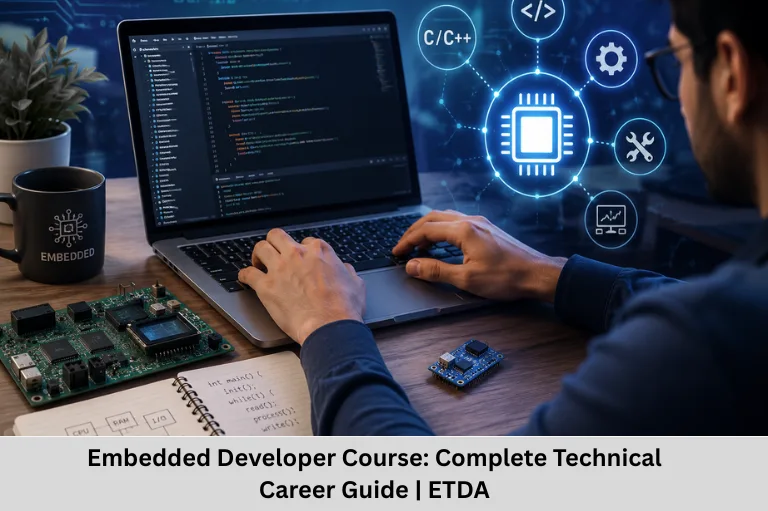
Learn what an embedded developer course covers, including C, Embedded C, microcontrollers, ARM, RTOS, protocols, debugging, projects, and career opportunities. Embedded Tech Development Academy (ETDA).
- Embedded Developer Course: Complete Technical Career Guide | ETDA
-
Embedded Developer Course: Complete Technical Guide for Aspiring Engineers
- What Is an Embedded Developer?
- C Programming for Embedded Development
- Embedded C Programming
- Microcontrollers and ARM Architecture
- Embedded Communication Protocols
- Interrupts and Real-Time Programming
- RTOS for Embedded Developers
- Embedded Debugging Skills
- Projects in an Embedded Developer Course
- Career Scope After an Embedded Developer Course
- Why Choose ETDA for an Embedded Developer Course?
- Conclusion
Embedded Developer Course: Complete Technical Guide for Aspiring Engineers
An embedded developer course is designed to build the programming, hardware, debugging, and system-level skills required to develop firmware for real-world embedded products. Embedded developers work on automotive ECUs, Internet of Things (IoT) devices, industrial controllers, robotics, consumer electronics, medical devices, and smart products.
For engineering students, fresh graduates, and professionals planning to enter this field, learning only programming is not enough. A developer must understand C programming, Embedded C, microcontrollers, ARM architecture, memory, GPIO, timers, interrupts, UART, SPI, I2C, CAN, RTOS, debugging, and hardware-software integration.
For learners searching for a Top Embedded Training Institute in Bangalore, Embedded Tech Development Academy (ETDA) provides practical embedded systems training covering core programming and hardware technologies, along with assured placement support. A structured learning path can help learners develop the technical foundation required for embedded development.
What Is an Embedded Developer?
An embedded developer designs, writes, tests, and maintains software that runs on dedicated hardware.
Unlike desktop applications, embedded firmware directly interacts with physical components.
A typical system can be represented as:
Sensor → Microcontroller → Firmware → Processing → Output
The developer is responsible for implementing the firmware that controls this process.
Responsibilities of an Embedded Developer
An embedded developer may work on:
- Firmware development
- Microcontroller programming
- Peripheral configuration
- Device drivers
- Communication protocols
- Hardware interfacing
- Debugging
- Performance optimization
- RTOS applications
- Product testing
Hardware-Software Interaction
Embedded developers need to understand how software controls registers, peripherals, memory, and external devices.
Why Technical Fundamentals Matter
A strong foundation helps developers identify whether a problem originates in the firmware, hardware connection, timing, communication interface, or system configuration.
C Programming for Embedded Development
C is one of the most important languages in an embedded developer course.
C Concepts to Learn
Learners should understand:
- Variables
- Data types
- Operators
- Loops
- Conditional statements
- Functions
- Arrays
- Strings
- Pointers
- Structures
- Unions
- Enumerations
- Preprocessor directives
Pointers and Memory
Pointers are particularly important because embedded programs frequently work with addresses, buffers, arrays, and hardware registers.
uint32_t value = 10;
uint32_t *ptr = &value;
Bitwise Operations
Embedded developers regularly manipulate individual bits.
register_value |= (1U << 3);This operation sets bit 3 while preserving the remaining bits.
Embedded C Programming
Embedded C applies C programming concepts to microcontroller hardware.
Important Embedded C Concepts
An embedded developer should understand:
volatileconststatic- Register access
- Bit manipulation
- Memory-mapped I/O
- Interrupt routines
- Peripheral drivers
Volatile Keyword
volatile is important when a value can change outside normal program execution, such as a hardware register or data modified by an interrupt.
Register-Level Programming
Understanding registers helps developers configure peripherals and understand how firmware controls hardware at a low level.
Microcontrollers and ARM Architecture
Microcontroller knowledge is essential for embedded development.
Microcontroller Fundamentals
A microcontroller commonly contains:
- CPU
- Flash memory
- SRAM
- GPIO
- Timers
- ADC
- PWM
- UART
- SPI
- I2C
- Interrupt controller
ARM Cortex-M
ARM Cortex-M processors are widely used in modern embedded products.
Learners should understand:
- CPU registers
- Memory map
- Stack
- Exceptions
- Interrupts
- NVIC
- Clock configuration
- Peripheral architecture
STM32 Development
STM32 is an important platform for practical embedded learning. Developers can work with GPIO, timers, ADC, PWM, UART, SPI, I2C, CAN, DMA, and interrupts.
Embedded Communication Protocols
Communication protocols allow microcontrollers to exchange information with sensors, displays, memory devices, and other controllers.
UART
UART provides asynchronous serial communication.
Important concepts include:
- Baud rate
- Start bit
- Stop bit
- Parity
- Transmission
- Reception
UART is commonly used for debugging, GPS modules, Bluetooth modules, and serial terminals.
SPI
SPI is a synchronous protocol commonly used for high-speed peripheral communication.
Typical signals include:
- SCLK
- MOSI
- MISO
- CS
SPI Applications
SPI can connect displays, Flash memory, sensors, ADCs, and DACs.
SPI Timing
Developers should understand clock polarity, clock phase, setup time, hold time, and chip-select behavior.
I2C and CAN
I2C commonly uses SDA and SCL and supports addressed devices on a shared bus.
CAN is particularly important in automotive and industrial applications because it supports multi-node communication and arbitration.
Interrupts and Real-Time Programming
Embedded products often need to respond to events within strict timing requirements.
Interrupt Fundamentals
The general flow is:
Hardware Event → Interrupt Request → ISR → Processing → Return
Interrupt Service Routine
An ISR handles a specific hardware event. Developers need to understand interrupt vectors, priorities, latency, and shared data.
ISR Best Practices
ISRs should generally be short and efficient. Lengthy processing can increase latency and interfere with other real-time operations.
RTOS for Embedded Developers
An RTOS becomes useful when applications contain multiple tasks that need predictable scheduling.
Important RTOS Concepts
An embedded developer should learn:
- Tasks
- Scheduling
- Priorities
- Semaphores
- Mutexes
- Queues
- Event groups
- Software timers
Example RTOS Architecture
A connected device may use:
Sensor Task → Processing Task → Communication Task → Logging Task
RTOS Career Value
RTOS skills are useful in automotive ECUs, robotics, industrial automation, Internet of Things (IoT) gateways, and complex consumer devices.
Embedded Debugging Skills
Debugging is a critical part of embedded development.
Common Debugging Tools
Developers may use:
- JTAG
- SWD
- Debug probes
- Oscilloscopes
- Logic analyzers
- Multimeters
- Serial terminals
Firmware Debugging
Debuggers allow developers to inspect variables, registers, memory, breakpoints, call stacks, and program execution.
Protocol Debugging
Logic analyzers help identify problems in UART, SPI, I2C, and CAN communication.
Projects in an Embedded Developer Course
Projects transform theoretical knowledge into practical engineering skills.
Beginner Projects
Examples include:
- LED controller
- Digital counter
- Push-button interface
- UART application
- Temperature monitor
Intermediate Projects
Learners can develop:
- I2C sensor interface
- SPI display controller
- ADC data logger
- PWM motor controller
- CAN communication node
Advanced Projects
Advanced projects can combine ARM, RTOS, sensors, CAN, Internet of Things (IoT) connectivity, and multiple peripherals.
Skills Demonstrated Through Projects
Projects demonstrate firmware development, hardware interfacing, debugging, protocol implementation, and software organization.
Career Scope After an Embedded Developer Course
An embedded developer course can prepare learners for several technical roles.
Embedded Software Engineer
Develops firmware and software for microcontroller-based products.
Firmware Engineer
Works on low-level software that interacts directly with hardware.
Automotive Embedded Engineer
Develops software for ECUs, sensors, vehicle communication, and automotive control systems.
IoT Embedded Developer
Develops connected devices using microcontrollers, sensors, protocols, and networking technologies.
Embedded Linux Developer
With additional Linux skills, developers can work on applications, device drivers, networking, and processor-based embedded platforms.
Why Choose ETDA for an Embedded Developer Course?
Embedded Tech Development Academy (ETDA) focuses on practical embedded technology training.
Technical Learning
The curriculum can cover:
- C
- Embedded C
- C++
- Data Structures
- ARM Cortex-M
- STM32
- LPC1768
- GPIO
- Timers
- ADC
- PWM
- UART
- SPI
- I2C
- CAN
- RTOS
- Embedded Linux
- Internet of Things (IoT)
Practical Exposure
Learners can practice firmware development, peripheral configuration, communication protocols, debugging, and real-world projects.
Assured Placement Support
Embedded Tech Development Academy (ETDA) provides assured placement support, including technical interview preparation, resume guidance, coding practice, mock interviews, aptitude preparation, and career guidance.
FAQs
What is an embedded developer course?
It is a technical program that teaches C, Embedded C, microcontrollers, ARM, peripherals, communication protocols, debugging, RTOS, and project development for embedded systems.
Is C necessary for becoming an embedded developer?
Yes. C is one of the most widely used programming languages for embedded firmware, especially for microcontroller-based systems.
What should I learn after C programming?
After C, learners can progress to Embedded C, data structures, microcontrollers, ARM Cortex-M, peripherals, UART, SPI, I2C, CAN, RTOS, and debugging.
Are embedded projects important?
Yes. Projects provide practical experience in firmware development, hardware interfacing, debugging, and communication protocols.
What jobs can I get after embedded training?
Potential roles include Embedded Software Engineer, Firmware Engineer, Automotive Embedded Engineer, IoT Embedded Developer, and Embedded Linux Developer.
Does ETDA provide placement support?
Yes. Embedded Tech Development Academy (ETDA) provides assured placement support, including technical interview preparation, coding practice, resume guidance, mock interviews, aptitude preparation, and career guidance.
Conclusion
An embedded developer course provides a structured path for learning the programming and hardware skills required to develop reliable embedded products. C, Embedded C, microcontrollers, ARM architecture, peripherals, communication protocols, RTOS, debugging, and project development form the core of this technical career.
For learners searching for a Top Embedded Training Institute in Bangalore, Embedded Tech Development Academy (ETDA) offers practical training across these technologies with assured placement support. The focus on hardware interaction, firmware development, debugging, and projects can help learners build stronger technical confidence.
When comparing a Top Embedded Training Institute in Bangalore, look beyond course duration and basic theory. Evaluate the curriculum, hands-on hardware exposure, projects, debugging practice, technical mentoring, and placement support. With consistent practice and practical project experience, learners can build a strong foundation for careers in firmware, automotive electronics, Internet of Things (IoT), robotics, and industrial automation.
Author: ETDA Trainers
Experience: 10+ Years of Industry Experience in Embedded Systems, IoT, and Embedded C Programming