
Embedded Hardware Training: Complete Technical Guide | ETDA
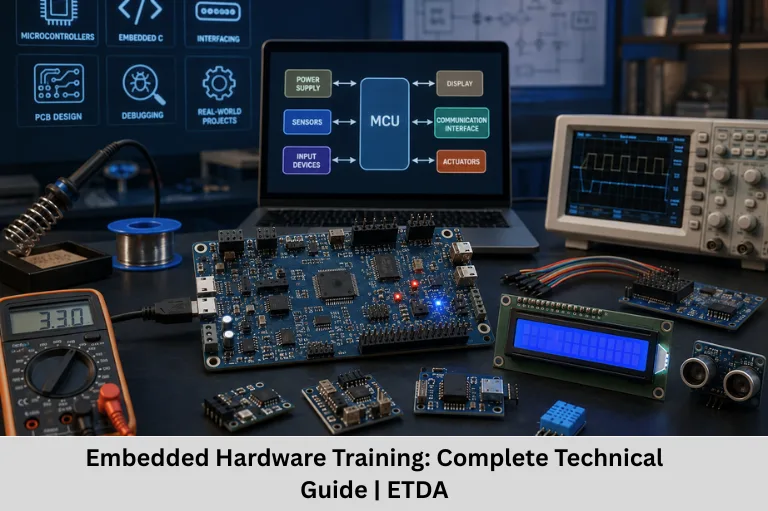
Learn embedded hardware training, microcontrollers, PCB basics, sensors, GPIO, UART, SPI, I2C, CAN, debugging, projects, and career skills with Embedded Tech Development Academy (ETDA).
- Embedded Hardware Training: Complete Technical Guide | ETDA
-
Embedded Hardware Training: Complete Technical Guide for Beginners
- What Is Embedded Hardware?
- Digital Electronics Fundamentals
- Microcontrollers in Embedded Hardware
- GPIO and Hardware Interfacing
- Analog Electronics for Embedded Hardware
- PWM and Motor Control
- Embedded Communication Interfaces
- Clocks, Reset and Power Supply
- PCB Fundamentals for Embedded Engineers
- Embedded Hardware Debugging
- Hardware-Software Integration
- Practical Projects in Embedded Hardware Training
- Why Choose ETDA for Embedded Hardware Training?
-
Career Opportunities After Embedded Hardware Training
- Embedded Hardware Engineer
- Embedded Firmware Engineer
- FAQs
- What is embedded hardware training?
- Is electronics knowledge necessary for embedded systems?
- Which microcontroller is good for learning embedded hardware?
- What tools are used for embedded hardware debugging?
- Do embedded hardware engineers need programming skills?
- What communication protocols should I learn?
- Does ETDA provide placement support?
- Why choose ETDA for embedded hardware training?
- Conclusion
Embedded Hardware Training: Complete Technical Guide for Beginners
Embedded systems are built through the combination of hardware and software. While firmware controls the behavior of a device, embedded hardware provides the physical components required to sense, process, communicate, and control real-world signals. Understanding this interaction is essential for engineers working in automotive electronics, industrial automation, robotics, Internet of Things (IoT), consumer electronics, medical devices, and other technology domains.
For engineering students and graduates searching for practical embedded hardware training, it is important to learn more than basic electronic components. A technical program should cover microcontrollers, digital electronics, analog interfaces, GPIO, timers, ADC, PWM, sensors, communication interfaces, power supplies, PCB fundamentals, debugging, and hardware-software integration.
Students looking for a Top Embedded Training Institute in Bangalore can consider Embedded Tech Development Academy (ETDA), which focuses on practical embedded technologies, hardware interfacing, firmware development, real-time systems, projects, and assured placement support.
This guide explains the important concepts covered in embedded hardware training and how these skills can prepare engineering students for embedded technology careers.
What Is Embedded Hardware?
Embedded hardware refers to the physical electronic components used inside an embedded system to perform a dedicated function.
A typical embedded hardware system may contain:
- Microcontroller or processor
- Memory
- Power supply
- Sensors
- Actuators
- Oscillator
- GPIO interfaces
- Communication peripherals
- Analog circuits
- Digital circuits
- Connectors
- PCB
The hardware provides the platform on which embedded firmware executes.
Hardware and Firmware Relationship
Embedded hardware and software must work together.
For example:
Sensor → Microcontroller → Firmware → Communication Interface → Output
A temperature sensor generates a signal. The microcontroller reads the signal, firmware processes it, and the system may display or transmit the temperature.
Why Hardware Knowledge Matters for Firmware Engineers
A firmware developer who understands hardware can more effectively:
- Read datasheets
- Configure peripherals
- Understand electrical signals
- Debug communication problems
- Identify hardware-related failures
- Configure microcontroller registers
- Work with development boards
Hardware-Software Co-Design
Modern embedded products require hardware and software to be developed with consideration for each other. Pin assignments, memory requirements, communication interfaces, clock configuration, and power requirements can directly affect firmware design.
Digital Electronics Fundamentals
Digital electronics is one of the foundations of embedded hardware training.
Digital Logic
Digital systems commonly represent information using binary values:
0 = LOW
1 = HIGH
Important digital concepts include:
- Logic gates
- Boolean algebra
- Truth tables
- Flip-flops
- Registers
- Counters
- Multiplexers
- Decoders
Logic Gates
The basic gates include:
- AND
- OR
- NOT
- NAND
- NOR
- XOR
- XNOR
Understanding these gates helps engineers understand how digital hardware performs logical operations.
Sequential Logic
Sequential circuits depend on previous states.
Examples include:
- Counters
- Shift registers
- Latches
- Flip-flops
These concepts are useful when understanding microcontroller peripherals and digital hardware.
Microcontrollers in Embedded Hardware
The microcontroller is often the central processing component of an embedded system.
What Does a Microcontroller Contain?
A typical microcontroller integrates:
- CPU core
- Flash memory
- SRAM
- GPIO
- Timers
- ADC
- PWM
- UART
- SPI
- I2C
- CAN
- Interrupt controller
ARM Cortex-M Microcontrollers
ARM Cortex-M-based microcontrollers are widely used in embedded products.
Common processor families include:
- Cortex-M0
- Cortex-M0+
- Cortex-M3
- Cortex-M4
- Cortex-M7
Training should help students understand the relationship between the CPU core, memory, peripherals, clock system, and interrupt controller.
Reading a Microcontroller Datasheet
A hardware-oriented engineer should learn how to locate:
- Pin descriptions
- Electrical characteristics
- Memory maps
- Peripheral registers
- Clock requirements
- Operating voltage
- GPIO specifications
- Communication peripheral details
GPIO and Hardware Interfacing
GPIO stands for General-Purpose Input/Output.
GPIO pins allow a microcontroller to interact with external hardware.
GPIO as Digital Output
A GPIO output can control:
- LED
- Relay
- Buzzer
- Digital actuator
For example, firmware can set a GPIO register to HIGH to turn on an LED through an appropriate circuit.
GPIO as Digital Input
GPIO inputs can read signals from:
- Push buttons
- Switches
- Digital sensors
- External controllers
Pull-Up and Pull-Down Resistors
Pull-up and pull-down resistors prevent input pins from remaining in an undefined floating state.
GPIO Electrical Considerations
Hardware training should also cover:
- Voltage levels
- Current limits
- Input thresholds
- Pull-up configuration
- Pull-down configuration
- Open-drain outputs
These details are important when connecting external components safely.
Analog Electronics for Embedded Hardware
Many real-world sensors generate analog signals, making analog electronics important in embedded systems.
ADC – Analog-to-Digital Conversion
An ADC converts an analog voltage into a digital value that the microcontroller can process.
For an N-bit ADC, the number of digital levels is:
2ᴺ
For example, a 12-bit ADC provides:
2¹² = 4096 levels
ADC Applications
ADC is commonly used for:
- Temperature measurement
- Battery monitoring
- Light sensing
- Pressure sensing
- Current measurement
- Potentiometer input
ADC Resolution
Higher ADC resolution allows smaller voltage differences to be represented digitally, although practical accuracy also depends on factors such as noise, reference voltage, circuit design, and sensor characteristics.
PWM and Motor Control
PWM, or Pulse Width Modulation, is an important embedded hardware technique.
What Is PWM?
PWM controls the average power delivered to a load by changing the duty cycle of a periodic digital signal.
For example:
Duty Cycle = ON Time / Total Period × 100
PWM Applications
PWM is used for:
- Motor speed control
- LED brightness control
- Servo motors
- Power control
- Fan control
Motor Interfacing
A microcontroller generally should not drive a motor directly. A suitable driver circuit or transistor-based interface is required because motors can require substantially more current than a microcontroller GPIO can provide.
Embedded Communication Interfaces
Embedded hardware training should include communication interfaces because modern products frequently contain multiple controllers and peripherals.
UART
UART provides asynchronous serial communication.
Typical applications include:
- GPS modules
- Bluetooth modules
- Debugging
- Serial terminals
Important concepts include:
- Baud rate
- Start bit
- Stop bit
- Parity
- Transmit
- Receive
SPI
SPI is a synchronous serial interface commonly used for relatively high-speed peripheral communication.
Typical signals are:
- SCLK
- MOSI
- MISO
- CS
SPI Applications
SPI is commonly used with:
- Displays
- Flash memory
- ADCs
- DACs
- Sensors
SPI Timing
Engineers should understand clock polarity, clock phase, setup time, hold time, and chip-select behavior when debugging SPI communication.
I2C
I2C normally uses two signals:
- SDA
- SCL
It allows multiple devices to share a bus through addressing.
Important concepts include:
- START
- STOP
- ACK
- NACK
- Addressing
- Repeated START
- Pull-up resistors
CAN
CAN is widely used in automotive and industrial embedded systems.
Important concepts include:
- CAN frames
- Identifiers
- Arbitration
- Bit timing
- Error detection
- CAN nodes
- Bus termination
Clocks, Reset and Power Supply
A microcontroller cannot operate correctly without appropriate clock, reset, and power circuitry.
Clock System
Microcontrollers can use:
- Internal oscillators
- External crystals
- PLL-based clock systems
Clock configuration affects CPU speed and peripheral timing.
Reset Circuit
Reset circuitry ensures that the microcontroller starts from a known state.
Reset sources can include:
- Power-on reset
- External reset
- Watchdog reset
- Software reset
Power Supply Design
Embedded hardware must provide stable operating voltage.
Engineers should understand:
- Voltage regulators
- Decoupling capacitors
- Power rails
- Grounding
- Current requirements
- Voltage tolerances
Poor power design can cause unpredictable firmware behavior.
PCB Fundamentals for Embedded Engineers
PCB knowledge is valuable even for firmware engineers.
What Is a PCB?
A Printed Circuit Board mechanically supports and electrically connects components through conductive tracks, pads, vias, and layers.
Important PCB Concepts
Students should understand:
- Schematic
- Components
- Footprints
- Traces
- Vias
- Ground planes
- Power planes
- Connectors
PCB and Firmware Interaction
PCB design determines which microcontroller pins connect to sensors, displays, communication devices, and other peripherals.
Therefore, firmware developers need to understand the board schematic and pin mapping before writing low-level drivers.
Embedded Hardware Debugging
Debugging is one of the most important practical skills in embedded development.
Common Hardware Debugging Tools
Engineers may use:
- Digital multimeter
- Oscilloscope
- Logic analyzer
- JTAG debugger
- SWD debugger
- Power supply
- Function generator
Logic Analyzer
A logic analyzer is particularly useful for observing digital protocols such as:
- UART
- SPI
- I2C
- CAN
Oscilloscope
An oscilloscope can help identify:
- Clock problems
- Signal distortion
- Noise
- Voltage fluctuations
- Timing problems
- PWM behavior
Hardware-Software Integration
A strong embedded engineer should be able to connect hardware behavior with firmware execution.
Example: Sensor Interface
Consider an I2C temperature sensor.
The development process may involve:
- Identify the sensor address.
- Configure the microcontroller’s I2C peripheral.
- Generate START condition.
- Send the device address.
- Read the sensor register.
- Convert the received data.
- Display or transmit the result.
Debugging the Interface
If communication fails, the engineer should check:
- Power supply
- Ground
- SDA/SCL connections
- Pull-up resistors
- Device address
- Clock configuration
- Firmware initialization
Why This Skill Matters
This hardware-software troubleshooting ability is one of the key differences between theoretical knowledge and practical embedded engineering.
Practical Projects in Embedded Hardware Training
Projects help students apply hardware concepts in realistic scenarios.
Beginner Projects
Examples include:
- LED controller
- Digital switch
- Traffic light controller
- Digital thermometer
- Buzzer control
Intermediate Projects
Students can work on:
- I2C sensor interfacing
- SPI display controller
- UART-based communication
- ADC-based monitoring system
- PWM motor controller
Advanced Projects
Advanced projects can include:
- CAN-based automotive node
- RTOS-based embedded controller
- Internet of Things (IoT) sensor node
- Industrial monitoring system
- Embedded Linux gateway
Skills Developed Through Projects
Projects help learners improve:
- Circuit understanding
- Firmware development
- Datasheet reading
- Debugging
- Protocol analysis
- Hardware-software integration
Why Choose ETDA for Embedded Hardware Training?
Embedded Tech Development Academy (ETDA) focuses on practical embedded systems education for engineering students, graduates, and aspiring embedded professionals.
Technical Learning
Training can cover:
- Digital electronics
- C programming
- Embedded C
- C++
- Data Structures
- ARM Cortex-M
- STM32
- LPC1768
- GPIO
- Timers
- ADC
- PWM
- UART
- SPI
- I2C
- CAN
- Ethernet
- RTOS
- Embedded Linux
- Internet of Things (IoT)
Hands-On Hardware Exposure
Students can gain practical exposure by working with microcontrollers, sensors, communication interfaces, and embedded development boards.
Assured Placement Support
Embedded Tech Development Academy (ETDA) also provides assured placement support, including:
- Technical interview preparation
- Resume preparation
- Embedded C coding practice
- Mock interviews
- Aptitude preparation
- HR interview preparation
- Career guidance
Career Opportunities After Embedded Hardware Training
Embedded hardware skills can support careers across several engineering domains.
Embedded Hardware Engineer
Works on electronic circuits, microcontrollers, interfaces, schematics, and hardware validation.
Embedded Firmware Engineer
Develops low-level software that controls microcontrollers and interacts directly with hardware.
Hardware Validation Engineer
Tests electronic designs, validates interfaces, analyzes failures, and verifies system behavior.
Automotive Embedded Engineer
Works with automotive ECUs, CAN communication, sensors, actuators, diagnostics, and vehicle electronics.
IoT Hardware Engineer
Designs and integrates sensors, microcontrollers, connectivity modules, power systems, and Internet of Things (IoT) devices.
FAQs
What is embedded hardware training?
Embedded hardware training teaches the fundamentals of electronic hardware used in embedded products, including microcontrollers, digital electronics, sensors, GPIO, ADC, PWM, communication interfaces, power supplies, PCB basics, and hardware debugging.
Is electronics knowledge necessary for embedded systems?
Basic electronics and digital electronics knowledge is highly useful. Engineers should understand voltage, current, signals, logic levels, sensors, and microcontroller interfaces.
Which microcontroller is good for learning embedded hardware?
ARM Cortex-M-based microcontrollers are widely used for learning and professional embedded development. STM32 and LPC1768 are examples of platforms students may encounter.
What tools are used for embedded hardware debugging?
Common tools include multimeters, oscilloscopes, logic analyzers, JTAG/SWD debuggers, power supplies, and function generators.
Do embedded hardware engineers need programming skills?
Yes. Programming knowledge, particularly C and Embedded C, is valuable because modern embedded development requires close interaction between hardware and firmw
What communication protocols should I learn?
UART, SPI, I2C, and CAN are important embedded interfaces. Ethernet and wireless technologies can be added for networking and IoT applications.
Does ETDA provide placement support?
Yes. Embedded Tech Development Academy (ETDA) provides assured placement support, including technical interview preparation, resume guidance, coding practice, mock interviews, aptitude preparation, and career guidance.
Why choose ETDA for embedded hardware training?
Embedded Tech Development Academy (ETDA) combines hardware and firmware concepts through training in digital electronics, C, Embedded C, ARM, STM32, LPC1768, peripherals, communication protocols, RTOS, Embedded Linux, Internet of Things (IoT), and practical projects, making it an option for students seeking a Top Embedded Training Institute in Bangalore.
Conclusion
Embedded hardware training provides the technical foundation needed to understand how electronic products are designed, controlled, tested, and debugged. From digital electronics and microcontrollers to ADC, PWM, communication protocols, PCB fundamentals, power supplies, and debugging tools, each topic contributes to building practical embedded engineering skills.
For engineering students searching for a Top Embedded Training Institute in Bangalore, Embedded Tech Development Academy (ETDA) offers practical learning across embedded hardware, firmware, ARM microcontrollers, communication protocols, RTOS, Embedded Linux, and Internet of Things (IoT). The training approach combines technical concepts with hands-on projects and assured placement support.
Choosing a Top Embedded Training Institute in Bangalore should not be based only on course duration or certification. Students should evaluate the technical curriculum, hardware exposure, project work, debugging practice, trainer guidance, and career preparation.
With a strong understanding of both hardware and firmware, learners can build a solid foundation for careers in embedded systems, automotive electronics, industrial automation, Internet of Things (IoT), robotics, consumer electronics, and other hardware-driven technology fields.
Author: ETDA Trainers
Experience: 10+ Years of Industry Experience in Embedded Systems, IoT, and Embedded C Programming