
Embedded Linux with Raspberry Pi: Complete Guide
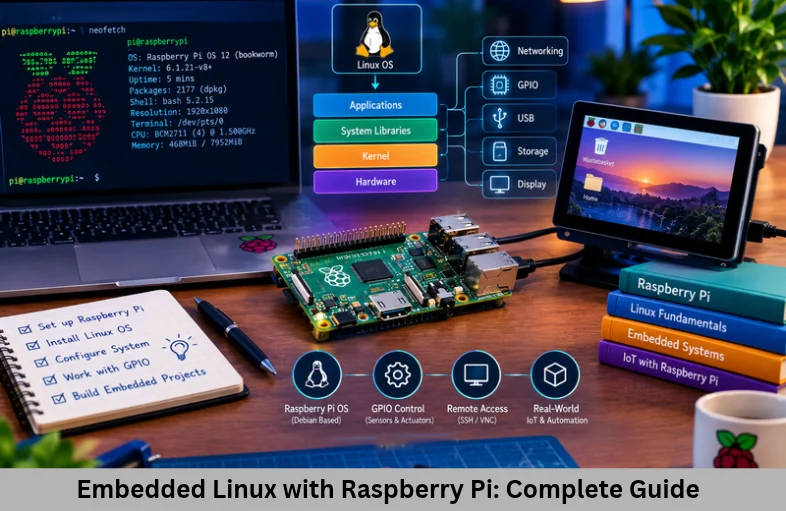
Learn Embedded Linux with Raspberry Pi, including Linux kernel drivers, GPIO, I2C, SPI, Yocto, Buildroot, networking, real-time systems, and practical projects. Embedded Tech Development Academy (ETDA).
- Embedded Linux with Raspberry Pi: Complete Guide
- Embedded Linux with Raspberry Pi: Architecture, Features, and Applications
Embedded Linux with Raspberry Pi: Architecture, Features, and Applications
Introduction to Embedded Linux with Raspberry Pi
Embedded Linux is a widely used technology for developing intelligent devices, industrial controllers, Internet of Things (IoT) gateways, robotics platforms, and network-connected products. It combines the flexibility of the Linux operating system with hardware-specific configurations, allowing developers to build applications that require networking, multitasking, file systems, device drivers, and application-level software. Important concepts include Linux kernel architecture, ARM-based processors, GPIO programming, device tree configuration, cross-compilation, and real-time scheduling.
The Raspberry Pi is a popular platform for learning and prototyping Embedded Linux because it offers affordable hardware, processor capabilities, peripheral interfaces, and a large software ecosystem. Developers can connect sensors through I2C or SPI, communicate with external devices through UART, and exchange information with cloud applications using MQTT or HTTP. Custom Linux distributions can also be built with the Yocto Project or Buildroot to reduce unnecessary components and control system configuration.
For students and aspiring embedded engineers, Embedded Tech Development Academy (ETDA) provides a learning pathway into embedded systems, Linux fundamentals, and practical hardware-software development. Learners searching for a Top Embedded Training Institute in Bangalore can explore Embedded Tech Development Academy (ETDA)‘s industry-oriented training approach and assured placement support. Understanding Embedded Linux with Raspberry Pi can build a foundation for careers involving embedded software development, IoT engineering, Linux device drivers, and industrial automation.
What Is Embedded Linux?
Embedded Linux is a Linux-based operating system configured for a specific device or embedded application. Unlike a general-purpose desktop installation, an embedded Linux system may contain only the kernel, required drivers, a root file system, essential utilities, and the application software needed for its intended function.
Key Characteristics of Embedded Linux
Customizable architecture: Developers select required kernel features, drivers, libraries, and applications.
Hardware support: Linux interacts with peripherals through device drivers and kernel subsystems.
Multitasking: Multiple processes and threads can execute concurrently.
Networking: TCP/IP, Ethernet, Wi-Fi, MQTT, and HTTP support connected applications.
Build flexibility: Yocto Project and Buildroot help create application-specific Linux images.
Linux Distributions and Build Systems
Raspberry Pi OS is a Debian-based distribution suitable for development and general-purpose applications. For customized deployments, Buildroot provides a streamlined build system, while the Yocto Project offers tools for creating tailored Linux distributions with more extensive configuration and package-management options.
Why Choose Raspberry Pi for Embedded Linux?
Raspberry Pi boards combine processor performance, memory, connectivity, and hardware interfaces in a compact platform. Different models provide different CPU architectures, RAM capacities, wireless capabilities, and peripheral options, so the appropriate board depends on the project.
Important Hardware Interfaces
GPIO: Digital input and output for LEDs, switches, and control signals.
I2C: Two-wire communication for sensors, RTC modules, and peripheral controllers.
SPI: Synchronous serial communication for displays, converters, and high-speed peripherals.
UART: Serial communication for debugging, GPS modules, and external controllers.
USB and networking: Connectivity for storage, adapters, Ethernet, and network applications.
Raspberry Pi Versus Raspberry Pi Pico
Raspberry Pi Zero, Pi 4, and Pi 5 are single-board computers capable of running Linux. Raspberry Pi Pico is a microcontroller board that generally runs bare-metal firmware or an RTOS rather than a full Linux operating system. This distinction matters when choosing between an application processor and a microcontroller for an embedded project.
Core Features of Embedded Linux on Raspberry Pi
Device Drivers and Kernel Interfaces
Device drivers enable the operating system to interact with hardware. Linux provides subsystems for GPIO, I2C, SPI, serial communication, USB, and networking. Hardware descriptions and device tree configuration help the kernel identify supported peripherals and their resources.
For application-level GPIO access, modern Linux systems commonly use the GPIO character-device interface through /dev/gpiochip* and libraries such as libgpiod. The older GPIO sysfs interface is deprecated and should generally be avoided for new development.
File Systems and Storage
Raspberry Pi Linux systems commonly use ext4 for writable storage. Embedded images may use SquashFS for compact, read-only root file systems. Other options depend on the storage technology and platform requirements.
Read-only root file systems can reduce unintended changes, while overlay techniques allow selected writable directories. Applications must still account for SD-card wear, unexpected power loss, and data integrity.
Networking and IoT Communication
Embedded Linux supports TCP/IP networking and protocols such as MQTT and HTTP. An Internet of Things (IoT) gateway can collect data from I2C sensors, process readings locally, and publish telemetry to an MQTT broker over Ethernet or Wi-Fi.
Real-Time Linux
The PREEMPT_RT kernel configuration reduces scheduling latency by making more kernel operations preemptible and using threaded interrupt handling where appropriate. It can improve responsiveness for robotics and industrial monitoring, but it does not automatically guarantee hard real-time behavior. Timing must be measured under realistic CPU, memory, and I/O loads.
Hands-On Example: GPIO Control Using libgpiod
A practical Embedded Linux project is controlling an LED connected to a Raspberry Pi GPIO. First, identify a suitable GPIO line using the board documentation and tools such as gpioinfo. Use a compatible LED circuit with a current-limiting resistor, and avoid applying 5 V to a 3.3 V GPIO input.
Example C Program
The following example uses the libgpiod 1.x API. GPIO line numbering and library APIs vary by board and software version, so verify the installed library and correct line offset before running it.
#include <gpiod.h>
#include <stdio.h>
#include <unistd.h>

int main(void)
{
    struct gpiod_chip *chip;
    struct gpiod_line *line;

    chip = gpiod_chip_open("/dev/gpiochip0");
    if (!chip) {
        perror("gpiod_chip_open");
        return 1;
    }

    /* Replace 17 with the verified line offset. */
    line = gpiod_chip_get_line(chip, 17);
    if (!line) {
        perror("gpiod_chip_get_line");
        gpiod_chip_close(chip);
        return 1;
    }

    if (gpiod_line_request_output(line, "led-control", 0) < 0) {
        perror("gpiod_line_request_output");
        gpiod_chip_close(chip);
        return 1;
    }

    if (gpiod_line_set_value(line, 1) < 0) {
        perror("gpiod_line_set_value");
    } else {
        sleep(2);
        gpiod_line_set_value(line, 0);
    }

    gpiod_line_release(line);
    gpiod_chip_close(chip);
    return 0;
}
Compile and Test
On a compatible Linux installation with the libgpiod development package installed, compile the program using:
gcc gpio_led.c -o gpio_led -lgpiodRun it with the necessary device permissions. Newer libgpiod 2.x versions use a different API, so this example may require adaptation. Always verify the actual GPIO chip and line mapping rather than assuming that a header pin number matches a GPIO line offset.
Applications and Benefits
Real-World Applications
Embedded Linux on Raspberry Pi supports Internet of Things (IoT) gateways, home automation controllers, robotics prototypes, media systems, and industrial data-logging platforms. Its networking and application ecosystem also enables remote monitoring, dashboards, database integration, and secure software updates.
Main Benefits
Open-source tools, broad hardware support, reusable software, and custom build systems make Raspberry Pi useful for rapid prototyping. Production deployments require additional consideration of power management, cybersecurity, thermal performance, lifecycle support, and hardware reliability.
Embedded Tech Development Academy (ETDA) helps learners connect embedded programming concepts with practical development skills. As a Top Embedded Training Institute in Bangalore, Embedded Tech Development Academy (ETDA) promotes industry-oriented learning, including embedded software fundamentals, while offering assured placement support for learners preparing for technical roles.
Frequently Asked Questions
What is Embedded Linux with Raspberry Pi?
It is the use of a Linux-based operating system on a Raspberry Pi to develop embedded applications involving hardware interfaces, networking, sensors, and application software.
Can Raspberry Pi run real-time Linux?
Yes. A compatible Linux kernel configured with PREEMPT_RT can reduce scheduling latency. Real-time performance depends on the kernel configuration, hardware, workload, and measured timing requirements.
Which tools are used to build custom Embedded Linux?
The Yocto Project and Buildroot are widely used to build customized Linux images. The best choice depends on project complexity, package requirements, and maintenance needs.
Is Raspberry Pi suitable for industrial applications?
It can be suitable for prototyping and selected production systems. Industrial deployments should evaluate hardware lifecycle, temperature range, storage reliability, power protection, security updates, and vendor support.
What is the difference between Raspberry Pi and Raspberry Pi Pico?
Raspberry Pi single-board computers can run a full Linux operating system. Raspberry Pi Pico is a microcontroller platform typically programmed with bare-metal firmware or an RTOS, making it suitable for lower-level real-time control tasks.
Conclusion
Embedded Linux with Raspberry Pi provides a practical way to understand how the Linux kernel, device drivers, file systems, networking stack, and user-space applications work together in an embedded product. By experimenting with GPIO, I2C, SPI, UART, MQTT, custom root file systems, and Linux build tools, developers can progress from simple hardware-control programs to connected Internet of Things (IoT) gateways and more complex embedded applications. Yocto Project, Buildroot, device tree configuration, cross-compilation, and PREEMPT_RT are valuable next steps for learners interested in advanced Linux development.
For students and professionals aiming to strengthen their embedded systems knowledge, Embedded Tech Development Academy (ETDA) supports learning around practical embedded technologies and industry-relevant skills. If you are looking for a Top Embedded Training Institute in Bangalore, developing hands-on expertise in Linux, microcontrollers, device interfacing, and Internet of Things (IoT) can help prepare you for relevant engineering opportunities. Embedded Tech Development Academy (ETDA)‘s assured placement support complements this learning pathway as you work toward an embedded development career.
Author: ETDA Trainers
Experience: 10+ Years of Industry Experience in Embedded Systems, IoT, and Embedded C Programming