
Embedded Systems Course in Bangalore | ETDA Training
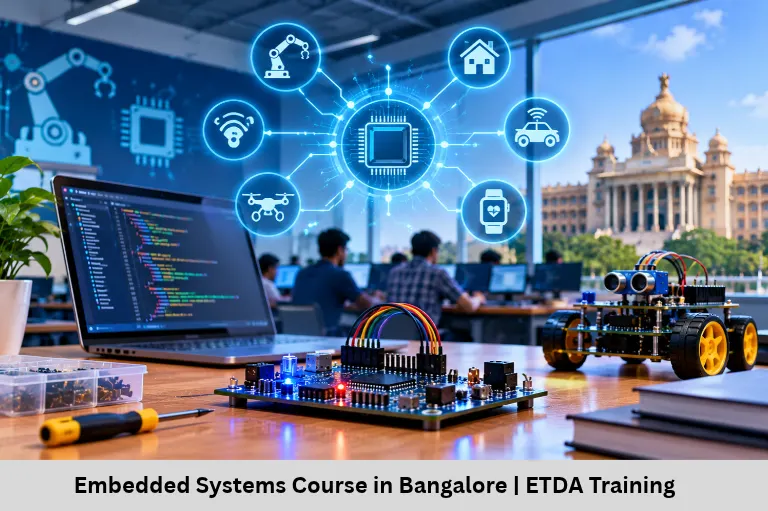
Join an embedded systems course in Bangalore at Embedded Tech Development Academy (ETDA). Learn C, Embedded C, ARM, STM32, RTOS, Internet of Things (IoT), debugging, practical projects, and assured placement support.
- Embedded Systems Course in Bangalore | ETDA Training
-
Embedded Systems Course in Bangalore: Technical Training for Engineering Students
- Introduction
- What Is Embedded Systems Training?
- C Programming and Embedded C Fundamentals
- Microcontrollers and ARM Cortex-M Development
- Communication Protocols in Embedded Systems
- RTOS, Embedded Linux, and IoT Training
- Practical Embedded Systems Projects
- Why Choose ETDA for an Embedded Systems Course in Bangalore?
- Career Opportunities After Embedded Training
-
Frequently Asked Questions
- Which embedded systems course is suitable for beginners?
- What programming languages are used in embedded systems?
- What topics should an embedded systems course cover?
- Does ETDA provide placement support?
- Are projects important for embedded engineering students?
- What careers can students pursue after embedded training?
- Conclusion
Embedded Systems Course in Bangalore: Technical Training for Engineering Students
Introduction
Embedded systems are an important part of modern technology, powering automotive electronics, industrial automation, robotics, medical equipment, smart appliances, and Internet of Things (IoT) devices. These systems combine hardware and software to perform dedicated functions with specific performance, memory, and timing requirements.
For engineering students interested in firmware development and hardware-oriented programming, choosing an embedded systems course in Bangalore can provide a structured path toward technical skill development. Students need to understand programming, microcontroller architecture, peripheral interfacing, communication protocols, debugging, and real-time software development.
Students searching for a Top Embedded Training Institute in Bangalore can explore Embedded Tech Development Academy (ETDA), which focuses on practical embedded systems training, technical projects, and assured placement support. For learners seeking a Top Embedded Training Institute in Bangalore, Embedded Tech Development Academy (ETDA) combines programming fundamentals with hardware-oriented learning to help students prepare for embedded engineering opportunities.
What Is Embedded Systems Training?
Embedded systems training teaches students how to develop firmware for electronic devices using microcontrollers or microprocessors. Unlike general application programming, embedded development requires direct interaction with hardware resources and peripheral registers.
A typical embedded systems includes a processor, memory, input/output interfaces, firmware, and external components such as sensors, displays, motors, and communication modules.
Important Embedded Technologies
A comprehensive course should introduce:
C programming and Embedded C
C++ fundamentals
Microcontroller architecture
GPIO and peripheral configuration
Timers and interrupts
ADC and PWM
UART, SPI, I2C, and CAN
ARM Cortex-M and STM32
RTOS fundamentals
Embedded Linux and Internet of Things (IoT)
Firmware debugging and testing
Hardware and Software Integration
Consider an automatic temperature-control system. A sensor produces an electrical signal, an ADC converts it into a digital value, and the firmware compares the temperature against a predefined threshold. The controller then adjusts a fan using PWM.
Practical Understanding
Developing this application teaches students how software decisions affect hardware behavior. It also introduces sensor interfacing, register configuration, timing, signal measurement, and debugging.
C Programming and Embedded C Fundamentals
C programming is one of the most important foundations of embedded development. It provides efficient execution, pointers, bitwise operations, and memory-level programming capabilities.
Essential C Concepts
Students should understand variables, data types, operators, conditional statements, loops, functions, arrays, strings, pointers, structures, and unions.
Pointers are especially important because embedded programs frequently manipulate memory addresses, data buffers, and hardware-related information.
Bit Manipulation in Embedded C
Microcontroller peripherals are controlled using registers containing individual configuration bits.
register_value |= (1U << 5);This operation sets bit 5 while preserving other bits. Students should also learn how to clear, toggle, and check register bits using bitwise operators.
Memory and Volatile Variables
The volatile keyword is commonly used with hardware registers and variables that may change outside normal program execution. Understanding memory, pointers, and register access helps students develop reliable firmware.
Microcontrollers and ARM Cortex-M Development
Microcontrollers integrate a processor, memory, and peripherals into a single chip. They are widely used in automotive electronics, consumer products, industrial controllers, and Internet of Things (IoT) applications.
Microcontroller Architecture
Students should learn about CPU operation, Flash memory, SRAM, clock systems, interrupt controllers, GPIO, timers, ADC, and communication peripherals.
ARM Cortex-M architecture introduces concepts such as registers, stack operation, exception handling, interrupt priorities, and memory mapping.
STM32 Development
STM32 development boards provide practical experience with GPIO, timers, ADC, PWM, UART, SPI, I2C, CAN, and interrupts. Students can configure peripherals, compile firmware, flash programs, and test hardware behavior.
Firmware Development Workflow
A typical development workflow includes writing source code, compiling it, generating firmware, programming the microcontroller, testing functionality, and debugging errors. Learning this workflow helps students understand actual embedded development practices.
Communication Protocols in Embedded Systems
Embedded devices exchange data with sensors, displays, memory devices, controllers, and other electronic systems.
UART Communication
UART is an asynchronous serial communication protocol commonly used for debugging and device communication. Students should understand baud rate, transmit and receive signals, start bits, stop bits, and serial data formats.
SPI and I2C Protocols
SPI uses clock, data, and chip-select signals for synchronous communication. I2C uses SDA and SCL lines and supports multiple addressed devices on a shared bus.
CAN Communication
CAN is widely used in automotive and industrial embedded applications. Important topics include message identifiers, arbitration, frame structure, acknowledgement, bit timing, and error detection.
Protocol Debugging
Logic analyzers and oscilloscopes help verify communication signals and identify timing problems, incorrect configurations, missing acknowledgements, and wiring issues.
RTOS, Embedded Linux, and IoT Training
Modern embedded applications often require multiple tasks, networking, and operating-system support.
Real-Time Operating Systems
An RTOS manages concurrent tasks according to scheduling policies and timing requirements. Students should understand task creation, priorities, scheduling, queues, semaphores, mutexes, and software timers.
Embedded Linux Fundamentals
Advanced embedded training can introduce Linux commands, processes, threads, file systems, cross-compilation, device drivers, and networking.
IoT Application Development
Internet of Things (IoT) systems connect embedded devices with networks and cloud applications. Students can learn sensor data collection, communication modules, data transmission, and system integration while understanding reliability and security considerations.
Practical Embedded Systems Projects
Projects help students combine programming, hardware interfacing, communication, and debugging into working applications.
Beginner Projects
Students can develop LED control, push-button interfaces, UART communication applications, and temperature-monitoring systems.
Intermediate Projects
More advanced applications include ADC data loggers, PWM motor controllers, SPI display interfaces, I2C sensor systems, and CAN communication nodes.
Advanced Project Development
Students can progress toward RTOS-based monitoring systems, Internet of Things (IoT) sensor applications, and embedded controllers that combine multiple peripherals.
Project Documentation
Students should document system architecture, firmware modules, circuit connections, test results, and debugging methods. This improves technical understanding and helps them explain their projects during interviews.
Why Choose ETDA for an Embedded Systems Course in Bangalore?
Embedded Tech Development Academy (ETDA) provides practical embedded systems training designed to help engineering students build technical foundations and develop industry-oriented skills.
Technical Learning at ETDA
Training areas include C, Embedded C, C++, data structures, 8051, ARM Cortex-M, STM32, LPC1768, GPIO, timers, ADC, PWM, UART, SPI, I2C, CAN, RTOS, Embedded Linux, Internet of Things (IoT), and debugging.
Students can strengthen their programming skills while learning how firmware interacts with electronic hardware.
Practical Training and Career Preparation
Practical exercises and project development help students understand peripheral configuration, firmware testing, communication protocols, and debugging. These skills are relevant to entry-level embedded engineering roles.
Assured Placement Support
Embedded Tech Development Academy (ETDA) provides assured placement support to help students prepare for employment opportunities. Career preparation can include coding practice, technical interview preparation, resume guidance, mock interviews, aptitude preparation, and HR interview preparation.
Students should verify the applicable placement-support terms, eligibility conditions, and services before enrollment.
Career Opportunities After Embedded Training
An embedded systems course can help students work toward several technical career paths.
Embedded Software Engineer: Develops firmware for microcontrollers and embedded processors.
Firmware Engineer: Implements low-level software and hardware interfaces.
Automotive Embedded Engineer: Works with ECUs, CAN communication, diagnostics, and automotive electronics.
Internet of Things (IoT) Developer: Develops connected devices using sensors, microcontrollers, and communication technologies.
Embedded Linux Developer: Works with embedded applications, device drivers, and processor-based platforms.
Career opportunities depend on technical proficiency, practical experience, project quality, and interview performance.
Frequently Asked Questions
Which embedded systems course is suitable for beginners?
A course covering C programming, Embedded C, electronics fundamentals, microcontrollers, peripheral interfacing, and practical projects is suitable for beginners.
What programming languages are used in embedded systems?
C and Embedded C are widely used for firmware development. C++ is also used in many embedded applications, while Python is useful for scripting, testing, and certain development workflows.
What topics should an embedded systems course cover?
Students should learn microcontrollers, ARM, STM32, GPIO, timers, ADC, PWM, interrupts, UART, SPI, I2C, CAN, RTOS, debugging, and project development.
Does ETDA provide placement support?
Yes. Embedded Tech Development Academy (ETDA) provides assured placement support with career preparation activities such as coding practice, resume guidance, and interview preparation.
Are projects important for embedded engineering students?
Yes. Projects provide practical experience in firmware development, hardware interfacing, testing, debugging, and technical documentation.
What careers can students pursue after embedded training?
Students can prepare for embedded software engineering, firmware development, automotive embedded engineering,Internet of Things (IoT) development, and embedded Linux roles.
Conclusion
Choosing an embedded systems course in Bangalore can be an important step for engineering students interested in firmware development, automotive electronics, robotics, Internet of Things (IoT), and industrial automation. A strong course should combine programming fundamentals, microcontroller architecture, peripheral interfacing, communication protocols, debugging, and practical project development.
For students searching for a Top Embedded Training Institute in Bangalore, Embedded Tech Development Academy (ETDA) offers practical technical learning and assured placement support to help learners prepare for engineering opportunities.
When comparing a Top Embedded Training Institute in Bangalore, students should evaluate curriculum depth, hardware access, trainer guidance, project quality, and placement preparation. Embedded Tech Development Academy (ETDA)‘s technical learning approach helps students strengthen their embedded development foundation and prepare for industry-oriented roles.
Author: ETDA Trainers
Experience: 10+ Years of Industry Experience in Embedded Systems, IoT, and Embedded C Programming