
Embedded Systems Course with Placement: Complete Career Guide | ETDA
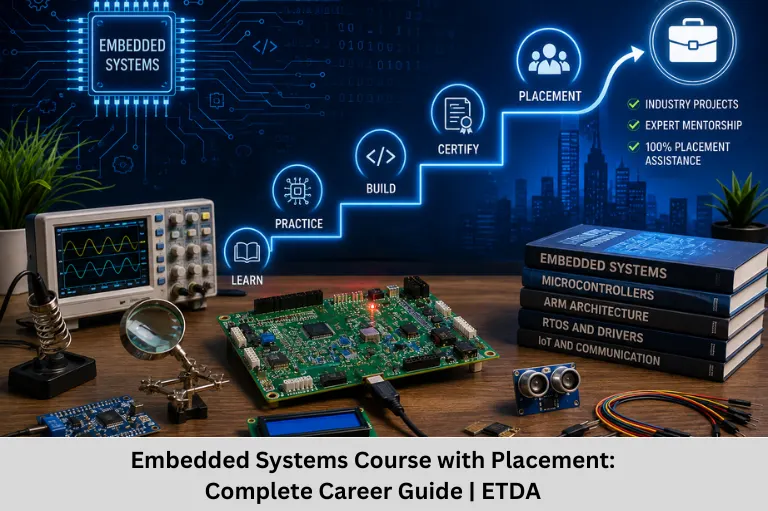
Explore an embedded systems course with placement covering C, Embedded C, ARM, microcontrollers, UART, SPI, I2C, CAN, RTOS, projects, and career preparation. Embedded Tech Development Academy (ETDA).
- Embedded Systems Course with Placement: Complete Career Guide | ETDA
-
Embedded Systems Course with Placement: Complete Guide for Beginners
- What Is an Embedded Systems Course?
- Why Choose an Embedded Systems Course with Placement?
- C Programming for Embedded Systems
- Embedded C and Microcontroller Programming
- Communication Protocols Every Embedded Engineer Should Know
- Interrupts and Real-Time Embedded Programming
- RTOS in Embedded Systems
- Embedded Linux and Advanced Learning
- Importance of Hands-On Embedded Projects
- How to Choose the Right Embedded Training Institute
- Why Choose Embedded Tech Development Academy (ETDA)?
- Career Opportunities After Embedded Systems Training
-
Why Placement Support Matters
- Technical Interview Preparation
- FAQs
- What is an embedded systems course with placement?
- Is C programming necessary for embedded systems?
- What technologies should I learn for an embedded job?
- Are embedded systems projects important for placement?
- What are the career opportunities after embedded systems training?
- What should I check before joining an embedded systems course?
- Does ETDA provide assured placement support?
- Why is ETDA a good choice for embedded training?
- Conclusion
Embedded Systems Course with Placement: Complete Guide for Beginners
Embedded systems power a wide range of products, including automobiles, medical devices, industrial controllers, smart appliances, consumer electronics, robotics, and Internet of Things (IoT) devices. As these products become more intelligent and connected, engineers with practical embedded development skills are increasingly important.
However, learning embedded systems requires more than understanding programming syntax. A good embedded systems course with placement should combine C programming, Embedded C, microcontrollers, electronics, communication protocols, debugging, real-time operating systems, projects, and career preparation.
For engineering students searching for a Top Embedded Training Institute in Bangalore, Embedded Tech Development Academy (ETDA) provides technical training focused on practical embedded development along with assured placement support. The goal is to help learners build skills that can be applied to real embedded software and firmware development.
What Is an Embedded Systems Course?
An embedded systems course is a structured technical program that teaches students how to design, program, test, and debug systems built around microcontrollers or processors.
Unlike general software development, embedded development requires engineers to understand the interaction between hardware and software.
Core Areas of Embedded Systems
A comprehensive course generally covers:
- C programming
- Embedded C
- C++
- Data Structures
- Digital electronics
- Microcontrollers
- ARM architecture
- GPIO
- Timers
- Interrupts
- ADC and PWM
- UART
- SPI
- I2C
- CAN
- Ethernet
- RTOS
- Embedded Linux
- Internet of Things (IoT)
- Debugging
- Embedded projects
Hardware and Software Integration
An embedded developer may write software that directly controls a hardware component.
For example:
Sensor → Microcontroller → Firmware → Decision → Actuator
The firmware reads sensor data, processes it, and controls the required hardware based on application logic.
Why This Combination Matters
This hardware-software interaction is what makes embedded development different from many conventional programming jobs. Engineers need to understand both the code and the hardware behavior behind that code.
Why Choose an Embedded Systems Course with Placement?
Learning technical concepts is only one part of starting an embedded career. Students also need to understand how those skills are evaluated during technical interviews.
Industry-Oriented Technical Skills
A placement-focused course should teach concepts that are commonly relevant to embedded development, including:
- Pointers
- Memory management
- Bit manipulation
- Registers
- Interrupts
- Peripheral configuration
- Communication protocols
- Microcontroller architecture
- Debugging
Practical Coding
Students should regularly write programs rather than simply watching demonstrations.
Examples include:
- GPIO programming
- UART drivers
- SPI communication
- I2C sensor interfacing
- Timer-based applications
- ADC data acquisition
Interview Preparation
Placement preparation can include:
- Technical questions
- C programming problems
- Embedded C questions
- Microcontroller questions
- Project discussions
- Mock interviews
- Resume preparation
C Programming for Embedded Systems
C programming is one of the most important foundations for embedded development.
C Topics Beginners Should Learn
Students should understand:
- Variables
- Data types
- Operators
- Loops
- Conditional statements
- Functions
- Arrays
- Strings
- Pointers
- Structures
- Unions
- Enumerations
- Preprocessor directives
Pointers and Memory
Pointers are particularly important because embedded software frequently interacts with memory addresses and hardware registers.
For example:
The exact address and usage depend on the target microcontroller.
Bit Manipulation
Embedded developers frequently use bitwise operations to configure registers.
These operations can set and clear individual bits.
Embedded C and Microcontroller Programming
After learning C, students should understand how C is used in resource-constrained embedded systems.
Embedded C Concepts
Important topics include:
volatile- Memory-mapped I/O
- Bitwise operations
- Interrupt service routines
- Fixed-width integer types
- Register programming
- Peripheral drivers
Understanding volatile
The volatile keyword tells the compiler that a variable may change unexpectedly outside normal program flow.
It is commonly relevant to:
- Hardware registers
- Interrupt-related variables
- Memory-mapped peripherals
Microcontroller Architecture
Students should understand:
- CPU core
- Flash
- SRAM
- GPIO
- Timers
- Interrupt controller
- Communication peripherals
- ADC
- PWM
ARM Cortex-M microcontrollers are particularly important in modern embedded learning.
Communication Protocols Every Embedded Engineer Should Know
Communication protocols allow microcontrollers to exchange information with other devices.
UART
UART is an asynchronous serial communication protocol commonly used for:
- Debugging
- GPS modules
- Bluetooth modules
- Serial terminals
Students should understand baud rate, start bit, stop bit, parity, transmission, reception, and UART interrupts.
SPI
SPI is a synchronous communication protocol commonly used for:
- Sensors
- Displays
- Flash memory
- ADCs
- DACs
SPI Signals
The main signals are:
- SCLK
- MOSI
- MISO
- CS
SPI Modes
SPI communication uses four standard modes based on CPOL and CPHA. Understanding these modes is important when interfacing microcontrollers with external peripherals.
I2C
I2C uses two primary lines:
- SDA
- SCL
It supports addressed communication between multiple devices on a shared bus.
Important concepts include:
- START
- STOP
- ACK
- NACK
- Device addressing
- Repeated START
- Clock stretching
CAN
CAN is particularly important in automotive and industrial applications.
Students should understand:
- CAN frames
- Identifiers
- Arbitration
- Bus communication
- Error detection
- CAN controllers
Interrupts and Real-Time Embedded Programming
Interrupts allow embedded systems to respond to events without continuously checking every peripheral.
How an Interrupt Works
A simplified sequence is:
Hardware Event → Interrupt Request → CPU → ISR → Return
For example, a UART peripheral can generate an interrupt when a new byte is received.
Interrupt Service Routine
An ISR should generally be short and efficient.
Students should learn:
- Interrupt vectors
- ISR execution
- Interrupt priorities
- Nested interrupts
- Interrupt latency
Real-Time Requirements
Embedded systems often have timing requirements. Missing a deadline can cause incorrect system behavior, especially in automotive, industrial, and control applications.
RTOS in Embedded Systems
As embedded applications become more complex, developers may use an RTOS.
What Is an RTOS?
A Real-Time Operating System provides mechanisms for managing multiple tasks with timing and priority requirements.
Important concepts include:
- Tasks
- Scheduling
- Priorities
- Semaphores
- Mutexes
- Queues
- Event groups
- Software timers
Why Learn RTOS?
RTOS knowledge is useful for applications that need several activities to execute concurrently.
For example:
Sensor Task → Data Processing Task → Communication Task → Display Task
RTOS Skills for Placement
Candidates should be prepared to explain task scheduling, synchronization, priority inversion, inter-task communication, and the difference between RTOS and bare-metal programming.
Embedded Linux and Advanced Learning
Students who want to progress beyond microcontroller-based development can learn Embedded Linux.
Embedded Linux Fundamentals
Important topics include:
- Linux commands
- Processes
- Threads
- File systems
- Shell scripting
- Cross-compilation
- Device drivers
- Boot process
Where Embedded Linux Is Used
Embedded Linux is commonly found in:
- Internet of Things (IoT) gateways
- Industrial systems
- Networking equipment
- Smart cameras
- Automotive platforms
- Consumer devices
Career Advantage
Learning Embedded Linux along with microcontroller programming can broaden a candidate’s understanding of embedded software development.
Importance of Hands-On Embedded Projects
Projects are one of the most important components of an embedded systems course with placement.
Beginner Projects
Students can start with:
- LED controller
- Digital thermometer
- Traffic light controller
- UART-based terminal
- Digital clock
Intermediate Projects
After learning communication protocols, students can build:
- I2C temperature monitor
- SPI display controller
- EEPROM data logger
- CAN communication application
- Motor controller
Advanced Projects
Advanced projects may include:
- RTOS-based monitoring system
- Internet of Things (IoT) device
- Automotive communication system
- Embedded Linux application
- Industrial automation controller
What Projects Demonstrate
Projects allow students to demonstrate:
- Programming ability
- Hardware understanding
- Driver development
- Debugging
- Communication protocols
- System design
- Problem-solving
How to Choose the Right Embedded Training Institute
Choosing a training institute should involve more than comparing course fees.
Check the Curriculum
A good course should cover both fundamentals and advanced embedded technologies.
Look for:
- C
- Embedded C
- Microcontrollers
- ARM
- Communication protocols
- RTOS
- Embedded Linux
- Projects
Look for Practical Training
Hands-on development is important because embedded engineering involves actual hardware and firmware interaction.
Evaluate Placement Support
Students should also look for:
- Technical interview preparation
- Coding assessments
- Resume assistance
- Mock interviews
- Aptitude preparation
- Career guidance
For learners looking for a Top Embedded Training Institute in Bangalore, Embedded Tech Development Academy (ETDA) combines technical training with assured placement support.
Why Choose Embedded Tech Development Academy (ETDA)?
Embedded Tech Development Academy (ETDA) focuses on practical embedded systems education for engineering students and aspiring embedded professionals.
Technical Training
The training can cover:
- C Programming
- Embedded C
- C++
- Data Structures
- ARM Cortex-M
- STM32
- LPC1768
- GPIO
- Timers
- ADC
- PWM
- UART
- SPI
- I2C
- CAN
- Ethernet
- RTOS
- Embedded Linux
- Internet of Things (IoT)
Practical Development
Students can work on microcontroller-based exercises and projects to understand how firmware interacts with real hardware.
Assured Placement Support
Embedded Tech Development Academy (ETDA) also provides assured placement support, helping learners prepare for employment through:
- Technical interview preparation
- Embedded C coding practice
- Resume building
- Mock interviews
- Aptitude preparation
- HR interview preparation
- Career guidance
Register-Level Programming
Understanding these registers helps embedded engineers troubleshoot communication problems at the hardware level rather than relying only on high-level libraries.
Career Opportunities After Embedded Systems Training
An embedded systems course can prepare learners for several technical roles.
Embedded Software Engineer
Develops firmware and software for microcontrollers and embedded products.
Firmware Engineer
Works on low-level software that directly interacts with hardware.
Automotive Embedded Engineer
Works with vehicle controllers, automotive communication protocols, diagnostics, and electronic systems.
IoT Embedded Developer
Develops connected devices combining sensors, microcontrollers, communication technologies, and networking.
Device Driver Developer
Develops software that allows operating systems or applications to communicate with hardware devices.
Why Placement Support Matters
Technical knowledge helps candidates qualify for opportunities, but career preparation helps them communicate that knowledge effectively.
Technical Interview Preparation
Candidates may be asked about:
- Pointers
- Structures
- Memory
- Interrupts
- Microcontrollers
- UART
- SPI
- I2C
- CAN
- RTOS
- Debugging
Project-Based Questions
Interviewers may also ask:
- Why did you select this microcontroller?
- How did you configure UART?
- How did you debug your SPI communication?
- What happens during an interrupt?
- Why did you use an RTOS?
- How did you handle communication errors?
Communication Skills
Engineers should be able to explain technical concepts clearly and describe their project contributions confidently.
FAQs
What is an embedded systems course with placement?
It is a training program that teaches embedded technologies such as C, Embedded C, microcontrollers, communication protocols, RTOS, and projects while also providing career and placement preparation.
Is C programming necessary for embedded systems?
Yes. C is one of the primary languages used for embedded firmware because it provides efficient control over memory, registers, and hardware resources.
What technologies should I learn for an embedded job?
Important technologies include C, Embedded C, ARM microcontrollers, UART, SPI, I2C, CAN, RTOS, debugging, and basic Embedded Linux. The exact requirements vary by role.
Are embedded systems projects important for placement?
Yes. Projects demonstrate that a candidate can apply programming and hardware concepts to solve practical problems.
What are the career opportunities after embedded systems training?
Common roles include Embedded Software Engineer, Firmware Engineer, Embedded Developer, Automotive Embedded Engineer, IoT Embedded Developer, and Device Driver Developer.
What should I check before joining an embedded systems course?
Check the technical curriculum, hands-on training, microcontroller platforms, projects, trainer expertise, interview preparation, and placement support.
Does ETDA provide assured placement support?
Yes. Embedded Tech Development Academy (ETDA) provides assured placement support with technical interview preparation, resume guidance, coding practice, mock interviews, aptitude preparation, and career guidance.
Why is ETDA a good choice for embedded training?
Embedded Tech Development Academy (ETDA) focuses on practical embedded technologies including C, Embedded C, ARM, STM32, LPC1768, UART, SPI, I2C, CAN, RTOS, Embedded Linux, and Internet of Things (IoT), making it an option for students looking for a Top Embedded Training Institute in Bangalore with placement-focused training.
Conclusion
Choosing an embedded systems course with placement can be an important step for engineering students who want to build careers in firmware, embedded software, automotive electronics, Internet of Things (IoT), industrial automation, and related fields. The right learning path should combine C programming, Embedded C, microcontrollers, ARM architecture, GPIO, timers, interrupts, UART, SPI, I2C, CAN, RTOS, Embedded Linux, debugging, and hands-on projects.
For students searching for a Top Embedded Training Institute in Bangalore, Embedded Tech Development Academy (ETDA) offers practical technical training designed to build real embedded development skills. Embedded Tech Development Academy (ETDA) combines structured learning, hands-on projects, interview preparation, and assured placement support.
If your goal is to become an embedded software or firmware engineer, selecting a course that teaches both technical fundamentals and practical development can give you a stronger foundation for entering the industry. A Top Embedded Training Institute in Bangalore should not only teach theory but also help students understand how embedded systems are designed, programmed, tested, and debugged in real-world applications.
Author: ETDA Trainers
Experience: 10+ Years of Industry Experience in Embedded Systems, IoT, and Embedded C Programming