
ESP32 vs STM32 vs LPC1768: Complete Comparison
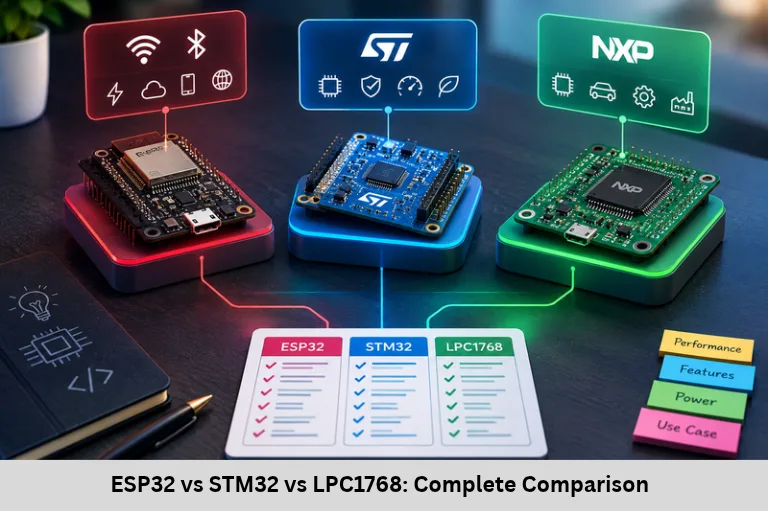
Compare ESP32, STM32, and LPC1768 microcontrollers by CPU architecture, memory, connectivity, power efficiency, development tools, and applications. Embedded Tech Development Academy (ETDA).
- ESP32 vs STM32 vs LPC1768: Complete Comparison
-
ESP32, STM32, and LPC1768: An In-Depth Comparison of Modern Microcontroller Platforms
- Introduction to ESP32, STM32, and LPC1768
- Understanding the ESP32 Microcontroller
- Understanding the STM32 Microcontroller Family
- Understanding the LPC1768 Microcontroller
- ESP32 vs STM32 vs LPC1768: Technical Comparison
- Practical Microcontroller Development and Career Skills
- Frequently Asked Questions
- Conclusion
ESP32, STM32, and LPC1768: An In-Depth Comparison of Modern Microcontroller Platforms
Introduction to ESP32, STM32, and LPC1768
Microcontrollers are the processing units of embedded systems, controlling sensors, actuators, communication interfaces, and real-time operations in electronic products. They are widely used in industrial automation, automotive electronics, medical equipment, robotics, smart appliances, and Internet of Things (IoT) devices. Selecting the right microcontroller affects CPU performance, Flash memory, SRAM capacity, power consumption, peripheral availability, firmware complexity, development cost, and product reliability.
The ESP32, STM32, and LPC1768 are popular platforms with different strengths. ESP32 is well suited to wireless connectivity, STM32 provides a broad portfolio for control and high-performance applications, and LPC1768 offers a practical ARM Cortex-M3 platform for embedded programming and wired communication. Understanding microcontroller architecture, GPIO, ADC, PWM, UART, SPI, I2C, CAN, interrupt handling, real-time operating systems, and development environments helps engineers select the right device for their requirements.
Embedded Tech Development Academy (ETDA) supports practical learning in Embedded C, microcontroller programming, firmware debugging, and hardware interfacing. Learners searching for a Top Embedded Training Institute in Bangalore can develop industry-relevant skills through hands-on embedded projects. Embedded Tech Development Academy (ETDA) also provides assured placement support to help learners prepare for embedded engineering opportunities.
Understanding the ESP32 Microcontroller
Architecture and Technical Features
Developed by Espressif Systems, the ESP32 family includes microcontrollers designed for connected applications. Many original ESP32 variants use dual-core Xtensa LX6 processors with clock speeds up to 240 MHz. Newer family members can use different processor architectures, so specifications must be checked against the exact device.
Depending on the variant, features include integrated Wi-Fi, Bluetooth or Bluetooth Low Energy, GPIO, ADC, PWM, timers, UART, SPI, and I2C. Some models provide DAC or other specialized peripherals, but not every ESP32 device supports the same features.
ESP32 Applications and Development Tools
ESP32 is widely used in smart home automation, wireless sensor networks, remote monitoring, and cloud-connected Internet of Things (IoT) products. Developers can use Espressif’s ESP-IDF framework or compatible Arduino tooling. ESP-IDF provides networking libraries, configuration tools, debugging support, and FreeRTOS-based application development for supported devices.
Important Design Considerations
Wireless connectivity simplifies networking but introduces security, antenna, interference, and power-consumption considerations. Engineers should verify GPIO restrictions, ADC characteristics, memory availability, and radio requirements before selecting a particular ESP32 board.
Understanding the STM32 Microcontroller Family
Processor Architecture and Peripheral Integration
STM32 is a broad family developed by STMicroelectronics and based on different Arm Cortex-M processor architectures. Depending on the series, devices may use Cortex-M0/M0+, M3, M4, M7, M33, or other supported cores. Clock speeds, memory capacity, floating-point support, digital signal processing instructions, and security features vary by model.
STM32 peripherals may include high-resolution timers, ADCs, DACs, UART, SPI, I2C, USB, CAN or FDCAN, and Ethernet on selected devices. These capabilities support motor control, sensor acquisition, robotics, industrial automation, and real-time data processing.
STM32 Development Environment
STM32CubeIDE, STM32CubeMX, HAL libraries, and Low-Layer (LL) drivers support peripheral configuration and firmware development. Developers can also program registers directly when greater control or reduced software overhead is needed.
Choosing an STM32 Series
Select the series based on required CPU performance, RAM, Flash, ADC resolution, timer features, power consumption, security requirements, and peripheral count. The STM32 name alone does not identify a single performance level.
Understanding the LPC1768 Microcontroller
ARM Cortex-M3 Architecture
The LPC1768, developed by NXP Semiconductors, uses a 32-bit Arm Cortex-M3 processor operating at up to 100 MHz. It includes 512 KB of on-chip Flash and 64 KB of SRAM, making it suitable for many control, communication, and educational applications.
Integrated peripherals include GPIO, UART, SPI, I2C, CAN, USB, Ethernet, ADC, DAC, PWM, timers, and interrupt-control functionality. The precise capabilities and pin assignments should be verified using the device datasheet.
LPC1768 Applications and Tools
LPC1768 is useful for industrial monitoring, CAN communication demonstrations, data acquisition, automation projects, and ARM-based embedded learning. Development commonly involves Keil MDK, CMSIS-based software, and compatible NXP tools.
Why Learn LPC1768?
Although it is an older microcontroller platform, LPC1768 helps learners understand Cortex-M3 programming, register configuration, interrupt service routines, peripheral drivers, and real-time operating system concepts.
ESP32 vs STM32 vs LPC1768: Technical Comparison
Processor Performance and Memory
| Feature | ESP32 | STM32 | LPC1768 |
|---|---|---|---|
| CPU architecture | Depends on variant | Depends on series | Arm Cortex-M3 |
| Clock speed | Up to 240 MHz on original ESP32 variants | Varies by model | Up to 100 MHz |
| Flash memory | Configuration-dependent; often external | Varies by model | 512 KB on-chip |
| SRAM | Varies by variant | Varies by model | 64 KB |
| Wireless connectivity | Integrated on supported variants | Usually external or model-specific | External hardware required |
| Main strength | Connected Internet of Things (IoT) | Broad control and performance range | Control and learning applications |
ESP32 can be suitable for networking workloads, STM32 includes devices for demanding signal-processing and control tasks, and LPC1768 is capable of conventional embedded control. Raw clock speed alone does not determine performance; core architecture, memory access, peripherals, and software workload also matter.
Communication Interfaces and Power Efficiency
ESP32 is especially convenient when Wi-Fi or Bluetooth is required. STM32 offers a broad range of wired interfaces depending on the model, while LPC1768 includes useful interfaces such as CAN, USB, and Ethernet.
Power consumption depends on operating frequency, peripheral activity, workload, and low-power modes. ESP32 radio transmission can increase current consumption, while selected STM32 families are designed for ultra-low-power applications. LPC1768 supports conventional power-management methods, but the most efficient option must be determined using datasheet values and the actual operating profile.
Real-Time Performance
Real-time performance depends on interrupt latency, task scheduling, execution time, peripheral behavior, and timing constraints. An RTOS can help organize tasks, but it does not automatically guarantee that every deadline will be met.
Selecting the Right Platform
- Choose ESP32 for wireless sensors and connected Internet of Things (IoT) products.
- Choose STM32 for applications requiring specific control peripherals, advanced processing, or low-power operation.
- Choose LPC1768 for suitable legacy designs, wired communication, and Cortex-M3 learning projects.
Practical Microcontroller Development and Career Skills
Build and Test Real Projects
Before selecting a controller, define GPIO requirements, ADC resolution, PWM channels, communication protocols, memory budget, operating voltage, power limits, and software support. Check the datasheet for pin multiplexing, peripheral conflicts, clock configuration, and debugging compatibility.
Practical projects could include an ESP32 Wi-Fi temperature monitor, an STM32 motor-control application, or an LPC1768 CAN communication system. Embedded Tech Development Academy (ETDA) encourages hands-on practice in Embedded C, peripheral interfacing, debugging, and firmware development. Learners looking for a Top Embedded Training Institute in Bangalore can strengthen these skills through project-based learning, with assured placement support for career preparation.
Frequently Asked Questions
Which is better for IoT: ESP32 or STM32?
ESP32 is often a convenient choice when Wi-Fi or Bluetooth is required. STM32 may be preferable for specialized control, real-time processing, or low-power applications. The specific model and requirements determine the best option.
Is STM32 more powerful than ESP32?
Some high-performance STM32 devices outperform particular ESP32 variants in specific workloads, but the result depends on the CPU core, clock speed, memory system, and application. Compare exact part numbers rather than entire families.
What are the main specifications of LPC1768?
LPC1768 uses an Arm Cortex-M3 processor running at up to 100 MHz and provides 512 KB of Flash and 64 KB of SRAM, along with peripherals such as CAN, USB, Ethernet, ADC, DAC, and PWM.
Which microcontroller is easiest for beginners?
ESP32 is approachable for wireless IoT projects, STM32 provides experience across many embedded applications, and LPC1768 is useful for learning Cortex-M3 fundamentals. The best starting point depends on the project and available development tools.
Can ESP32, STM32, and LPC1768 run an RTOS?
Supported devices from all three platforms can run an RTOS when a compatible kernel port, toolchain, memory configuration, and hardware setup are available. FreeRTOS is commonly used with ESP32 and is also suitable for many STM32 and LPC1768 projects.
Conclusion
ESP32, STM32, and LPC1768 serve different embedded systems requirements. ESP32 offers integrated wireless connectivity on supported variants, STM32 provides a wide selection of processors and peripherals, and LPC1768 remains useful for Cortex-M3 learning and control-oriented applications. The best choice depends on the exact device, processing workload, memory needs, communication interfaces, energy budget, development ecosystem, component availability, and long-term maintenance requirements.
Developers should gain practical experience in Embedded C, GPIO, ADC, PWM, UART, SPI, I2C, CAN, interrupt handling, debugging, and firmware testing. Embedded Tech Development Academy (ETDA) supports learning across embedded programming and microcontroller development. Learners searching for a Top Embedded Training Institute in Bangalore can focus on real-world projects and industry-relevant technical skills. Embedded Tech Development Academy (ETDA)‘s assured placement support can help learners prepare for embedded software, firmware, and hardware-interfacing roles.
Author: ETDA Trainers
Experience: 10+ Years of Industry Experience in Embedded Systems, IoT, and Embedded C Programming