
Embedded AI Developer Roadmap: Skills and Projects
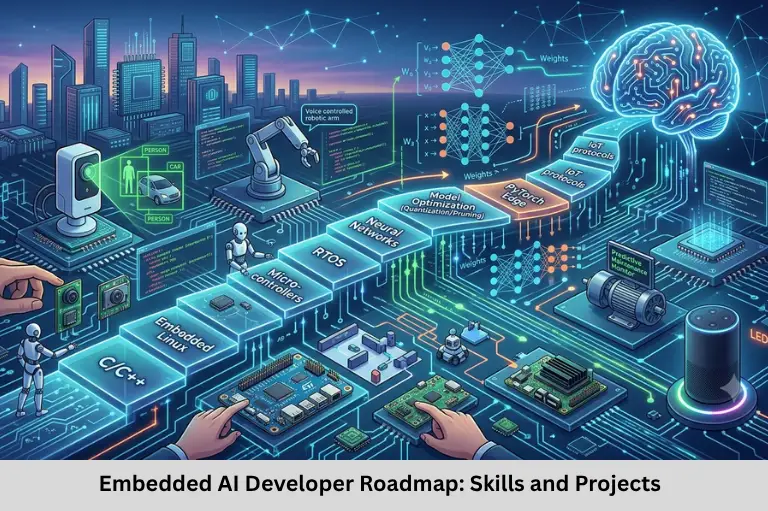
Learn how to become an Embedded AI Developer with Embedded C, microcontrollers, machine learning, TinyML, Edge AI, RTOS, and practical projects. Embedded Tech Development Academy (ETDA).
- Embedded AI Developer Roadmap: Skills and Projects
-
How to Become an Embedded AI Developer: A Complete Roadmap
- Introduction to Embedded AI Development
- 1. Build a Strong Foundation in Embedded Systems
- 2. Develop Programming and Mathematical Skills
- 3. Learn Electronics and Sensor Data Processing
- 4. Learn Machine Learning and Artificial Intelligence
- 5. Master Edge AI and TinyML Deployment
- 6. Learn RTOS and Embedded Optimization
- 7. Build Real-World Embedded AI Projects
- 8. Explore Embedded AI Career Opportunities
- Frequently Asked Questions
- Conclusion
How to Become an Embedded AI Developer: A Complete Roadmap
Introduction to Embedded AI Development
Embedded Artificial Intelligence (Embedded AI) combines embedded systems, machine learning, electronics, and firmware development to create intelligent devices that analyze data and make decisions locally. From predictive maintenance and smart surveillance to autonomous robots, voice recognition, and automotive driver-assistance systems, Embedded AI is transforming how electronic products operate. Unlike cloud-dependent applications, Edge AI processes data directly on a device, helping reduce latency, network dependency, and unnecessary data transmission.
Becoming an Embedded AI Developer requires more than learning artificial intelligence algorithms. You must understand microcontrollers, Embedded C, Python, electronics, sensor interfacing, digital signal processing, model training, and hardware-aware optimization. Knowledge of TinyML, TensorFlow Lite, RTOS, and model quantization helps developers deploy machine learning models on resource-constrained devices with limited RAM, flash memory, processing power, and energy.
For aspiring engineers, a structured roadmap with practical projects is essential. Embedded Tech Development Academy (ETDA) supports technical learning in embedded systems and related development skills. Learners searching for a Top Embedded Training Institute in Bangalore should evaluate hands-on hardware training, real-time firmware projects, and AI deployment practice. Embedded Tech Development Academy (ETDA) also offers assured placement support to help learners prepare for relevant technical career opportunities.
1. Build a Strong Foundation in Embedded Systems
Understand Microcontrollers and Hardware Architecture
Start by learning how microcontrollers operate, including CPU architecture, registers, interrupts, timers, GPIO, memory maps, and peripheral buses. Practice with platforms such as Arduino, STM32, and LPC1768-based development boards.
Understand the difference between microcontrollers and application processors. Microcontrollers are often preferred for low-power, deterministic applications, while more powerful processors may be required for computationally demanding computer vision models.
Learn Embedded C and Peripheral Interfacing
Embedded C is essential for writing low-level firmware that controls hardware. Learn pointers, arrays, structures, bitwise operations, memory management, and interrupt service routines.
Communication Protocols
Practice UART, SPI, I2C, CAN, and PWM. Connect sensors, displays, and actuators, then inspect signals using a logic analyzer or oscilloscope where available.
Foundation Project
Build a sensor data acquisition system that reads temperature or motion data, filters measurements, and transmits results through UART. This project introduces peripheral configuration, debugging, and reliable data collection for future AI applications.
2. Develop Programming and Mathematical Skills
Learn Python and C++
Python is widely used for preparing datasets, training machine learning models, and evaluating inference accuracy. Learn NumPy, Pandas, Matplotlib, and basic data-processing workflows. C++ is valuable when developing efficient firmware, inference applications, and performance-sensitive embedded software.
Understand Algorithms and Mathematics
Study data structures, algorithm complexity, probability, statistics, linear algebra, and basic calculus. Focus on vectors, matrices, averages, standard deviation, and probability distributions because these concepts appear in machine learning and sensor-data analysis.
Developers should also understand numerical precision, fixed-point arithmetic, and floating-point limitations when deploying models on microcontrollers.
3. Learn Electronics and Sensor Data Processing
Understand Sensors and Signal Conditioning
Embedded AI systems rely on reliable input data. Learn voltage levels, current, ADC resolution, sampling frequency, noise filtering, and sensor calibration. Common inputs include accelerometers, gyroscopes, microphones, cameras, and environmental sensors.
Apply Digital Signal Processing
Sensor signals frequently require preprocessing before entering a machine learning model. Learn moving-average filters, normalization, windowing, and frequency-domain analysis using the Fast Fourier Transform (FFT).
These techniques are useful in vibration analysis, audio classification, gesture recognition, and predictive maintenance. Practical electronics experience is a valuable part of training at Embedded Tech Development Academy (ETDA) for learners preparing to develop hardware-connected intelligent products.
4. Learn Machine Learning and Artificial Intelligence
Understand Core Machine Learning Concepts
Begin with supervised learning, unsupervised learning, classification, regression, training datasets, validation datasets, and testing datasets. Learn how to evaluate models using accuracy, precision, recall, confusion matrices, and suitable error metrics.
Use Scikit-learn for basic experiments before progressing to neural networks.
Explore Neural Networks and Computer Vision
Learn neurons, activation functions, loss functions, backpropagation, and optimization. Then explore convolutional neural networks (CNNs) for image classification and computer vision.
TensorFlow and PyTorch are common frameworks for training and experimentation. However, a model that performs well on a computer may not fit a microcontroller, so evaluate model size, inference latency, memory requirements, and accuracy before deployment.
5. Master Edge AI and TinyML Deployment
Understand Local Inference
Edge AI runs machine learning inference on or near the device that collects data. This can reduce response time and network traffic while supporting operation without continuous internet access.
TinyML focuses on machine learning on highly resource-constrained devices, particularly microcontrollers.
Optimize Models for Embedded Hardware
Learn quantization, pruning, model compression, and operator selection. Quantization can reduce model storage and computation by representing weights and activations with lower-precision values, such as int8, when supported by the model and inference runtime.
Deployment Tools
Explore TensorFlow Lite for Microcontrollers, supported LiteRT deployment workflows, and Edge Impulse. Check compatibility with your target board, memory capacity, and required operators.
Deployment Workflow
A typical workflow involves collecting representative data, training the model, evaluating accuracy, converting and optimizing the model, integrating it into firmware, and testing inference on the target device. Measure RAM usage, flash consumption, latency, power, and prediction quality.
6. Learn RTOS and Embedded Optimization
Understand Real-Time Operating Systems
Learn FreeRTOS concepts such as tasks, priorities, queues, semaphores, mutexes, and task scheduling. An RTOS can coordinate sensor acquisition, data preprocessing, inference, and communication.
Not every TinyML application requires an RTOS; a bare-metal design may be sufficient for simpler systems.
Optimize Memory and Performance
Use profiling, compiler optimization, efficient buffers, and careful memory allocation. Avoid unnecessary dynamic allocation in critical real-time paths. Ensure that model inference does not block time-sensitive tasks or cause unacceptable response delays.
7. Build Real-World Embedded AI Projects
Create a Technical Project Portfolio
Start with projects that demonstrate progressively stronger skills:
- Keyword spotting: Recognize a small set of voice commands using a microphone.
- Gesture recognition: Classify movement using accelerometer data.
- Predictive maintenance: Detect unusual motor vibration patterns.
- Object classification: Run a compact vision model on compatible hardware.
- Smart environmental monitoring: Combine sensor readings with anomaly detection.
Document the hardware, dataset, model architecture, accuracy, inference latency, memory usage, and limitations. Publish clean source code and demonstration videos where possible.
Embedded Tech Development Academy (ETDA) can help learners strengthen their embedded development foundation through practical exercises. When comparing a Top Embedded Training Institute in Bangalore, check whether projects include actual hardware deployment, firmware debugging, and measurable model performance. Embedded Tech Development Academy (ETDA)‘s assured placement support can help learners prepare for technical interviews and project discussions.
8. Explore Embedded AI Career Opportunities
Relevant Job Roles
Potential career paths include Embedded AI Engineer, TinyML Developer, Edge AI Engineer, Embedded Firmware Engineer, Internet of Things (IoT) Developer, and Machine Learning Deployment Engineer.
Employers may assess C/C++ programming, Python, microcontroller architecture, communication protocols, model evaluation, debugging, and resource optimization. The specific requirements depend on the industry and role.
Frequently Asked Questions
What skills are required to become an Embedded AI Developer?
You need Embedded C or C++, Python, microcontroller programming, electronics, sensor interfacing, machine learning, model optimization, and hardware debugging skills.
Is Python enough for Embedded AI development?
No. Python is useful for data processing and model training, but C or C++ is often essential for firmware, hardware integration, and efficient deployment on resource-constrained devices.
What is the difference between Edge AI and TinyML?
Edge AI broadly refers to running AI inference locally near the data source. TinyML focuses on deploying machine learning on highly resource-constrained hardware, especially microcontrollers.
Which tools should beginners learn for Embedded AI?
Start with Python, NumPy, Scikit-learn, and a microcontroller development environment. Progress to TensorFlow or PyTorch for model training, then explore TensorFlow Lite for Microcontrollers or Edge Impulse for supported hardware deployment.
How can I gain practical experience in Embedded AI?
Build projects such as sensor-based gesture recognition, keyword spotting, or predictive maintenance. Test on real hardware and document model accuracy, inference latency, RAM usage, flash size, and power considerations.
Conclusion
Becoming an Embedded AI Developer requires a combination of embedded firmware expertise, electronics knowledge, programming ability, machine learning fundamentals, and practical deployment experience. Start with microcontrollers and Embedded C, develop Python and mathematical skills, learn sensor processing and machine learning, and then progress to TinyML, Edge AI, model quantization, and real-time optimization. Most importantly, deploy models on real hardware and measure their performance rather than relying only on desktop simulations.
A strong portfolio featuring gesture recognition, keyword spotting, predictive maintenance, or compact computer vision applications can demonstrate your ability to solve practical engineering problems. Embedded Tech Development Academy (ETDA) provides a learning pathway for students who want to strengthen their embedded technology skills. Those looking for a Top Embedded Training Institute in Bangalore should prioritize practical microcontroller training, industry-relevant projects, and technical mentoring. With assured placement support, Embedded Tech Development Academy (ETDA) aims to help aspiring developers prepare for opportunities in embedded systems, firmware, Internet of Things (IoT), and intelligent device development.
Author: ETDA Trainers
Experience: 10+ Years of Industry Experience in Embedded Systems, IoT, and Embedded C Programming