
Interrupts in Embedded Systems: Types, Working & Uses
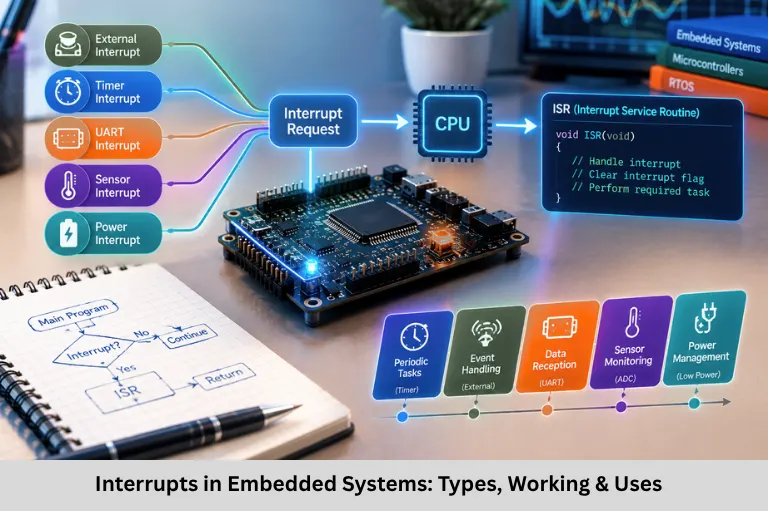
Learn how interrupts work in embedded systems, including ISR, interrupt priorities, hardware and software interrupts, polling, and real-time applications. Embedded Tech Development Academy (ETDA).
- Interrupts in Embedded Systems: Types, Working & Uses
-
Interrupts in Embedded Systems: Why They Are Important
- Introduction to Interrupts in Embedded Systems
- What Is an Interrupt in an Embedded System?
- Why Are Interrupts Important?
- How Do Interrupts Work?
- Types of Interrupts in Embedded Systems
- Interrupts vs. Polling
- Interrupt Service Routine (ISR) Design
- Interrupt Priority and Nested Interrupts
- Practical Applications of Interrupts
- Best Practices and Common Challenges
- Best Practices
- Frequently Asked Questions
- Conclusion
Interrupts in Embedded Systems: Why They Are Important
Introduction to Interrupts in Embedded Systems
Embedded systems are designed to perform dedicated tasks with accuracy, reliability, and predictable timing. They are widely used in automotive electronics, industrial automation, medical equipment, consumer electronics, robotics, and Internet of Things (IoT) devices. In many of these applications, a microcontroller must respond to external events or internal hardware conditions within a specific time. Interrupts in embedded systems make this possible by allowing the processor to temporarily suspend its current execution and handle an important event.
Without interrupts, a processor may need to use polling, which continuously checks whether a button has been pressed, a timer has expired, a sensor has generated data, or a communication message has arrived. This approach can waste CPU cycles and increase power consumption. Interrupt-driven programming improves CPU utilization, event handling, and responsiveness in real-time embedded applications.
For engineers learning microcontroller programming, understanding interrupt handling, interrupt latency, interrupt priority, and Interrupt Service Routines (ISRs) is essential. At Embedded Tech Development Academy (ETDA), practical embedded systems training helps learners connect these concepts with hardware and firmware development. Learners exploring the Top Embedded Training Institute in Bangalore can build relevant technical skills through microcontroller programming, debugging, and real-time system concepts. With assured placement support, Embedded Tech Development Academy (ETDA) helps aspiring engineers prepare for embedded software and firmware development opportunities.
What Is an Interrupt in an Embedded System?
An interrupt is a hardware signal or software-generated event that requests the processor’s attention. When an enabled interrupt is accepted, the processor transfers control to a specific routine called an Interrupt Service Routine (ISR). After handling the event, execution generally returns to the interrupted program.
For example, when a user presses a button connected to a microcontroller’s GPIO pin, an external interrupt can notify the processor without requiring it to check the pin continuously.
Key Components of Interrupt Handling
- Interrupt source: A peripheral, external pin, timer, or software instruction that generates the event.
- Interrupt controller: Hardware that manages interrupt requests, enables, priorities, and dispatching.
- Interrupt vector table: A table that identifies the handler associated with each interrupt.
- Interrupt Service Routine: The function that handles the event.
- Context: The processor state that must be preserved so execution can resume correctly.
Why Are Interrupts Important?
1. Real-Time Responsiveness
Interrupts allow a microcontroller to respond to important events without waiting for a polling loop to detect them. In an automotive controller, for example, a timer or sensor-related interrupt can initiate time-sensitive processing.
2. Efficient CPU Utilization
With polling, the processor repeatedly checks hardware status registers. Interrupt-driven systems allow the CPU to execute other tasks until an event occurs, improving processing efficiency.
3. Reduced Power Consumption
Battery-powered Internet of Things (IoT) devices can enter a low-power state and wake when a timer, GPIO pin, or supported peripheral generates an interrupt. This helps reduce unnecessary processing and extend battery life.
4. Efficient Event Management
A microcontroller may need to handle timer events, incoming UART data, and user inputs within the same application. Interrupts allow these events to request attention according to the configured priority and hardware capabilities.
How Do Interrupts Work?
Interrupt processing follows a sequence of hardware and software operations.
- Event generation: A timer expires, a GPIO pin changes state, or a peripheral receives data.
- Interrupt request: The peripheral or external source raises an interrupt request.
- Interrupt acceptance: The processor checks whether the interrupt is enabled and permitted by its priority and masking rules.
- Context preservation: The processor saves the required execution state, automatically or through software, depending on the architecture.
- ISR execution: The processor executes the corresponding Interrupt Service Routine.
- Event handling: The ISR records the event, captures essential data, or clears the appropriate interrupt flag.
- Context restoration: The processor restores the required state and resumes the interrupted program, unless the operating system schedules another task.
Understanding Interrupt Latency
Interrupt latency is the time between an interrupt request and the start of its service routine. It depends on factors such as the processor architecture, time spent with interrupts disabled, higher-priority interrupt activity, and the current instruction sequence.
Low interrupt latency is important in real-time systems. Engineers must consider worst-case latency, not just average response time, when designing time-critical firmware.
Types of Interrupts in Embedded Systems
1. Hardware Interrupts
Hardware interrupts originate from external pins or internal peripherals.
Examples include:
- A push-button input triggering a GPIO interrupt.
- A timer generating a periodic interrupt.
- A UART peripheral indicating received data.
- An ADC signaling completion of a conversion.
2. Software Interrupts
Software interrupts are generated through specific instructions or software-controlled mechanisms supported by a processor architecture. They may be used to request operating-system services or transfer control to privileged code. Their implementation differs across microcontrollers and operating systems.
3. Maskable Interrupts
Maskable interrupts can be disabled or selectively blocked through interrupt-enable controls or processor masking mechanisms. This is useful when firmware needs to protect a short critical section or manage interrupt priorities. Disabling interrupts for too long can increase latency and cause missed deadlines.
4. Non-Maskable Interrupts (NMI)
A non-maskable interrupt is intended for important conditions that should not be blocked by ordinary interrupt masking. Depending on the processor, it may be used for events such as serious hardware faults or power-failure warnings. An NMI does not automatically guarantee recovery; the response depends on the hardware and firmware design.
5. Internal Peripheral Interrupts
Internal peripherals generate interrupts when configured events occur. Common examples include timer overflow, PWM events, DMA transfer completion, and ADC conversion completion.
Interrupts vs. Polling
| Feature | Interrupts | Polling |
|---|---|---|
| CPU utilization | CPU can perform other work between events | CPU repeatedly checks status |
| Response time | Event-driven; depends on latency and priority | Depends on polling interval |
| Power consumption | Can support sleep and wake-up operation | Frequent checking may consume more power |
| Implementation | Requires interrupt configuration and ISR design | Often simpler to implement |
| Best suited for | Asynchronous and time-sensitive events | Simple systems or predictable, frequent checks |
Neither approach is universally superior. Interrupts are useful for asynchronous events, while polling can be appropriate when hardware must be checked at fixed intervals or when the application is simple.
Interrupt Service Routine (ISR) Design
An ISR is a function executed in response to an interrupt. Good ISR design is essential because a poorly written handler can delay other interrupts, disrupt timing, or cause data loss.
Example of an Interrupt Service Routine
The following generic C example illustrates an ISR setting a flag for the main program to process later. Actual ISR declaration syntax depends on the microcontroller, compiler, and framework.
Example Code
#include <stdbool.h>

volatile bool button_event = false;

/* Use the MCU-specific ISR declaration here. */
void button_ISR(void)
{
    button_event = true;
}

int main(void)
{
    /* Initialize GPIO and configure the interrupt. */

    while (1)
    {
        if (button_event)
        {
            button_event = false;
            /* Process the button event here. */
        }

        /* Perform other non-blocking tasks. */
    }
}
Technical Considerations
The volatile qualifier tells the compiler that the variable may change outside the normal program flow. However, volatile alone does not guarantee atomic access or thread safety. On systems where an interrupt and main code access shared data, engineers must evaluate data size, atomicity, synchronization, and race conditions. The interrupt flag should also be cleared or acknowledged according to the microcontroller’s hardware requirements.
Interrupt Priority and Nested Interrupts
Interrupt priority determines which event receives service first when multiple requests occur. For example, a critical motor-control event may need higher priority than a user-interface button.
Some processors support nested interrupts, allowing a higher-priority interrupt to pre-empt a lower-priority ISR. Nested handling must be carefully designed because it can increase stack usage, complicate shared-data access, and introduce timing problems.
Practical Applications of Interrupts
Microcontrollers and IoT
In 8051, ARM Cortex-M, and ESP32-based systems, interrupts support timer scheduling, GPIO events, UART communication, and low-power wake-up operations. The exact features vary by device.
Automotive Electronics
Engine controllers, vehicle monitoring units, and safety-related electronic control units use interrupt mechanisms to handle sensor updates, timers, and communication events. Safety-critical functions also require appropriate validation and fault-handling mechanisms.
Industrial Automation and Consumer Electronics
Industrial controllers use interrupts for encoder signals, data acquisition, and communication. Consumer electronics use them to process button presses, touchscreen events, remote-control signals, and peripheral activity.
Best Practices and Common Challenges
Best Practices
- Keep ISRs short and predictable.
- Defer lengthy calculations and blocking operations to the main loop or an RTOS task.
- Configure interrupt priorities according to timing requirements.
- Handle interrupt flags and peripheral status correctly.
- Protect shared data using suitable synchronization techniques.
- Measure interrupt latency and test worst-case timing.
- Avoid disabling interrupts for unnecessarily long periods.
Common Challenges
Interrupt-driven firmware can be difficult to debug because event timing may vary. Priority conflicts, race conditions, stack overflow, excessive ISR execution time, and missed peripheral flags can cause intermittent failures. Hardware debugging tools, logic analyzers, trace facilities, and systematic timing tests help identify these issues.
For learners at Embedded Tech Development Academy (ETDA), practicing interrupt configuration and debugging can build a stronger foundation in real-time firmware development. Those evaluating the Top Embedded Training Institute in Bangalore should look for hands-on work with timers, GPIO, UART, and microcontroller debugging. Embedded Tech Development Academy (ETDA) combines technical learning with assured placement support to help learners prepare for embedded engineering roles.
Frequently Asked Questions
What is an interrupt in an embedded system?
An interrupt is a signal or event that requests the processor’s attention. The processor runs the associated ISR and then resumes normal execution when appropriate.
What is an Interrupt Service Routine (ISR)?
An ISR is a function that handles an interrupt event. It should generally execute quickly, avoid blocking operations, and leave lengthy processing to the main program or an RTOS task.
What is the difference between interrupts and polling?
Interrupts notify the processor when an event occurs, while polling repeatedly checks a hardware or software condition. Interrupts can improve efficiency for asynchronous events, whereas polling may be simpler for some applications.
What is interrupt latency?
Interrupt latency is the time between an interrupt request and the start of its service routine. It is influenced by processor behavior, interrupt masking, priority, and other ongoing operations.
Why are interrupts important in real-time embedded systems?
Interrupts help embedded systems respond to time-sensitive events, including timer expiration, sensor activity, and communication data. Correct priority configuration and short, predictable ISRs help maintain reliable real-time behavior.
Conclusion
Interrupts are fundamental to efficient embedded system design because they enable processors to respond to hardware and software events without constantly checking every possible condition. By understanding interrupt types, interrupt latency, priority management, context preservation, and ISR design, engineers can develop responsive firmware for microcontrollers, automotive electronics, industrial automation, and Internet of Things (IoT) devices. Interrupts must still be designed carefully to avoid race conditions, excessive latency, and missed real-time deadlines.
For anyone learning Embedded C, ARM Cortex-M programming, peripheral interfacing, or real-time operating systems, practical interrupt handling is an essential skill. Embedded Tech Development Academy (ETDA) supports learners in developing practical embedded technology knowledge. Those considering the Top Embedded Training Institute in Bangalore should prioritize hands-on microcontroller projects, debugging practice, and real-time programming fundamentals. With industry-oriented learning and assured placement support, Embedded Tech Development Academy (ETDA) aims to help aspiring engineers work toward opportunities in embedded software, firmware development, and connected-device engineering.
Author: ETDA Trainers
Experience: 10+ Years of Industry Experience in Embedded Systems, IoT, and Embedded C Programming