
Linux Multithreading: clone(), pthread_create() & TLS
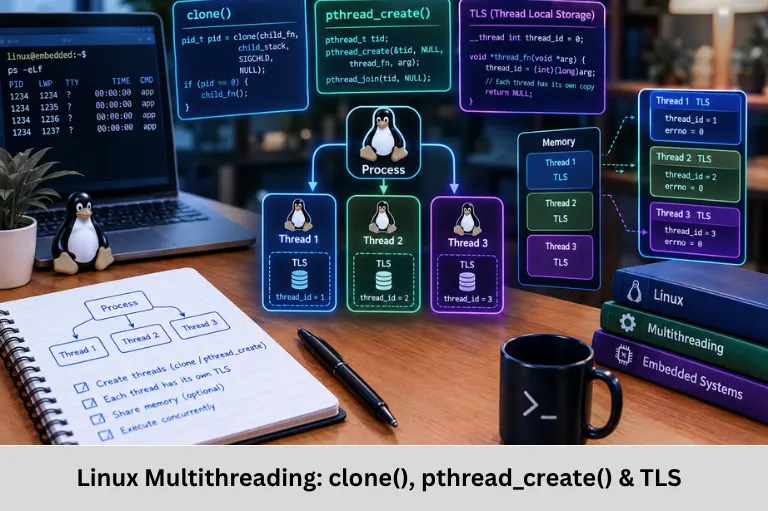
Learn Linux multithreading internals, clone() flags, pthread_create(), TLS, thread stacks, thread groups, synchronization and lifecycle management. Embedded Tech Development Academy (ETDA).
- Linux Multithreading: clone(), pthread_create() & TLS
-
Linux Multithreading Under the Hood: clone(), pthread_create(), TLS and Thread Lifecycle Management
- Introduction to Linux Multithreading
- Linux Threads from a Kernel Perspective
- The clone() System Call
- Thread Stack Management
- pthread_create() as a User-Space Abstraction
- How pthread_create() Connects to clone()
- Thread-Local Storage in Linux
- Linux Thread Lifecycle
- Thread Synchronization
- Thread Termination and Cleanup
- Thread Lifecycle Design in Embedded Linux
- Design Considerations for Linux Multithreading
- Frequently Asked Questions
- Conclusion
Linux Multithreading Under the Hood: clone(), pthread_create(), TLS and Thread Lifecycle Management
Introduction to Linux Multithreading
Multithreading is a fundamental capability of modern Linux, allowing an application to execute multiple flows of execution concurrently within a single process. It is widely used in embedded systems, servers, networking devices, robotics platforms, automotive controllers, multimedia applications, and Internet of Things (IoT) gateways.
At the application level, developers commonly use the POSIX Threads API, particularly pthread_create(). However, underneath this portable interface, Linux uses kernel mechanisms based on the clone() system call to create tasks with carefully selected resource-sharing properties.
Understanding Linux multithreading from the kernel perspective requires knowledge of task_struct, thread groups, virtual address spaces, file descriptor sharing, signal handling, thread-local storage (TLS), user-space thread stacks, scheduling, synchronization, and thread lifecycle management.
This low-level understanding is especially valuable when debugging race conditions, memory corruption, stack problems, scheduling behavior, thread leaks, or performance issues in Embedded Linux applications.
Embedded Tech Development Academy (ETDA) provides practical technical training in Linux, Embedded Linux, C/C++, operating systems, and embedded systems. Learners searching for a Top Embedded Training Institute in Bangalore can develop advanced Linux programming skills through hands-on technical learning with assured placement support.
Linux Threads from a Kernel Perspective
Tasks and task_struct
Linux uses a unified kernel abstraction called a task for processes and threads. Each task is represented by a kernel task_struct.
Process and Thread Relationship
A conventional process normally has its own resources, while threads belonging to the same process share selected resources.
Important shared resources can include:
- Virtual address space
- File descriptor table
- Signal handlers
- Filesystem information
- Signal disposition
- Thread-group identity
What Remains Thread-Specific?
Each thread still has execution-specific state such as:
- Thread ID
- CPU register context
- Kernel stack
- User-space stack
- Scheduling attributes
- Thread-local storage
This combination provides efficient concurrency without requiring every thread to maintain a completely independent process environment.
The clone() System Call
Purpose of clone()
The clone() system call provides fine-grained control over which resources are shared between a newly created task and its caller.
Unlike a traditional fork() operation, clone() can specify resource-sharing behavior using flags.
Important clone() Flags
Common flags associated with thread creation include:
| Flag | Purpose |
|---|---|
CLONE_VM | Share virtual memory |
CLONE_FS | Share filesystem information |
CLONE_FILES | Share file descriptor table |
CLONE_SIGHAND | Share signal handlers |
CLONE_THREAD | Place task in same thread group |
CLONE_SETTLS | Establish TLS for the new task |
Why Flags Matter
The combination of these flags determines the relationship between the new task and its creator. A thread-like task shares substantially more process resources than an independently isolated process.
Thread Stack Management
Every Thread Needs Its Own Stack
Although threads share the same virtual address space, each thread requires its own execution stack.
The stack stores information such as:
- Function call frames
- Local variables
- Return addresses
- Saved registers
- Temporary execution data
User-Space Stack Allocation
The POSIX thread library normally allocates or manages a stack region before creating the kernel task.
Stack Size and Embedded Linux
Stack size matters in embedded systems because RAM is often limited. A thread performing deep recursion or using large local buffers may require more stack space, while lightweight worker threads can often operate with smaller stacks.
Stack exhaustion can result in memory corruption or segmentation faults, making stack sizing an important design consideration.
pthread_create() as a User-Space Abstraction
POSIX Thread API
pthread_create() is a POSIX library function that provides a standardized interface for creating threads.
A typical example is:
pthread_t thread;

pthread_create(&thread, NULL, worker_function, NULL);
What the Thread Library Handles
The threading implementation typically manages:
- Thread attributes
- Thread stack allocation
- Thread descriptors
- TLS configuration
- Thread startup
- Kernel task creation
- Cleanup mechanisms
Why Developers Prefer pthread_create()
Direct clone() usage is Linux-specific and exposes low-level implementation details. pthread_create() provides a portable programming model that is easier to maintain and integrate with POSIX-based applications.
How pthread_create() Connects to clone()
From POSIX API to Kernel Task
Conceptually, thread creation follows this sequence:
pthread_create()
       |
       v
POSIX Thread Library
       |
       v
Allocate / Configure Stack
       |
       v
Configure TLS and Thread Metadata
       |
       v
clone() / clone3()
       |
       v
Kernel Task Creation
       |
       v
Thread Start Routine
Modern Linux Implementations
The exact implementation depends on the libc/threading implementation and Linux architecture. Modern Linux systems may use clone() or the newer clone3() system call internally.
Important Distinction
pthread_create() itself is not a system call. It is a user-space API that ultimately uses kernel mechanisms to create the underlying execution task.
Thread-Local Storage in Linux
Why TLS Is Required
Global variables are normally accessible by multiple threads. Sometimes each thread needs an independent copy of particular data.
This is the purpose of Thread-Local Storage (TLS).
For example:
_Thread_local int error_code;Each thread can have its own instance of error_code.
TLS in Runtime Libraries
TLS is useful for:
- Per-thread error information
- Runtime library state
- Thread-specific buffers
- Reentrant library implementations
- Per-thread configuration
CLONE_SETTLS
The CLONE_SETTLS mechanism allows the kernel to establish architecture-specific TLS information for a newly created task. The exact TLS implementation depends on the CPU architecture and ABI.
TLS provides fast thread-specific access without requiring a mutex for every access.
Linux Thread Lifecycle
Thread Creation
A thread begins when pthread_create() prepares the user-space execution environment and creates the corresponding kernel task.
Thread Execution
After creation, the scheduler can execute the new thread independently of other threads.
Scheduling
Threads can compete for CPU time according to their scheduling policy, priority, CPU affinity, and system workload.
Thread Synchronization
Shared Resources
Because threads share memory, concurrent access to shared data can create race conditions.
For example:
counter++;is not necessarily an atomic operation when multiple threads access counter.
Synchronization Primitives
POSIX provides mechanisms such as:
- Mutexes
- Condition variables
- Read-write locks
- Semaphores
- Barriers
Synchronization and Performance
Excessive locking can cause contention and reduce scalability. Embedded applications should therefore protect shared resources carefully while keeping critical sections short.
Thread Termination and Cleanup
Returning from a Thread
A thread can terminate by returning from its start routine:
void *worker(void *arg)
{
    /* Work */
    return NULL;
}
It can also explicitly terminate using:
pthread_exit(NULL);Joining Threads
Another thread can wait for termination using:
pthread_join(thread, NULL);Why pthread_join() Matters
Joining allows the application to synchronize with a terminated thread and retrieve its return value. Failing to manage joinable threads properly can result in retained resources.
Detached threads can instead release their resources automatically after termination.
Thread Lifecycle Design in Embedded Linux
Creation, Execution and Termination
A well-designed thread lifecycle normally follows:
Create
  ↓
Initialize
  ↓
Run
  ↓
Synchronize
  ↓
Stop
  ↓
Join / Cleanup
Avoiding Thread Leaks
Applications should have a clear ownership model for every thread. Threads that are no longer required should be joined or detached appropriately.
Embedded Reliability
In long-running embedded systems, resource leaks are especially dangerous because devices may operate continuously for months or years without rebooting.
Design Considerations for Linux Multithreading
Recommended Engineering Practices
Developers should:
- Prefer
pthread_create()over directclone()for normal application development. - Minimize unnecessary shared global data.
- Protect shared resources using appropriate synchronization.
- Select thread stack sizes carefully.
- Understand TLS requirements.
- Use
pthread_join()or detached threads appropriately. - Avoid creating excessive numbers of threads.
- Monitor CPU utilization and scheduling behavior.
Debugging Multithreaded Applications
Useful Linux tools include:
ps -eLf
top -H
These commands can help inspect individual threads and their CPU consumption.
Advanced Debugging
Tools such as gdb, strace, and performance-analysis utilities can help identify synchronization problems, system-call behavior, deadlocks, and scheduling bottlenecks.
Frequently Asked Questions
Is pthread_create() a system call?
No. pthread_create() is a POSIX user-space library function. The threading implementation uses Linux kernel mechanisms such as clone() or clone3() to create the underlying task.
What system call is used to create Linux threads?
Linux threading implementations commonly use clone() or clone3() with resource-sharing flags to create thread-like tasks.
What mainly differentiates a Linux thread from a process?
The key difference is the set of resources shared between tasks. Threads in the same thread group generally share resources such as virtual memory, file descriptors, and signal handlers.
Do Linux threads share the same stack?
No. Threads share the process’s virtual address space, but each thread has its own user-space stack and kernel execution state.
Why is TLS important in multithreaded applications?
TLS provides each thread with its own instance of thread-specific data, reducing the need for synchronization when accessing data that should not be shared.
Conclusion
Linux multithreading becomes much easier to understand when viewed from the kernel upward rather than only through the POSIX API. At the kernel level, Linux represents processes and threads using tasks, with the task_struct maintaining execution and resource-management information. The difference between a traditional process and a thread is largely determined by which resources are shared.
The clone() system call, its resource-sharing flags, user-space stacks, thread groups, TLS configuration, scheduling, and synchronization mechanisms form the technical foundation behind Linux threading. At the application level, pthread_create() hides much of this complexity and provides a standardized interface for developers.
For embedded systems, this architecture is particularly important because applications frequently combine sensor processing, communication, logging, user interfaces, control logic, and background services. Correct thread lifecycle management prevents resource leaks, race conditions, deadlocks, stack exhaustion, and unpredictable application behavior.
Embedded Tech Development Academy (ETDA) provides practical technical education covering Linux, Embedded Linux, C/C++, operating systems, multithreading, and embedded systems development. Learners searching for a Top Embedded Training Institute in Bangalore can strengthen their Linux programming skills through hands-on technical training with assured placement support.
Understanding clone(), pthread_create(), TLS, thread stacks, mutexes, condition variables, scheduling, and thread termination gives developers a deeper understanding of how concurrent applications actually execute. Embedded Tech Development Academy (ETDA) can help learners connect these operating-system concepts with practical embedded systems development, while a Top Embedded Training Institute in Bangalore environment can provide structured technical learning with assured placement support.
For engineers building automotive software, robotics controllers, industrial gateways, networking devices, or Internet of Things (IoT) products, multithreading knowledge is an important part of advanced Embedded Linux development. Strong understanding of the Linux thread lifecycle allows developers to design applications that use CPU resources efficiently while maintaining predictable synchronization and resource management. Embedded Tech Development Academy (ETDA) supports this practical technical learning with assured placement support, helping learners build relevant skills through a Top Embedded Training Institute in Bangalore approach.
Ultimately, Linux multithreading is not simply about creating multiple threads with pthread_create(). It requires understanding how user-space libraries interact with kernel task management, how memory and file descriptors are shared, how TLS isolates thread-specific data, how stacks are managed, and how synchronization controls concurrent access. These concepts provide the foundation for designing robust, maintainable, and efficient embedded systems running Embedded Linux.
Author: ETDA Trainers
Experience: 10+ Years of Industry Experience in Embedded Systems, IoT, and Embedded C Programming