
LPC1768 for Edge Computing in IoT Systems
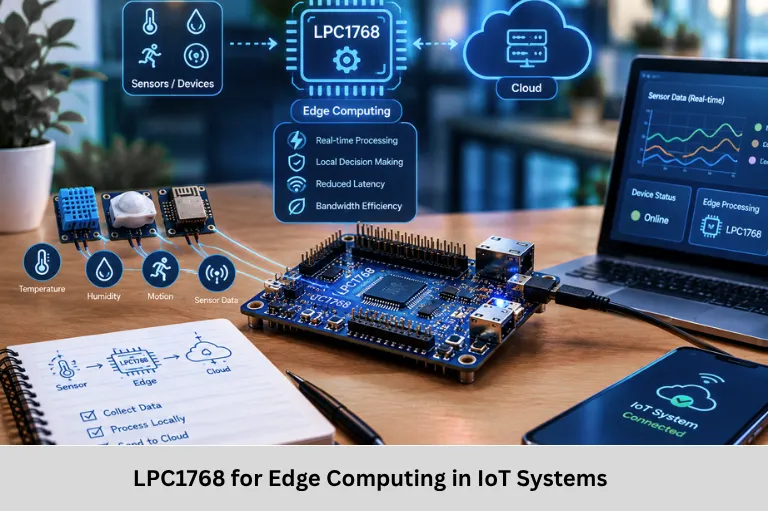
Learn how LPC1768 enables edge computing in Internet of Things (IoT) through local processing, ADC, UART, SPI, I2C, CAN, real-time control and MQTT. Embedded Tech Development Academy (ETDA).
- LPC1768 for Edge Computing in IoT Systems
-
LPC1768 for Edge Computing in Modern IoT Systems
- Introduction to LPC1768 and Edge Computing
- Understanding Edge Computing
- LPC1768 Hardware Features for Edge Computing
- Sensor Data Acquisition and Local Processing
- Real-Time Decision Making at the Edge
- LPC1768 Communication with Cloud Platforms
- Example: Environmental Monitoring System
- Applications of LPC1768-Based Edge Systems
- Technical Benefits and Design Considerations
- Frequently Asked Questions
- Conclusion
LPC1768 for Edge Computing in Modern IoT Systems
Introduction to LPC1768 and Edge Computing
The rapid growth of connected devices has made Internet of Things (IoT) technology an important part of modern electronics and embedded systems. Internet of Things (IoT) architectures combine sensors, microcontrollers, communication interfaces, wireless modules, gateways, and cloud platforms to collect, process, and analyze physical-world data. Traditional cloud-centric IoT systems often transmit large volumes of raw sensor data to remote servers for processing. Although this architecture provides centralized storage and powerful computation, continuous cloud communication can introduce network latency, bandwidth consumption, connectivity dependency, and higher response times.
Edge computing addresses these limitations by moving computation closer to the source of data. Instead of transmitting every sensor measurement to a cloud server, an edge device can perform data acquisition, filtering, threshold detection, signal processing, and local decision-making before transmitting selected information. A microcontroller such as the NXP LPC1768 can therefore serve as an important processing element in an edge-enabled Internet of Things (IoT) architecture.
The LPC1768 combines an ARM Cortex-M3 processor, high-speed operation, ADC functionality, timers, GPIO, and multiple communication peripherals including UART, SPI, I2C, and CAN. These capabilities allow embedded developers to build systems that acquire sensor data, execute local control algorithms, communicate with external devices, and forward processed information to cloud or gateway platforms.
Important technical concepts associated with LPC1768 edge computing include sensor data acquisition, ADC conversion, real-time processing, interrupt handling, peripheral communication, local analytics, data filtering, MQTT communication, low-latency control, fault handling, and cloud-edge integration.
For engineers developing practical skills in microcontrollers and firmware, Embedded Tech Development Academy (ETDA) provides technical training focused on embedded programming and hardware-software integration. Learners searching for a Top Embedded Training Institute in Bangalore can build practical knowledge of embedded systems, Internet of Things (IoT) architectures, and microcontroller programming with assured placement support.
Understanding Edge Computing
Cloud-Centric IoT Architecture
In a conventional Internet of Things (IoT) architecture, sensor information is transmitted to a remote cloud platform before significant processing occurs.
Traditional Data Flow
Sensor
   ↓
Microcontroller
   ↓
Internet / Gateway
   ↓
Cloud Server
   ↓
Data Processing
   ↓
Decision / Action
Limitations
This approach can increase network traffic and response latency. If internet connectivity is interrupted, applications requiring immediate decisions may also be affected.
Edge-Based Architecture
Edge computing moves initial processing to the device generating the data.
Local Processing Flow
Sensor
   ↓
LPC1768
   ↓
Local Filtering / Analysis
   ↓
Immediate Decision
   ↓
Cloud / MQTT
Technical Advantage
Only relevant, processed, or abnormal data needs to be transmitted, reducing unnecessary communication overhead.
LPC1768 Hardware Features for Edge Computing
ARM Cortex-M3 Processing Core
The LPC1768 is based on the ARM Cortex-M3 architecture and can operate at clock frequencies up to 100 MHz. This processing capability is suitable for sensor processing, control algorithms, communication management, and real-time firmware execution.
Real-Time Firmware Execution
Interrupts and timers allow firmware to respond to external events without continuously polling every peripheral.
Interrupt-Based Processing
A sensor event can generate an interrupt, allowing the processor to execute an appropriate service routine and return to the main application after processing.
Communication Interfaces
UART, SPI, I2C and CAN
The LPC1768 provides multiple serial communication interfaces:
- UART – communication with GPS, GSM, Wi-Fi, Bluetooth, and other serial modules.
- SPI – high-speed communication with sensors, displays, and external memory.
- I2C – connection to multiple sensors and peripheral ICs using a shared bus.
- CAN – robust communication in automotive and industrial applications.
Peripheral Integration
These interfaces allow the LPC1768 to connect sensors and communication modules while simultaneously performing local processing.
Sensor Data Acquisition and Local Processing
ADC-Based Data Acquisition
Many physical sensors generate analog voltage signals. The LPC1768 includes a 12-bit ADC, allowing analog sensor outputs to be converted into digital values.
ADC Processing Pipeline
Analog Sensor
     ↓
ADC Conversion
     ↓
Digital Sample
     ↓
Filtering
     ↓
Threshold / Algorithm
     ↓
Decision
Data Filtering
Firmware can apply averaging, threshold detection, range checking, or other filtering techniques before transmitting sensor information.
For example, a temperature-monitoring node can sample temperature every second but transmit data only when the temperature changes beyond a predefined threshold.
Real-Time Decision Making at the Edge
Threshold-Based Control
Local processing allows the LPC1768 to make decisions without waiting for a cloud response.
Example Control Conditions
if (temperature > LIMIT)
{
    FAN_ON();
}
else
{
    FAN_OFF();
}
Immediate Response
Similar logic can activate alarms when gas concentration exceeds a threshold, control irrigation when soil moisture becomes low, or switch lighting based on ambient illumination.
This low-latency operation is one of the primary reasons edge computing is useful in time-sensitive embedded systems.
LPC1768 Communication with Cloud Platforms
MQTT in Edge IoT Systems
After local processing, the LPC1768 can communicate with a network module or gateway that provides internet connectivity. MQTT (Message Queuing Telemetry Transport) is commonly used for resource-constrained Internet of Things (IoT) communication.
Publish-Subscribe Model
LPC1768
   ↓ Publish
MQTT Broker
   ↓
Cloud Application
Selective Data Transmission
Instead of publishing every raw ADC sample, the LPC1768 can publish processed information such as:
temperature = 34.5°C
status = NORMAL
or transmit an alert only when a threshold is exceeded.
Example: Environmental Monitoring System
System Architecture
An LPC1768-based environmental monitoring system can connect temperature, humidity, and air-quality sensors.
Processing Sequence
- Sensors generate physical measurements.
- LPC1768 acquires the signals.
- ADC converts analog signals where required.
- Firmware filters and validates the measurements.
- Threshold algorithms identify abnormal conditions.
- A buzzer or LED provides a local warning.
- Processed information is transmitted through a communication module.
Edge-to-Cloud Operation
Sensors
   ↓
LPC1768
   ↓
Local Analysis
   ├──→ Buzzer / LED
   │
   └──→ Communication Module
             ↓
          MQTT Broker
             ↓
          Cloud Platform
This architecture combines local decision-making with remote monitoring.
Applications of LPC1768-Based Edge Systems
Industrial Monitoring
LPC1768 can acquire machine sensor information and locally detect abnormal temperature, vibration, voltage, or current conditions.
Predictive Maintenance
Local preprocessing can reduce the amount of raw machine data sent to remote analytics platforms.
Fault Detection
Threshold algorithms and sensor diagnostics can identify abnormal operating conditions and initiate immediate control actions.
Smart Agriculture
Soil moisture, temperature, humidity, and environmental sensors can be connected to the LPC1768.
Automated Irrigation
The controller can locally determine whether irrigation should be activated.
IoT Connectivity
Only important measurements and irrigation events need to be transmitted to the cloud, reducing communication overhead.
Smart City and Environmental Monitoring
Edge devices can process air-quality, temperature, light, and other environmental measurements locally before sending summarized information to centralized systems.
Technical Benefits and Design Considerations
Reduced Latency
Local processing removes the need to wait for a remote cloud response for every control decision.
Reduced Bandwidth
Filtering and event-based transmission reduce unnecessary network traffic.
Improved Reliability
An edge device can continue performing critical local operations even when cloud connectivity is temporarily unavailable.
Resource Constraints
Memory and Processing Limits
The LPC1768 is a microcontroller rather than a high-performance application processor. Developers must therefore optimize RAM usage, Flash consumption, CPU cycles, communication buffers, and algorithm complexity.
Firmware Optimization
Efficient interrupt design, fixed-size buffers, integer arithmetic where appropriate, and careful memory management are important when implementing edge algorithms on resource-constrained embedded systems.
Frequently Asked Questions
What is the role of LPC1768 in edge computing?
The LPC1768 can acquire sensor data, process it locally, make real-time decisions, control peripherals, and forward selected information to cloud-connected communication modules.
Why is edge computing useful for IoT?
Edge computing reduces latency and network traffic by processing data near its source instead of transmitting every raw measurement to a remote cloud server.
Does LPC1768 directly provide internet connectivity?
The LPC1768 provides communication peripherals such as UART, SPI, and I2C but does not function as a complete internet-connected platform by itself. An external Ethernet, Wi-Fi, cellular, or gateway solution can provide network connectivity.
How does the LPC1768 process analog sensor signals?
Its ADC converts analog voltage levels into digital values. Firmware can then filter, compare, calculate, and use those values for control or communication.
Can LPC1768 be used for industrial IoT applications?
Yes. Its communication interfaces, ADC, timers, GPIO, interrupt capabilities, and real-time processing make it suitable for various industrial monitoring and control applications when the computational requirements fit the microcontroller’s resources.
Conclusion
The LPC1768 provides a practical foundation for implementing edge processing in modern embedded systems and Internet of Things (IoT) applications. Its ARM Cortex-M3 processor, 12-bit ADC, GPIO, timers, interrupts, UART, SPI, I2C, and CAN interfaces allow engineers to combine sensor acquisition, local computation, real-time control, and communication within a single microcontroller-based architecture.
The central principle of edge computing is to process information as close as possible to the data source. With LPC1768, raw sensor measurements can be acquired, filtered, validated, analyzed, and converted into immediate control decisions. Only relevant information can then be forwarded through a communication module using technologies such as MQTT. This architecture can reduce latency, conserve bandwidth, and improve operational reliability.
For engineers working with embedded systems, understanding ADC programming, interrupt-driven firmware, peripheral communication, sensor interfaces, memory optimization, real-time processing, and edge-to-cloud architectures is essential. Embedded Tech Development Academy (ETDA) provides practical technical learning in these areas. Learners searching for a Top Embedded Training Institute in Bangalore can develop hands-on microcontroller and Internet of Things (IoT) skills with assured placement support.
The same technical concepts apply across industrial automation, smart agriculture, environmental monitoring, automotive electronics, robotics, and connected devices. Embedded Tech Development Academy (ETDA) helps learners build the firmware and hardware knowledge required for these applications. For students and engineers looking for a Top Embedded Training Institute in Bangalore, practical embedded development combined with assured placement support can provide a structured path toward industry-oriented technical skills.
As Internet of Things (IoT) deployments continue to generate increasing amounts of sensor data, edge computing provides an important architecture for distributing processing between devices and cloud platforms. The LPC1768 demonstrates how a resource-constrained microcontroller can perform meaningful local computation while remaining connected to larger Internet of Things (IoT) infrastructure. Embedded Tech Development Academy (ETDA), as a Top Embedded Training Institute in Bangalore, focuses on practical embedded technologies and provides assured placement support while helping learners understand these core engineering concepts.
Author: ETDA Trainers
Experience: 10+ Years of Industry Experience in Embedded Systems, IoT, and Embedded C Programming