
LPC1768 Ethernet Communication Using Socket Programming Concepts | ETDA
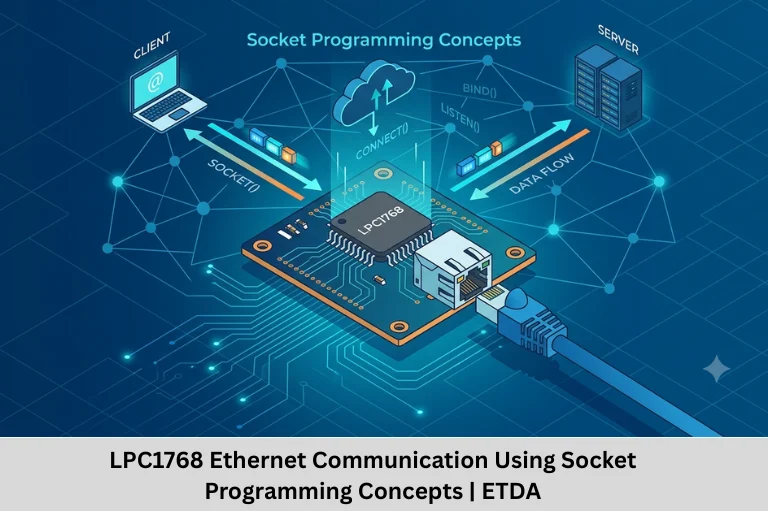
Learn LPC1768 Ethernet communication using socket programming concepts, TCP/IP, TCP, UDP, Ethernet interfacing, and embedded networking with Embedded Tech Development Academy (ETDA).
- LPC1768 Ethernet Communication Using Socket Programming Concepts | ETDA
-
LPC1768 Ethernet Communication Using Socket Programming Concepts
- Introduction
- Understanding Socket Programming – Basic Idea
- Why LPC1768 Cannot Run Traditional Socket Programming
- How LPC1768 Supports Ethernet Communication
- Using an Ethernet Module with Built-in TCP/IP Support
- Typical LPC1768 Ethernet System Architecture
- Client and Server Concepts in LPC1768
- TCP Communication with LPC1768
- UDP Communication with LPC1768
- Applications of LPC1768 Ethernet Communication
- Advantages of LPC1768 Ethernet Communication
- Limitations of Ethernet Communication on LPC1768
- LPC1768 Ethernet vs PC Socket Programming
- Learning Path for Students
- Real-World Industry Usage
-
Why Learn Embedded Networking?
- Practical Training at Embedded Tech Development Academy
- FAQs
- Can LPC1768 run normal socket programming like Linux?
- How does LPC1768 communicate over Ethernet?
- Can LPC1768 act as a TCP server?
- What is the difference between TCP and UDP communication on LPC1768?
- Is LPC1768 Ethernet communication useful for IoT projects?
- Conclusion
LPC1768 Ethernet Communication Using Socket Programming Concepts
Introduction
Networking is no longer limited to computers, smartphones, and servers. Modern embedded systems are increasingly connected to Ethernet networks and the Internet to exchange data, monitor sensors, control equipment, and support Internet of Things (IoT) applications. From industrial automation and smart manufacturing to remote monitoring and connected devices, embedded networking has become an important part of modern electronics and firmware development.
One of the most widely known methods of network communication is socket programming. On computers, socket programming allows applications to communicate with other devices using protocols such as TCP and UDP. This communication model is commonly used in client-server applications, web services, remote monitoring systems, and network-based applications.
For embedded engineers and students, an important question is whether a microcontroller such as the LPC1768 ARM Cortex-M3 can use the same socket programming concepts. The answer is yes, although the implementation is different from traditional PC-based socket programming.
The LPC1768 does not normally run a desktop operating system such as Windows or Linux. Instead, it executes embedded firmware, with networking functionality provided through an embedded TCP/IP stack, networking library, RTOS, or external Ethernet hardware. The LPC1768 also includes an integrated Ethernet MAC controller, making it suitable for Ethernet-based embedded applications when paired with the appropriate external PHY and software support.
In practical embedded networking, concepts such as TCP/IP communication, Ethernet interfacing, TCP client, TCP server, UDP communication, IP addressing, packet transmission, network protocols, embedded sockets, and Internet of Things (IoT) connectivity can all be applied to the LPC1768.
For students learning embedded systems programming, understanding Ethernet communication provides valuable practical knowledge because many industrial and Internet of Things (IoT) devices need to communicate with computers, servers, gateways, or other controllers.
At Embedded Tech Development Academy (ETDA), students can strengthen their embedded networking knowledge through practical learning involving microcontrollers, communication protocols, embedded C, ARM controllers, and real-world projects. As a Top Embedded Training Institute in Bangalore, Embedded Tech Development Academy (ETDA) focuses on industry-oriented embedded systems training along with assured placement support, helping learners develop practical skills required for embedded software and firmware careers.
This article explains how LPC1768 Ethernet communication works, how it relates to socket programming, the role of TCP/IP stacks, client-server communication, and how students can use these concepts to develop practical embedded networking projects.
Understanding Socket Programming – Basic Idea
Socket programming is a communication mechanism that allows two devices or applications to exchange information over a network.
In a typical client-server architecture:
- The server waits for incoming connections.
- The client initiates the connection.
- Once connected, both sides can exchange data.
- TCP or UDP can be used depending on application requirements.
Socket programming is commonly used in:
- Chat applications
- Web servers
- File transfer systems
- Remote monitoring
- Industrial communication
- Internet of Things (IoT) applications
- Network-based control systems
Basic Socket Communication Model
A typical TCP communication process can be represented as:
Server → Creates socket → Binds address → Listens → Accepts connection → Exchanges data
Client → Creates socket → Connects to server → Exchanges data
On a computer, operating systems provide networking APIs that make this process relatively straightforward.
Why LPC1768 Cannot Run Traditional Socket Programming
The LPC1768 is a microcontroller rather than a general-purpose computer.
A typical desktop socket application depends on an operating system that provides:
- Process management
- Memory management
- Networking services
- TCP/IP implementation
- File descriptors
- Socket APIs
- Device drivers
The LPC1768 does not inherently provide these operating-system services.
Therefore, standard Linux or Windows socket programs cannot simply be compiled and executed directly on the microcontroller.
However, this does not mean that LPC1768 cannot communicate using TCP/IP.
Instead, embedded developers use a suitable networking software stack or external networking hardware.
Embedded Networking Instead of Traditional PC Sockets
The important distinction is:
PC: Operating system + TCP/IP stack + socket API + Ethernet driver
LPC1768: Firmware + TCP/IP stack + Ethernet driver + Ethernet MAC/PHY
The programming environment is different, but the underlying networking concepts remain similar.
How LPC1768 Supports Ethernet Communication
The LPC1768 contains an integrated Ethernet MAC controller that can be used for network communication with suitable Ethernet PHY hardware and software.
There are two common approaches to implementing network communication:
- Using a lightweight TCP/IP software stack
- Using an external Ethernet controller/module with networking capabilities
Using a Lightweight TCP/IP Stack
A lightweight TCP/IP stack is designed specifically for resource-constrained embedded systems.
It can provide protocols and services such as:
- IP
- TCP
- UDP
- ARP
- ICMP
- DHCP
- DNS
- HTTP
Depending on the stack and application, networking APIs can provide functionality that resembles socket programming.
How the TCP/IP Stack Works
The general process is:
Application → TCP/UDP → IP → Ethernet driver → Ethernet MAC/PHY → Network
When data is received, the process occurs in the opposite direction:
Network → Ethernet MAC/PHY → Ethernet driver → IP → TCP/UDP → Application
This allows the LPC1768 firmware to send and receive network data without implementing every networking protocol from scratch.
Benefits of a Lightweight TCP/IP Stack
A lightweight stack provides:
- Better control over networking
- Lower memory requirements
- Support for embedded applications
- Flexible protocol configuration
- Integration with RTOS-based applications
However, developers need to understand memory usage, buffers, interrupts, network configuration, and protocol operation.
Using an Ethernet Module with Built-in TCP/IP Support
Another approach is to use an external Ethernet networking module or controller.
In this architecture:
- LPC1768 communicates with the Ethernet controller.
- Communication may occur through SPI or another supported interface.
- The external device handles much of the networking processing.
- LPC1768 sends commands and application data.
This approach can simplify development for beginners because some networking complexity is moved to the external hardware.
When Should Students Use an External Module?
External Ethernet controllers can be useful when:
- A project requires simple network connectivity.
- Software resources are limited.
- A ready-to-use TCP/IP implementation is preferred.
- The developer wants to focus on the application rather than the complete network stack.
Typical LPC1768 Ethernet System Architecture
A basic embedded Ethernet system can be represented as:
PC/Laptop
↓
Ethernet Network
↓
Ethernet PHY / Network Interface
↓
LPC1768 Ethernet MAC
↓
Embedded TCP/IP Stack
↓
Application Firmware
The PC can use conventional socket programming, while the LPC1768 uses an embedded networking stack.
Both devices communicate using standard networking protocols.
Client and Server Concepts in LPC1768
Although LPC1768 does not normally use desktop socket libraries directly, it can still implement client-server communication.
The LPC1768 can operate as:
- TCP client
- TCP server
- UDP sender
- UDP receiver
LPC1768 as a TCP Server
In a server application:
- LPC1768 initializes Ethernet.
- A network address is configured.
- The TCP server waits for a connection.
- A PC or another device connects.
- Data is exchanged.
- The connection is closed or maintained.
For example, a PC application can send a command such as:
LED_ON
The LPC1768 receives the command and switches an LED.
LPC1768 as a TCP Client
In client mode:
- LPC1768 initializes the network.
- It obtains or configures an IP address.
- It connects to a remote server.
- It sends sensor or device data.
- It receives responses or commands.
For example, LPC1768 can periodically send temperature information to a monitoring application running on a PC.
Data Communication Process
A typical LPC1768 Ethernet communication process consists of the following steps:
Step 1 – Initialize Ethernet Hardware
The Ethernet controller, PHY interface, clocks, pins, and required peripherals are initialized.
Step 2 – Configure Network Parameters
Network parameters may include:
- MAC address
- IP address
- Subnet mask
- Gateway
- DNS server
The IP configuration may be static or obtained dynamically using DHCP, depending on the application.
Step 3 – Initialize TCP/IP Stack
The embedded networking stack is initialized so that protocols such as TCP, UDP, IP, and ARP can operate.
Step 4 – Establish Communication
The LPC1768 either:
- Waits for a TCP connection, or
- Connects to a remote server.
Step 5 – Exchange Data
Application data is transmitted and received through the networking stack.
Step 6 – Close or Maintain Connection
Depending on the application, the TCP connection can be closed after communication or maintained for continuous data exchange.
TCP Communication with LPC1768
TCP is a connection-oriented protocol.
It is useful when reliable data delivery is important.
Examples include:
- Remote device control
- Configuration systems
- Industrial monitoring
- Sensor data collection
- Embedded web applications
TCP provides mechanisms for reliable delivery, ordering, and retransmission of data.
UDP Communication with LPC1768
UDP is connectionless and generally has lower communication overhead than TCP.
It can be useful when speed and simplicity are more important than guaranteed delivery.
Potential applications include:
- Real-time sensor updates
- Broadcasting
- Device discovery
- Lightweight telemetry
- Time-sensitive embedded communication
The choice between TCP and UDP depends on the requirements of the embedded application.
Applications of LPC1768 Ethernet Communication
Ethernet-enabled LPC1768 systems can be used in various embedded applications.
Remote Device Control
A computer can send commands to the LPC1768 to control:
- Motors
- Relays
- LEDs
- Actuators
- Industrial equipment
Sensor Data Monitoring
Sensors connected to LPC1768 can provide information such as:
- Temperature
- Humidity
- Pressure
- Light intensity
- Voltage
- Current
This data can be transmitted to a PC or monitoring server.
Industrial Automation
Ethernet communication enables embedded controllers to connect with industrial monitoring and control systems, supporting reliable data exchange, remote monitoring, automation, and real-time control.
Home Automation
The LPC1768 communicates with central applications to control appliances, sensors, and other connected devices, enabling efficient monitoring, automation, data exchange, and remote operation.
IoT Gateway Applications
Embedded controllers collect sensor data and transmit it to higher-level systems or cloud-connected gateways, enabling monitoring, analysis, communication, and efficient data processing.
Advantages of LPC1768 Ethernet Communication
Some important advantages include:
- Network connectivity
- Real-time data exchange
- TCP/IP support through embedded stacks
- Suitable for IoT applications
- Useful for industrial automation
- Low-power embedded operation
- Cost-effective implementation
- Integration with sensor-based systems
Limitations of Ethernet Communication on LPC1768
Despite its advantages, embedded Ethernet communication has some limitations.
Limited Resources
A microcontroller has considerably less memory and processing capability than a PC.
Software Complexity
Developers need to understand:
- TCP/IP
- Ethernet drivers
- Memory buffers
- Interrupts
- Network configuration
- Embedded C
Hardware Requirements
Depending on the implementation, external Ethernet PHY hardware or a suitable Ethernet controller may be required.
Debugging Challenges
Network debugging can be more difficult because problems may occur at multiple levels, including hardware, drivers, IP configuration, TCP/UDP communication, and application firmware.
LPC1768 Ethernet vs PC Socket Programming
| Feature | PC Socket Programming | LPC1768 Ethernet |
|---|---|---|
| Operating System | Usually required | Not necessarily required |
| TCP/IP Stack | OS provided | Embedded stack |
| Socket API | Standard APIs | Embedded networking APIs |
| Memory | Large | Limited |
| Processing Power | High | Limited |
| Ethernet Support | Through network interface | Ethernet MAC + PHY |
| Application | General-purpose | Embedded/IoT |
| Programming | C/C++ and other languages | Mainly Embedded C/C++ |
| Real-Time Control | Depends on OS | Suitable for embedded real-time applications |
The implementation differs, but the core concepts of network communication remain similar.
Learning Path for Students
Students interested in embedded networking can follow a structured learning path.
Step 1 – Learn Networking Fundamentals
Understand:
- IP addresses
- MAC addresses
- Ethernet
- TCP
- UDP
- Client-server architecture
- Ports
- Packets
Step 2 – Learn PC Socket Programming
Practice simple TCP client-server programs on a computer.
This helps students understand how network communication works before moving to microcontrollers.
Step 3 – Learn LPC1768 Programming
Study:
- ARM Cortex-M3 architecture
- Embedded C
- GPIO
- Timers
- UART
- SPI
- Interrupts
- Ethernet peripherals
Step 4 – Study Embedded TCP/IP
Understand how a lightweight networking stack operates on a microcontroller.
Step 5 – Build a Practical Project
A good beginner project could be:
PC ↔ Ethernet ↔ LPC1768 ↔ Temperature Sensor
The LPC1768 can collect temperature data and send it to a PC application through Ethernet.
Real-World Industry Usage
Modern embedded products increasingly require network connectivity. Industrial controllers, gateways, monitoring devices, smart energy systems, building automation systems, and Internet of Things (IoT) devices may communicate through Ethernet or other network technologies.
In professional embedded development, engineers generally do not simply transfer desktop socket programs to a microcontroller. Instead, they work with:
- Embedded TCP/IP stacks
- Ethernet drivers
- RTOS networking
- Network protocols
- Hardware interfaces
- Communication APIs
- Resource-constrained firmware
Learning these concepts gives students a stronger foundation for embedded networking and Internet of Things (IoT) development.
Why Learn Embedded Networking?
Embedded networking combines multiple important engineering skills.
Students learn how hardware, firmware, communication protocols, and software applications interact.
This knowledge can be valuable for careers involving:
- Embedded software development
- Firmware development
- Internet of Things (IoT) development
- Industrial automation
- Automotive electronics
- Networked embedded systems
- Device communication
- Embedded Linux and RTOS development
Practical Training at Embedded Tech Development Academy
Embedded Tech Development Academy (ETDA) focuses on practical embedded systems learning for students and engineering graduates who want to develop industry-relevant skills.
As a Top Embedded Training Institute in Bangalore, Embedded Tech Development Academy (ETDA) provides hands-on exposure to embedded programming, microcontrollers, communication protocols, real-time systems, and project-based development.
Students can strengthen their understanding through practical exercises and real-world-oriented projects instead of relying only on theoretical concepts. Embedded Tech Development Academy (ETDA) also provides assured placement support, helping learners prepare for interviews and pursue opportunities in the embedded systems domain.
FAQs
Can LPC1768 run normal socket programming like Linux?
No. LPC1768 cannot directly run traditional Linux or Windows socket programs because it does not normally provide a desktop operating system environment. However, it can implement socket-like networking functionality using an embedded TCP/IP stack and suitable networking APIs.
How does LPC1768 communicate over Ethernet?
LPC1768 can communicate over Ethernet using its Ethernet MAC together with an appropriate PHY interface and embedded TCP/IP software stack. An external Ethernet controller can also be used in some system designs.
Can LPC1768 act as a TCP server?
Yes. With suitable networking software, LPC1768 can operate as a TCP server. It can listen for incoming connections from a PC or another network device and exchange data after establishing a connection.
What is the difference between TCP and UDP communication on LPC1768?
TCP is connection-oriented and provides reliable, ordered data delivery. UDP is connectionless and has lower protocol overhead but does not guarantee delivery. The appropriate protocol depends on the application’s communication requirements.
Is LPC1768 Ethernet communication useful for IoT projects?
Yes. Ethernet-enabled LPC1768 systems can be used for sensor monitoring, remote control, industrial automation, data logging, IoT gateways, and other connected embedded applications. Learning these concepts also helps students understand broader embedded networking technologies.
Conclusion
LPC1768 Ethernet communication demonstrates how microcontrollers can participate in modern computer networks without relying on traditional desktop operating systems. Although the LPC1768 cannot directly execute conventional Linux or Windows socket programs, it can implement the same fundamental network communication concepts using embedded TCP/IP stacks, Ethernet drivers, networking APIs, and suitable hardware interfaces.
Through Ethernet interfacing, the LPC1768 can function as a TCP client, TCP server, UDP sender, or UDP receiver. It can exchange sensor data, receive control commands, communicate with PC applications, and participate in Internet of Things (IoT) and industrial automation systems. Understanding concepts such as Ethernet communication, TCP/IP protocol, embedded networking, socket programming concepts, TCP client-server architecture, UDP communication, IP addressing, network packets, Ethernet MAC, PHY interface, RTOS networking, and Internet of Things (IoT) connectivity can therefore provide a strong foundation for embedded engineers.
For students, learning LPC1768 Ethernet communication is more valuable when combined with practical programming. Starting with networking fundamentals, followed by PC socket programming, embedded C, LPC1768 peripherals, Ethernet interfacing, and TCP/IP stack development, can help learners understand the complete communication path from hardware to application software.
At Embedded Tech Development Academy (ETDA), students can develop these skills through practical, industry-oriented embedded systems training. As a Top Embedded Training Institute in Bangalore, Embedded Tech Development Academy (ETDA) focuses on hands-on learning, microcontroller programming, communication protocols, embedded projects, and career preparation. With assured placement support, the academy helps aspiring engineers build practical knowledge and prepare for opportunities in embedded software, firmware, Internet of Things (IoT), and related technology domains.
Learning Ethernet communication on LPC1768 is therefore not simply about connecting a microcontroller to a network. It is an opportunity to understand how embedded hardware, firmware, communication protocols, and network applications work together—a valuable skill set for today’s connected embedded systems industry.
Author: ETDA Trainers
Experience: 10+ Years of Industry Experience in Embedded Systems, IoT, and Embedded C Programming