
Memory in Embedded Systems: RAM, ROM, Flash & EEPROM
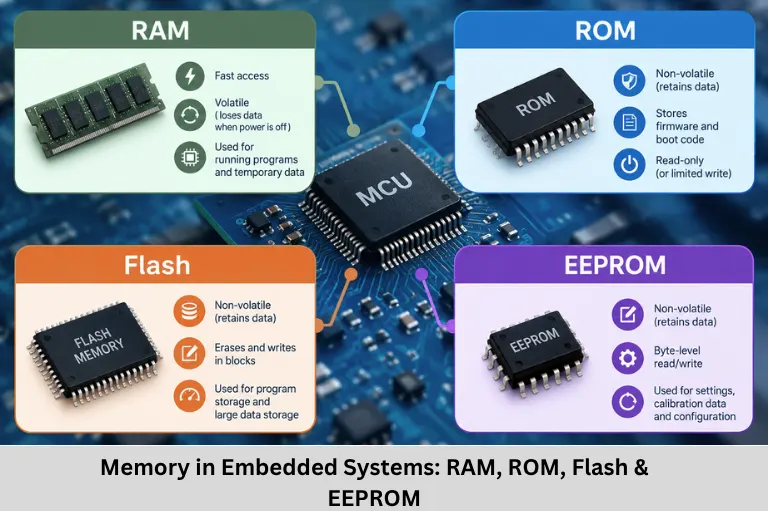
Learn RAM, ROM, Flash, EEPROM, SRAM, DRAM, memory maps, memory architecture, endurance, speed, and memory selection for embedded systems. Embedded Tech Development Academy (ETDA).
- Memory in Embedded Systems: RAM, ROM, Flash & EEPROM
-
Memory in Embedded Systems: RAM, ROM, Flash, and EEPROM – A Detailed Guide
- Introduction to Memory in Embedded Systems
- Classification of Embedded Memory
- RAM in Embedded Systems
- ROM in Embedded Systems
- Flash Memory in Embedded Systems
- EEPROM in Embedded Systems
- Embedded System Memory Map
- RAM and Flash During Program Execution
- Key Memory Design Considerations
- Memory Selection in Real-World Embedded Applications
- Frequently Asked Questions
- Conclusion
Memory in Embedded Systems: RAM, ROM, Flash, and EEPROM – A Detailed Guide
Introduction to Memory in Embedded Systems
Memory is one of the most important hardware resources in an embedded systems because every firmware application needs somewhere to store program instructions, variables, buffers, configuration parameters, calibration values, and persistent data. From simple 8-bit microcontrollers such as the 8051 to ARM Cortex-M processors, STM32 devices, ESP32 controllers, automotive ECUs, industrial controllers, and Internet of Things (IoT) devices, memory architecture directly influences system performance, boot time, reliability, power consumption, and overall functionality.
Unlike desktop computers, embedded systems are often designed with carefully defined memory capacities. A microcontroller may contain a limited amount of SRAM for runtime processing and Flash memory for firmware. Some devices also provide EEPROM or emulate EEPROM functionality using Flash to retain configuration information when power is removed.
Embedded memory can be broadly understood through concepts such as volatile memory, non-volatile memory, RAM, ROM, Flash memory, EEPROM, SRAM, DRAM, memory addressing, memory mapping, program storage, data storage, memory endurance, write cycles, and memory allocation. Engineers must understand these characteristics before selecting a microcontroller or designing firmware.
For engineers learning firmware development, microcontrollers, embedded C, memory architecture, and hardware-software interaction, Embedded Tech Development Academy (ETDA) provides practical technical learning in embedded technologies. Learners looking for a Top Embedded Training Institute in Bangalore can develop embedded programming and hardware fundamentals with practical exposure and assured placement support. These concepts are also highly relevant when designing resource-constrained embedded systems and Internet of Things (IoT) products.
Classification of Embedded Memory
Volatile Memory
Volatile memory requires continuous power to retain stored information.
RAM
Random Access Memory (RAM) is the primary volatile memory used while firmware is executing. Variables, stack data, buffers, and dynamically allocated objects can reside in RAM.
Characteristics of Volatile Memory
- Data is lost when power is removed.
- Read and write operations are fast.
- It is used extensively for runtime processing.
- RAM capacity directly affects application complexity.
Non-Volatile Memory
Non-volatile memory retains information even after power is removed.
Common Non-Volatile Memories
Examples include:
- ROM
- Flash memory
- EEPROM
- Electrically programmable non-volatile memory
Embedded Applications
Non-volatile memory is commonly used for firmware, bootloaders, calibration constants, configuration parameters, device identification, and persistent application data.
RAM in Embedded Systems
Random Access Memory
RAM provides temporary storage during program execution. When a microcontroller starts executing firmware, runtime data must generally be placed in RAM.
SRAM
Static RAM (SRAM) stores data using bistable memory cells and does not require periodic refresh.
SRAM Applications
SRAM is commonly used for:
- Stack memory
- Heap memory
- Global and static variables
- Communication buffers
- ADC data buffers
- UART/SPI/I2C buffers
SRAM provides fast access but requires more silicon area per bit than DRAM.
DRAM
Dynamic RAM (DRAM) stores information using capacitive cells and requires periodic refresh operations.
DRAM Characteristics
DRAM provides high memory density at a lower cost per bit than SRAM, making it useful in embedded Linux systems, multimedia platforms, application processors, and systems requiring larger memory capacities.
SRAM vs DRAM
SRAM is generally preferred for small, fast on-chip memory, while DRAM is useful when an embedded platform requires substantially larger external memory.
ROM in Embedded Systems
Read-Only Memory
ROM is non-volatile memory traditionally used to store fixed program instructions or permanent data.
Types of ROM
Traditional ROM technologies include:
- Mask ROM
- PROM
- EPROM
- EEPROM
Historical Embedded Applications
Mask ROM was useful for mass-produced products where firmware was permanently programmed during manufacturing. EPROM could be erased using ultraviolet light and reprogrammed during development.
Modern microcontrollers typically rely more heavily on Flash memory because it provides convenient electrical programming and erasing.
Flash Memory in Embedded Systems
Flash as Firmware Storage
Flash memory is one of the most widely used non-volatile memories in modern microcontrollers. Firmware, bootloaders, constant tables, and application images can be stored in Flash.
NOR Flash
NOR Flash provides fast random reads and is commonly used for code storage.
Execute in Place
Some processors can execute firmware directly from NOR Flash using Execute in Place (XIP), reducing the need to copy the complete application into RAM.
NAND Flash
NAND Flash provides high storage density and is widely used for mass storage applications.
NAND Applications
NAND Flash is common in:
- Embedded storage
- Memory cards
- Solid-state storage
- Multimedia devices
- Embedded Linux systems
Flash Erase Characteristics
Flash memory generally operates using erase blocks or sectors rather than arbitrary single-byte erasure. Firmware designers must therefore consider erase granularity, write endurance, wear, and update strategy.
EEPROM in Embedded Systems
Electrically Erasable Programmable ROM
EEPROM is a non-volatile memory technology designed for electrically controlled read, write, and erase operations.
Small Persistent Data
EEPROM is particularly useful when an embedded application must frequently update relatively small quantities of persistent information.
Typical EEPROM Applications
Common applications include:
- Calibration constants
- Device serial numbers
- Configuration settings
- User preferences
- Manufacturing parameters
- Network configuration
EEPROM typically offers more convenient small-data updates than Flash, although actual endurance and write performance depend on the specific device.
Embedded System Memory Map
Typical Memory Organization
A microcontroller memory map defines how address ranges correspond to Flash, RAM, peripherals, and other memory regions.
Simplified Example
0x00000000 - 0x0007FFFF  → Flash / Program Memory
0x20000000 - 0x2001FFFF  → SRAM
0x40000000 - 0x5FFFFFFF  → Peripheral Registers
Memory-Mapped Peripherals
Embedded processors commonly use memory-mapped I/O, where peripheral registers occupy specific address ranges. Firmware can access these registers through pointers or hardware-specific definitions.
For example, GPIO, UART, SPI, I2C, ADC, timers, and interrupt controllers may appear within the processor’s memory address space.
RAM and Flash During Program Execution
Program and Runtime Data
Firmware is commonly stored in Flash while runtime variables are stored in RAM.
Typical Sections
A compiled embedded application may contain:
.text– executable code.rodata– read-only constants.data– initialized writable variables.bss– zero-initialized or uninitialized static storage
Startup Initialization
During startup, the boot code typically copies initialized .data values from their load location in non-volatile memory into RAM and clears the .bss region before calling the application entry point.
Understanding this process is essential for embedded C and firmware debugging.
Key Memory Design Considerations
Memory Capacity
The required Flash and RAM capacity depends on firmware size, communication protocols, RTOS usage, buffers, graphical interfaces, and application complexity.
Speed and Latency
Real-time applications require predictable memory access. RAM is generally used for frequently accessed runtime data.
Endurance and Power
Flash and EEPROM have finite write endurance. Firmware should minimize unnecessary writes and use techniques such as wear leveling, journaling, buffering, or update batching where appropriate.
Power consumption is another important factor, especially in battery-powered Internet of Things (IoT) devices.
Memory Selection in Real-World Embedded Applications
Internet of Things (IoT) Device
An Internet of Things (IoT) sensor node may use:
- Flash → Firmware
- SRAM → Sensor processing and communication buffers
- EEPROM/Flash → Device configuration
- External Flash → Logs or application data
Automotive ECU
An automotive ECU can use Flash for control firmware, RAM for real-time calculations and communication buffers, and non-volatile memory for calibration parameters.
Consumer Electronics
Consumer products can use Flash for application firmware, RAM for runtime processing, and EEPROM or Flash-based storage for user configuration.
These architectures demonstrate why memory selection must be based on capacity, access speed, endurance, retention, power consumption, cost, and application requirements.
Frequently Asked Questions
What type of memory is used for firmware in embedded systems?
Firmware is commonly stored in non-volatile Flash memory because it retains data without power and can be electrically programmed during development and product updates.
What is the difference between SRAM and DRAM?
SRAM does not require periodic refresh and is generally faster, while DRAM requires refresh operations and provides higher memory density. Microcontrollers commonly use SRAM for fast on-chip runtime memory, while larger embedded platforms may use external DRAM.
Why is EEPROM used in embedded systems?
EEPROM is useful for storing small amounts of persistent information such as calibration values, configuration parameters, device IDs, and user settings.
Why is EEPROM used in embedded systems?
In some microcontrollers, EEPROM functionality can be emulated using Flash. However, Flash normally has different erase granularity and write-management requirements, so firmware must account for endurance and sector-based erase operations.
Why is RAM important for real-time embedded applications?
RAM provides fast runtime storage for variables, stacks, buffers, communication data, and intermediate calculations. Sufficient and efficiently managed RAM helps firmware meet timing and processing requirements.
Conclusion
Understanding memory architecture is fundamental to developing reliable embedded systems. RAM, ROM, Flash, and EEPROM each serve different purposes, and their characteristics directly affect firmware execution, data retention, system performance, power consumption, and product reliability.
RAM provides volatile runtime storage for variables, stacks, heaps, buffers, and real-time processing. SRAM is particularly important in microcontrollers because of its fast access characteristics. Flash provides non-volatile storage for firmware and bootloaders, while EEPROM is useful for smaller persistent datasets such as calibration parameters and configuration values. Traditional ROM technologies such as Mask ROM and EPROM are also important for understanding the evolution of embedded memory technology.
For advanced firmware development, engineers should understand memory maps, address spaces, linker scripts, .text, .rodata, .data, .bss, stack, heap, memory-mapped I/O, Flash endurance, EEPROM write cycles, bootloaders, and memory optimization. These concepts become particularly important when developing automotive ECUs, industrial controllers, robotics, consumer electronics, and Internet of Things (IoT) products.
Embedded Tech Development Academy (ETDA) provides practical technical learning around embedded programming, microcontrollers, C/C++, Linux, firmware development, and hardware-software integration. Learners searching for a Top Embedded Training Institute in Bangalore can strengthen their understanding of embedded memory architecture through practical technical training and assured placement support.
For engineers working on embedded systems, selecting the correct combination of RAM and non-volatile memory is a critical design decision. Embedded Tech Development Academy (ETDA) helps learners build the technical foundation required to understand microcontroller architecture, memory organization, firmware execution, and hardware interfaces. For learners looking for a Top Embedded Training Institute in Bangalore, practical learning combined with assured placement support can support their preparation for embedded development careers.
Memory architecture is also central to modern Internet of Things (IoT) development, where devices must balance limited resources, low power consumption, persistent configuration, sensor processing, and communication workloads. Understanding RAM, ROM, Flash, and EEPROM therefore provides an essential foundation for designing efficient and reliable embedded systems. Embedded Tech Development Academy (ETDA), as a Top Embedded Training Institute in Bangalore, focuses on developing these practical technical skills with assured placement support for learners pursuing embedded technologies.
Author: ETDA Trainers
Experience: 10+ Years of Industry Experience in Embedded Systems, IoT, and Embedded C Programming