
Memory Management in Embedded Systems | RAM, ROM & Flash
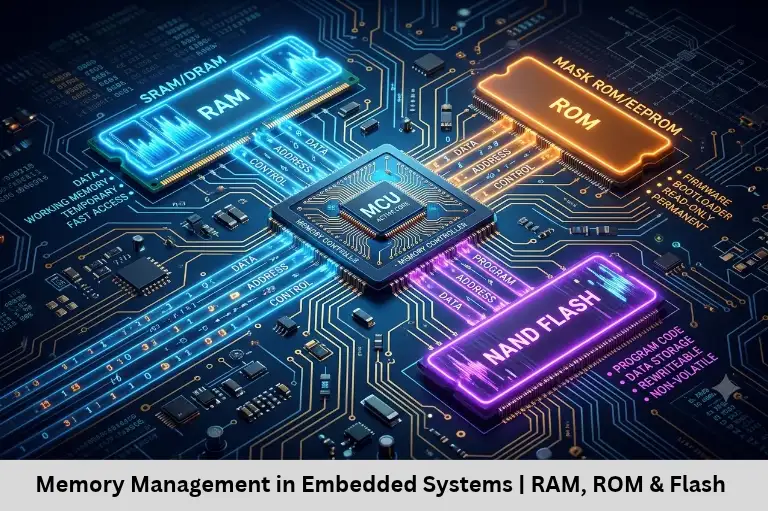
Learn RAM, ROM, Flash, EEPROM, stack, heap, and memory optimization in Embedded Systems with practical Embedded C concepts and Embedded Tech Development Academy (ETDA) training.
- Memory Management in Embedded Systems | RAM, ROM & Flash
-
Memory Management in Embedded Systems: RAM, ROM, Flash and EEPROM
- Introduction
- Understanding Memory Architecture in Embedded Systems
- RAM in Embedded Systems
- ROM and Flash Memory in Microcontrollers
- EEPROM Memory for Persistent Data Storage
- Practical Memory Management Techniques
- Common Memory Management Problems in Embedded Systems
- Learn Embedded Memory Management at ETDA
- Frequently Asked Questions
- Conclusion
Memory Management in Embedded Systems: RAM, ROM, Flash and EEPROM
Introduction
Memory management is one of the most important concepts in embedded programming because microcontrollers operate with limited memory resources. Every variable, function, buffer, stack operation, and stored configuration consumes memory. Understanding how RAM, ROM, Flash, and EEPROM work helps engineers develop efficient firmware for automotive electronics, industrial automation, robotics, and Internet of Things (IoT) devices.
For students learning Embedded C, memory management is more than understanding storage types; it involves knowing where data resides, how long it remains available, and how efficiently a program uses available resources. Students searching for the Top Embedded Training Institute in Bangalore can benefit from practical training that connects programming concepts with microcontroller architecture. Embedded Tech Development Academy (ETDA) provides technical learning, hands-on projects, and assured placement support for aspiring embedded engineers.
Understanding Memory Architecture in Embedded Systems
A microcontroller contains different memory regions designed for specific purposes. Some memory stores executable firmware, while other memory stores temporary variables, buffers, and application data.
The memory architecture determines how the processor accesses instructions and data during program execution. Engineers must understand memory capacity, access speed, retention characteristics, and write limitations before designing firmware.
Volatile and Non-Volatile Memory
Memory is broadly classified into volatile and non-volatile categories.
Volatile memory: Requires power to retain stored information. RAM is the most common example.
Non-volatile memory: Retains information even when power is removed. Flash, EEPROM, and ROM belong to this category.
This distinction is important because embedded applications may need temporary processing data as well as permanent configuration information.
RAM in Embedded Systems
Random Access Memory (RAM) stores variables and data that firmware uses during execution. RAM is generally fast and supports frequent read and write operations, but its contents are lost when the system loses power.
Microcontrollers commonly use Static RAM (SRAM), which does not require refresh cycles like DRAM. SRAM is useful for storing application variables, communication buffers, stack information, and temporary calculations.
Stack and Heap Memory
The stack stores function-related information such as local variables, return addresses, and saved processor context. Function calls consume stack space, and deeply nested calls or large local arrays can cause stack overflow.
The heap is used for dynamically allocated memory through functions such as malloc() and free(). Although dynamic allocation provides flexibility, it can introduce fragmentation, allocation failures, and unpredictable execution behavior in embedded applications.
Example of RAM Usage in Embedded C
#include <stdint.h>

uint8_t sensor_value = 0;  // Global variable in RAM

void process_sensor(void)
{
    uint16_t filtered_value = 250;
    sensor_value = (uint8_t)filtered_value;
}
Here, global and local variables generally occupy RAM during program execution. The exact storage location depends on compiler behavior, optimization, and variable lifetime.
Students should learn to inspect map files and compiler reports to understand actual memory usage rather than relying only on source code assumptions.
ROM and Flash Memory in Microcontrollers
Read-Only Memory (ROM) traditionally stores permanent instructions or data that cannot be modified during normal operation. Modern microcontrollers commonly use internal Flash memory instead of conventional mask ROM for storing firmware.
Flash is non-volatile and can be electrically erased and programmed. It stores the application code, startup routines, constant tables, and sometimes configuration data.
Flash Memory Characteristics
Flash memory offers several advantages for embedded development:
Retains firmware without external power.
Supports programmable firmware updates.
Stores executable code and constant data.
Provides relatively high storage capacity compared with many EEPROM implementations.
However, Flash has finite erase and write endurance. Programming typically occurs in units such as pages or sectors, while erasure may require larger blocks. Engineers must understand the device-specific programming restrictions before implementing persistent storage.
Flash Usage in Embedded C
#include <stdint.h>

const uint16_t lookup_table[] = {
    100, 200, 300, 400, 500
};
On many microcontroller toolchains, constant data can be placed in Flash or another read-only memory region. The compiler and linker determine its final placement.
Using constant tables can reduce RAM consumption when the application does not need to modify those values. This is useful for embedded applications with limited SRAM.
EEPROM Memory for Persistent Data Storage
Electrically Erasable Programmable Read-Only Memory (EEPROM) is non-volatile memory designed for storing data that may be updated during application operation. Unlike ordinary RAM, EEPROM retains information after power is removed.
EEPROM is useful for storing calibration values, device configuration, counters, user settings, and operating parameters. Many EEPROM devices support byte-level updates, although actual programming behavior and endurance depend on the device.
EEPROM Versus Flash
EEPROM and Flash are both non-volatile, but their usage differs.
| Feature | EEPROM | Flash |
|---|---|---|
| Typical purpose | Configuration and small data | Firmware and larger data |
| Update granularity | Often byte-oriented | Commonly page/sector-oriented |
| Capacity | Usually smaller | Usually larger |
| Write endurance | Device-dependent | Device-dependent |
| Erase requirements | Often finer-grained | Often block-based |
Some microcontrollers do not contain dedicated EEPROM. In such devices, engineers may emulate EEPROM using internal Flash or use an external EEPROM chip through I2C or SPI.
Practical Memory Management Techniques
Efficient memory usage improves firmware reliability and helps prevent runtime failures. Embedded developers should plan memory requirements during application design rather than waiting until the project is nearly complete.
Reducing RAM Consumption
Students can optimize RAM by avoiding unnecessary global variables, reducing buffer sizes, reusing temporary storage, and selecting appropriate data types.
For example, using a uint8_t variable for a value that never exceeds 255 can consume less memory than a 32-bit integer. However, engineers should consider alignment, processor efficiency, and actual application requirements before choosing smaller types.
Managing Persistent Data Safely
Persistent data should be written only when necessary because repeated writes can reduce memory endurance. Configuration updates can use validation checks, checksums, version fields, or redundant storage to protect against interrupted writes.
Memory Optimization in IoT Devices
Internet of Things (IoT) devices often operate with limited RAM and power resources. Firmware may need to maintain sensor buffers, communication packets, network stacks, and application variables simultaneously.
Efficient memory management helps reduce RAM usage, improve responsiveness, and support reliable operation. Students should understand how memory requirements increase when Wi-Fi, MQTT, encryption, or real-time tasks are added.
Practical Student Project
A useful project is an Internet of Things (IoT) sensor logger that collects temperature readings and stores selected measurements in non-volatile memory. Students can use RAM for temporary processing, Flash for firmware, and EEPROM or suitable Flash storage for persistent configuration.
The project can include power-cycle testing to verify that stored data remains available after restarting the microcontroller. It also introduces memory allocation, data validation, sensor interfacing, and debugging techniques.
Common Memory Management Problems in Embedded Systems
Embedded developers frequently encounter memory-related errors that can affect application reliability.
Stack overflow: Occurs when function calls and local variables exceed available stack space.
Heap fragmentation: Results from repeated dynamic allocation and deallocation.
Buffer overflow: Happens when software writes beyond allocated memory boundaries.
Memory leaks: Occur when dynamically allocated memory is not released appropriately.
Flash endurance problems: Result from excessive erase and write operations.
Incorrect data placement: Can cause unexpected RAM consumption or access errors.
Understanding these problems helps students develop safer and more predictable firmware. Debuggers, linker map files, compiler warnings, static analysis, and memory usage reports are useful tools for identifying memory-related issues.
Learn Embedded Memory Management at ETDA
Embedded Tech Development Academy (ETDA) provides technical training opportunities for students interested in Embedded C, microcontroller architecture, firmware development, and hardware-software integration.
Practical learning helps students understand memory organization, variable storage, pointers, stack behavior, peripheral programming, and microcontroller debugging. Project-based activities connect programming fundamentals with real embedded hardware.
For students searching for the Top Embedded Training Institute in Bangalore, Embedded Tech Development Academy (ETDA) offers industry-oriented technical learning and practical project exposure. Students can strengthen their understanding of memory management, Embedded Systems, and Internet of Things (IoT) development while preparing for engineering career opportunities.
Embedded Tech Development Academy (ETDA) also provides assured placement support through relevant training programs, helping learners improve their technical preparation and explore embedded development roles.
Frequently Asked Questions
What is memory management in Embedded Systems?
Memory management involves organizing, allocating, and using RAM, Flash, and other memory resources efficiently while developing reliable microcontroller firmware.
What is the difference between RAM and Flash?
RAM stores temporary data during execution and normally loses its contents when power is removed. Flash stores firmware and persistent information without requiring continuous power.
What is EEPROM used for in microcontrollers?
EEPROM stores persistent information such as calibration values, configuration settings, counters, and device parameters.
What is stack memory in Embedded C?
Stack memory stores function-related information, local variables, return addresses, and execution context during program operation.
Why is memory optimization important in IoT devices?
Internet of Things (IoT) devices often have limited memory and power resources. Efficient memory usage improves reliability, reduces resource consumption, and supports more complex application functionality.
Does ETDA provide practical embedded training and placement support?
Embedded Tech Development Academy (ETDA) provides practical technical training and assured placement support through relevant programs, helping students develop Embedded C, microcontroller, and firmware development skills.
Conclusion
Memory management is a fundamental skill for developing efficient and reliable Embedded Systems. Understanding RAM, ROM, Flash, EEPROM, stack, heap, and memory optimization helps students write better firmware for microcontrollers, automotive electronics, industrial automation, and Internet of Things (IoT) applications.
For students searching for the Top Embedded Training Institute in Bangalore, Embedded Tech Development Academy (ETDA) offers industry-oriented technical training, hands-on projects, and assured placement support. Developing strong memory management and Embedded C skills can help learners build a solid foundation for embedded engineering careers.
Author: ETDA Trainers
Experience: 10+ Years of Industry Experience in Embedded Systems, IoT, and Embedded C Programming