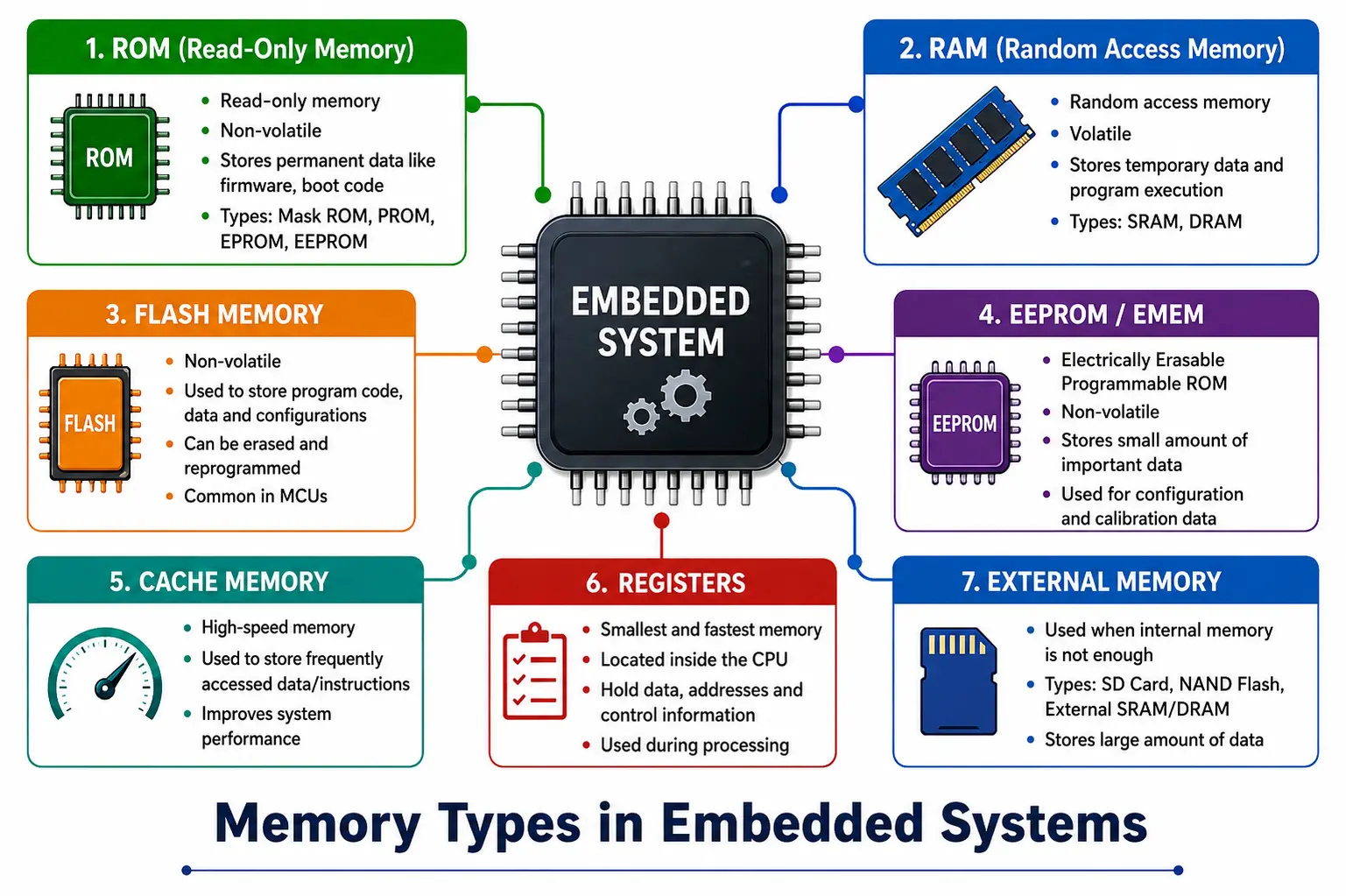
Learn memory types in embedded systems, including RAM, ROM, Flash, EEPROM, Cache, and Registers. Understand their functions, differences, and applications.
Memory is one of the most important components of any embedded system. Whether you’re working with a simple microcontroller-based project or a complex IoT device, memory plays a critical role in storing program instructions, processing data, and ensuring smooth system operation. Understanding the different memory types in embedded systems is essential for students, embedded engineers, and IoT developers. Choosing the right memory can significantly impact system performance, power consumption, reliability, and cost. In this guide, we’ll explore the various types of memory used in embedded systems, their characteristics, applications, advantages, and how they contribute to the overall functionality of an embedded device.
What is Memory in Embedded Systems?
Memory is a hardware component used to store data and program instructions within an embedded system.
An embedded system uses memory to:
Store firmware and application code
Hold temporary data during execution
Save user settings and configurations
Store sensor readings and logs
Manage real-time processing tasks
Unlike desktop computers, embedded systems often have limited memory resources. Therefore, understanding memory architecture is crucial for efficient embedded software development.
Why Memory is Important in Embedded Systems
Memory directly affects the performance and functionality of embedded devices.
Key Functions of Memory
Program Storage
Stores firmware and application code.
Data Storage
Holds variables and runtime data.
Configuration Storage
Saves system settings and calibration values.
Temporary Processing
Provides working space for CPU operations.
Fast Data Access
Enables quick execution of critical tasks. Efficient memory utilization is a key requirement in embedded systems design.
Classification of Memory in Embedded Systems
Memory in embedded systems can generally be classified into two categories:
Volatile Memory
Volatile memory loses its data when power is turned off.
Examples:
RAM
Cache Memory
Registers
Non-Volatile Memory
Non-volatile memory retains data even after power is removed.
Examples:
ROM
EEPROM
Flash Memory
Understanding this distinction helps developers select appropriate memory for different applications.
Registers
Registers are the fastest memory units inside a microcontroller or processor. They are directly connected to the CPU and store temporary data during instruction execution.
Characteristics of Registers
Extremely fast access speed
Small storage capacity
Located inside the CPU
Used for arithmetic and logical operations
Examples of Register Usage
Program Counter (PC)
Accumulator
Status Register
Stack Pointer
Registers are critical for efficient processor performance.
RAM (Random Access Memory)
RAM is one of the most commonly used memory types in embedded systems. It temporarily stores data that the processor needs during program execution.
Characteristics of RAM
Volatile memory
Fast read and write operations
Temporary storage
Loses data when power is removed
Uses of RAM
Variables
Stack memory
Buffers
Runtime data
Task management in RTOS
Types of RAM
SRAM (Static RAM)
SRAM stores data using flip-flops.
Advantages
Faster access
No refresh required
Lower latency
Disadvantages
Expensive
Lower density
DRAM (Dynamic RAM)
DRAM stores data using capacitors.
Advantages
High storage capacity
Cost effective
Disadvantages
Requires periodic refreshing
Slower than SRAM
SRAM is commonly used in microcontrollers, while DRAM is often found in larger embedded systems.
ROM (Read Only Memory)
ROM is a non-volatile memory used to store permanent program instructions. Once programmed, data remains intact even when power is removed.
Characteristics of ROM
Non-volatile
Permanent storage
Reliable data retention
Low power consumption
Uses of ROM
Bootloader storage
Firmware storage
System startup instructions
ROM is often used in devices that require fixed software functionality.
PROM (Programmable Read-Only Memory)
PROM is a type of ROM that can be programmed once after manufacturing.
Features
Programmable by the user
Non-volatile
Permanent storage
Once programmed, the contents cannot be modified.
EPROM (Erasable Programmable Read-Only Memory)
EPROM allows stored data to be erased and reprogrammed.
Characteristics
Non-volatile
Reprogrammable
Erased using ultraviolet (UV) light
Applications
Firmware development
Prototype systems
EPROM was widely used before Flash memory became popular.
EEPROM allows data to be erased and rewritten electrically.
Features
Non-volatile
Reprogrammable
Data retention without power
Applications
Configuration storage
Calibration data
User settings
Device identification
EEPROM is commonly used when small amounts of data need frequent updates.
Flash Memory
Flash memory is one of the most widely used memory types in modern embedded systems. It combines the advantages of EEPROM with larger storage capacity.
Characteristics
Non-volatile
High storage density
Electrically programmable
Cost effective
Applications
Firmware storage
IoT devices
Mobile devices
Embedded Linux systems
Flash memory has become the standard choice for embedded firmware storage.
Types of Flash Memory
NOR Flash
Provides fast random access to stored data.
Advantages
Faster code execution
Reliable read performance
Applications
Firmware storage
Code execution
NAND Flash
Optimized for high-capacity storage.
Advantages
Larger storage
Lower cost
Applications
SD cards
USB drives
Embedded storage devices
Cache Memory
Cache memory is a high-speed memory located between the CPU and main memory. It stores frequently accessed data and instructions.
Benefits of Cache Memory
Faster data access
Reduced processor waiting time
Improved system performance
Cache Levels
L1 Cache
Fastest and smallest cache.
L2 Cache
Larger than L1 but slightly slower.
L3 Cache
Used in advanced processors for additional performance improvements. Not all microcontrollers include cache memory, but it is common in advanced embedded processors.
Stack and Heap Memory
During program execution, RAM is often divided into stack and heap regions.
Stack Memory
Used for:
Local variables
Function calls
Return addresses
Advantages
Fast allocation
Automatic management
Heap Memory
Used for dynamic memory allocation.
Example:
ptr = malloc(100);
Advantages
Flexible memory usage
Challenges
Memory fragmentation
Potential memory leaks
Embedded developers often minimize heap usage to improve reliability.
Memory Hierarchy in Embedded Systems
The memory hierarchy is organized based on speed, cost, and storage capacity.
From fastest to slowest:
Registers
Cache Memory
SRAM
DRAM
Flash Memory
EEPROM
External Storage
The CPU accesses higher levels more frequently for better performance.
Safety-critical applications require highly reliable memory. Choosing the right memory type helps optimize system performance and efficiency.
Applications of Memory in Embedded Systems
Different memory types are used in various embedded applications.
Consumer Electronics
Smart TVs
Cameras
Wearable devices
Automotive Systems
Engine control units
ADAS systems
Infotainment systems
Medical Devices
Patient monitors
Diagnostic equipment
Industrial Automation
PLC systems
Robotics
IoT Devices
Smart sensors
Connected appliances
Every embedded application relies on multiple memory types working together.
Challenges of Memory Management in Embedded Systems
Challenges of Memory Management in Embedded Systems
Limited Memory Resources
Many microcontrollers have very small memory capacities.
Memory Fragmentation
Dynamic memory allocation can cause fragmentation issues.
Power Constraints
Memory operations consume power.
Data Corruption Risks
Improper memory handling can lead to system failures. Efficient memory management is essential for reliable embedded applications.
Future Trends in Embedded Memory Technology
Future Trends in Embedded Memory Technology
Higher Density Flash Memory
More storage in smaller devices.
Low-Power Memory Solutions
Optimized for IoT and wearable devices.
MRAM and FRAM
Emerging memory technologies offering faster access and better endurance.
AI and Edge Computing
Advanced embedded applications require larger and faster memory systems. These innovations will support next-generation embedded and IoT solutions.
Frequently Asked Questions (FAQs)
What are the main memory types in embedded systems?
The primary memory types include Registers, RAM, ROM, EEPROM, Flash Memory, and Cache Memory.
What is volatile memory?
Volatile memory loses stored data when power is turned off. Examples include RAM and Cache.
What is non-volatile memory?
Non-volatile memory retains data even after power removal. Examples include ROM, EEPROM, and Flash Memory.
Why is Flash Memory commonly used in embedded systems?
Flash Memory offers large storage capacity, low cost, and non-volatile operation, making it ideal for firmware storage.
What is the difference between SRAM and DRAM?
SRAM is faster and does not require refreshing, while DRAM offers larger capacity at a lower cost but requires periodic refreshing.
What is EEPROM used for?
EEPROM is used to store configuration settings, calibration data, and other information that must be retained after power loss.
What is Cache Memory?
Cache Memory is high-speed memory that stores frequently used data and instructions for faster CPU access.
Why is memory management important in embedded systems?
Proper memory management improves performance, reduces power consumption, prevents crashes, and ensures reliable system operation.
Conclusion
Memory is a fundamental building block of every embedded system. From registers and RAM to EEPROM and Flash Memory, each memory type serves a unique purpose in storing data, executing programs, and maintaining system performance. Understanding memory architecture helps embedded engineers optimize resource utilization, improve reliability, and design efficient applications. As embedded systems continue to evolve with IoT, Industry 4.0, artificial intelligence, and smart devices, knowledge of memory technologies becomes increasingly important. Engineers who understand memory management and architecture are better equipped to develop robust, high-performance embedded solutions.
At Embedded Tech Development Academy (ETDA), students gain hands-on experience with microcontrollers, memory architecture, Embedded C programming, RTOS, and IoT development, helping them build industry-ready skills for successful careers in embedded systems engineering.
Author: ETDA Trainers Experience: 10+ Years of Industry Experience in Embedded Systems, IoT, and Embedded C Programming