
Introduction to Microcontrollers and Microprocessors
In the world of electronics and embedded systems, microcontrollers and microprocessors play a major role in controlling devices and performing computations. From smartphones and laptops to washing machines and IoT devices, these tiny electronic components are the brains behind modern technology. Although many people use the terms microcontroller and microprocessor interchangeably, they are designed for different purposes and applications. Understanding the difference between them is essential for students, beginners in embedded systems, and electronics enthusiasts. This blog explains the basics of microcontrollers and microprocessors, their architecture, features, differences, applications, advantages, and real-world examples.
-
Introduction to Microcontrollers and Microprocessors
- What is a Microprocessor?
- Key Features of a Microprocessor
- Basic Block Diagram of a Microprocessor
- Examples of Microprocessors
- What is a Microcontroller?
- Key Features of a Microcontroller
- Basic Block Diagram of a Microcontroller
- Examples of Microcontrollers
- Difference Between Microcontroller and Microprocessor
- Applications of Microprocessors
- Applications of Microcontrollers
- Advantages of Microprocessors
- Advantages of Microcontrollers
- Real-World Example
- Conclusion
- FAQs
What is a Microprocessor?
A microprocessor is an integrated circuit (IC) that contains the central processing unit (CPU) of a computer system on a single chip. It is designed mainly for high-speed processing and complex computations. A microprocessor requires external components such as:
- RAM
- ROM
- Input/Output ports
- Timers
- Storage devices
These components are connected externally to create a complete computing system.
Key Features of a Microprocessor
- High processing speed
- Supports multitasking
- Suitable for complex calculations
- Requires external memory and peripherals
- Used in computers and advanced systems
Basic Block Diagram of a Microprocessor
The major components include:
- Arithmetic Logic Unit (ALU)
- Control Unit
- Registers
- External Memory Interface
- Input/Output Interface
Examples of Microprocessors
Some common microprocessors include:
- Intel Pentium
- Intel Core i3/i5/i7
- AMD Ryzen processors
- ARM Cortex-A processors
What is a Microcontroller?
A microcontroller is a compact integrated circuit designed specifically for embedded applications. It contains:
- CPU
- RAM
- ROM/Flash memory
- Timers
- Input/Output ports
- Communication interfaces
All these components are integrated into a single chip.
Microcontrollers are widely used in automation and embedded systems where dedicated control operations are required.
Key Features of a Microcontroller
- Compact design
- Low power consumption
- Cost-effective
- Integrated peripherals
- Ideal for real-time control applications
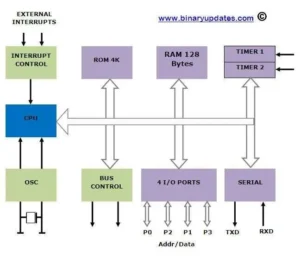
Basic Block Diagram of a Microcontroller
A microcontroller typically includes:
- CPU
- Flash Memory
- RAM
- GPIO Ports
- Timers/Counters
- ADC/DAC
- UART, SPI, I2C communication modules
Examples of Microcontrollers
Popular microcontrollers include:
- 8051 Microcontroller
- PIC Microcontroller
- AVR ATmega328
- STM32
- ESP32
- ARM Cortex-M series
Difference Between Microcontroller and Microprocessor
| Feature | Microprocessor | Microcontroller |
|---|---|---|
| Components | CPU only | CPU + Memory + I/O |
| Memory | External memory required | Built-in memory |
| Power Consumption | Higher | Lower |
| Cost | Expensive | Cost-effective |
| Speed | High processing speed | Moderate speed |
| Application | Computers and servers | Embedded systems |
| Size | Larger system size | Compact |
| Complexity | More complex | Simpler for dedicated tasks |
Applications of Microprocessors
Microprocessors are mainly used in systems that require powerful processing capabilities.
Common Applications
- Desktop computers
- Laptops
- Servers
- Gaming systems
- Workstations
- High-performance computing
Applications of Microcontrollers
Microcontrollers are used in embedded systems where dedicated functions are needed.
Common Applications
- Washing machines
- Microwave ovens
- Smart TVs
- IoT devices
- Robotics
- Automotive systems
- Medical equipment
- Industrial automation
Advantages of Microprocessors
- High computational capability
- Supports operating systems
- Better for multitasking
- Suitable for complex applications
Advantages of Microcontrollers
- Low power consumption
- Compact and lightweight
- Cost-effective solution
- Easy integration in embedded systems
Real-World Example
A laptop uses a microprocessor because it needs to run multiple applications simultaneously and perform complex tasks. A smart home automation device uses a microcontroller because it performs dedicated control functions with low power consumption.
Conclusion
Microcontrollers and microprocessors are both essential components in modern electronics. A microprocessor is best suited for high-performance computing applications, while a microcontroller is ideal for embedded systems and automation tasks.
Understanding their architecture, differences, and applications helps students and engineers choose the right component for their projects. As technology continues to evolve, both devices will remain fundamental in the fields of embedded systems, IoT, robotics, and computing.
FAQs
What is the main difference between a microcontroller and a microprocessor?
A microprocessor contains only the CPU and requires external memory and peripherals, whereas a microcontroller includes CPU, memory, and input/output peripherals on a single chip.
Where are microcontrollers commonly used?
Microcontrollers are commonly used in embedded systems such as home appliances, automotive systems, IoT devices, robotics, and industrial automation.
Which is better for embedded systems: microcontroller or microprocessor?
Microcontrollers are generally better for embedded systems because they are compact, cost-effective, and consume less power while providing built-in peripherals.
Recent Posts
- C++ Namespaces: Syntax, Types, Using Directive & Examples
- Number Systems in Digital Electronics: Binary, Octal & Hex
- NumPy Module in Python: Arrays, Functions & Applications
- Operating System Scheduling Algorithms: FCFS, SJF, RR & Priority
- PCB Design: Complete Guide to Modern PCB Design & Manufacturing