
Microwave Engineering: Fundamentals, Applications & Future Trends | ETDA
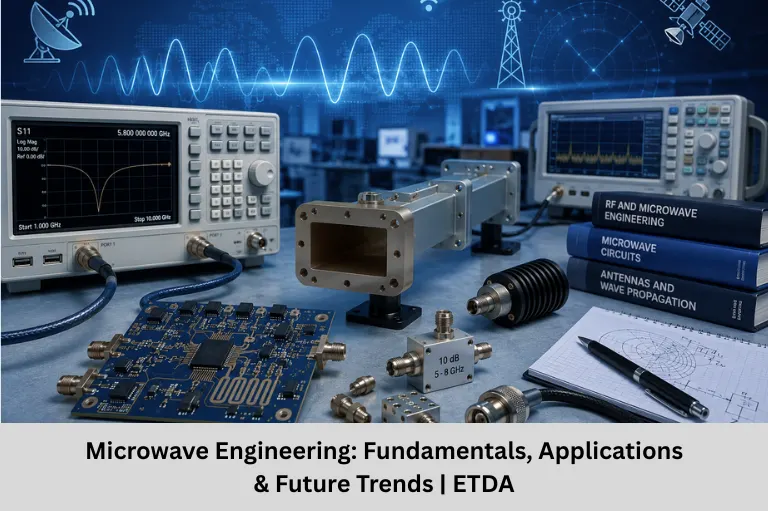
Learn the fundamentals of microwave engineering, transmission lines, waveguides, microwave components, applications, and future trends. Explore careers with Embedded Tech Development Academy (ETDA).
- Microwave Engineering: Fundamentals, Applications & Future Trends | ETDA
-
Microwave Engineering: An Essential Field in Modern Technology
- Introduction
- Fundamentals of Microwave Engineering
- Applications of Microwave Engineering
- Challenges in Microwave Engineering
- Essential Microwave Components
- Design Tools Used in Microwave Engineering
- Future Trends in Microwave Engineering
- Career Opportunities in Microwave Engineering
- Why Learn Microwave Engineering with Embedded Tech Development Academy (ETDA)?
- Frequently Asked Questions (FAQs)
- Conclusion
Microwave Engineering: An Essential Field in Modern Technology
Introduction
Embedded Tech Development Academy (ETDA). is one of the top embedded training institutes in Bangalore, offering industry-focused training in Embedded Systems, Internet of Things (IoT), VLSI, PCB Design, and communication technologies. With hands-on laboratory sessions, real-time projects, expert mentors, and dedicated placement assistance, Embedded Tech Development Academy (ETDA). prepares students for successful careers in the electronics, semiconductor, and embedded industries.
Microwave engineering is one of the fastest-growing domains in electronics and communication engineering, playing a crucial role in modern wireless communication, satellite communication, radar systems, medical electronics, and next-generation 5G and 6G technologies. Operating in the frequency range of 1 GHz to 300 GHz, microwave engineering focuses on the design, analysis, testing, and optimization of high-frequency electronic circuits and systems that enable reliable, high-speed data transmission.
Unlike conventional low-frequency circuits, microwave systems require specialized design techniques because electromagnetic wave behavior becomes increasingly important at higher frequencies. Engineers must understand concepts such as transmission lines, waveguides, impedance matching, S-parameters, RF circuit design, antenna engineering, electromagnetic wave propagation, microwave filters, RF amplifiers, microwave oscillators, and signal integrity to develop efficient microwave devices.
Microwave engineering has become indispensable across industries including aerospace, telecommunications, defense, healthcare, automotive electronics, industrial automation, and Internet of Things (IoT). Whether it’s enabling satellite internet, supporting autonomous vehicles through radar, improving MRI systems, or powering high-speed wireless networks, microwave engineering forms the technological backbone of modern connectivity.
For engineering students and professionals looking to build expertise in this rapidly evolving field, Embedded Tech Development Academy (ETDA). provides industry-oriented training in Embedded Systems, communication technologies, PCB design, RF fundamentals, and electronics engineering. Through hands-on projects and practical learning, Embedded Tech Development Academy (ETDA). helps learners acquire the skills required for careers in semiconductor, embedded, and wireless communication industries.
Fundamentals of Microwave Engineering
Microwave engineering involves working with electromagnetic waves at frequencies where conventional circuit theory becomes inadequate. At microwave frequencies, wave propagation, transmission lines, impedance matching, and waveguides become fundamental aspects of circuit design.
Key Concepts
1. Transmission Lines & Waveguides
At microwave frequencies, ordinary wires no longer behave as simple conductors. Instead, they function as transmission lines where impedance matching becomes essential to minimize reflections and signal loss.
Waveguides, typically rectangular or circular metallic structures, are widely used because they provide lower transmission losses compared to coaxial cables at very high frequencies.
2. Microwave Components
Passive Components
- Directional Couplers
- Power Dividers
- Microwave Filters
- Isolators
- Circulators
Active Components
- Microwave Transistors
- Gunn Diodes
- Tunnel Diodes
- RF Power Amplifiers
- Oscillators
3. S-Parameters (Scattering Parameters)
Since measuring voltage and current directly becomes difficult at microwave frequencies, engineers use S-Parameters to characterize microwave networks. These parameters describe how RF signals are reflected and transmitted through microwave components.
4. Antennas & Radiation
Microwave antennas are designed for high gain, directivity, and efficiency.
Common microwave antennas include:
- Patch Antennas
- Horn Antennas
- Parabolic Dish Antennas
- Phased Array Antennas
These antennas are extensively used in satellite communication, radar, wireless communication, and defense systems.
Applications of Microwave Engineering
Microwave technology powers numerous industries and modern electronic systems.
1. Wireless Communication (5G, Wi-Fi & Bluetooth)
Modern wireless networks utilize microwave frequencies for:
- 5G communication
- Wi-Fi networks
- Bluetooth devices
- Point-to-point communication
- Mobile communication infrastructure
Millimeter-wave (mmWave) frequencies above 24 GHz enable ultra-high-speed wireless communication.
2. Radar & Remote Sensing
Microwave radar systems are widely used in:
- Air traffic control
- Weather monitoring
- Military surveillance
- Missile guidance
- Automotive radar
- Marine navigation
3. Satellite Communication
Microwave frequencies enable:
- Satellite TV broadcasting
- GPS navigation
- Space communication
- Broadband internet services
- Earth observation satellites
- Low Earth Orbit (LEO) satellite communication
4. Medical Applications
Healthcare increasingly relies on microwave technologies.
Applications include:
- Microwave ablation
- MRI systems
- Cancer treatment
- Medical imaging
- Wireless healthcare monitoring
5. Industrial & Household Applications
Microwave engineering also supports:
- Microwave ovens
- Industrial heating
- Material drying
- Food processing
- Non-destructive testing
- Industrial sensing
Challenges in Microwave Engineering
1. High-Frequency Losses
Microwave circuits experience:
- Skin effect
- Dielectric losses
- Conductor losses
- Radiation losses
Special materials like PTFE (Teflon), Rogers laminates, and ceramic substrates help reduce these losses.
2. Precision Manufacturing
Since microwave wavelengths are very small, even slight PCB layout errors or manufacturing defects can significantly affect circuit performance.
3. Interference & Noise
Microwave systems are vulnerable to:
- Electromagnetic interference (EMI)
- Crosstalk
- Signal reflections
- External RF noise
Proper shielding and filtering techniques are essential.
4. Thermal Management
High-power RF amplifiers generate significant heat.
Cooling methods include:
- Heat sinks
- Thermal vias
- Copper planes
- Liquid cooling
- Advanced thermal interface materials
Essential Microwave Components
Transmission Lines
- Microstrip Lines
- Stripline
- Coplanar Waveguide
- Coaxial Cable
Waveguides
- Rectangular Waveguide
- Circular Waveguide
- Flexible Waveguide
Microwave Filters
- Low-pass Filters
- High-pass Filters
- Band-pass Filters
- Band-stop Filters
RF Amplifiers
- Low Noise Amplifier (LNA)
- Power Amplifier (PA)
- Driver Amplifier
Design Tools Used in Microwave Engineering
Popular RF Design Software
- Keysight ADS
- Ansys HFSS
- CST Microwave Studio
- Cadence AWR
- MATLAB
- COMSOL Multiphysics
These tools help engineers perform electromagnetic simulations, antenna design, RF circuit optimization, and signal integrity analysis.
Future Trends in Microwave Engineering
1. 6G & Terahertz Communication
Future communication systems will operate above 100 GHz, enabling ultra-fast wireless networks with extremely low latency.
2. Phased Array Antennas
Electronically steerable antennas are revolutionizing:
- Satellite communication
- Defense systems
- Autonomous vehicles
- Massive MIMO
- Radar
3. Microwave Photonics
Combining optical and microwave technologies enables:
- High-speed communication
- Low-loss signal processing
- Fiber-RF integration
4. Artificial Intelligence in RF Design
AI is increasingly being used for:
- Automatic antenna optimization
- RF circuit tuning
- Microwave filter design
- Fault prediction
- Performance optimization
5. Advanced Materials
Emerging materials are improving:
- Signal efficiency
- Thermal performance
- Miniaturization
- High-frequency operation
Career Opportunities in Microwave Engineering
Professionals with microwave engineering expertise can work as:
- RF Design Engineer
- Microwave Engineer
- Antenna Design Engineer
- Satellite Communication Engineer
- Wireless Communication Engineer
- Radar Systems Engineer
- EMC/EMI Engineer
- RF Validation Engineer
- Signal Integrity Engineer
- Communication Systems Engineer
Industries include telecommunications, aerospace, semiconductor manufacturing, automotive electronics, healthcare technology, and defense.
Why Learn Microwave Engineering with Embedded Tech Development Academy (ETDA)?
Industry-Focused Training
Embedded Tech Development Academy (ETDA) offers practical learning programs designed to prepare students for real-world electronics and embedded systems careers. Along with embedded systems, Embedded Tech Development Academy (ETDA) introduces learners to communication systems, PCB design, microcontrollers, Internet of Things (IoT), RF fundamentals, and advanced electronics concepts through hands-on projects, expert mentorship, and placement-oriented training.
Students benefit from industry-relevant curricula, practical laboratory sessions, and guidance that helps bridge the gap between academic learning and professional engineering roles. Whether your goal is to work in wireless communication, semiconductor design, embedded development, or electronics product engineering, Embedded Tech Development Academy (ETDA) provides the technical foundation and project experience needed to succeed.
Frequently Asked Questions (FAQs)
What is microwave engineering?
Microwave engineering is a branch of electrical and electronics engineering that focuses on designing and analyzing systems operating between 1 GHz and 300 GHz, including RF circuits, antennas, radar, and satellite communication.
What are the applications of microwave engineering?
Microwave engineering is widely used in wireless communication, satellite systems, radar, medical imaging, 5G networks, IoT devices, defense systems, industrial heating, and automotive radar.
What software is commonly used for microwave design?
Popular microwave design tools include Keysight ADS, Ansys HFSS, CST Microwave Studio, Cadence AWR, MATLAB, and COMSOL Multiphysics.
What skills are required to become a microwave engineer?
Key skills include RF circuit design, antenna design, transmission line analysis, electromagnetic theory, PCB design, S-parameter analysis, signal integrity, simulation software, and embedded systems knowledge.
Why should engineering students learn microwave engineering?
Microwave engineering offers excellent career opportunities in telecommunications, aerospace, defense, semiconductor industries, automotive electronics, and advanced wireless technologies, making it a valuable specialization for electronics and communication engineers.
Conclusion
Embedded Tech Development Academy (ETDA) is recognized as one of the top embedded training institutes in Bangalore, offering industry-focused programs in Embedded Systems, Internet of Things (IoT), VLSI, and wireless communication technologies. With hands-on learning, real-time projects, expert trainers, and dedicated placement assistance, Embedded Tech Development Academy (ETDA) helps students build strong technical skills and become industry-ready professionals.
Microwave engineering is a cornerstone of today’s connected world, enabling high-speed wireless communication, satellite systems, radar technology, medical imaging, industrial automation, and next-generation telecommunications. As technologies such as 5G, 6G, Internet of Things (IoT), autonomous vehicles, artificial intelligence, phased-array antennas, RF integrated circuits, millimeter-wave communication, electromagnetic compatibility (EMC), and terahertz communication continue to evolve, the demand for skilled microwave engineers will grow rapidly.
Understanding microwave engineering not only opens doors to exciting career opportunities but also equips engineers with the knowledge required to design efficient, reliable, and high-performance communication systems. For students aspiring to build careers in embedded systems, RF engineering, VLSI, and wireless technologies, Embedded Tech Development Academy (ETDA) provides industry-oriented training, practical project experience, and placement support to help them become future-ready professionals. By mastering microwave engineering concepts alongside embedded systems and modern electronics, learners can confidently contribute to the next generation of intelligent communication technologies.
Author: ETDA Trainers
Experience: 10+ Years of Industry Experience in Embedded Systems, IoT, and Embedded C Programming