
Power Electronics: Components, Applications & Energy Conversion
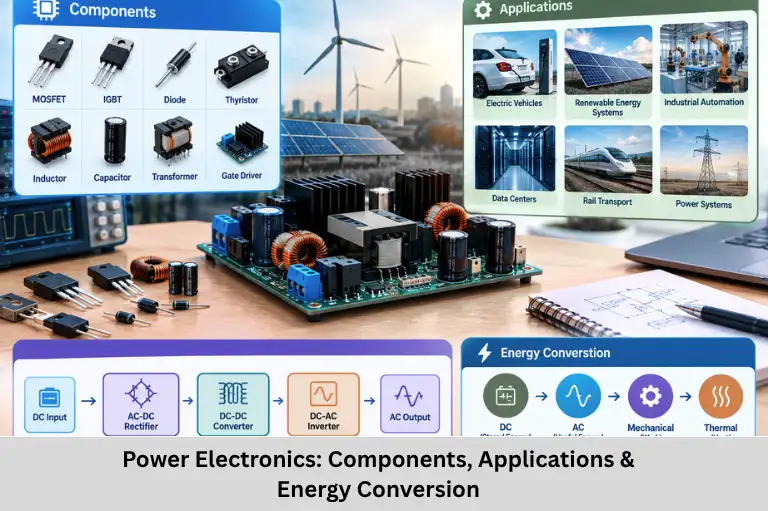
Learn power electronics, power semiconductor devices, AC/DC converters, inverters, motor drives, renewable energy applications, SiC, GaN, and future trends. Embedded Tech Development Academy (ETDA).
- Power Electronics: Components, Applications & Energy Conversion
-
Power Electronics: The Driving Force Behind Modern Energy Conversion
- Introduction to Power Electronics
- Fundamentals of Power Electronics
- Core Components of Power Electronic Systems
- Major Power Electronics Applications
- Renewable Energy and Power Electronics
- Power Electronics in Electric Vehicles
- Recent Technological Advancements
- Challenges in Power Electronics
- Future Trends in Power Electronics
- Frequently Asked Questions
- Conclusion
Power Electronics: The Driving Force Behind Modern Energy Conversion
Introduction to Power Electronics
Power electronics is a specialized field of electrical and electronic engineering concerned with the conversion, control, conditioning, and efficient utilization of electrical energy. It combines power semiconductor devices, electrical circuits, control systems, embedded controllers, signal processing, thermal management, and switching techniques to control electrical power with high efficiency and precision.
Modern electrical infrastructure depends heavily on power electronic converters. Smartphone chargers convert AC power into regulated DC voltage, solar inverters convert photovoltaic DC power into grid-compatible AC, electric vehicles use power converters to control battery and motor energy flow, and industrial automation systems use variable-frequency drives to control motor speed and torque. Even data centers, telecommunications equipment, aircraft, robotics, and energy-storage systems depend on advanced power conversion.
Unlike traditional linear power-control techniques, switching-based power electronics uses semiconductor devices that operate primarily between ON and OFF states. This significantly reduces conduction and switching losses when properly designed. Engineers must nevertheless consider switching frequency, semiconductor losses, gate-drive requirements, electromagnetic interference (EMI), thermal resistance, voltage/current ratings, control-loop stability, power density, and reliability.
Understanding power converters, semiconductor switching devices, PWM control, inverter circuits, rectifiers, DC-DC converters, motor drives, renewable energy systems, battery management, wide-bandgap semiconductors, embedded control, and energy-efficient power conversion is increasingly valuable for engineers. Embedded Tech Development Academy (ETDA) provides industry-oriented technical learning that connects embedded controllers with practical electronics and control applications. For learners searching for a Top Embedded Training Institute in Bangalore, Embedded Tech Development Academy (ETDA) also provides practical exposure and assured placement support.
Fundamentals of Power Electronics
Power electronics uses semiconductor switches to control the transfer of electrical energy from a source to a load. The converter topology selected depends on the input and output voltage, current, frequency, isolation, efficiency, and control requirements.
Major Power Conversion Types
The four fundamental conversion categories are:
- AC to DC – Rectification: Converts alternating current into direct current. It is used in DC power supplies, battery chargers, and electronic equipment.
- DC to AC – Inversion: Converts DC power into controlled AC power. Solar inverters, UPS systems, and EV traction systems use inverter stages.
- DC to DC Conversion: Changes one DC voltage level to another using switching topologies such as buck, boost, and buck-boost converters.
- AC to AC Conversion: Changes AC voltage, frequency, or waveform characteristics. Applications include motor drives and frequency-conversion systems.
Important Performance Parameters
A power converter is evaluated using parameters such as efficiency, switching losses, conduction losses, power density, voltage regulation, transient response, total harmonic distortion (THD), electromagnetic compatibility, and thermal performance.
Role of Switching Frequency
Increasing switching frequency can reduce the physical size of inductors and transformers and improve transient response, but it can also increase switching losses and EMI. Therefore, switching frequency must be selected as part of an overall converter design trade-off.
Core Components of Power Electronic Systems
Power Semiconductor Devices
Power semiconductor switches form the main energy-control stage.
Common devices include:
- Power diodes
- SCRs/thyristors
- Power MOSFETs
- IGBTs
- SiC MOSFETs
- GaN transistors
Device Selection
Device selection depends on blocking voltage, current rating, switching speed, conduction loss, switching loss, operating temperature, gate-drive requirements, and cost.
Wide-Bandgap Devices
Silicon Carbide (SiC) and Gallium Nitride (GaN) offer material properties that enable high-frequency and high-efficiency converter designs. They are increasingly important in EV chargers, renewable-energy converters, data-center power supplies, and high-density power systems.
Passive Components
Inductors, capacitors, transformers, filters, and snubber networks determine energy storage, ripple filtering, isolation, and transient behavior.
Control and Gate-Drive Circuits
Gate drivers provide the appropriate voltage and current required to switch MOSFETs, IGBTs, SiC devices, or other controlled semiconductor switches. Digital controllers may use microcontrollers, DSPs, FPGAs, ADCs, timers, PWM peripherals, and communication interfaces.
Major Power Electronics Applications
Consumer Electronics
Power electronics is fundamental to:
- Switch-mode power supplies
- USB chargers
- LED drivers
- Laptop adapters
- Battery chargers
- Smart appliances
SMPS technology uses high-frequency switching to achieve compact size and high conversion efficiency.
Industrial Automation
Industrial applications include:
- Variable-frequency drives
- Servo drives
- Welding systems
- Induction heating
- Industrial DC supplies
- Robotics
Motor Control
A variable-frequency drive controls the frequency and voltage supplied to an AC motor. Advanced drive systems use feedback sensors and digital control algorithms to regulate speed, torque, acceleration, braking, and energy consumption.
Embedded Control in Motor Drives
Microcontrollers and DSPs can execute control algorithms such as field-oriented control (FOC) and monitor current, voltage, rotor position, temperature, and fault conditions in real time.
Renewable Energy and Power Electronics
Solar Power Conversion
Photovoltaic panels produce DC electricity. A solar inverter converts this energy into AC suitable for grid connection or local loads.
Maximum Power Point Tracking (MPPT) algorithms continuously adjust the operating point of a photovoltaic array to extract available power under changing irradiance and temperature conditions.
Wind Energy Conversion
Wind turbines use power electronic converters to regulate generator output and control energy transfer to the electrical grid.
Energy Storage Systems
Battery energy-storage systems require bidirectional converters to manage charging and discharging.
Bidirectional DC-DC Conversion
A bidirectional converter allows energy to flow in both directions between a battery and DC bus. This is important in electric vehicles, battery-storage systems, regenerative braking, and hybrid energy systems.
Power Electronics in Electric Vehicles
EV Powertrain
Electric vehicles use several power electronic subsystems, including:
- Traction inverter
- On-board charger
- DC-DC converter
- Battery-management electronics
- Auxiliary power converters
The traction inverter converts battery DC power into controlled three-phase AC for the electric motor.
Regenerative Braking
During regenerative braking, the motor operates as a generator. The inverter controls the resulting electrical power so that energy can be transferred back into the battery within the limits of the battery and vehicle control system.
EV Efficiency Requirements
High efficiency is essential because converter losses directly affect driving range, thermal requirements, component ratings, and overall vehicle performance.
Recent Technological Advancements
Digital Power Control
Modern converters increasingly use DSPs, microcontrollers, and FPGAs for digital PWM generation, current control, voltage regulation, protection, communication, and diagnostics.
Advanced Control Algorithms
Techniques such as model predictive control, adaptive control, digital current-mode control, and sensorless control can improve converter dynamic response and operating performance.
Intelligent Power Modules
Intelligent Power Modules integrate power semiconductor devices with gate-drive and protection functions, reducing system complexity and improving integration.
Wireless Power Transfer
Resonant inductive coupling enables contactless power transfer. It is used in consumer charging systems and is being developed for applications such as dynamic and stationary EV charging.
Challenges in Power Electronics
Thermal Management
Power semiconductor losses generate heat. Excessive junction temperature can reduce efficiency and reliability.
Engineers use:
- Heat sinks
- Forced-air cooling
- Liquid cooling
- Thermal interface materials
- Advanced packaging
Resonance Prevention
Engineers must calculate semiconductor losses and thermal resistance from the junction to the ambient environment to ensure that junction temperature remains within the device’s specified operating range.
EMI and EMC
Fast switching edges generate high dv/dt and di/dt, which can produce conducted and radiated electromagnetic interference. PCB layout, shielding, filtering, grounding, gate-resistor selection, and controlled switching transitions are important mitigation techniques.
Reliability
Power cycling, thermal cycling, semiconductor degradation, capacitor aging, solder fatigue, and insulation stress can influence long-term converter reliability.
Future Trends in Power Electronics
Ultra-Efficient Conversion
Research continues toward higher conversion efficiency and lower standby losses through improved semiconductor materials, magnetic components, topologies, and control techniques.
AI-Based Power Management
Machine-learning algorithms can analyze converter measurements for predictive maintenance, fault detection, load forecasting, thermal prediction, and efficiency optimization.
Smart and Connected Power Systems
Internet of Things (IoT)-enabled converters can transmit voltage, current, temperature, fault, and energy data to monitoring platforms.
Sustainable Power Conversion
Future designs will increasingly consider component lifetime, recyclable materials, reduced standby consumption, repairability, and efficient energy management.
Integration With Embedded Systems
The convergence of power electronics, embedded systems, Internet of Things (IoT), sensors, digital control, and artificial intelligence is creating intelligent power-conversion platforms capable of real-time monitoring, protection, diagnostics, and optimization.
Frequently Asked Questions
What is power electronics?
Power electronics is the branch of engineering that uses semiconductor switching devices and control circuits to convert, regulate, and control electrical power efficiently.
What are the four basic types of power converters?
The major categories are AC-to-DC rectifiers, DC-to-AC inverters, DC-to-DC converters, and AC-to-AC converters.
Why are MOSFETs and IGBTs used in power electronics?
MOSFETs provide fast switching and are widely used at low-to-medium voltage ranges, while IGBTs offer useful high-voltage and high-current switching characteristics in many medium- and high-power applications.
What are SiC and GaN devices?
SiC and GaN are wide-bandgap semiconductor technologies that enable power converters to operate at higher switching frequencies and temperatures with potentially lower losses in suitable applications.
What is the role of embedded systems in power electronics?
Embedded controllers monitor voltage, current, temperature, and other signals while executing PWM generation, feedback control, protection, communication, diagnostics, and power-management algorithms.
Conclusion
Power electronics is a fundamental technology behind modern energy conversion, electrical transportation, renewable energy, industrial automation, battery systems, motor control, consumer electronics, smart grids, and energy-storage infrastructure. By combining semiconductor switching devices, passive components, gate drivers, digital controllers, feedback sensors, thermal-management systems, and sophisticated control algorithms, power electronic systems can convert electrical energy between different voltage, current, and frequency levels with high efficiency and precise control.
The continued development of SiC and GaN power devices, high-frequency switching, digital power control, intelligent power modules, bidirectional converters, EV inverters, renewable-energy converters, wireless power transfer, AI-based diagnostics, and Internet of Things (IoT)-enabled monitoring is expanding the capabilities of modern power-conversion systems. At the same time, engineers must address challenging technical requirements involving thermal design, switching losses, EMI/EMC, control-loop stability, semiconductor reliability, PCB layout, protection circuits, fault detection, and system-level efficiency.
For engineering students and professionals interested in building practical expertise across embedded systems, electronics, microcontrollers, digital control, motor control, power electronics, and industrial automation, Embedded Tech Development Academy (ETDA) offers industry-oriented technical learning and hands-on project exposure. As a Top Embedded Training Institute in Bangalore, Embedded Tech Development Academy (ETDA) helps learners develop the practical skills needed to understand the interaction between embedded controllers and power electronic systems, along with assured placement support.
Choosing Embedded Tech Development Academy (ETDA) can help aspiring engineers build a strong technical foundation in embedded programming, microcontrollers, control systems, and electronics while understanding real-world applications such as EV powertrains, renewable-energy systems, industrial motor drives, and intelligent power converters. For candidates searching for a Top Embedded Training Institute in Bangalore, Embedded Tech Development Academy (ETDA) combines practical technical training with assured placement support, making it a career-focused option for engineers preparing for the evolving embedded and electronics industry.
Author: ETDA Trainers
Experience: 10+ Years of Industry Experience in Embedded Systems, IoT, and Embedded C Programming