
Preprocessor Directives and Macros in C/C++: Complete Guide
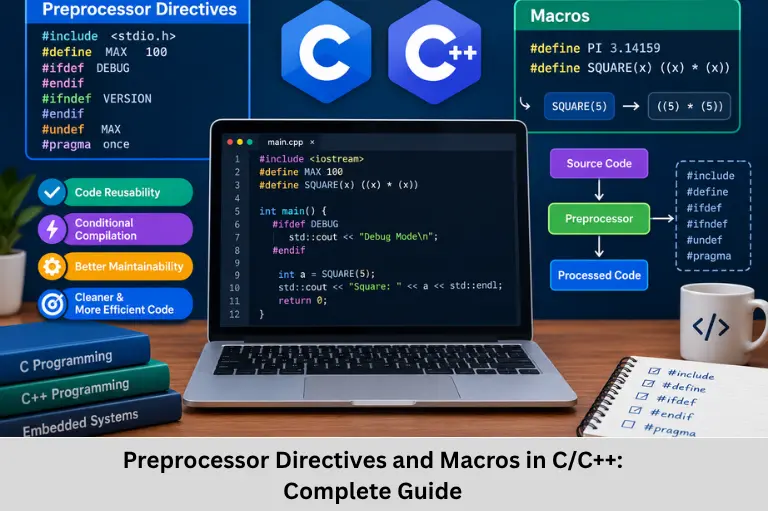
Learn C/C++ preprocessor directives, macros, conditional compilation, header files, include guards, debugging, common mistakes, and best practices. Embedded Tech Development Academy (ETDA).
- Preprocessor Directives and Macros in C/C++: Complete Guide
-
Preprocessor Directives and Macros in C/C++
- Introduction to Preprocessor Directives and Macros in C/C++
- What Is a C/C++ Preprocessor?
- General Preprocessor Directives
- #define – Constants and Macro Definitions
- #include – Header File Inclusion
- Conditional Compilation
- Include Guards and #pragma once
- #undef – Removing a Macro
- #error – Compile-Time Error Generation
- #pragma – Compiler-Specific Instructions
- Practical Debugging Using Macros
- Common Mistakes With Preprocessor Macros
- Best Practices for C/C++ Preprocessor Usage
- Frequently Asked Questions
- Conclusion
Preprocessor Directives and Macros in C/C++
Introduction to Preprocessor Directives and Macros in C/C++
Before C or C++ source code is passed to the compiler, it goes through an important preprocessing stage. The C/C++ preprocessor analyzes source code and processes instructions that begin with the # symbol. These instructions are called preprocessor directives, and they control operations such as header-file inclusion, macro expansion, conditional compilation, and compile-time error generation.
The preprocessor does not normally understand the complete C/C++ language in the same way as the compiler. Instead, it performs source-level transformations before the compiler parses the resulting translation unit. For example, #include brings header contents into the source, while #define creates macros that can be expanded during preprocessing.
Understanding C preprocessor directives, C++ macros, macro expansion, conditional compilation, header files, include guards, compile-time configuration, embedded C programming, compiler preprocessing, and source-code optimization is especially important for embedded software developers. Preprocessor techniques are extensively used for hardware abstraction, register definitions, platform-specific code, debugging configurations, and feature selection.
For students developing professional embedded programming skills, Embedded Tech Development Academy (ETDA) provides practical training in C, C++, Embedded C, microcontrollers, and firmware development. Learners searching for a Top Embedded Training Institute in Bangalore can benefit from industry-oriented programming practice and assured placement support.
What Is a C/C++ Preprocessor?
The preprocessor is a source-code processing stage that runs before the compiler performs compilation. It processes directives beginning with # and produces an expanded source file that is subsequently passed to the compiler.
Basic Examples of Preprocessor Directives
#include <stdio.h>
#define PI 3.14159
The first directive requests inclusion of the required header contents, while the second defines a macro named PI.
What Happens During Preprocessing?
A simplified compilation pipeline is:
Source Code → Preprocessor → Compiler → Assembler → Linker → Executable
Important Point About Macro Expansion
A macro is generally expanded by the preprocessor before the compiler analyzes the resulting C/C++ expression. Therefore, macros should be treated as source-code substitution mechanisms, not as type-safe functions or variables.
General Preprocessor Directives
The commonly used directives include:
| Directive | Purpose |
|---|---|
#define | Defines macros and symbolic constants |
#include | Includes header files |
#undef | Removes a macro definition |
#ifdef | Checks whether a macro is defined |
#ifndef | Checks whether a macro is not defined |
#if | Performs conditional compilation |
#else | Alternative conditional branch |
#elif | Additional conditional branch |
#endif | Ends conditional compilation |
#pragma | Provides implementation-specific instructions |
#error | Generates a preprocessing error |
#define – Constants and Macro Definitions
Defining Symbolic Constants
A simple macro can represent a constant:
#define PI 3.14159When the preprocessor encounters PI, it substitutes the corresponding replacement text.
Function-Like Macros
Macros can also accept arguments:
#define SQUARE(x) ((x) * (x))Using:
int result = SQUARE(5);produces the equivalent expanded expression:
int result = ((5) * (5));Why Parentheses Matter
Consider:
#define BAD_SQUARE(x) x * xCalling:
BAD_SQUARE(2 + 3)can expand to:
2 + 3 * 2 + 3because of operator precedence, producing an unexpected result. The safer form is:
#define SQUARE(x) ((x) * (x))However, even this macro can evaluate its argument more than once. Therefore, expressions with side effects should be avoided as macro arguments.
#include – Header File Inclusion
The #include directive allows declarations, definitions, macros, and other preprocessor content from another file to become part of the current translation unit.
System Header Files
#include <stdio.h>Angle brackets are conventionally used for system or implementation-provided headers.
User-Defined Header Files
#include "myheader.h"Double quotes are commonly used for project-specific headers.
Importance in Embedded Software
Header files are heavily used in embedded projects for register definitions, peripheral APIs, data types, configuration macros, function declarations, and hardware abstraction layers.
Conditional Compilation
Conditional compilation allows developers to include or exclude sections of source code depending on compile-time conditions.
#ifdef and #ifndef
#define DEBUG

#ifdef DEBUG
printf("Debugging enabled\n");
#endif
If DEBUG is defined, the debugging code is included in the preprocessed output.
#if, #else and #elif
Conditional compilation can also evaluate constant expressions:
#if MCU_TYPE == 1
    // MCU-specific implementation
#elif MCU_TYPE == 2
    // Alternative implementation
#else
    // Default implementation
#endif
This technique is highly useful when the same codebase supports multiple microcontrollers, processors, operating systems, or hardware configurations.
Include Guards and #pragma once
Preventing Multiple Header Inclusion
A header can accidentally be included through multiple dependency paths. Include guards prevent repeated processing:
#ifndef MYHEADER_H
#define MYHEADER_H

void myFunction(void);

#endif
Using #pragma once
Many compilers support:
#pragma onceThis instructs the implementation to include the header only once per translation unit.
Include Guards vs #pragma once
Include guards are based on standard preprocessor directives and are highly portable. #pragma once is widely supported but technically belongs to implementation-specific behavior.
#undef – Removing a Macro
The #undef directive removes an existing macro definition.
#define VALUE 100
#undef VALUE
#define VALUE 200
When Is #undef Useful?
It can be useful when managing temporary configuration macros or deliberately changing preprocessing configuration within controlled source regions.
#error – Compile-Time Error Generation
The #error directive deliberately stops preprocessing with an implementation-defined diagnostic.
#ifndef OS
#error "OS is not defined before compiling!"
#endif
This is useful for detecting missing configuration options early rather than allowing an incorrectly configured program to compile.
#pragma – Compiler-Specific Instructions
The #pragma directive provides implementation-specific instructions to the compiler or build environment.
Common Example
#pragma onceOther pragmas can control compiler warnings, packing, optimization, or implementation-specific behavior. Because pragmas are compiler-dependent, they should be used carefully when portability is important.
Practical Debugging Using Macros
Compile-Time Debug Configuration
#define DEBUG

#ifdef DEBUG
printf("System initialized\n");
#endif
Developers can enable or disable diagnostic code during compilation without modifying the main application logic.
Embedded Debugging Applications
In embedded systems, macros are commonly used for:
- Debug logging
- Register-level configuration
- Feature flags
- Development/release builds
- Hardware-specific code
- Compiler-specific options
Production Build Consideration
Debug macros should be carefully controlled in production firmware so that unnecessary logging does not consume flash, RAM, CPU time, or communication bandwidth.
Common Mistakes With Preprocessor Macros
| Mistake | Recommended Fix |
|---|---|
| Missing parentheses | Parenthesize macro arguments and complete expressions |
| Multiple evaluation of arguments | Prefer inline functions where appropriate |
| Excessive macro usage | Use const, enum, or inline functions when suitable |
| Header included repeatedly | Use include guards or #pragma once |
| Compiler-specific pragmas everywhere | Isolate implementation-specific code |
| Complex logic inside macros | Prefer normal functions or templates |
| Accidental macro name collisions | Use project-specific naming conventions |
Best Practices for C/C++ Preprocessor Usage
Prefer Type-Safe Alternatives When Possible
In C++, constants can often be represented using:
constexpr double PI = 3.14159;In C, const objects, enumerations, and appropriately typed variables may be preferable depending on the requirement.
Use Macros for Configuration
Preprocessor macros remain useful for conditional compilation, platform abstraction, compiler configuration, feature selection, and low-level embedded development.
Keep Macros Simple
Macros should avoid complicated control flow and unexpected side effects. Complex functionality should generally be implemented using functions, inline functions, templates, or other language features.
Naming Conventions
Project-specific uppercase names can reduce accidental collisions:
#define ETDA_DEBUG_ENABLED 1Maintainability
Every macro should have a clear reason for existing. Excessive macro usage can make debugging difficult because the code executed by the compiler may differ significantly from the original source.
Frequently Asked Questions
What is a preprocessor directive in C?
A preprocessor directive is an instruction beginning with # that is processed before compilation, such as #define, #include, and #ifdef.
What is the difference between a macro and a function?
A macro is expanded by the preprocessor as source text, while a function is compiled according to the language’s type and calling rules. Functions generally provide better type checking and safer argument evaluation.
Why are include guards required?
Include guards prevent the same header’s declarations or definitions from being processed multiple times within a translation unit, reducing redefinition errors.
Are macros still important in embedded C?
Yes. Macros are widely used in embedded software for register definitions, bit manipulation, hardware configuration, conditional compilation, debugging, and platform-specific builds.
Is #pragma once better than include guards?
#pragma once is convenient and broadly supported, but include guards rely on standard preprocessor facilities and are often preferred when maximum portability is required.
Conclusion
Preprocessor directives and macros are fundamental features of C and C++ programming, especially in embedded software where compile-time configuration, hardware abstraction, conditional compilation, register definitions, debugging, and platform-specific implementation are common requirements. Directives such as #define, #include, #ifdef, #ifndef, #if, #undef, #error, and #pragma provide developers with powerful mechanisms for controlling how source code is prepared before compilation.
For embedded developers, mastering macro expansion, header-file management, conditional compilation, include guards, compiler preprocessing, Embedded C programming, firmware configuration, microcontroller programming, and C/C++ best practices helps create maintainable and portable firmware. However, macros must be used carefully because text substitution can introduce operator-precedence problems, unintended multiple evaluation, naming conflicts, and difficult debugging scenarios.
Embedded Tech Development Academy (ETDA) focuses on practical programming and embedded development skills, helping learners apply these concepts to real-world firmware projects. For candidates looking for a Top Embedded Training Institute in Bangalore, Embedded Tech Development Academy (ETDA) provides industry-oriented technical learning with practical exposure and assured placement support. Developing strong C/C++ fundamentals through Embedded Tech Development Academy (ETDA) can help aspiring engineers build the programming foundation required for embedded software careers, while the institute’s assured placement support adds career-oriented value for learners seeking a Top Embedded Training Institute in Bangalore.
Author: ETDA Trainers
Experience: 10+ Years of Industry Experience in Embedded Systems, IoT, and Embedded C Programming