
Register-Level Programming in Embedded C: Complete Guide
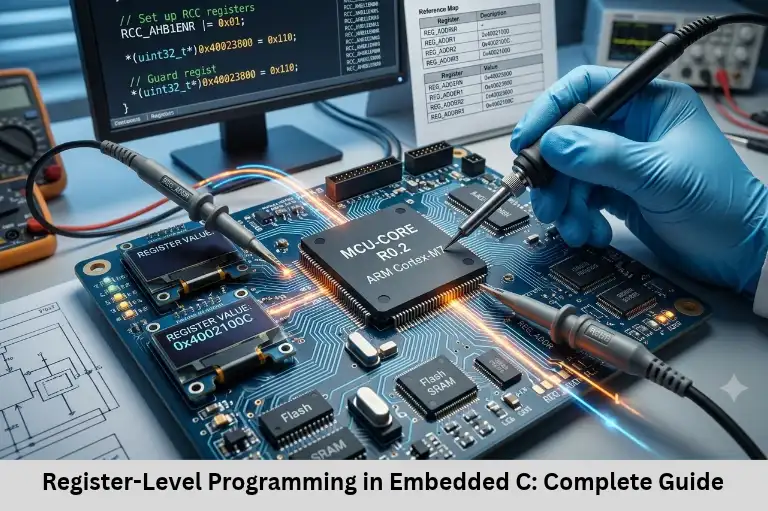
Learn register-level programming in Embedded C, GPIO register configuration, bitwise operations, memory-mapped peripherals, and practical hardware control examples. Embedded Tech Development Academy (ETDA).
- Register-Level Programming in Embedded C: Complete Guide
-
Register-Level Programming in Embedded C: Direct Hardware Control
- Introduction
- What Is Register-Level Programming in Embedded C?
- Understanding Memory-Mapped Hardware Registers
- Bitwise Operations for Register Manipulation
- GPIO Register-Level Programming Example
- Register-Level Control of Timers and ADCs
- Register-Level Programming Versus HAL Libraries
- Common Errors in Direct Hardware Control
- Applications in Embedded Systems and IoT
- Learn Register-Level Programming at ETDA
-
Frequently Asked Questions
- What is register-level programming in Embedded C?
- Why is volatile used for hardware registers?
- What are memory-mapped registers?
- What is the difference between register-level programming and HAL?
- Why are bitwise operators important in embedded programming?
- Why should students learn register-level programming?
- Conclusion
Register-Level Programming in Embedded C: Direct Hardware Control
Introduction
Register-level programming in Embedded C is an essential skill for students who want to understand how microcontrollers control physical hardware. Instead of relying entirely on high-level libraries, developers access hardware registers directly to configure GPIO pins, timers, ADCs, communication peripherals, and interrupt controllers. This approach provides better understanding of peripheral operation, execution efficiency, and hardware configuration.
For students interested in embedded systems, automotive firmware, and Internet of Things (IoT) development, register-level programming builds a strong foundation for professional firmware engineering. Embedded Tech Development Academy (ETDA), a Top Embedded Training Institute in Bangalore, helps learners develop practical microcontroller programming skills through technical training and hardware-based projects. Its industry-oriented learning approach and assured placement support help students prepare for embedded engineering careers.
What Is Register-Level Programming in Embedded C?
Register-level programming is a technique in which firmware directly reads or modifies hardware registers to control microcontroller peripherals. A register is a small storage location inside a processor or peripheral that holds configuration, status, or data information.
For example, a GPIO control register determines whether a pin operates as an input or output. A timer control register selects its operating mode, while an ADC control register configures analog conversion.
Unlike library-based programming, register-level programming exposes the actual hardware configuration to the developer. Understanding these registers helps students learn how microcontrollers work internally.
Understanding Memory-Mapped Hardware Registers
Most modern microcontrollers use memory-mapped I/O. Peripheral registers are assigned specific addresses within the processor’s address space, allowing software to access them using memory operations.
Register Address and Data Access
A hardware register can be accessed using a pointer to a suitable volatile integer type.
#include <stdint.h>

#define GPIO_REG \
    (*(volatile uint32_t *)0x40020000U)
In this example, GPIO_REG represents a hypothetical 32-bit hardware register at the specified address. The address is illustrative and must be replaced with the correct address from the selected microcontroller’s reference manual.
The volatile keyword tells the compiler that the register can change independently of normal program execution. Therefore, accesses should not be removed or treated as ordinary cached variable operations.
Why Volatile Is Important
Hardware registers may change because of peripheral activity, incoming communication, interrupts, or external signals. Without volatile, compiler optimizations could incorrectly eliminate or reuse register accesses.
However, volatile does not automatically guarantee atomic operations, thread safety, or synchronization. Developers must consider these requirements separately when designing reliable embedded firmware.
Bitwise Operations for Register Manipulation
Register-level programming frequently uses bitwise operators to modify individual control bits without disturbing other register settings.
Setting a Register Bit
The bitwise OR operator sets a particular bit.
REG |= (1U << 3);This statement sets bit 3 while preserving the other bits in the register. It is commonly used to enable peripherals, configure outputs, and activate control functions.
Clearing a Register Bit
The bitwise AND operator combined with bitwise NOT clears a selected bit.
REG &= ~(1U << 3);This operation clears bit 3 while retaining the remaining register values. It is useful for disabling interrupt sources, clearing configuration bits, and switching hardware functions.
Toggling a Register Bit
The XOR operator toggles a selected bit.
REG ^= (1U << 3);If the bit is zero, it becomes one. If it is one, it becomes zero. This technique is commonly used for GPIO output toggling and diagnostic signals.
Understanding Read-Modify-Write Operations
Expressions such as REG |= mask perform a read-modify-write operation. They read the current register value, modify selected bits, and write the result back.
Some registers contain write-one-to-clear flags, reserved bits, or hardware-updated fields. Applying ordinary read-modify-write operations to such registers may produce incorrect behavior.
Students should always check the register description and access rules in the microcontroller reference manual before modifying hardware registers.
GPIO Register-Level Programming Example
GPIO programming is one of the easiest ways to understand direct hardware control. A GPIO peripheral usually includes registers for pin direction, output data, input data, and alternate-function configuration.
Configuring a GPIO Output
The following example demonstrates the general approach used by a hypothetical GPIO peripheral.
#include <stdint.h>

#define GPIO_DIR \
    (*(volatile uint32_t *)0x40020000U)

#define GPIO_OUT \
    (*(volatile uint32_t *)0x40020004U)

#define LED_PIN (1U << 5)

void GPIO_Init(void)
{
    GPIO_DIR |= LED_PIN;
}

void LED_ON(void)
{
    GPIO_OUT |= LED_PIN;
}

void LED_OFF(void)
{
    GPIO_OUT &= ~LED_PIN;
}

void main(void)
{
    GPIO_Init();

    while(1)
    {
        LED_ON();
        LED_OFF();
    }
}
This example illustrates how firmware configures a pin as an output and changes its output state. The register addresses and bit positions are demonstration values, not universal microcontroller addresses.
For an actual board, students must identify the GPIO peripheral base address, direction register, output register, and correct pin configuration from the datasheet.
Register-Level Control of Timers and ADCs
Timer Register Configuration
Timer peripherals use control registers, counter registers, prescaler registers, and status flags. Direct register configuration allows developers to select timer frequency, counting mode, and interrupt behavior.
For example, a timer prescaler divides the peripheral clock before it reaches the counter. Understanding the prescaler and auto-reload value helps students calculate periodic timing intervals accurately.
ADC Register Configuration
ADC peripherals generally contain configuration registers, conversion control registers, data registers, and status flags. Register-level programming enables developers to select channels, configure sampling time, start conversions, and read conversion results.
This knowledge is valuable for sensor interfacing, signal acquisition, motor control, and Internet of Things (IoT) monitoring applications.
Register-Level Programming Versus HAL Libraries
Hardware Abstraction Layer (HAL) libraries simplify peripheral configuration by providing predefined functions. Developers can initialize GPIO, timers, ADCs, and communication peripherals without manually handling every register.
Register-level programming offers greater visibility into hardware configuration and helps developers understand what library functions actually perform.
When Should Students Use Register-Level Programming?
Register-level programming is useful when learning microcontroller architecture, optimizing critical operations, debugging peripheral behavior, or working with hardware features that are not supported by existing libraries.
HAL programming is useful for rapid development, portability, and reducing development complexity. Experienced embedded engineers often combine both approaches depending on project requirements.
Common Errors in Direct Hardware Control
Incorrect register addresses, bit positions, clock configuration, and peripheral initialization sequences can prevent hardware from functioning correctly.
Students should verify the peripheral clock before accessing registers and ensure that GPIO alternate functions are configured correctly for communication peripherals such as UART, SPI, and I2C.
Debugging tools such as breakpoints, watch windows, memory inspection, and oscilloscopes help identify register configuration problems. Hardware debugging experience is essential for developing reliable embedded systems firmware.
Applications in Embedded Systems and IoT
Register-level programming is used in automotive controllers, industrial automation, robotics, wearable electronics, and Internet of Things (IoT) devices.
It supports precise control of GPIO outputs, timer-based scheduling, sensor acquisition, communication interfaces, and interrupt configuration. Understanding direct hardware control also helps developers analyze low-level driver implementations and improve firmware performance.
Learn Register-Level Programming at ETDA
Students preparing for embedded engineering careers should develop a strong foundation in C programming, pointers, bitwise operations, microcontroller architecture, peripheral registers, and hardware debugging.
Embedded Tech Development Academy (ETDA) provides technical learning opportunities in Embedded C, microcontrollers, communication protocols, and practical embedded systems projects.
Choosing a Top Embedded Training Institute in Bangalore helps learners strengthen their technical knowledge through structured training and practical exercises. Embedded Tech Development Academy (ETDA) emphasizes industry-oriented learning and provides assured placement support to help students prepare for technical interviews and firmware development opportunities.
Build a Register-Level GPIO Project
A useful beginner project is a register-controlled LED and push-button application. Configure a GPIO output register for the LED and an input register for the push button, then implement the required control logic using bitwise operations.
This exercise helps students understand hardware register access, input/output configuration, debugging, and direct peripheral control. These skills become valuable when progressing toward STM32, ARM Cortex-M, automotive embedded systems, and Internet of Things (IoT) development.
Frequently Asked Questions
What is register-level programming in Embedded C?
Register-level programming directly accesses microcontroller hardware registers to configure and control peripherals such as GPIO, timers, ADCs, and communication modules.
Why is volatile used for hardware registers?
volatile prevents the compiler from removing or incorrectly optimizing register accesses that may change independently of normal program execution.
What are memory-mapped registers?
Memory-mapped registers are hardware control or status registers assigned specific addresses in the processor’s address space.
What is the difference between register-level programming and HAL?
Register-level programming directly manipulates hardware registers, while HAL provides predefined functions that simplify peripheral configuration and control.
Why are bitwise operators important in embedded programming?
Bitwise operators allow developers to set, clear, toggle, and inspect individual register bits without unnecessarily changing other configuration bits.
Why should students learn register-level programming?
It develops microcontroller architecture knowledge, hardware debugging skills, peripheral configuration understanding, and low-level firmware development expertise.
Conclusion
Register-level programming in Embedded C provides a deeper understanding of microcontroller hardware and peripheral operation. Learning memory-mapped registers, volatile access, bitwise manipulation, GPIO configuration, timer programming, and ADC control helps students develop efficient and reliable firmware.
Students searching for a Top Embedded Training Institute in Bangalore can explore Embedded Tech Development Academy (ETDA) to strengthen their embedded programming knowledge through practical learning and hardware-based projects. Embedded Tech Development Academy (ETDA) combines technical training with assured placement support, helping students prepare for embedded engineering career opportunities.
Author: ETDA Trainers
Experience: 10+ Years of Industry Experience in Embedded Systems, IoT, and Embedded C Programming