
RFID Attendance System Using 8051 Microcontroller
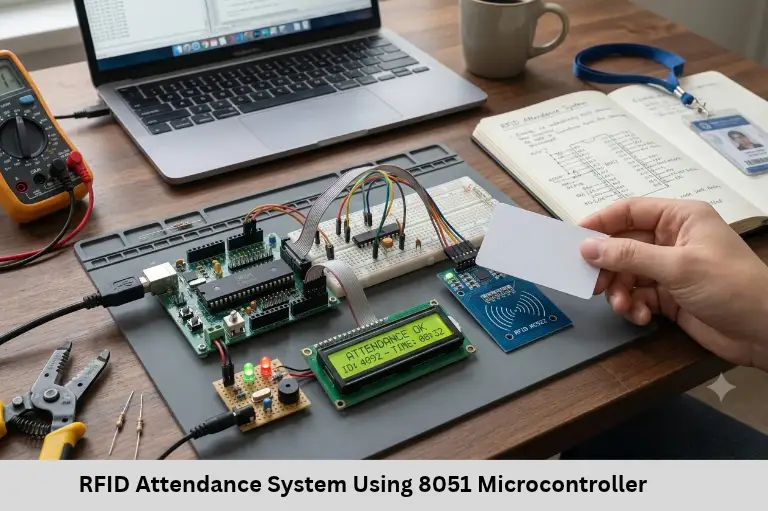
Learn how to develop an RFID-based attendance management system using the 8051 microcontroller. Explore RFID interfacing, Embedded C programming, system design, and practical embedded training at Embedded Tech Development Academy (ETDA).
- RFID Attendance System Using 8051 Microcontroller
-
RFID-Based Attendance Management System Using 8051
- Introduction
- What Is an RFID-Based Attendance Management System?
- Main Components Required
- Working Principle of the RFID Attendance System
- Interfacing RFID Reader with the 8051 Microcontroller
- Embedded C Programming Logic
- Applications and Benefits
- How This Project Connects to Embedded Systems and IoT
- Why Choose ETDA for Embedded Systems Training?
- Frequently Asked Questions
- Conclusion
RFID-Based Attendance Management System Using 8051
Introduction
Managing attendance manually in colleges, schools, and workplaces can consume time and lead to errors. An RFID-Based Attendance Management System Using 8051 offers an automated approach by identifying users through RFID cards and recording their attendance electronically. It combines radio-frequency identification technology with microcontroller programming to make attendance tracking faster and more organised.
This project is a useful practical exercise for students interested in embedded systems, automation, and Internet of Things (IoT) applications. Learners exploring a Top Embedded Training Institute in Bangalore can benefit from understanding how RFID readers, microcontrollers, serial communication, and Embedded C work together. Embedded Tech Development Academy (ETDA) encourages practical project learning and provides assured placement support to help students prepare for technical careers.
What Is an RFID-Based Attendance Management System?
RFID stands for Radio Frequency Identification. It is a technology that uses radio waves to identify objects or people through electronic tags. In an attendance system, each student or employee receives an RFID card containing a unique identification number.
When a user places the card near an RFID reader, the reader captures its identification data and sends it to the 8051 microcontroller. The microcontroller checks the received ID against stored information and processes the attendance entry. A display can show whether the card is recognised, while additional hardware can store attendance records.
Main Components Required
An RFID attendance project combines identification hardware, processing electronics, and output devices. Understanding each component helps students design and troubleshoot the complete system.
8051 Microcontroller
The 8051 microcontroller acts as the central processing unit. It receives data from the RFID reader, checks the card information, and controls output devices such as an LCD or buzzer. An AT89C51 or compatible 8051-family controller can be used, depending on memory and interface requirements.
RFID Reader and RFID Cards
An RFID reader communicates with RFID tags or cards and retrieves their identification data. A commonly used reader module, such as an MFRC522, operates at 13.56 MHz and typically communicates through SPI. However, this module is not directly interchangeable with every 8051 interface design; suitable SPI interfacing or an alternative serial-output RFID reader may be required.
LCD Display
A 16×2 LCD can display messages such as “Card Detected”, “Attendance Marked”, or “Invalid Card”. It provides immediate feedback and makes the system easier to operate without a computer.
Buzzer and Memory
A buzzer can indicate successful card detection or an invalid ID. External EEPROM or another suitable storage solution can retain attendance information when power is switched off. The memory design must account for record capacity and write-cycle limitations.
Working Principle of the RFID Attendance System
The system works by reading a card’s unique ID and comparing it with authorised user information. The 8051 executes the control program and decides whether to accept the card and register attendance.
Step-by-Step Operation
Each authorised user receives an RFID card with a registered identification number.
The user places the card near the RFID reader.
The reader captures the card ID and sends it to the microcontroller.
The 8051 receives and processes the data using its programmed logic.
If the ID matches a registered user, the system records attendance and displays a confirmation message.
If the ID is not recognised, the system displays an error and may activate the buzzer.
A complete design should also prevent repeated attendance entries within the same session. This can be achieved by checking whether the same user has already been marked present.
Interfacing RFID Reader with the 8051 Microcontroller
Interfacing is one of the most important technical parts of this project. The selected RFID module determines the communication method, voltage requirements, and connections.
Serial Communication and SPI
Some RFID readers provide UART or serial output, which can be connected to the 8051’s serial interface using suitable voltage levels and baud-rate settings. Modules such as the MFRC522 use SPI, so students need to implement or configure SPI communication using the 8051’s GPIO pins or suitable interface hardware.
The microcontroller must receive the complete card data before comparing it with stored IDs. Students should understand data framing, timing, bit operations, and error checking to make the communication reliable.
Important Electrical Considerations
Many RFID modules operate at 3.3V and are not designed for direct connection to 5V logic. Before connecting a reader to an 8051 development board, check the module’s datasheet and use appropriate level shifting where required. Incorrect voltage connections can damage the reader.
Embedded C Programming Logic
Embedded C is used to develop the program that controls the attendance process. The software reads the RFID data, compares the received ID with registered values, and updates the output devices.
A simplified program flow is:
#include <reg51.h>

void main(void)
{
    // Initialise LCD and RFID interface

    while(1)
    {
        // Check whether an RFID card is detected
        // Read the card identification data
        // Compare ID with registered user records

        // If ID is valid:
        //     Check duplicate attendance
        //     Store attendance record
        //     Display success message

        // Otherwise:
        //     Display invalid card message
    }
}
This is a program structure rather than a complete driver. Actual code depends on the selected reader, communication protocol, memory arrangement, and LCD connections. Students should implement the reader initialisation, data reception, ID comparison, and storage functions separately.
Applications and Benefits
RFID attendance systems are useful wherever organisations need quick and consistent identity-based attendance recording. They reduce manual register work and make attendance information easier to organise.
Common applications include colleges, schools, training centres, offices, laboratories, and industrial workplaces. The system can also be expanded to support access control, visitor tracking, and equipment identification.
Its main benefits include faster attendance entry, fewer manual recording errors, unique card identification, and opportunities for digital record management. However, RFID cards can be shared or lost, so organisations should combine the system with suitable security and identity-verification procedures.
How This Project Connects to Embedded Systems and IoT
This project introduces important embedded systems concepts, including GPIO interfacing, serial communication, memory handling, input validation, and real-time response. These fundamentals are also used in industrial automation, smart buildings, and connected devices.
An Internet of Things (IoT)-enabled version can send attendance records to a server through a Wi-Fi or Ethernet module. A central dashboard could display attendance reports and timestamps. Students can explore data communication, network connectivity, and device-to-cloud integration while extending the basic 8051 project.
Skills Students Can Develop
Working on this project helps students practise circuit connections, Embedded C programming, debugging, and hardware-software integration. These skills provide a foundation for more advanced microcontrollers, communication protocols, and Internet of Things (IoT) development.
Why Choose ETDA for Embedded Systems Training?
A practical project becomes more valuable when students understand the design decisions behind it. Embedded Tech Development Academy (ETDA) focuses on helping learners develop technical skills through microcontroller programming, hardware interfacing, debugging, and guided project work.
Students comparing a Top Embedded Training Institute in Bangalore should look for hands-on experience rather than theory alone. Embedded Tech Development Academy (ETDA) supports learning in Embedded C, microcontrollers, communication protocols, embedded systems, and Internet of Things (IoT) concepts. Its assured placement support can help learners prepare through technical guidance and career-oriented training. Students should confirm current course details and placement-support terms directly with the academy.
Frequently Asked Questions
What is an RFID-based attendance management system?
It is an automated system that uses RFID cards and a reader to identify users and record their attendance electronically.
Why is the 8051 microcontroller used?
The 8051 processes RFID data, checks card IDs, controls the LCD and buzzer, and manages attendance logic.
Which RFID reader can be used?
A UART-output RFID reader can simplify serial interfacing. An MFRC522 can also be used, but it requires SPI communication and suitable voltage interfacing.
Which programming language is used?
Embedded C is commonly used to write the 8051 program, handle reader communication, compare card IDs, and control output devices.
Can this project be connected to IoT?
Yes. A suitable communication module can send attendance records to a server or cloud platform for remote monitoring and report generation.
Can beginners learn this project at ETDA?
Yes. Students with basic electronics and C programming knowledge can build their understanding through microcontroller programming, hardware interfacing, and guided embedded project practice.
Conclusion
An RFID-Based Attendance Management System Using 8051 is a valuable project for understanding how identification technology and microcontroller programming can solve everyday problems. It gives students practical exposure to RFID interfacing, serial communication, Embedded C, data storage, and automation.
For students planning a career in embedded systems development, project-based learning builds a strong technical foundation. Embedded Tech Development Academy (ETDA) offers practical training and assured placement support to help learners prepare for industry opportunities. If you are searching for a Top Embedded Training Institute in Bangalore, focus on building real hardware and software skills that can support your long-term career growth.
Author: ETDA Trainers
Experience: 10+ Years of Industry Experience in Embedded Systems, IoT, and Embedded C Programming