
Understanding EMI and EMC: Complete Guide for Electronics Design
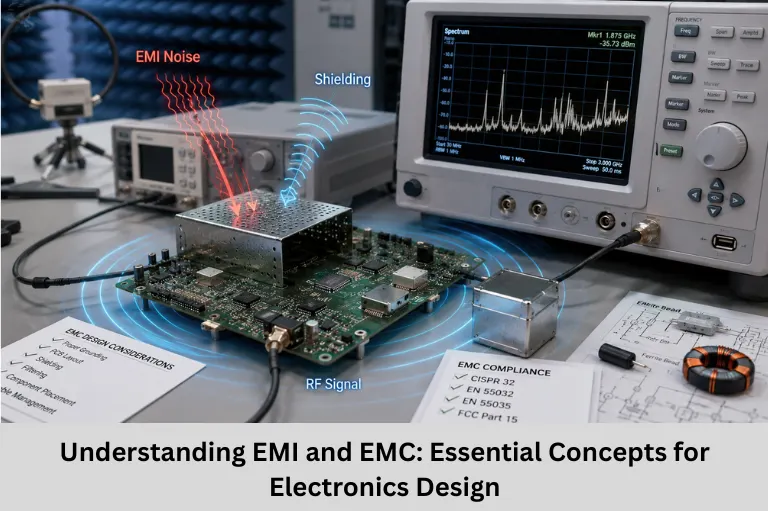
Learn the fundamentals of EMI and EMC, their differences, types, effects, PCB design techniques, shielding methods, compliance standards, testing procedures, and practical applications in electronics.
- Understanding EMI and EMC: Complete Guide for Electronics Design
-
Introduction: Understanding EMI and EMC in Modern Electronics
- What is Electromagnetic Interference (EMI)?
- Types of Electromagnetic Interference
- Effects of EMI on Electronic Systems
- What is Electromagnetic Compatibility (EMC)?
- Two Key Aspects of EMC
- EMI vs EMC
- Techniques to Reduce EMI and Improve EMC
- Applications of EMI and EMC Design
- International EMC Standards
- Best Practices for EMI/EMC Design
- Frequently Asked Questions (FAQs)
- Conclusion
Introduction: Understanding EMI and EMC in Modern Electronics
As electronic devices become faster, smaller, and more interconnected, Electromagnetic Interference (EMI) and Electromagnetic Compatibility (EMC) have become essential aspects of electronics design. Whether it is a smartphone, medical device, automotive control unit, industrial automation system, Internet of Things (IoT) device, or communication equipment, every electronic product must operate reliably without causing or being affected by unwanted electromagnetic interference. Ignoring EMI and EMC during product development can result in communication failures, reduced performance, regulatory non-compliance, and costly redesigns.
Electromagnetic Interference (EMI) refers to unwanted electromagnetic energy that disrupts the normal operation of electronic circuits, while Electromagnetic Compatibility (EMC) ensures that electronic equipment functions correctly in its electromagnetic environment without generating excessive interference for other devices. Together, EMI and EMC form the foundation of reliable electronic product design and are critical for meeting international safety and performance standards.
Today, industries such as consumer electronics, automotive electronics, aerospace, defense, telecommunications, industrial automation, renewable energy, robotics, medical equipment, embedded systems, and Internet of Things (IoT) rely heavily on proper EMI and EMC practices. Engineers must understand concepts such as electromagnetic radiation, signal integrity, PCB layout, grounding techniques, shielding, EMI filters, decoupling capacitors, conducted emissions, radiated emissions, EMC compliance testing, electromagnetic shielding, RF interference, noise suppression, and EMC standards to design robust electronic systems.
For aspiring electronics and embedded engineers, learning EMI and EMC principles through practical implementation is invaluable. Embedded Tech Development Academy (ETDA) provides industry-oriented training that combines theoretical knowledge with hands-on experience in embedded systems, PCB design, microcontroller programming, Internet of Things (IoT), signal integrity, hardware debugging, and EMC-aware circuit design. Through real-time projects and laboratory sessions, Embedded Tech Development Academy (ETDA) prepares students for careers in electronics design, semiconductor industries, automotive electronics, and embedded product development.
In this guide, you’ll explore the fundamentals of EMI and EMC, their differences, sources of interference, practical design techniques, compliance testing methods, and best practices for developing reliable electronic products.
What is Electromagnetic Interference (EMI)?
Electromagnetic Interference (EMI) refers to unwanted electromagnetic energy that affects the performance of electronic devices and communication systems.
EMI can originate from:
- Natural sources
- Electronic equipment
- Switching circuits
- Wireless transmitters
- High-speed digital systems
Common Sources of EMI
- Lightning
- Electric motors
- Switching power supplies
- Mobile phones
- Radio transmitters
- High-frequency clocks
- Industrial machinery
Types of Electromagnetic Interference
EMI is generally classified into four categories.
1. Conducted EMI
Conducted EMI travels through:
- Power cables
- Signal wires
- PCB traces
This type of interference commonly affects power distribution systems.
2. Radiated EMI
Radiated EMI travels through free space as electromagnetic waves.
Common sources include:
- RF transmitters
- Antennas
- Wireless communication devices
- High-speed digital circuits
3. Narrowband EMI
Characteristics include:
- Generated by oscillators
- Radio transmitters
- Clock circuits
- Communication equipment
4. Broadband EMI
Generated by:
- Electric motors
- Switching regulators
- Power converters
- Mechanical switching devices
Why EMI Matters
Even small amounts of interference can reduce system reliability and lead to communication failures, incorrect measurements, or complete equipment malfunction.
Effects of EMI on Electronic Systems
Electromagnetic interference can negatively impact electronic devices in many ways.
Common Effects
- Data corruption
- Communication failures
- Audio noise
- Video distortion
- Sensor inaccuracies
- Equipment malfunction
- Reduced wireless performance
- Unexpected system resets
What is Electromagnetic Compatibility (EMC)?
Electromagnetic Compatibility (EMC) refers to the ability of an electronic device to operate correctly within its electromagnetic environment without generating excessive electromagnetic interference.
An EMC-compliant product should:
- Operate reliably
- Resist external interference
- Avoid disturbing nearby devices
Why EMC is Important
EMC ensures:
- Product reliability
- Regulatory compliance
- Safe operation
- Improved product quality
- Better customer satisfaction
Two Key Aspects of EMC
1. EMI Emissions
The device must limit the amount of electromagnetic noise it generates.
Types of Emissions
- Conducted emissions
- Radiated emissions
2. EMI Immunity
The device should continue functioning correctly when exposed to external electromagnetic disturbances.
Goal of EMC
The objective is to achieve reliable operation in real-world electromagnetic environments while meeting international compliance standards.
EMI vs EMC
| Aspect | EMI | EMC |
|---|---|---|
| Definition | Unwanted electromagnetic noise | Ability to operate without interference |
| Focus | Source of interference | Overall system performance |
| Objective | Reduce noise generation | Ensure reliable operation |
| Measurement | Emission levels | Emission and immunity compliance |
Techniques to Reduce EMI and Improve EMC
Proper design practices significantly reduce EMI issues.
1. PCB Design Best Practices
PCB Layout Techniques
- Use continuous ground planes.
- Keep high-speed traces short.
- Separate analog and digital circuits.
- Minimize loop areas.
- Route differential signals carefully.
- Maintain controlled impedance.
2. Filtering and Decoupling
Noise suppression methods include:
- Ferrite beads
- EMI filters
- Bypass capacitors
- Decoupling capacitors
- LC filters
3. Shielding Techniques
Shielding helps block unwanted electromagnetic radiation.
Methods include:
- Metallic enclosures
- Shielded cables
- Grounded shields
- RF shielding materials
4. Grounding Techniques
Proper grounding reduces noise significantly.
Recommended methods:
- Star grounding
- Ground planes
- Low impedance return paths
5. Compliance Testing
Electronic products undergo several EMC tests.
Common EMC Tests
- Conducted Emission Test
- Radiated Emission Test
- Electrostatic Discharge (ESD) Test
- Surge Immunity Test
- Fast Transient Test
- Radiated Immunity Test
Testing Tip
Perform pre-compliance testing during product development to identify EMI issues early and reduce redesign costs.
Applications of EMI and EMC Design
EMI and EMC principles are essential across many industries.
Major Applications
- Consumer electronics
- Automotive electronics
- Aerospace systems
- Medical equipment
- Industrial automation
- Telecommunications
- Robotics
- Internet of Things (IoT) devices
- Renewable energy systems
- embedded systems
- Defense electronics
International EMC Standards
Electronic products often comply with standards such as:
Common Standards
- FCC (United States)
- CE Marking (Europe)
- CISPR Standards
- IEC Standards
- ISO Standards
- MIL-STD (Defense Applications)
Compliance is mandatory for selling products in many international markets.
Best Practices for EMI/EMC Design
Design Recommendations
- Follow good PCB layout practices.
- Use adequate decoupling capacitors.
- Minimize high-current loop areas.
- Employ proper cable shielding.
- Select appropriate filtering components.
- Separate noisy and sensitive circuits.
- Verify designs through EMC testing.
- Consider EMC requirements during the initial design phase.
Frequently Asked Questions (FAQs)
What is the difference between EMI and EMC?
EMI (Electromagnetic Interference) is unwanted electromagnetic noise that disrupts electronic devices, while EMC (Electromagnetic Compatibility) is the ability of a device to operate correctly without causing or being affected by electromagnetic interference.
What are the main types of EMI?
The primary types of EMI are conducted EMI, which travels through wires and PCB traces, radiated EMI, which propagates through the air, narrowband EMI, and broadband EMI generated by switching circuits and motors.
Why is EMC testing important?
EMC testing verifies that an electronic product meets regulatory emission and immunity requirements, ensuring reliable performance and compliance with standards such as FCC, CE, CISPR, and IEC.
How can EMI be reduced in PCB design?
EMI can be minimized by using proper grounding, continuous ground planes, short signal traces, decoupling capacitors, shielding, EMI filters, controlled impedance routing, and careful component placement.
Which industries require strong EMI and EMC design practices?
EMI and EMC are critical in consumer electronics, automotive electronics, aerospace, medical devices, telecommunications, industrial automation, renewable energy systems, defense electronics, Internet of Things (IoT) devices, and embedded systems, where reliable and interference-free operation is essential.
Conclusion
As electronic systems continue to become faster, smaller, and more connected, understanding Electromagnetic Interference (EMI) and Electromagnetic Compatibility (EMC) has become a fundamental requirement for every electronics engineer. Concepts such as signal integrity, electromagnetic radiation, PCB grounding, EMI filters, decoupling techniques, shielding methods, EMC testing, conducted emissions, radiated emissions, RF interference, compliance standards, and noise suppression are essential for developing reliable and high-performance electronic products.
Proper EMI and EMC design practices not only improve product reliability but also ensure compliance with global regulatory standards for consumer electronics, automotive systems, aerospace, medical equipment, industrial automation, Internet of Things (IoT) devices, telecommunications, renewable energy systems, and embedded products. By considering electromagnetic compatibility from the early stages of product development, engineers can reduce design failures, minimize development costs, and accelerate product certification.
At Embedded Tech Development Academy (ETDA), students receive practical training in embedded systems, PCB design, signal integrity, microcontroller programming, hardware debugging, Internet of Things (IoT) development, and EMC-aware electronics design through hands-on laboratories and real-world projects. Embedded Tech Development Academy (ETDA)‘s industry-focused curriculum equips aspiring engineers with the practical skills required to design reliable, standards-compliant electronic systems and succeed in careers across embedded systems, electronics manufacturing, semiconductor industries, and automation.
Whether you are a student, electronics hobbyist, PCB designer, or professional engineer, mastering EMI and EMC principles is an essential step toward designing robust, interference-free, and globally compliant electronic products.
Author: ETDA Trainers
Experience: 10+ Years of Industry Experience in Embedded Systems, IoT, and Embedded C Programming