
Understanding UDP Protocol: Features, Working, Uses & TCP Comparison
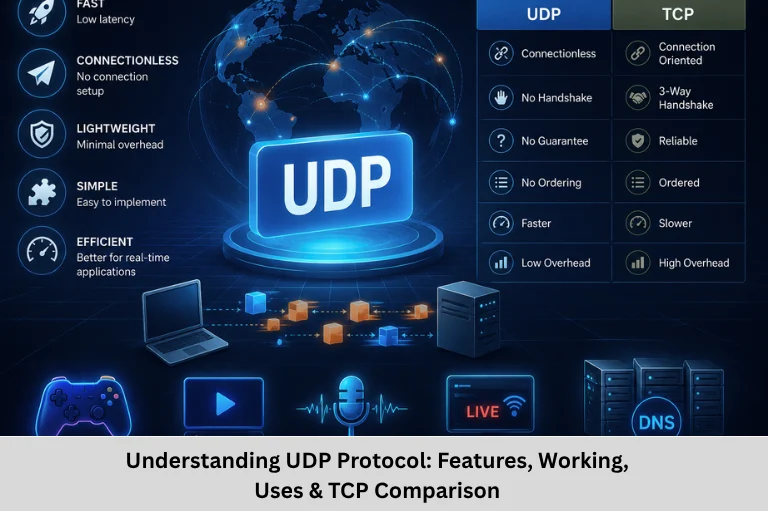
Learn what UDP is, how User Datagram Protocol works, its header structure, features, advantages, limitations, applications, and UDP vs TCP.
- Understanding UDP Protocol: Features, Working, Uses & TCP Comparison
- Understanding UDP Protocol: Fast and Lightweight Communication
Understanding UDP Protocol: Fast and Lightweight Communication
Modern computer networks support many types of applications, and every application does not require the same communication characteristics. A file-transfer application may prioritize reliable delivery, while an online game, voice call, live video application, or real-time sensor system may prioritize low latency and fast data transmission. This difference is one of the main reasons why networking protocols provide different approaches to data delivery.
UDP, or User Datagram Protocol, is a transport-layer protocol in the Internet Protocol Suite. It provides a lightweight mechanism for sending application data as independent datagrams without establishing a connection between the sender and receiver. Unlike TCP, UDP does not perform connection establishment, retransmission, sequencing, or congestion control at the transport layer.
This simple design reduces protocol overhead and can provide lower latency, but it also means that applications using UDP must tolerate packet loss, duplication, or reordering, or implement their own mechanisms when required. UDP is therefore particularly useful in real-time communication, network programming, embedded networking, Internet of Things (IoT) communication, DNS, online gaming, VoIP, streaming, and multimedia applications.
For embedded engineers, understanding UDP networking, socket programming, transport-layer protocols, IP communication, network packets, client-server communication, and real-time data transfer is important when developing connected devices and network-enabled firmware.
Embedded Tech Development Academy (ETDA) emphasizes practical technical learning in embedded systems, networking, C/C++, Linux, and communication protocols. As a Top Embedded Training Institute in Bangalore, Embedded Tech Development Academy (ETDA) helps learners develop industry-relevant technical skills with hands-on exposure and assured placement support.
For engineers working toward careers in embedded networking and software development, learning UDP at Embedded Tech Development Academy (ETDA), a Top Embedded Training Institute in Bangalore, provides useful foundations for understanding real-time network communication while building practical skills backed by assured placement support.
What Is UDP?
User Datagram Protocol (UDP) is a connectionless transport-layer protocol defined for the Internet Protocol Suite.
UDP allows an application to send a datagram without first establishing a connection with the destination.
Connectionless Communication
TCP establishes a connection before exchanging application data. UDP does not perform this connection setup.
An application can send a UDP datagram directly using the destination IP address and port number.
No Delivery Guarantee
UDP itself does not guarantee that a datagram will:
- Reach the destination
- Arrive only once
- Arrive in the original order
- Be retransmitted if lost
If reliability is required, it must be implemented by the application or by a higher-level protocol.
Why Use UDP?
The absence of connection-management and retransmission overhead makes UDP attractive when latency, simplicity, and timely delivery are more important than guaranteed delivery.
Key Features of UDP
1. Connectionless Protocol
UDP does not require a handshake before transmitting application data. This reduces initial communication overhead.
2. Lightweight Transport
The UDP header is only 8 bytes, making it considerably smaller than the minimum TCP header.
3. No Built-In Reliability
UDP does not provide transport-layer acknowledgments or retransmissions.
4. No Sequencing
UDP datagrams contain no sequence numbers at the transport layer. Applications that require ordering must implement it separately.
5. No Built-In Congestion Control
UDP does not automatically reduce its transmission rate in response to network congestion. Applications therefore need to implement appropriate rate-control mechanisms when necessary.
6. Message-Oriented Transmission
UDP preserves application message boundaries by transmitting individual datagrams rather than treating the data as a continuous byte stream.
How UDP Works
When an application sends data using UDP, the transport layer creates a UDP datagram.
The datagram contains the UDP header and application payload.
UDP Communication Flow
The basic process is:
Application → UDP → IP → Network → IP → UDP → Application
The sending application supplies information such as:
- Source port
- Destination port
- Application data
The IP layer then adds the source and destination IP addresses.
UDP Does Not Perform a Handshake
Unlike TCP’s connection establishment process, UDP can send data immediately.
The receiver examines the destination port and passes the payload to the appropriate application or socket.
UDP Header Structure
The UDP header contains four fields, each 16 bits wide.
| Field | Size | Purpose |
|---|---|---|
| Source Port | 16 bits | Identifies the sending application port |
| Destination Port | 16 bits | Identifies the receiving application port |
| Length | 16 bits | Specifies UDP header plus payload length |
| Checksum | 16 bits | Provides error detection |
UDP Checksum
The checksum is used to detect corruption of the UDP datagram. It is important to distinguish error detection from error recovery.
UDP can detect certain transmission errors using the checksum, but it does not automatically retransmit corrupted or lost data.
UDP vs TCP
UDP and TCP both operate at the transport layer but provide different communication models.
| Feature | UDP | TCP |
|---|---|---|
| Connection | Connectionless | Connection-oriented |
| Reliability | Not guaranteed | Reliable |
| Ordering | Not guaranteed | Guaranteed |
| Retransmission | No | Yes |
| Header | 8-byte minimum | 20-byte minimum |
| Flow Control | No | Yes |
| Congestion Control | No | Yes |
| Communication | Datagram-oriented | Byte-stream-oriented |
| Typical Uses | DNS, gaming, VoIP | Web, file transfer, email |
Choosing Between UDP and TCP
UDP is suitable when the application values timeliness and low overhead.
TCP is generally more appropriate when complete, ordered, and reliable delivery is required.
Real-World Applications of UDP
Online Gaming
Multiplayer games frequently require rapid transmission of player movement, state updates, and real-time events. Waiting for retransmission of an outdated packet may sometimes be less useful than receiving the newest state.
Voice and Video Communication
Interactive voice and video applications are sensitive to delay and jitter. UDP can provide a suitable transport foundation where applications implement their own techniques for handling packet loss and media quality.
DNS
DNS commonly uses UDP for standard query-response communication because DNS requests and responses are often small and do not require a persistent transport connection.
IoT and Embedded Systems
Embedded devices can use UDP for telemetry, device discovery, sensor data, control messages, and local-network communication.
Real-Time Sensor Communication
For example, an embedded controller may periodically transmit temperature, pressure, or motion data to a monitoring application. If one measurement is lost, the next measurement may make the old one less important.
Advantages of UDP
Low Overhead
The small header and absence of connection establishment reduce protocol overhead.
Low Latency
UDP can transmit data without waiting for a connection handshake or transport-layer acknowledgment.
Simple Implementation
UDP’s basic communication model makes it relatively straightforward to use in network applications.
Suitable for Real-Time Applications
Applications that prioritize timely information can benefit from UDP’s lightweight communication model.
Disadvantages of UDP
No Guaranteed Delivery
Packets may be dropped because of network congestion, routing problems, wireless interference, or other network conditions.
No Ordering
Datagrams may arrive in a different order from the order in which they were transmitted.
No Automatic Recovery
UDP does not retransmit lost datagrams or repair missing application data.
Application Responsibility
If reliability, sequencing, authentication, or rate control is required, these mechanisms must be provided by the application or another protocol layer.
UDP in Embedded and Network Programming
UDP is particularly relevant to embedded developers because many connected devices have limited CPU, memory, and power resources.
Typical Embedded UDP Architecture
A connected embedded device might contain:
Sensor → Microcontroller → UDP Socket → IP Network → Server
The firmware collects sensor measurements and periodically sends them to a server or gateway.
Important Design Considerations
Developers should consider:
- Packet size
- Transmission frequency
- Network latency
- Packet loss
- Buffer management
- Timeout handling
- Checksum/error detection
- Application-level sequence numbers
- Security requirements
Reliability When Required
If an application requires reliable UDP communication, developers can implement sequence numbers, acknowledgments, retransmission policies, duplicate detection, and timeouts at the application layer. However, this increases complexity and may reduce some of UDP’s simplicity advantages.
Frequently Asked Questions
What is UDP in computer networking?
UDP, or User Datagram Protocol, is a connectionless transport-layer protocol that sends application data as independent datagrams without providing guaranteed delivery or ordering.
Is UDP faster than TCP?
UDP generally has lower protocol overhead than TCP because it does not perform connection establishment, acknowledgments, retransmissions, flow control, or congestion control. However, actual application performance depends on the network and application design.
What is the UDP header size?
The UDP header is 8 bytes and contains source port, destination port, length, and checksum fields.
Where is UDP commonly used?
UDP is commonly used for DNS, online gaming, real-time voice and video communication, IoT applications, embedded networking, and other applications where low latency or lightweight communication is important.
Can UDP provide reliable communication?
UDP itself does not provide reliable delivery. However, an application can implement mechanisms such as acknowledgments, sequence numbers, retransmissions, and timeouts when reliability is required.
Conclusion
UDP is a lightweight, connectionless transport-layer protocol designed for efficient datagram communication. Its 8-byte header, absence of connection establishment, lack of retransmission, and message-oriented operation make it useful for applications where low overhead and timely delivery are important.
Understanding UDP requires more than simply remembering that it is “faster than TCP.” The real technical distinction is that UDP provides fewer transport-layer services. It does not guarantee delivery, ordering, retransmission, flow control, or congestion control. These characteristics allow applications to make their own decisions about how communication should behave.
UDP is widely relevant to network programming, socket programming, Internet of Things (IoT) communication, embedded networking, real-time systems, DNS, VoIP, online gaming, and multimedia applications. For embedded developers, UDP can be especially useful for lightweight telemetry, sensor networks, device discovery, and local-network communication.
Embedded Tech Development Academy (ETDA) helps learners develop practical knowledge of embedded systems, networking protocols, C/C++, Linux, and real-time communication. As a Top Embedded Training Institute in Bangalore, Embedded Tech Development Academy (ETDA) focuses on hands-on technical learning and provides assured placement support for career-oriented learners.
For students and professionals aiming to build careers in embedded software and networking, Embedded Tech Development Academy (ETDA), a Top Embedded Training Institute in Bangalore, can provide practical exposure to communication protocols and embedded development methodologies along with assured placement support. A strong understanding of UDP, TCP, IP addressing, sockets, and network architecture can provide an important technical foundation for modern connected-device development.
Author: ETDA Trainers
Experience: 10+ Years of Industry Experience in Embedded Systems, IoT, and Embedded C Programming