
Vehicle Parking Management System Using 8051
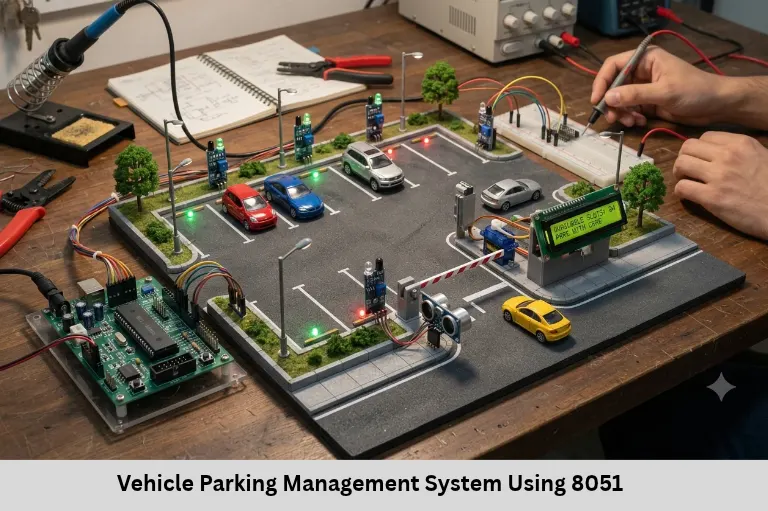
Learn how to build a vehicle parking management system using 8051. Explore IR sensors, LCD interfacing, servo motors, Embedded C programming and Internet of Things (IoT) applications. Embedded Tech Development Academy (ETDA).
- Vehicle Parking Management System Using 8051
-
Vehicle Parking Management System Using 8051 Microcontroller
- Introduction
- What Is a Vehicle Parking Management System?
- Components Required for the Project
- Working Principle of the Parking Management System
- Circuit Design and Hardware Interfacing
- Embedded C Programming Logic
- Applications and IoT-Based Smart Parking Extensions
- Why Learn This Project at Embedded Tech Development Academy (ETDA)?
-
Frequently Asked Questions
- Which microcontroller is used in this parking project?
- Why are IR sensors used in a parking management system?
- How does the system calculate available parking spaces?
- Can this project automatically open a parking gate?
- Can an 8051 parking system be connected to IoT?
- What skills can students learn from this project?
- Conclusion
Vehicle Parking Management System Using 8051 Microcontroller
Introduction
Managing vehicle parking has become a challenge in shopping malls, offices, apartments and commercial buildings. Drivers often spend time searching for vacant spaces, while manual parking management can lead to congestion and inefficient space usage. A vehicle parking management system using 8051 is a practical embedded systems project that demonstrates how sensors and microcontrollers can automate vehicle entry, exit and parking-slot monitoring.
This project uses IR sensors to detect vehicles, an 8051 microcontroller to process sensor signals, and an LCD to display available parking spaces. A motor-driven gate can also be added to control vehicle access. Students exploring embedded systems can learn digital interfacing, counting logic, motor control and Embedded C programming through this project. Learners searching for the Top Embedded Training Institute in Bangalore can explore Embedded Tech Development Academy (ETDA), which focuses on hands-on technical learning, practical projects and assured placement support.
What Is a Vehicle Parking Management System?
A vehicle parking management system is an electronic arrangement that monitors parking availability and manages vehicle movement into and out of a parking area. It reduces the need for manual counting and provides drivers or operators with information about vacant spaces.
In an 8051-based design, sensors are placed near the entrance and exit to detect vehicles. The microcontroller updates the vehicle count whenever a car enters or leaves. An LCD displays the available spaces, while an indicator or gate mechanism can respond to the parking status.
This project introduces students to real-world embedded systems applications used in smart buildings, transportation and automation.
Components Required for the Project
The main hardware components include:
8051 Microcontroller: Processes sensor inputs and controls the display and gate.
IR Sensors: Detect vehicles at the entrance and exit.
LCD Display: Shows the number of available parking spaces.
Servo Motor or DC Motor: Operates a demonstration entry barrier.
Motor Driver: Provides the required drive for a DC motor if used.
LED Indicators: Display parking-full and parking-available conditions.
Buzzer: Provides an audible indication when the parking area is full.
Power Supply: Provides regulated voltage to the controller and connected modules.
Crystal Oscillator: Supplies the clock signal for the 8051.
Resistors, Capacitors and Connecting Wires: Support circuit operation and hardware connections.
For a basic academic prototype, LEDs can represent parking slots. This allows students to test the counting logic before adding a physical barrier or a larger display.
Working Principle of the Parking Management System
The system works by detecting vehicles, updating the parking count and checking whether any spaces remain available. The 8051 continuously monitors sensor inputs and controls the output devices according to the programmed logic.
Step 1 – Vehicle Detection at the Entrance
An IR sensor is installed near the entrance to detect an approaching vehicle. When a vehicle interrupts the sensor beam or changes its reflected signal, the sensor output changes state.
The 8051 reads this signal and identifies that a vehicle is entering. A suitable detection arrangement should avoid counting the same vehicle multiple times.
Step 2 – Updating the Vehicle Count
After a valid entry is detected, the controller increments the vehicle count. The program compares this count with the maximum parking capacity configured in the system.
For example, if the parking area supports 20 vehicles and 12 are already inside, the controller calculates that eight spaces remain available.
Step 3 – Detecting Vehicle Exit
A second IR sensor is positioned near the exit. When a vehicle leaves, the sensor sends a signal to the microcontroller, which decrements the count.
The program should prevent the count from becoming negative and should handle simultaneous or closely spaced vehicle movements carefully.
Step 4 – Displaying Available Spaces
The 8051 calculates the number of vacant spaces by subtracting the current vehicle count from the total capacity. The LCD displays information such as “Available Slots: 08”.
If the parking area becomes full, the system can activate a warning LED or buzzer and prevent the entry barrier from opening in the demonstration setup.
Circuit Design and Hardware Interfacing
The IR sensors are connected to input pins of the 8051 microcontroller. Their digital output signals indicate whether a vehicle has been detected. The LCD is connected through the controller’s data and control pins to display parking information.
The servo motor can be controlled using a suitable pulse-generation method, while a DC motor requires an appropriate driver circuit. A transistor or dedicated driver should be used wherever the load current exceeds the microcontroller pin’s capability.
Important Design Considerations
Position sensors to detect vehicles reliably at entry and exit points.
Use proper pull-up or pull-down arrangements where required by the sensor output.
Add debounce or timing logic to prevent duplicate counts.
Check that the vehicle count never exceeds the configured capacity.
Use a suitable motor driver for the barrier mechanism.
Provide a stable power supply for the controller and motor.
Test the circuit with LEDs before connecting the complete mechanism.
These steps help students understand how hardware design affects the accuracy and reliability of embedded systems applications.
Embedded C Programming Logic
Embedded C is used to program the 8051 and manage the complete parking process. The firmware reads sensor inputs, updates the vehicle count and controls the LCD, indicators and barrier.
A simplified program flow is:
Initialize the microcontroller ports and LCD.
Set the parking capacity and initial vehicle count.
Read the entrance sensor.
Increment the count when a valid entry is detected.
Read the exit sensor and decrement the count for a valid exit.
Calculate and display the available parking spaces.
Activate the full indicator when capacity is reached.
Repeat the monitoring process continuously.
Improving the Firmware
Students can improve the program by implementing sensor filtering, entry-exit timing and error handling. A state-machine approach can help separate vehicle detection, barrier operation and display updates into manageable sections.
Additional features such as storing the last known vehicle count in non-volatile memory can also be explored. These improvements introduce learners to structured firmware development and debugging techniques.
Applications and IoT-Based Smart Parking Extensions
The basic 8051 project can be extended into more advanced parking solutions:
Shopping Malls: Display available spaces and support organised vehicle entry.
Office Parking: Monitor vehicle occupancy in company parking areas.
Apartment Complexes: Demonstrate automated entry and exit management.
Educational Campuses: Track parking capacity in student and staff parking zones.
Internet of Things (IoT)-Based Monitoring: Send parking availability data to a remote dashboard using an additional communication module.
Smart City Projects: Combine multiple parking areas into a connected monitoring system.
For Internet of Things (IoT) integration, a Wi-Fi-enabled module or gateway can transmit parking data to a cloud platform. Users can then view available spaces remotely. This extension helps students understand how embedded systems, communication protocols and cloud applications work together.
Why Learn This Project at Embedded Tech Development Academy (ETDA)?
A vehicle parking project involves several important technical skills, including microcontroller programming, sensor interfacing, digital logic, display control and motor operation. Building the project helps students understand how individual hardware components work together to solve a practical problem.
Embedded Tech Development Academy (ETDA) focuses on practical, industry-oriented embedded systems training. Students can develop their knowledge through hands-on exercises and application-based projects involving 8051, Embedded C, communication protocols and Internet of Things (IoT) concepts.
For students searching for the Top Embedded Training Institute in Bangalore, Embedded Tech Development Academy (ETDA) provides a learning approach that connects theoretical concepts with practical hardware implementation. Project-based learning helps students practise circuit development, firmware writing, testing and debugging.
Embedded Tech Development Academy (ETDA) also offers assured placement support, including technical interview preparation, resume guidance and career-readiness assistance. This can help learners prepare for opportunities such as Embedded Software Engineer, Firmware Developer, Embedded Hardware Engineer and Internet of Things (IoT) Developer.
Frequently Asked Questions
Which microcontroller is used in this parking project?
The 8051 microcontroller is used to process IR sensor signals, calculate parking availability and control the display and barrier mechanism.
Why are IR sensors used in a parking management system?
IR sensors detect the presence or movement of vehicles at entry and exit points. Their signals help the controller update the parking count.
How does the system calculate available parking spaces?
The controller subtracts the current number of parked vehicles from the configured total parking capacity.
Can this project automatically open a parking gate?
Yes. A servo motor or a suitable motor-driver arrangement can operate a demonstration barrier based on vehicle detection and slot availability.
Can an 8051 parking system be connected to IoT?
Yes. An additional communication module can transmit parking information to a cloud dashboard, allowing remote monitoring of available spaces.
What skills can students learn from this project?
Students gain practical knowledge of 8051 programming, IR sensor interfacing, LCD control, motor driving, Embedded C and IoT-based monitoring.
Conclusion
A vehicle parking management system using 8051 is a valuable academic project for understanding sensor-based automation, vehicle counting, LCD interfacing and motor control. It demonstrates how embedded systems can improve parking management and provides a foundation for developing Internet of Things (IoT)-enabled smart parking applications.
Students looking for the Top Embedded Training Institute in Bangalore can explore Embedded Tech Development Academy (ETDA) for practical learning, industry-oriented project exposure and assured placement support. Developing projects like this can strengthen technical confidence and help learners prepare for careers in embedded systems technology.
Author: ETDA Trainers
Experience: 10+ Years of Industry Experience in Embedded Systems, IoT, and Embedded C Programming