
What Is CAN Protocol? CAN Bus in Automotive Systems
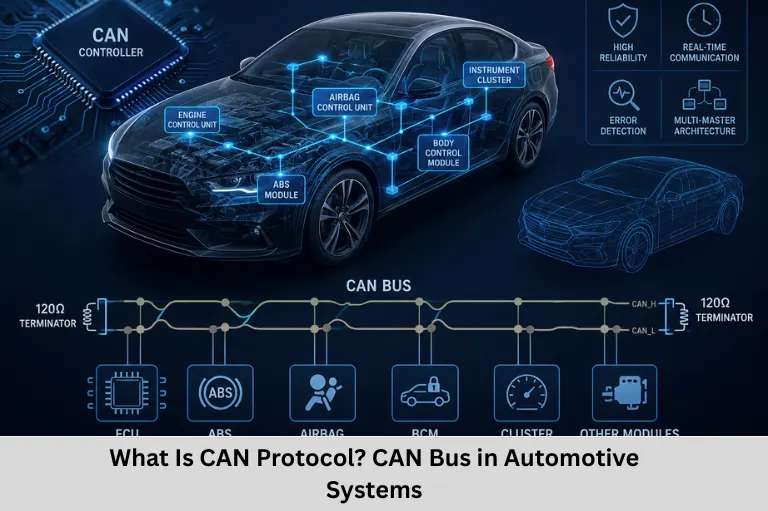
Learn CAN protocol, CAN bus communication, frames, arbitration, error handling, CAN FD, ECU communication, and automotive applications. Embedded Tech Development Academy (ETDA).
- What Is CAN Protocol? CAN Bus in Automotive Systems
-
What Is CAN Protocol? Introduction to Controller Area Network in Automotive Systems
- Introduction to CAN Protocol in Automotive Systems
- What Is CAN Protocol?
- Why Is CAN Important in Automotive Systems?
- Key Features of CAN Protocol
- Basic Architecture of a CAN Network
- CAN Frame Structure
- CAN Frame Types
- CAN Frame Types
- CAN Arbitration
- CAN Error Handling
- CAN Bit Rate and CAN FD
- Applications of CAN in Automotive Systems
- CAN Protocol in Embedded Systems
- CAN in Automotive Diagnostics
- Advantages of CAN Protocol
- Limitations of CAN Protocol
- CAN Protocol and Embedded Engineering Careers
-
Embedded Tech Development Academy for CAN Training
- Industry-Oriented Embedded Learning
- Assured Placement Support
- FAQs
- What is CAN protocol?
- Why is CAN protocol used in automotive systems?
- What are CAN_H and CAN_L?
- What is CAN arbitration?
- What is the difference between Classical CAN and CAN FD?
- Is CAN protocol important for an automotive embedded engineer?
- Conclusion
What Is CAN Protocol? Introduction to Controller Area Network in Automotive Systems
Introduction to CAN Protocol in Automotive Systems
Modern vehicles are sophisticated automotive embedded systems containing numerous electronic control units (ECUs), sensors, actuators, microcontrollers, and communication interfaces. Engine management, braking, transmission, airbags, body electronics, infotainment, and advanced driver assistance systems (ADAS) continuously exchange information.
The Controller Area Network (CAN) protocol is one of the most widely used automotive communication protocols for this purpose. CAN is a robust, real-time, message-based, multi-master communication protocol that allows multiple ECUs and microcontrollers to communicate over a shared bus without requiring a central host computer.
CAN is important in embedded systems programming because it combines hardware and software concepts such as microcontrollers, Embedded C, CAN controllers, CAN transceivers, interrupts, message filtering, bit timing, arbitration, and error handling.
For students interested in automotive embedded systems and practical communication protocols, Embedded Tech Development Academy (ETDA) provides industry-oriented technical training. As a Top Embedded Training Institute in Bangalore, Embedded Tech Development Academy (ETDA) focuses on practical embedded technologies and career-oriented learning with assured placement support.
Why CAN Is Important for Embedded Engineers
An embedded engineer working with CAN should understand not only how to transmit and receive a frame but also how arbitration, bus termination, error detection, identifiers, filtering, and physical-layer signaling work.
Assured Placement Support
Embedded Tech Development Academy (ETDA) combines technical training with practical projects and assured placement support, helping learners prepare for embedded software and automotive electronics careers.
What Is CAN Protocol?
Controller Area Network (CAN) is a serial, message-based communication protocol originally developed by engineers at Robert Bosch GmbH during the 1980s for automotive applications.
Before CAN, many automotive systems used point-to-point wiring. As vehicles gained more electronic functions, this approach increased wiring complexity, weight, cost, and maintenance requirements.
Shared CAN Bus Architecture
CAN replaced many dedicated connections with a shared communication bus.
How CAN Communication Works
A CAN node transmits a message containing an identifier and data. All nodes connected to the bus can observe the message and determine whether it is relevant to their application.
Example
An engine ECU may transmit engine RPM information. The instrument cluster, transmission controller, and other ECUs can receive the same message and process it according to their requirements.
Why Is CAN Important in Automotive Systems?
Modern vehicles may contain numerous ECUs responsible for different functions.
Common Automotive ECUs
Examples include:
- Engine Control Unit
- Transmission Control Unit
- ABS Controller
- Airbag Control Unit
- Body Control Module
- Instrument Cluster
- Electric Power Steering Controller
- Infotainment Controller
ECU Communication
These controllers continuously exchange information such as vehicle speed, engine RPM, braking status, temperature, torque requests, and steering information.
Real-Time Communication
CAN’s priority-based arbitration allows important messages to gain bus access according to their configured priority, making CAN suitable for many real-time automotive applications.
Key Features of CAN Protocol
1. Multi-Master Communication
CAN is a multi-master protocol, meaning any node can initiate communication when the bus is available.
Multi-Master Architecture
There is no permanent central controller responsible for all communication.
Advantage
This distributed architecture allows different ECUs to independently transmit information.
2. Message-Based Communication
CAN uses identifiers rather than traditional device addresses.
CAN Identifier
The identifier represents the type and priority of the message.
Example Messages
Messages can represent engine speed, vehicle speed, brake status, battery voltage, coolant temperature, or steering information.
3. Non-Destructive Arbitration
Multiple nodes can attempt to transmit at the same time.
Dominant and Recessive States
CAN uses dominant and recessive bus states during bit-by-bit arbitration.
Message Priority
A lower numerical identifier generally has higher priority. A node that loses arbitration stops transmitting without damaging the winning frame.
4. Error Detection
CAN provides several mechanisms for detecting communication errors.
Error Detection Mechanisms
These include CRC checking, bit monitoring, bit-stuffing checks, frame-format checks, and acknowledgment.
Fault Confinement
5. Differential Signaling
A typical high-speed CAN network uses two wires:
- CAN_H
- CAN_L
CAN Physical Layer
The receiver evaluates the differential voltage between CAN_H and CAN_L.
Noise Immunity
Differential signaling provides good immunity to common-mode electrical noise, which is important in automotive environments.
Basic Architecture of a CAN Network
A CAN network consists of nodes, a physical bus, transceivers, controllers, and termination.
CAN Node
A node can be an ECU, sensor controller, or embedded device.
Components of a CAN Node
A typical CAN node contains:
- Microcontroller
- CAN controller or integrated CAN peripheral
- CAN transceiver
Role of the Components
The microcontroller executes application firmware, the CAN controller handles protocol operations, and the transceiver provides the electrical interface to CAN_H and CAN_L.
CAN Bus Termination
High-speed CAN networks normally use 120-ohm termination resistors at both physical ends of the main bus.
Purpose of Termination
Termination helps reduce signal reflections.
Resistance Measurement
With power removed, measuring between CAN_H and CAN_L on a correctly terminated network normally produces approximately 60 ohms, because two 120-ohm resistors are connected in parallel.
CAN Frame Structure
CAN communication occurs through structured messages called CAN frames.
Standard CAN Data Frame
A Classical CAN data frame contains:
- Start of Frame
- Identifier
- Control Field
- Data Field
- CRC Field
- Acknowledgment Field
- End of Frame
CAN Identifier
The identifier determines message identity and participates in arbitration.
Standard Identifier
The standard CAN format uses an 11-bit identifier.
CAN Data Field
The data field contains application information.
Classical CAN Payload
Classical CAN supports a maximum of 8 bytes of application data per data frame.
Extended CAN Frame
CAN also supports an extended identifier format.
CAN Frame Types
Extended CAN uses a 29-bit identifier.
Standard vs Extended CAN
Standard CAN uses 11-bit identifiers, while extended CAN uses 29-bit identifiers.
CAN Frame Types
Data Frame
A data frame carries application information between nodes.
Typical Data
Examples
Engine RPM, vehicle speed, sensor values, battery information, and system status can be transmitted using data frames.
Remote Frame
Classical CAN defines a remote frame for requesting a corresponding data frame.
Remote Transmission Request
Usage
Modern CAN architectures commonly rely more heavily on data frames and higher-layer protocols.
Error Frame
An error frame is generated when a CAN node detects a protocol error.
Error Notification
Retransmission
CAN provides mechanisms for handling detected errors and retransmitting affected frames.
CAN Arbitration
How CAN Arbitration Works
When multiple ECUs want to transmit simultaneously, CAN performs arbitration bit by bit.
Identifier-Based Priority
Higher-Priority Message
The node transmitting the higher-priority identifier continues, while nodes that lose arbitration stop and wait for another opportunity.
This is called non-destructive arbitration because the winning message is not corrupted by the losing transmissions.
CAN Error Handling
Types of CAN Errors
CAN can detect several types of errors.
Bit, Stuff, CRC, Form, and ACK Errors
Error Detection
These mechanisms help CAN identify corrupted or invalid communication frames.
CAN Error States
CAN nodes can enter different error states.
Error Active and Error Passive
An error-active node operates normally and can actively signal errors. An error-passive node has accumulated more errors and operates with additional restrictions.
Bus Off
A severely faulty node can enter the Bus Off state, preventing it from continuing normal bus communication and helping protect the network.
CAN Bit Rate and CAN FD
Common Classical CAN nominal bit rates include 125 kbit/s, 250 kbit/s, 500 kbit/s, and 1 Mbit/s. The appropriate rate depends on bus length, topology, timing, and physical-layer characteristics.
What Is CAN FD?
CAN FD (CAN with Flexible Data-Rate) extends Classical CAN capabilities.
Larger Payload
Up to 64 Bytes
CAN FD supports up to 64 bytes of application data, compared with 8 bytes for Classical CAN. It can also use a higher bit rate during the data phase.
Applications of CAN in Automotive Systems
Engine Management
CAN connects engine-related controllers with other vehicle systems.
Engine Parameters
Examples
Engine RPM, torque, coolant temperature, throttle position, and engine status can be exchanged.
ABS and Safety Systems
CAN supports communication involving braking and stability systems.
ABS Communication
Wheel-Speed Data
Wheel-speed and braking-related information can be shared with other controllers.
Body Electronics
CAN can support body-control functions.
Body Control Module
Applications
Lighting, central locking, power windows, wipers, and other body functions can use CAN communication.
Instrument Cluster and Infotainment
Vehicle Information
Display Data
Vehicle speed, engine RPM, warnings, temperature, and other information can be transmitted to display-related systems.
CAN Protocol in Embedded Systems
CAN is highly relevant to embedded firmware development.
CAN Implementation Process
Step 1: Configure CAN Peripheral
Bit Timing
Configure the required nominal bit rate, timing parameters, filters, interrupts, and operating mode.
Step 2: Configure CAN Transceiver
Physical Connection
Connect the CAN transceiver correctly to CAN_H and CAN_L.
Step 3: Create and Transmit a Message
CAN Message Parameters
Prepare the identifier, data length, and payload before requesting transmission.
Step 4: Receive and Filter Messages
Acceptance Filtering
Acceptance filters allow the controller to process only relevant CAN identifiers.
CAN in Automotive Diagnostics
Unified Diagnostic Services
UDS (Unified Diagnostic Services) is a higher-layer automotive diagnostic protocol.
UDS Over CAN
Diagnostic Functions
UDS can support diagnostic trouble codes, ECU identification, diagnostic routines, and ECU programming when implemented using suitable CAN transport mechanisms.
Advantages of CAN Protocol
Major Advantages
CAN provides:
- Reduced wiring complexity
- Multi-master communication
- Priority-based arbitration
- Error detection
- Fault confinement
- Good noise immunity
- Distributed architecture
- Reliable ECU communication
Real-Time Communication
Priority-Based Transmission
Higher-priority messages can gain bus access before lower-priority messages according to the arbitration mechanism.
Limitations of CAN Protocol
Limited Classical CAN Payload
8-Byte Limitation
CAN FD Solution
Classical CAN supports only 8 bytes of application data, while CAN FD supports up to 64 bytes.
Bandwidth Limitation
Network Loading
Message Latency
High bus utilization can increase waiting time for lower-priority messages.
Security Limitations
No Native Encryption
Classical CAN does not inherently provide encryption or strong message authentication, so additional security mechanisms may be required.
CAN Protocol and Embedded Engineering Careers
Skills Required for CAN Development
Embedded C and Microcontrollers
Core Skills
Engineers should understand Embedded C, interrupts, microcontrollers, memory, peripherals, debugging, and communication interfaces.
CAN and Automotive Networking
Important Topics
Important topics include CAN frames, identifiers, arbitration, bit timing, error handling, filters, CAN FD, UDS, and ECU communication.
Embedded Tech Development Academy for CAN Training
Industry-Oriented Embedded Learning
Embedded Tech Development Academy (ETDA) focuses on practical embedded technologies including Embedded C, microcontrollers, CAN, UART, SPI, I2C, RTOS, debugging, and automotive embedded systems.
Top Embedded Training Institute in Bangalore
Practical Learning
Students looking for a Top Embedded Training Institute in Bangalore can benefit from project-based learning that connects CAN theory with practical microcontroller development.
Assured Placement Support
Career-Oriented Training
Placement Preparation
Embedded Tech Development Academy (ETDA) provides assured placement support, helping learners prepare for technical interviews and embedded industry opportunities.
FAQs
What is CAN protocol?
CAN, or Controller Area Network, is a message-based, multi-master serial communication protocol that allows multiple ECUs and embedded devices to communicate over a shared bus. It is widely used in automotive embedded systems.
Why is CAN protocol used in automotive systems?
CAN is used because it reduces wiring complexity and provides reliable communication between multiple ECUs. Features such as priority-based arbitration, error detection, fault confinement, and differential signaling make it suitable for automotive environments.
What are CAN_H and CAN_L?
CAN_H (CAN High) and CAN_L (CAN Low) are the two differential signal lines used by a typical high-speed CAN physical layer. Differential signaling helps improve resistance to common-mode electrical noise.
What is CAN arbitration?
CAN arbitration is the process used when multiple nodes attempt to transmit simultaneously. CAN uses the message identifier to determine priority. The higher-priority message continues transmission, while nodes that lose arbitration wait for another opportunity.
What is the difference between Classical CAN and CAN FD?
Classical CAN supports up to 8 bytes of application data per frame. CAN FD (CAN with Flexible Data-Rate) supports up to 64 bytes and can use a higher bit rate during the data phase, making it more suitable for larger data transfers.
Is CAN protocol important for an automotive embedded engineer?
Yes. CAN is an important skill for engineers working in automotive embedded systems, ECU development, firmware development, diagnostics, and embedded testing. Understanding CAN along with Embedded C and microcontroller programming can strengthen an engineer’s automotive skill set.
Conclusion
The Controller Area Network (CAN) protocol is one of the most important communication technologies used in modern automotive embedded systems. It enables multiple ECUs, microcontrollers, sensors, and control modules to exchange information efficiently through a shared communication bus. Features such as multi-master communication, message-based transmission, priority-based arbitration, differential signaling, error detection, and fault confinement make CAN highly suitable for automotive applications.
For embedded engineers, learning CAN involves more than understanding CAN frames. A strong technical foundation should include Embedded C, microcontrollers, CAN controllers, CAN transceivers, CAN_H and CAN_L, message identifiers, arbitration, bit timing, error handling, CAN FD, UDS, and ECU communication.
Embedded Tech Development Academy (ETDA) provides industry-oriented embedded systems training covering practical technologies and real-world project development. As a Top Embedded Training Institute in Bangalore, Embedded Tech Development Academy (ETDA) helps learners develop practical skills in Embedded C, microcontrollers, communication protocols, automotive embedded systems, and debugging, along with assured placement support.
For students and aspiring engineers looking for a Top Embedded Training Institute in Bangalore, gaining practical knowledge of CAN protocol can provide a strong foundation for careers in automotive embedded software, ECU development, firmware development, testing, and diagnostics. With hands-on learning and assured placement support, Embedded Tech Development Academy (ETDA) focuses on helping learners move from embedded systems fundamentals toward industry-ready technical skills.
Author: ETDA Trainers
Experience: 10+ Years of Industry Experience in Embedded Systems, IoT, and Embedded C Programming