
What Is C++? Complete Guide for Beginners | ETDA
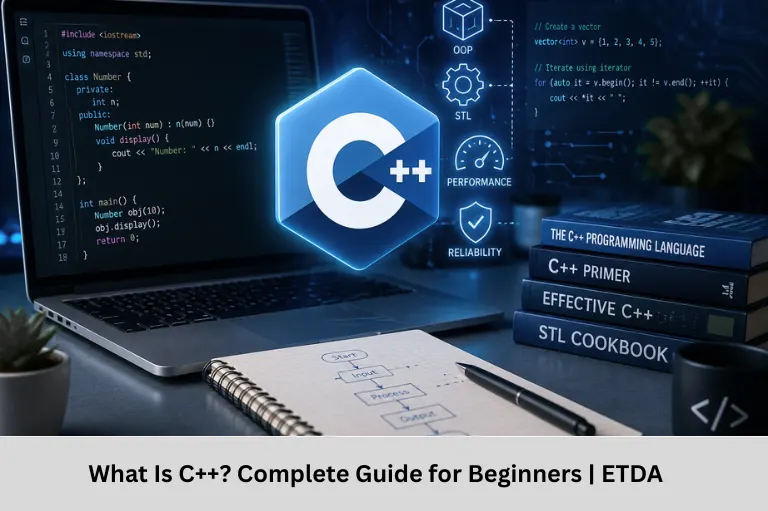
Learn what C++ is, its features, OOP concepts, syntax, memory management, applications, and role in embedded systems with this beginner-friendly guide. Embedded Tech Development Academy (ETDA).
- What Is C++? Complete Guide for Beginners | ETDA
-
What Is C++? A Complete Guide for Beginners
- What Is C++?
- C++ vs C Programming
- Key Features of C++
- Basic C++ Syntax
- Variables and Data Types in C++
- Functions in C++
- Pointers and References in C++
- Classes and Objects
- Constructors and Destructors
- C++ Standard Template Library
- Templates in C++
- Dynamic Memory Management
- Exception Handling in C++
- C++ in Embedded Systems
- C++ Applications
- Why Learn C++ for Embedded Systems?
- Learn C++ and Embedded Systems at ETDA
- Assured Placement Support at ETDA
-
Why Choose ETDA for Embedded Training?
- FAQs
- What is C++?
- Is C++ difficult for beginners?
- What is the difference between C and C++?
- What are the main concepts of C++?
- Is C++ used in Embedded Systems?
- Should I learn C before C++?
- What is object-oriented programming in C++?
- What is the STL in C++?
- Does ETDA provide placement support?
- Why choose ETDA for C++ and Embedded Systems training?
- Conclusion
What Is C++? A Complete Guide for Beginners
C++ is a powerful, general-purpose programming language used to develop software where performance, memory efficiency, and flexibility are important. It is widely used in system software, game development, desktop applications, high-performance computing, robotics, automotive systems, and embedded systems.
C++ evolved from the C programming language and introduced important programming concepts such as classes, objects, inheritance, polymorphism, encapsulation, templates, and exception handling. Because it supports both procedural and object-oriented programming, developers can choose the programming approach that best suits an application’s requirements.
For engineering students, learning C++ provides a strong foundation for understanding software architecture, object-oriented programming, data structures, algorithms, and embedded software development.
C++ is also relevant to modern embedded development. Many embedded products use C for low-level firmware and C++ when applications require more sophisticated software architecture. At Embedded Tech Development Academy (ETDA), students can build programming skills through practical training, embedded projects, and hardware-oriented development. Embedded Tech Development Academy (ETDA) also provides assured placement support to help learners prepare for embedded technology careers.
What Is C++?
C++ is a compiled, statically typed, general-purpose programming language that supports multiple programming paradigms.
It was developed by Bjarne Stroustrup at Bell Labs as an extension of C. The language originally introduced object-oriented features to C and gradually evolved into a powerful multi-paradigm programming language.
C++ supports:
- Procedural programming
- Object-oriented programming
- Generic programming
- Functional programming features
- Low-level programming
This combination makes C++ useful for applications ranging from operating-system components to high-performance embedded applications.
C++ vs C Programming
C++ is closely related to C, but the two languages have important differences.
| Feature | C | C++ |
|---|---|---|
| Programming Style | Procedural | Multi-paradigm |
| Classes and Objects | No | Yes |
| Encapsulation | Limited | Supported |
| Inheritance | No | Yes |
| Polymorphism | Limited | Supported |
| Templates | No | Yes |
| Exception Handling | No built-in mechanism | Supported |
| Standard Library | C Standard Library | C++ Standard Library |
C is often preferred for highly constrained firmware and low-level programming, while C++ is useful when software complexity requires object-oriented and generic programming techniques.
Key Features of C++
C++ provides a broad collection of features for developing structured and efficient software.
Object-Oriented Programming
Object-oriented programming, or OOP, organizes software around objects and classes.
Four Major OOP Principles
The commonly discussed principles are:
- Encapsulation
- Abstraction
- Inheritance
- Polymorphism
These concepts help developers create modular and maintainable applications.
Encapsulation
Encapsulation combines data and the functions that operate on that data within a class.
Access modifiers control how members can be accessed.
Common Access Specifiers
publicprivateprotected
For example, sensitive internal data can be declared private, while controlled access can be provided through public member functions.
Abstraction
Abstraction hides unnecessary implementation details and exposes only the functionality required by the user.
In large software systems, abstraction helps separate what a component does from how it performs the operation.
Inheritance
Inheritance allows one class to derive properties and behavior from another class.
Common Types
- Single inheritance
- Multilevel inheritance
- Multiple inheritance
- Hierarchical inheritance
Inheritance can reduce code duplication when classes share common behavior.
Polymorphism
Polymorphism allows the same interface to represent different implementations.
Common Forms
- Function overloading
- Operator overloading
- Function overriding
- Virtual functions
Runtime polymorphism is commonly implemented using virtual functions and inheritance.
Basic C++ Syntax
A basic C++ program can contain headers, a main() function, statements, and return values.
For example:
#include <iostream>

int main()
{
    std::cout << "Hello, C++!";
    return 0;
}
Here:
#include <iostream>provides input/output functionality.main()is the program’s entry point.std::coutdisplays output.return 0indicates successful program termination.
Understanding the syntax of small programs is the first step toward developing larger C++ applications.
Variables and Data Types in C++
Variables store values in memory.
Common Data Types
charintfloatdoubleboolvoid
C++ also supports modifiers such as:
signedunsignedshortlong
Why Data Types Matter
Data types determine how values are represented and how much memory they generally require. In embedded systems, choosing appropriate data types is particularly important because RAM and Flash resources may be limited.
Functions in C++
Functions divide a program into reusable blocks.
A function generally contains:
- Return type
- Function name
- Parameters
- Function body
Function Overloading
One important C++ feature is function overloading.
Multiple functions can have the same name as long as their parameter lists differ.
For example, a program could have separate functions for adding two integers and adding two floating-point values.
This allows developers to use a consistent interface for related operations.
Pointers and References in C++
Pointers are inherited from C and remain an important part of C++.
Pointers
A pointer stores the address of another variable.
Pointers are useful for:
- Dynamic memory
- Arrays
- Data structures
- Hardware access
- Function pointers
References
C++ also provides references.
A reference provides another name for an existing object and is commonly used for passing data to functions without making unnecessary copies.
Understanding pointers and references is essential for developers working with performance-sensitive software.
Classes and Objects
Classes are one of the central concepts in C++.
A class defines the properties and behaviors of an object.
Example Structure
A simple class may contain:
- Data members
- Constructors
- Member functions
- Access specifiers
- Destructors
Objects
An object is an instance of a class.
For example, a Motor class could define properties such as speed and state and provide functions to start, stop, or change the motor speed.
This approach makes complex applications easier to organize.
Constructors and Destructors
Constructors are special member functions that are automatically called when objects are initialized.
Destructors are called when objects are destroyed.
Constructor
A constructor is commonly used to initialize an object’s state.
Destructor
A destructor can be used to release resources associated with an object.
Importance in Embedded Systems
Resource management is particularly important in embedded applications. Developers must carefully manage memory, peripheral resources, communication buffers, and hardware-related objects.
C++ Standard Template Library
The Standard Template Library (STL) provides reusable components for common programming tasks.
Important STL Components
vectorlistdequemapsetqueuestack- Algorithms
- Iterators
STL containers and algorithms can reduce development time and improve code organization.
However, embedded developers need to consider memory usage and runtime behavior before using particular STL features on resource-constrained devices.
Templates in C++
Templates support generic programming, allowing developers to write reusable code that works with different data types.
Function Templates
A function template can perform the same logical operation on multiple data types.
Class Templates
Class templates allow developers to create reusable data structures.
Why Templates Matter
Templates are useful for building:
- Generic algorithms
- Data structures
- Reusable libraries
- Type-independent components
They are particularly powerful in large software projects.
Dynamic Memory Management
C++ provides mechanisms for dynamic memory allocation.
Traditional operators include:
newdelete
Modern C++ also provides smart pointers such as:
std::unique_ptrstd::shared_ptrstd::weak_ptr
Why Memory Management Matters
Poor memory management can result in:
- Memory leaks
- Dangling pointers
- Double deletion
- Fragmentation
- Undefined behavior
In embedded systems, these problems can be especially serious because devices may operate continuously with limited memory.
Exception Handling in C++
C++ supports exception handling using:
trycatchthrow
Exception handling provides a structured way to deal with certain runtime error conditions.
However, in highly constrained embedded applications, developers may avoid or restrict exceptions depending on compiler configuration, memory constraints, performance requirements, and project coding standards.
C++ in Embedded Systems
C++ is increasingly used in embedded software where software architecture and maintainability are important.
Applications of Embedded C++
C++ can be used for:
- Automotive software
- Robotics
- Internet of Things (IoT) devices
- Industrial controllers
- Consumer electronics
- Embedded Linux applications
- Real-time applications
- Device frameworks
Advantages
C++ provides:
- Object-oriented architecture
- Code reuse
- Encapsulation
- Strong type checking
- Generic programming
- Abstraction
- Efficient compiled code
These features can help developers manage complex embedded software projects.
C++ Applications
C++ is used across many technology domains.
Major Application Areas
- Game engines
- Operating systems
- Browsers
- Desktop applications
- Financial software
- Robotics
- Automotive systems
- Embedded systems
- High-performance computing
- Graphics applications
- Internet of Things (IoT)
platforms
Its combination of abstraction and performance makes it suitable for applications where execution efficiency is important.
Why Learn C++ for Embedded Systems?
For an embedded engineer, C++ can complement knowledge of C and Embedded C.
C helps developers understand:
- Memory
- Registers
- Pointers
- Hardware interfaces
- Low-level programming
C++ adds:
- Object-oriented design
- Abstraction
- Generic programming
- Reusable software components
- Advanced data structures
Together, these skills can help engineers work on increasingly complex firmware and embedded software architectures.
Learn C++ and Embedded Systems at ETDA
Embedded Tech Development Academy (ETDA) focuses on practical, industry-oriented technical education for engineering students and aspiring embedded professionals.
Technical Skills
Students can develop knowledge in:
- C Programming
- C++
- Embedded C
- Data Structures
- Object-Oriented Programming
- ARM Cortex-M
- STM32
- RTOS
- Embedded Linux
- UART
- SPI
- I2C
- CAN
- Internet of Things (IoT)
Project-Based Learning
Practical projects help students understand how programming concepts are applied to actual embedded hardware rather than learning syntax alone.
Assured Placement Support at ETDA
Learning C++ and embedded technologies is only one part of career preparation. Embedded Tech Development Academy (ETDA) also provides assured placement support to help students prepare for recruitment opportunities.
Placement Preparation
- Resume preparation
- Aptitude training
- Technical interview preparation
- Mock interviews
- HR interview guidance
- Communication skills development
- Career mentoring
This combination of technical learning and career preparation helps students approach entry-level embedded opportunities with greater confidence.
Why Choose ETDA for Embedded Training?
Students searching for a Top Embedded Training Institute in Bangalore should look beyond classroom theory and evaluate practical exposure, project work, curriculum quality, and career support.
Embedded Tech Development Academy (ETDA) focuses on:
- Industry-oriented curriculum
- Experienced technical trainers
- Practical hardware exposure
- Programming-focused learning
- Real-time embedded projects
- Microcontroller development
- Communication protocols
- RTOS concepts
- Assured placement support
This approach helps bridge the gap between academic programming knowledge and industry-oriented embedded development.
FAQs
What is C++?
C++ is a general-purpose, statically typed programming language that supports procedural, object-oriented, generic, and other programming approaches.
Is C++ difficult for beginners?
C++ can initially seem complex because it contains many features. Beginners can learn it progressively by starting with variables, operators, functions, arrays, pointers, and then moving to classes and object-oriented programming.
What is the difference between C and C++?
C primarily follows a procedural programming approach, while C++ supports procedural programming as well as object-oriented, generic, and other programming paradigms.
What are the main concepts of C++?
Important concepts include classes, objects, encapsulation, abstraction, inheritance, polymorphism, constructors, destructors, templates, pointers, references, and memory management.
Is C++ used in Embedded Systems?
Yes. C++ is used in automotive systems, robotics, IoT devices, embedded Linux, industrial applications, and other performance-sensitive embedded software.
Should I learn C before C++?
Learning C first can be beneficial, especially for embedded development, because it builds a strong foundation in pointers, memory, data types, and low-level programming. However, C++ can also be learned directly with a structured approach.
What is object-oriented programming in C++?
Object-oriented programming organizes software around classes and objects. Its major principles include encapsulation, abstraction, inheritance, and polymorphism.
What is the STL in C++?
The Standard Template Library provides reusable containers, algorithms, iterators, and other components that help developers implement common programming tasks efficiently.
Does ETDA provide placement support?
Yes. Embedded Tech Development Academy (ETDA) provides assured placement support, including technical interview preparation, aptitude training, resume guidance, mock interviews, and career mentoring.
Why choose ETDA for C++ and Embedded Systems training?
ETDA combines programming fundamentals with Embedded C, C++, microcontrollers, ARM Cortex-M, STM32, RTOS, communication protocols, real-time projects, practical hardware exposure, and assured placement support, helping students prepare for careers in embedded software development.
Conclusion
C++ is a powerful programming language that combines the efficiency of low-level programming with advanced features such as object-oriented programming, templates, abstraction, polymorphism, and generic programming.
For beginners, the most important concepts to master include variables, functions, pointers, references, classes, objects, constructors, inheritance, polymorphism, memory management, and the Standard Template Library. Once these concepts are understood, developers can progress toward advanced software architecture and specialized application development.
C++ is also valuable in embedded systems, particularly for complex firmware, automotive applications, robotics, Internet of Things (IoT), and embedded Linux. When combined with C, Embedded C, microcontroller programming, debugging, and communication protocols, C++ can become a valuable skill for an embedded software engineer.
Embedded Tech Development Academy (ETDA) provides practical training designed around programming, embedded hardware, real-time projects, and industry requirements. With assured placement support, Embedded Tech Development Academy (ETDA) helps students develop both technical and career-ready skills. For learners looking for a Top Embedded Training Institute in Bangalore, Embedded Tech Development Academy (ETDA) provides a structured environment for building a strong foundation in Embedded Systems and software development.
Author: ETDA Trainers
Experience: 10+ Years of Industry Experience in Embedded Systems, IoT, and Embedded C Programming