
What is Digital Electronics? Principles, Circuits & Applications | ETDA
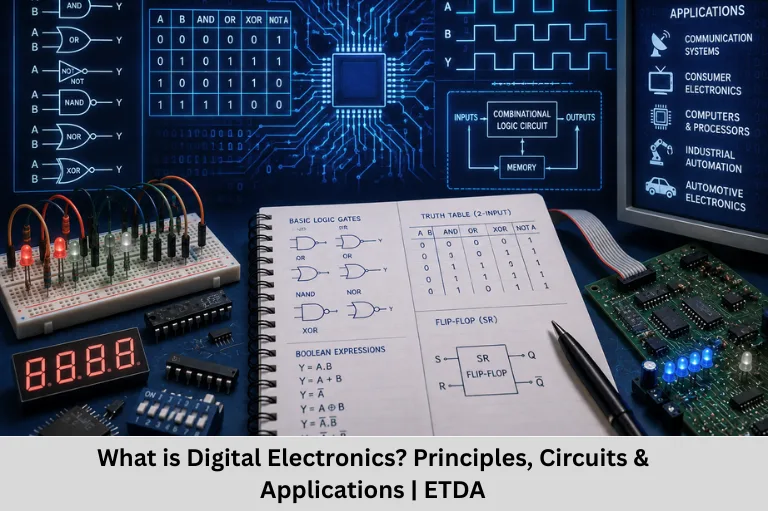
Learn digital electronics, logic gates, Boolean algebra, digital circuits, flip-flops, counters, applications, and career skills with Embedded Tech Development Academy (ETDA).
- What is Digital Electronics? Principles, Circuits & Applications | ETDA
-
What is Digital Electronics? Principles, Circuits & Applications
- What is Digital Electronics?
- Binary Number System in Digital Electronics
- Logic Gates in Digital Electronics
- Boolean Algebra
- Combinational Digital Circuits
- Sequential Digital Circuits
- Registers and Counters
- Memory in Digital Electronics
- Digital Electronics and Microcontrollers
- Applications of Digital Electronics
- Digital Electronics in Embedded Systems
- Why Learn Digital Electronics at ETDA?
- Assured Placement Support at ETDA
-
Frequently Asked Questions (FAQs)
- What is digital electronics?
- What are the basic building blocks of digital electronics?
- What is the difference between combinational and sequential circuits?
- What are flip-flops used for?
- What is Boolean algebra?
- Why is digital electronics important for Embedded Systems?
- What are the applications of digital electronics?
- Can digital electronics be learned before Embedded C?
- Does ETDA provide placement support?
- Why choose ETDA for Embedded Systems training?
- Conclusion
What is Digital Electronics? Principles, Circuits & Applications
Digital electronics is a branch of electronics that deals with discrete signals and digital data. Unlike analog electronics, where signals vary continuously, digital electronics primarily represents information using defined logic levels, commonly expressed as binary 0 and 1.
Digital electronics forms the foundation of computers, microcontrollers, smartphones, communication equipment, industrial automation systems, consumer electronics, and embedded devices. Modern processors and microcontrollers rely on millions or billions of digital switching elements to execute instructions and process information.
For engineering students, understanding digital electronics is essential before moving into advanced areas such as microcontrollers, Embedded C, computer architecture, FPGA design, Internet of things (IoT), and embedded systems.
Embedded Tech Development Academy (ETDA) provides practical, industry-oriented training that helps students connect digital electronics concepts with real embedded hardware. As a Top Embedded Training Institute in Bangalore, Embedded Tech Development Academy (ETDA) focuses on practical projects, technical skill development, and assured placement support for aspiring embedded engineers.
What is Digital Electronics?
Digital electronics deals with electronic circuits that operate using discrete signal levels rather than continuously varying signals.
The most common digital system uses binary logic, where:
- 0 represents LOW
- 1 represents HIGH
The exact voltage represented by HIGH and LOW depends on the technology and circuit design.
Digital circuits use these binary states to perform calculations, store information, make decisions, and control electronic systems.
Analog Electronics vs Digital Electronics
The primary difference is the way information is represented.
| Feature | Analog Electronics | Digital Electronics |
|---|---|---|
| Signal | Continuous | Discrete |
| Common Representation | Voltage/current waveform | Binary 0 and 1 |
| Noise Tolerance | Generally lower | Generally higher |
| Data Processing | Continuous values | Digital values |
| Applications | Amplifiers, sensors, audio | Computers, processors, controllers |
Modern embedded systems commonly combine both technologies. Sensors may generate analog signals, while microcontrollers process the converted information digitally.
Binary Number System in Digital Electronics
The binary number system is fundamental to digital electronics.
Unlike the decimal system, which uses ten digits from 0 to 9, binary uses only:
0 and 1
Each binary digit is called a bit.
Common Digital Number Systems
Binary
Base-2 number system using 0 and 1.
Decimal
Base-10 number system commonly used by humans.
Octal
Base-8 number system using digits from 0 to 7.
Hexadecimal
Base-16 number system using 0–9 and A–F.
Why Hexadecimal Matters
Hexadecimal provides a compact representation of binary values and is commonly used when programming microcontrollers, examining memory addresses, and working with registers.
For example, a binary value can be represented much more compactly in hexadecimal, making it easier for embedded developers to read and debug hardware-level information.
Logic Gates in Digital Electronics
Logic gates are the fundamental building blocks of digital circuits. They perform logical operations on one or more binary inputs to produce a binary output.
AND Gate
An AND gate produces HIGH output only when all inputs are HIGH.
Boolean Expression
Y = A · B
For two inputs:
| A | B | Y |
|---|---|---|
| 0 | 0 | 0 |
| 0 | 1 | 0 |
| 1 | 0 | 0 |
| 1 | 1 | 1 |
OR Gate
An OR gate produces HIGH output when at least one input is HIGH.
Boolean Expression
Y = A + B
NOT Gate
A NOT gate reverses the input.
Boolean Expression
Y = A̅
If the input is 1, the output is 0, and vice versa.
NAND Gate
A NAND gate is the inverse of an AND gate.
Boolean Expression
Y = (A · B)̅
NAND is known as a universal gate because complete digital systems can be constructed using only NAND gates.
NOR Gate
NOR is the inverse of an OR gate.
Boolean Expression
Y = (A + B)̅
NOR is also a universal logic gate.
XOR Gate
XOR produces HIGH output when the inputs are different.
Common Applications
- Binary addition
- Parity generation
- Error detection
- Digital comparators
XNOR Gate
XNOR produces HIGH output when the inputs are the same.
It is frequently used in equality comparison circuits.
Boolean Algebra
Boolean algebra is a mathematical system used to analyze and simplify digital logic circuits.
Basic Boolean Operations
The primary operations are:
- AND
- OR
- NOT
Important Boolean Laws
Common laws include:
- Identity Law
- Null Law
- Idempotent Law
- Complement Law
- Commutative Law
- Associative Law
- Distributive Law
- De Morgan’s Laws
Boolean simplification helps engineers reduce the number of gates required in a circuit.
Why Boolean Algebra Is Important
Simplifying a digital circuit can reduce:
- Hardware complexity
- Power consumption
- Propagation delay
- Circuit size
- Manufacturing cost
Combinational Digital Circuits
Combinational circuits produce outputs based only on their present inputs.
They do not normally store previous input states.
Half Adder
A half adder adds two binary bits and produces:
- Sum
- Carry
Applications
Half adders are fundamental building blocks for binary arithmetic circuits.
Full Adder
A full adder adds three inputs:
- A
- B
- Carry-in
It produces:
- Sum
- Carry-out
Full adders can be connected together to create multi-bit binary adders.
Multiplexer
A multiplexer, or MUX, selects one input from multiple inputs and sends it to a single output.
Applications
- Data selection
- Communication systems
- Processor architecture
- Signal routing
Demultiplexer
A demultiplexer performs the opposite operation by routing a single input to one of several outputs.
Encoder and Decoder
An encoder converts multiple input signals into a coded output.
A decoder converts coded input information into one of several output signals.
These circuits are widely used in memory systems, displays, communication interfaces, and control systems.
Sequential Digital Circuits
Sequential circuits differ from combinational circuits because their output depends on both the current input and previous state.
They require memory elements to retain information.
Flip-Flops
Flip-flops are basic storage elements used to store a single bit.
Types of Flip-Flops
- SR Flip-Flop
- JK Flip-Flop
- D Flip-Flop
- T Flip-Flop
Applications
Flip-flops are used in:
- Registers
- Counters
- Memory circuits
- Frequency dividers
- Control systems
Registers and Counters
Registers are groups of flip-flops used to store multiple bits.
Shift Registers
Shift registers move stored data from one position to another based on clock signals.
Applications
- Serial-to-parallel conversion
- Parallel-to-serial conversion
- Temporary data storage
- Communication interfaces
Digital Counters
Counters are sequential circuits that count clock pulses.
Common types include:
- Up Counter
- Down Counter
- Up/Down Counter
- Asynchronous Counter
- Synchronous Counter
Counters are widely used in timers, frequency measurement, digital clocks, and embedded systems.
Memory in Digital Electronics
Memory circuits store digital information for later processing.
Common Memory Types
- RAM
- ROM
- PROM
- EPROM
- EEPROM
- Flash Memory
Modern microcontrollers commonly combine different memory technologies for program storage and temporary data processing.
Digital Electronics and Microcontrollers
Digital electronics provides the hardware foundation for microcontrollers.
A microcontroller contains digital building blocks such as:
- CPU core
- Registers
- Timers
- Digital I/O
- Memory
- Communication peripherals
GPIO and Digital Signals
GPIO (General Purpose Input/Output) pins allow a microcontroller to interact with external digital devices.
Examples
A microcontroller can:
- Turn an LED ON or OFF
- Read a push button
- Control a relay
- Interface with a digital sensor
- Generate control signals
Understanding logic levels is essential when designing these interfaces.
Applications of Digital Electronics
Digital electronics is used across almost every modern technology sector.
Consumer Electronics
Applications include:
- Smartphones
- Televisions
- Digital cameras
- Smart appliances
- Gaming systems
Automotive Electronics
Digital circuits are used in:
- Engine control units
- Infotainment
- Driver assistance
- Instrument clusters
- Vehicle communication
Industrial Automation
Digital electronics enables:
- PLC systems
- Robotics
- Machine controllers
- Production automation
- Monitoring systems
Communication Systems
Digital circuits are fundamental to:
- Networking equipment
- Wireless systems
- Modems
- Routers
- Digital communication devices
Digital Electronics in Embedded Systems
Eembedded systems combine digital hardware with software to perform dedicated functions.
A typical embedded systems may contain:
Input → Digital/Analog Interface → Microcontroller → Processing → Output
Digital electronics helps the microcontroller interpret inputs and control external hardware.
For example, in an automatic door system:
- A sensor detects movement.
- The microcontroller receives the signal.
- Digital logic processes the input.
- The controller activates a motor driver.
- The door opens or closes.
This demonstrates how digital electronics concepts are translated into practical embedded applications.
Why Learn Digital Electronics at ETDA?
A strong foundation in digital electronics is essential for engineers working with microcontrollers, firmware, Internet of things (IoT), robotics, and embedded hardware.
At Embedded Tech Development Academy (ETDA), students can connect fundamental electronics concepts with practical embedded applications.
Technical Skills
Students can develop knowledge in:
- Digital Logic
- Logic Gates
- Boolean Algebra
- Combinational Circuits
- Sequential Circuits
- Flip-Flops
- Counters
- Registers
- Microcontrollers
- Embedded C
- Communication Protocols
- Internet of things (IoT) Systems
Practical Learning
Hands-on learning helps students understand how digital logic is implemented in actual hardware rather than simply memorizing truth tables and definitions.
Assured Placement Support at ETDA
Technical knowledge becomes more valuable when combined with career preparation. Embedded Tech Development Academy (ETDA) provides assured placement support to help students prepare for opportunities in embedded and electronics industries.
Placement Preparation
- Resume building
- Technical interview preparation
- Aptitude training
- Mock interviews
- HR interview preparation
- Communication skills
- Career guidance
This career-focused approach helps students become more confident when applying for entry-level engineering positions.
Frequently Asked Questions (FAQs)
What is digital electronics?
Digital electronics is a branch of electronics that processes information using discrete signal levels, commonly represented by binary 0 and 1.
What are the basic building blocks of digital electronics?
Logic gates such as AND, OR, NOT, NAND, NOR, XOR, and XNOR are the fundamental building blocks of digital circuits.
What is the difference between combinational and sequential circuits?
Combinational circuit outputs depend primarily on current inputs, while sequential circuit outputs depend on current inputs and stored previous states.
What are flip-flops used for?
Flip-flops are one-bit storage elements used in registers, counters, memory circuits, frequency dividers, and sequential logic systems.
What is Boolean algebra?
Boolean algebra is a mathematical system used to represent, analyze, and simplify logical expressions and digital circuits.
Why is digital electronics important for Embedded Systems?
Microcontrollers and processors operate using digital logic. Understanding digital electronics helps engineers work with GPIO, registers, timers, memory, interfaces, and digital peripherals.
What are the applications of digital electronics?
Digital electronics is used in computers, smartphones, automotive systems, industrial automation, robotics, communication equipment, medical devices, IoT products, and embedded systems.
Can digital electronics be learned before Embedded C?
Yes. Digital electronics provides the hardware foundation, while Embedded C provides the programming knowledge needed to control that hardware. Learning both creates a strong embedded systems foundation.
Does ETDA provide placement support?
Yes. Embedded Tech Development Academy (ETDA) provides assured placement support, including resume preparation, technical interview training, mock interviews, aptitude preparation, and career guidance.
Why choose ETDA for Embedded Systems training?
Embedded Tech Development Academy (ETDA) combines industry-oriented curriculum, practical hardware training, real-time projects, experienced trainers, embedded technology exposure, and assured placement support, making it a strong choice for engineering students pursuing embedded careers.
Conclusion
Digital electronics is the foundation of modern computing and electronic systems. From basic logic gates and Boolean algebra to complex processors, memory systems, counters, registers, and microcontrollers, digital circuits enable machines to process information and make decisions.
For engineering students, understanding digital electronics is particularly important because it provides the foundation for microcontroller programming, Embedded C, FPGA development, Internet of things (IoT), robotics, automation, and digital system design.
If you want to develop practical skills in embedded technology, Embedded Tech Development Academy (ETDA) provides industry-focused learning, practical exposure, real-time projects, and assured placement support. As a Top Embedded Training Institute in Bangalore, Embedded Tech Development Academy (ETDA) helps aspiring engineers build the technical foundation required to work with modern embedded systems and electronics systems.
Author: ETDA Trainers
Experience: 10+ Years of Industry Experience in Embedded Systems, IoT, and Embedded C Programming