
What Is Embedded C? Complete Guide for Beginners | ETDA
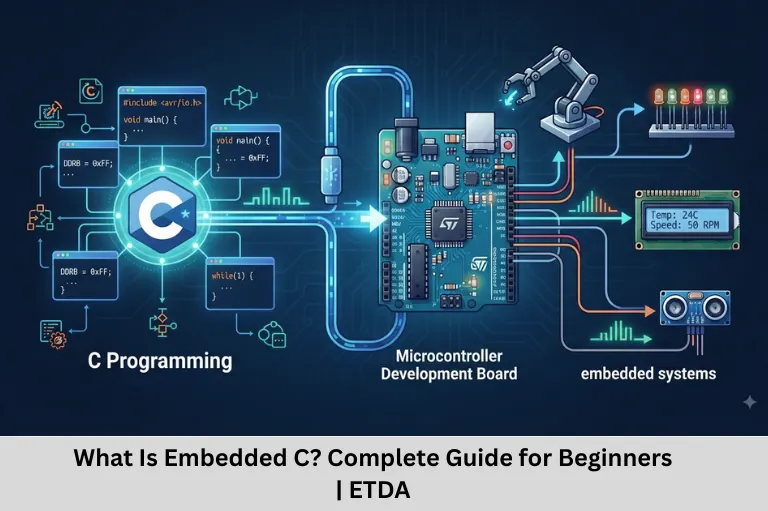
Learn what Embedded C is, its features, syntax, memory concepts, hardware programming, applications, and career benefits with this complete beginner’s guide.
- What Is Embedded C? Complete Guide for Beginners | ETDA
-
What Is Embedded C? A Complete Guide for Beginners
- What Is Embedded C?
- Why Is C Used in Embedded Systems?
- Important Features of Embedded C
- Data Types in Embedded C
- Memory Management in Embedded C
- Embedded C and Microcontrollers
- Interrupts in Embedded C
- Embedded C Communication Programming
- Embedded C and Real-Time Systems
- Embedded C Programming Best Practices
- Applications of Embedded C
- Embedded C vs Standard C
- Why Learn Embedded C at ETDA?
- Assured Placement Support at ETDA
-
Why Choose ETDA for Embedded Systems Training?
- Industry-Oriented Learning
- Practical Hardware Training
- Real-Time Projects
- Career-Focused Preparation
- FAQs
- What is Embedded C?
- Is Embedded C different from C Programming?
- Why is C used for embedded systems?
- What should I learn before Embedded C?
- What are the important topics in Embedded C?
- Is Embedded C used in STM32 development?
- Where is Embedded C used?
- Is Embedded C difficult to learn?
- Does ETDA provide placement support?
- Why choose ETDA for Embedded C training?
- Conclusion
What Is Embedded C? A Complete Guide for Beginners
Embedded systems are everywhere—from automotive control units and medical devices to industrial machines, smart appliances, Internet of Things (IoT) products, and consumer electronics. Behind many of these systems is firmware that directly controls microcontrollers and hardware peripherals.
One of the most important programming languages used to develop this firmware is Embedded C.
Embedded C is not a completely separate programming language from standard C. Instead, it refers to the use of the C language for developing software that runs on resource-constrained embedded hardware. It combines the programming capabilities of C with hardware-specific features such as registers, memory-mapped peripherals, interrupts, timers, GPIO, and communication interfaces.
For engineering students interested in firmware and embedded software development, learning Embedded C is an essential step. At Embedded Tech Development Academy (ETDA), students learn C and Embedded C through practical programming, microcontroller-based experiments, debugging, and real-time projects. Embedded Tech Development Academy (ETDA) also provides assured placement support for students preparing for careers in the embedded domain.
What Is Embedded C?
Embedded C is the application of the C programming language to embedded systems and microcontroller-based applications.
Standard C is designed to develop general-purpose software, whereas Embedded C is typically used when software needs to interact closely with hardware.
An Embedded C program can control:
- GPIO pins
- Timers
- ADCs
- PWM modules
- UART
- SPI
- I2C
- CAN
- Interrupt controllers
- Memory-mapped registers
The C language provides features such as pointers, structures, bitwise operators, functions, and arrays that make this low-level hardware interaction possible.
Why Is C Used in Embedded Systems?
C remains one of the most widely used languages for embedded development because it provides an excellent balance between performance, portability, and hardware control.
Low-Level Hardware Access
C allows programmers to access specific memory locations through pointers and addresses.
This capability is essential when controlling hardware registers.
Example
A microcontroller peripheral may expose control registers at predefined memory addresses. Firmware can read from or write to those registers to configure and operate the peripheral.
This is one reason pointers and bitwise operations are fundamental skills for embedded programmers.
Efficient Memory Usage
Embedded devices frequently have limited:
- RAM
- Flash memory
- CPU processing power
- Storage
C allows developers to write compact programs with relatively low runtime overhead.
Why This Matters
An embedded application may have only a few kilobytes of RAM. Poor memory management can therefore cause serious problems such as stack overflow, heap fragmentation, or unexpected system resets.
Fast Execution
C programs are generally compiled directly into machine instructions for the target processor.
This makes C suitable for applications where response time and deterministic execution are important.
Important Features of Embedded C
Embedded C uses the core features of C while emphasizing hardware-oriented programming.
Pointers
Pointers store memory addresses and are extensively used for:
- Register access
- Buffer management
- Arrays
- Data structures
- Peripheral drivers
Pointer Knowledge Is Essential
An embedded developer must understand:
- Pointer declaration
- Pointer arithmetic
- Pointer-to-pointer
- Function pointers
- Pointers with arrays
- Pointers with structures
constpointers
Incorrect pointer usage can cause memory corruption and system instability.
Bitwise Operators
Bitwise operators are extremely important in Embedded C.
The main operators are:
&— AND|— OR^— XOR~— NOT<<— Left shift>>— Right shift
Why Are Bitwise Operations Important?
Microcontroller registers contain individual bits representing configuration options or hardware states.
A developer may need to:
- Set a bit
- Clear a bit
- Toggle a bit
- Read a bit
- Modify selected bits
Bitwise operations allow these tasks to be performed efficiently.
Data Types in Embedded C
Choosing appropriate data types is important because embedded systems operate under strict memory constraints.
Common Data Types
charshortintlongfloatdoublevoid
Embedded development also commonly uses fixed-width integer types such as:
uint8_tuint16_tuint32_tint8_tint16_tint32_t
These types make the intended data width explicit.
Why Fixed-Width Types Matter
When working with hardware registers or communication protocols, knowing the exact number of bits is important.
For example, a 32-bit hardware register should generally be handled using an appropriately sized integer type.
Memory Management in Embedded C
Memory management is one of the most important areas of Embedded C.
A typical embedded application uses different memory regions for different purposes.
Stack
The stack generally stores:
- Local variables
- Function parameters
- Return addresses
- Temporary data
Excessive stack usage can cause stack overflow.
Heap
The heap is used for dynamic memory allocation.
Functions such as malloc() and free() are available in C, but dynamic memory is often used cautiously in embedded systems.
Why?
Repeated allocation and deallocation can cause heap fragmentation and unpredictable memory behavior.
For many real-time embedded applications, static allocation is preferred where practical.
Flash Memory
Flash commonly stores:
- Program instructions
- Constant data
- Firmware
- Configuration information
It is non-volatile, meaning its contents remain after power is removed.
Embedded C and Microcontrollers
Microcontrollers combine a processor core with memory and peripherals on a single chip.
Examples include ARM Cortex-M based microcontrollers and popular families such as STM32.
GPIO Programming
GPIO is one of the first peripherals beginners learn.
A GPIO pin can typically be configured as:
- Input
- Output
- Alternate function
- Analog
Example Applications
Embedded C can be used to:
- Turn an LED ON/OFF
- Read a push button
- Control a relay
- Interface a sensor
- Generate control signals
Interrupts in Embedded C
An interrupt allows hardware or software events to temporarily interrupt the normal execution flow.
Examples include:
- Timer interrupts
- UART receive interrupts
- External GPIO interrupts
- ADC interrupts
- Communication interrupts
Interrupt Service Routine
The function executed in response to an interrupt is commonly called an Interrupt Service Routine (ISR).
Important ISR Practices
An ISR should generally be:
- Short
- Fast
- Predictable
- Carefully synchronized with shared data
Long-running operations inside interrupt handlers can delay other important system activities.
Embedded C Communication Programming
Microcontrollers frequently communicate with external devices.
UART
UART is commonly used for:
- Debugging
- GPS modules
- Bluetooth modules
- Serial terminals
SPI
SPI is widely used for high-speed communication with:
- Displays
- Flash memory
- Sensors
- ADC/DAC devices
I2C
I2C allows multiple devices to communicate using a shared bus.
Common applications include:
- Sensors
- EEPROM
- RTC modules
- Display controllers
CAN
CAN is extensively used in automotive and industrial systems because it provides reliable multi-node communication.
Understanding these protocols is an important part of becoming an industry-ready Embedded C developer.
Embedded C and Real-Time Systems
Many embedded products need to respond to events within predictable time limits.
Examples include:
- Motor controllers
- Automotive control systems
- Industrial automation
- Medical devices
- Robotics
Role of RTOS
A Real-Time Operating System (RTOS) can provide task scheduling and synchronization mechanisms.
Embedded C is commonly used to develop applications running on RTOS platforms.
Common RTOS Concepts
- Tasks
- Scheduling
- Queues
- Semaphores
- Mutexes
- Timers
- Interrupt synchronization
Embedded C Programming Best Practices
Writing working code is not enough for professional embedded development. Code should also be reliable, maintainable, and predictable.
Recommended Practices
- Use meaningful variable names.
- Keep functions modular.
- Avoid unnecessary global variables.
- Validate array boundaries.
- Minimize dynamic memory usage where appropriate.
- Use fixed-width data types when hardware size matters.
- Comment hardware-specific logic.
- Handle error conditions.
- Follow consistent coding standards.
- Test firmware on actual hardware.
Debugging Is a Core Skill
Embedded developers should learn to diagnose:
- Incorrect register configuration
- Stack overflow
- Memory corruption
- Race conditions
- Timing problems
- Interrupt issues
- Communication failures
Debugging tools such as breakpoints, watch variables, memory inspection, and hardware debuggers are essential in professional firmware development.
Applications of Embedded C
Embedded C is used across multiple technology sectors.
Major Applications
- Automotive Electronics
- Industrial Automation
- Internet of Things (IoT) Devices
- Consumer Electronics
- Medical Equipment
- Robotics
- Smart Home Systems
- Aerospace Electronics
- Communication Equipment
- Energy Management Systems
The language is particularly valuable where software must directly control physical hardware.
Embedded C vs Standard C
Embedded C uses the C language but applies it to a different development environment.
| Feature | Standard C | Embedded C |
|---|---|---|
| Primary Use | General software | Embedded firmware |
| Hardware Access | Limited/direct APIs | Extensive register-level access |
| Resource Constraints | Usually less restrictive | RAM/Flash/CPU constraints |
| Peripherals | Not central | GPIO, UART, SPI, I2C, CAN, etc. |
| Timing Requirements | Often flexible | Frequently critical |
| Debugging | Software-focused | Hardware + software |
The underlying C language concepts remain the same, but Embedded C requires additional knowledge of processors, memory, peripherals, and hardware behavior.
Why Learn Embedded C at ETDA?
A strong understanding of C Programming is the foundation for becoming a successful firmware developer.
Embedded Tech Development Academy (ETDA) focuses on practical Embedded C training rather than limiting learning to theoretical programming concepts.
Technical Training
Students can develop skills in:
- C Programming
- Embedded C
- Data Structures
- Pointers
- Microcontrollers
- ARM Cortex-M
- STM32
- RTOS
- Embedded Linux
- UART
- SPI
- I2C
- CAN
- Internet of Things (IoT)
Students also gain experience working on real-time embedded projects.
Assured Placement Support at ETDA
Technical expertise needs to be supported by career preparation. Embedded Tech Development Academy (ETDA) provides assured placement support to help students prepare for employment opportunities in the embedded industry.
Placement Preparation
- Resume development
- Aptitude preparation
- Technical interview training
- Mock interviews
- HR interview preparation
- Communication skills
- Career mentoring
This approach helps students prepare for both technical assessments and professional interviews
Why Choose ETDA for Embedded Systems Training?
For students searching for a Top Embedded Training Institute in Bangalore, practical exposure should be one of the most important selection criteria.
Embedded Tech Development Academy (ETDA) focuses on:
Industry-Oriented Learning
Students learn concepts that are directly applicable to firmware and embedded development.
Practical Hardware Training
Coding concepts are connected to actual microcontroller hardware and peripherals.
Real-Time Projects
Project work helps students understand how individual programming concepts combine to form complete embedded applications.
Career-Focused Preparation
Technical training is supported by assured placement support and interview preparation.
FAQs
What is Embedded C?
Embedded C is the use of the C programming language for developing firmware and software that runs on embedded systems and microcontrollers.
Is Embedded C different from C Programming?
Embedded C uses the same fundamental C language concepts but applies them to hardware-oriented applications. Embedded development additionally requires knowledge of registers, memory, peripherals, interrupts, and microcontrollers.
Why is C used for embedded systems?
C provides efficient execution, low-level memory access, portability, small runtime overhead, and direct interaction with hardware, making it suitable for resource-constrained systems.
What should I learn before Embedded C?
A basic understanding of C Programming, including variables, functions, arrays, pointers, structures, loops, and bitwise operators, is highly recommended.
What are the important topics in Embedded C?
Important topics include pointers, bitwise operations, memory management, registers, GPIO, interrupts, timers, ADC, PWM, UART, SPI, I2C, CAN, debugging, and microcontroller programming.
Is Embedded C used in STM32 development?
Yes. Embedded C is extensively used for developing firmware for STM32 and other microcontroller families.
Where is Embedded C used?
Embedded C is used in automotive electronics, IoT, industrial automation, consumer electronics, robotics, medical devices, aerospace systems, and communication equipment.
Is Embedded C difficult to learn?
The fundamentals can be learned progressively. A strong foundation in C Programming followed by hands-on microcontroller programming makes Embedded C much easier to understand.
Does ETDA provide placement support?
Yes. Embedded Tech Development Academy (ETDA) provides assured placement support, including resume preparation, aptitude training, technical interview preparation, mock interviews, and career mentoring.
Why choose ETDA for Embedded C training?
ETDA combines C and Embedded C programming with microcontroller training, communication protocols, RTOS, real-time projects, practical hardware experience, and assured placement support, making it a strong choice for aspiring embedded engineers.
Conclusion
Embedded C is a critical skill for anyone planning to build a career in firmware and embedded systems development. It combines the efficiency and flexibility of C Programming with the hardware-level control required by microcontrollers and resource-constrained devices.
Understanding pointers, bitwise operations, memory organization, interrupts, registers, GPIO, communication protocols, and debugging is essential for developing professional Embedded C applications. As developers progress, they can expand their skills into RTOS, Embedded Linux, IoT, automotive systems, and advanced microcontroller architectures.
Embedded Tech Development Academy (ETDA) provides practical, industry-oriented Embedded C and Embedded Systems training through coding exercises, hardware-based learning, real-time projects, and assured placement support. For students looking for a Top Embedded Training Institute in Bangalore, Embedded Tech Development Academy (ETDA) offers a structured environment to develop both technical expertise and career readiness.
Author: ETDA Trainers
Experience: 10+ Years of Industry Experience in Embedded Systems, IoT, and Embedded C Programming