
What Is IoT? Complete Guide to the Internet of Things | ETDA
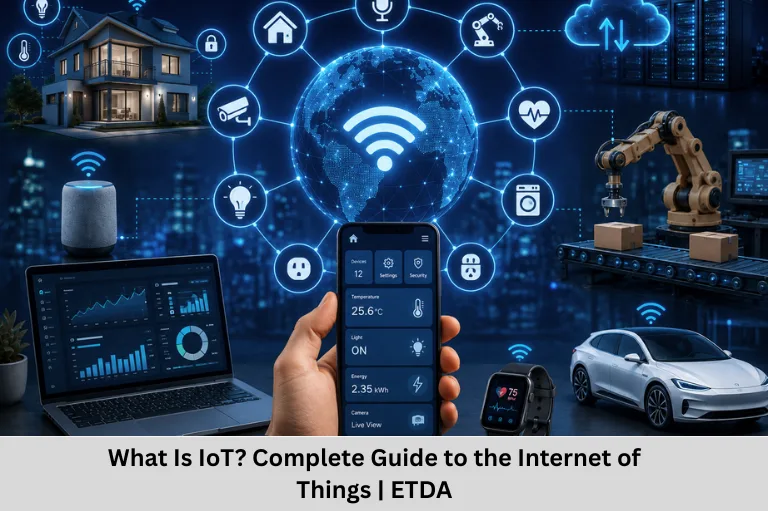
Learn what Internet of Things (IoT) is, how the Internet of Things works, its architecture, components, protocols, applications, security, and career opportunities with Embedded Tech Development Academy (ETDA).
- What Is IoT? Complete Guide to the Internet of Things | ETDA
-
What Is IoT? Complete Guide to the Internet of Things
- What Is IoT?
- How Does IoT Work?
- IoT Architecture
- Major Components of an IoT System
- Communication Protocols Used in IoT
- IoT Network and Application Protocols
- Edge Computing in IoT
- IoT Security
- IoT Applications
- IoT Programming Skills
- IoT Development Process
- IoT Projects for Engineering Students
- IoT and Embedded Systems Training at ETDA
- Career Opportunities in IoT
-
Why Choose ETDA for Embedded and IoT Training?
- FAQs
- What is IoT in simple terms?
- What are the main components of IoT?
- Is Embedded C important for IoT?
- Which protocols are important for IoT?
- What is MQTT used for in IoT?
- What is the difference between IoT and embedded systems?
- What projects can beginners build in IoT?
- Does ETDA provide placement support?
- Why choose ETDA for IoT and embedded training?
- Conclusion
What Is IoT? Complete Guide to the Internet of Things
The Internet of Things (IoT) is a technology ecosystem in which physical devices are connected to networks so they can collect, process, exchange, and sometimes act on data. Internet of Things (IoT) combines embedded systems, sensors, microcontrollers, communication protocols, networking, cloud platforms, data processing, and software to create connected solutions.
From smart homes and wearable devices to connected vehicles, industrial automation, healthcare equipment, and smart agriculture, Internet of Things (IoT) is becoming an important part of modern technology.
For engineering students searching for a Top Embedded Training Institute in Bangalore, understanding Internet of Things (IoT) from the hardware level to the cloud level is valuable. Embedded Tech Development Academy (ETDA) focuses on practical embedded and Internet of Things (IoT) technologies, including C, Embedded C, microcontrollers, communication protocols, RTOS, Embedded Linux, and IoT development, along with assured placement support.
This guide explains what Internet of Things (IoT) is, how it works, its architecture, major components, communication protocols, applications, security considerations, and the technical skills required to develop IoT systems.
What Is IoT?
IoT stands for Internet of Things (IoT). It refers to a network of physical objects equipped with electronics, sensors, software, and communication capabilities that allow them to exchange information.
An IoT device can:
- Sense physical information.
- Process the collected data.
- Communicate with another device or server.
- Receive commands.
- Perform an action.
A simple IoT system can be represented as:
Sensor → Embedded Device → Network → Cloud/Server → Application
For example, a temperature-monitoring system can measure temperature using a sensor, process the value using a microcontroller, send the data through Wi-Fi or another network, store it on a server, and display the information in a mobile or web application.
Why Is IoT Important?
Traditional electronic devices often operate independently. Internet of Things (IoT) connects these devices so information can be monitored, analyzed, and used for automated decisions.
Internet of Things (IoT) can enable:
- Remote monitoring
- Automation
- Predictive maintenance
- Real-time alerts
- Data collection
- Energy management
- Asset tracking
- Remote control
IoT and Embedded Systems
Embedded systems form the foundation of many Internet of Things (IoT) products.
An embedded device can collect information from sensors and communicate it to another system through:
- Wi-Fi
- Bluetooth
- Ethernet
- Cellular networks
- LoRaWAN
- Zigbee
- CAN
- MQTT-based systems
Example of an IoT Device
Consider a smart energy meter.
It can:
- Measure electrical parameters.
- Process measurements using a microcontroller.
- Store or transmit readings.
- Send information to a server.
- Allow users to monitor consumption remotely.
How Does IoT Work?
An Internet of Things (IoT) system usually operates through multiple interconnected layers.
Step 1 – Data Collection
Sensors collect information from the physical environment.
Examples include:
- Temperature
- Humidity
- Pressure
- Light
- Motion
- Acceleration
- Gas concentration
- Voltage
- Current
Step 2 – Local Processing
The embedded controller processes sensor data.
It may:
- Filter noise
- Convert analog signals
- Compare thresholds
- Perform calculations
- Detect events
Step 3 – Communication
The device sends information to another device, gateway, or cloud platform.
Communication can occur through wired or wireless technologies.
IoT Architecture
Understanding Internet of Things (IoT) architecture is important for designing scalable systems.
Perception Layer
The perception layer interacts with the physical environment.
It includes:
- Sensors
- Actuators
- RFID devices
- Cameras
- Embedded controllers
The primary function is collecting information or performing physical actions.
Network Layer
The network layer transfers data between devices and computing systems.
Technologies include:
- Wi-Fi
- Ethernet
- Bluetooth
- Cellular
- Zigbee
- LoRaWAN
- CAN
Processing Layer
The processing layer handles data storage, processing, analytics, and device management.
It can include:
- Edge computers
- Gateways
- Cloud servers
- Databases
- Data-processing platforms
Application Layer
The application layer provides services to end users.
Examples include:
- Smart home applications
- Fleet management
- Industrial monitoring
- Healthcare dashboards
- Agriculture monitoring
Major Components of an IoT System
An Internet of Things (IoT) system is not simply a sensor connected to the internet. Multiple technical components work together.
Sensors
Sensors convert physical parameters into electrical signals.
Examples include:
- Temperature sensors
- Humidity sensors
- Accelerometers
- Pressure sensors
- Light sensors
Microcontrollers
A microcontroller processes sensor data and controls connected peripherals.
Common embedded platforms include ARM Cortex-M-based microcontrollers.
Actuators
Actuators convert electrical control signals into physical actions.
Examples include:
- Motors
- Relays
- Valves
- Buzzers
- Solenoids
Communication Protocols Used in IoT
Communication protocols determine how devices exchange information.
UART
UART is commonly used for communication between embedded controllers and modules.
It is useful for:
- GPS
- Cellular modules
- Bluetooth modules
- Debugging
I2C
I2C is commonly used for short-distance communication between a microcontroller and peripherals.
Typical applications include:
- Sensors
- EEPROM
- RTC
- Displays
SPI
SPI is useful when higher-speed communication with peripherals is required.
It is commonly used with:
- Flash memory
- Displays
- Sensors
- ADCs
CAN
CAN is widely used in automotive and industrial environments where robust communication between multiple controllers is required.
IoT Network and Application Protocols
Internet of Things (IoT) applications often require protocols designed specifically for network communication.
MQTT
MQTT (Message Queuing Telemetry Transport) is a lightweight messaging protocol widely used in Internet of Things (IoT) applications.
It uses a publish-subscribe architecture.
For example:
Sensor → MQTT Publisher → Broker → MQTT Subscriber
This allows devices to publish data while applications subscribe to the information they need.
HTTP and HTTPS
HTTP and HTTPS can be used when Internet of Things (IoT) devices communicate with web services and APIs.
CoAP
Constrained Application Protocol (CoAP) is designed for constrained devices and networks.
Choosing the Right Protocol
The choice depends on:
- Data size
- Power consumption
- Network reliability
- Latency
- Security
- Device resources
- Application requirements
Edge Computing in IoT
Not every Internet of Things (IoT) operation needs to send all data to the cloud.
What Is Edge Computing?
Edge computing processes information closer to where it is generated.
For example:
Sensor → Edge Device → Local Decision
instead of:
Sensor → Cloud → Decision → Device
Benefits of Edge Processing
Edge computing can provide:
- Lower latency
- Reduced bandwidth usage
- Faster responses
- Improved availability
- Local data processing
Edge and Cloud Together
Modern IoT architectures often combine edge and cloud computing.
The edge handles time-sensitive processing, while the cloud can provide:
- Long-term storage
- Analytics
- Machine learning
- Device management
- Centralized dashboards
IoT Security
Security is a critical part of IoT development because connected devices can become potential entry points into larger networks.
Common IoT Security Risks
Risks can include:
- Weak passwords
- Insecure communication
- Unprotected APIs
- Outdated firmware
- Poor access control
- Insecure device configuration
Secure Communication
Protocols such as HTTPS and secure MQTT configurations can be used to protect data during transmission.
Secure Firmware
Internet of Things (IoT) devices should also consider:
- Secure boot
- Firmware authentication
- Signed updates
- Access control
- Encryption
- Secure key storage
Security should be considered during system design rather than added only after development.
IoT Applications
Internet of Things (IoT) technology is used across many industries.
Smart Home
Applications include:
- Smart lighting
- Smart thermostats
- Security systems
- Smart appliances
- Energy monitoring
Industrial IoT
Industrial Internet of Things (IoT) can monitor:
- Machines
- Production lines
- Motors
- Temperature
- Pressure
- Equipment health
Healthcare IoT
Connected healthcare devices can support:
- Patient monitoring
- Wearable devices
- Equipment monitoring
- Remote health measurements
Smart Agriculture
Internet of Things (IoT) can help monitor:
- Soil moisture
- Temperature
- Humidity
- Irrigation
- Weather conditions
Automotive IoT
Connected vehicles can exchange information related to:
- Vehicle diagnostics
- Location
- Fleet management
- Driver behavior
- Predictive maintenance
IoT Programming Skills
Internet of Things (IoT) developers need knowledge across several technical areas.
Embedded Programming
C and Embedded C are important for programming microcontrollers.
Students should understand:
- Pointers
- Memory
- Bitwise operations
- Interrupts
- Registers
- Peripheral programming
Python Programming
Python is frequently used for:
- IoT application development
- Data processing
- Automation
- Testing
- Prototyping
Linux
Linux knowledge is useful for IoT gateways and edge devices.
Important areas include:
- Shell commands
- Processes
- Threads
- Networking
- File systems
- Device interfaces
IoT Development Process
Developing an Internet of Things (IoT) product usually involves multiple stages.
Step 1 – Define Requirements
Determine:
- What data needs to be collected?
- How frequently should it be collected?
- What actions are required?
- What connectivity is available?
Step 2 – Select Hardware
Choose:
- Sensors
- Microcontroller
- Communication module
- Power source
- Memory
Step 3 – Develop Firmware
Firmware handles:
- Sensor acquisition
- Data processing
- Communication
- Device control
Step 4 – Build Backend
The backend can provide:
- Data storage
- APIs
- Device management
- Authentication
- Analytics
Step 5 – Develop User Application
The final application can display:
- Sensor readings
- Alerts
- Historical data
- Device status
- Control options
IoT Projects for Engineering Students
Practical projects are an effective way to learn Internet of Things (IoT).
Beginner IoT Projects
Examples include:
- IoT temperature monitor
- Smart lighting system
- Wi-Fi-based home automation
- Remote sensor dashboard
Intermediate Projects
Students can develop:
- IoT energy monitoring
- Environmental monitoring system
- Smart agriculture system
- IoT-based security system
Advanced Projects
Advanced learners can explore:
- Industrial IoT gateway
- Edge-based predictive maintenance
- Connected vehicle monitoring
- Cloud-connected RTOS device
Skills Developed Through Projects
Internet of Things (IoT) projects can develop:
- Embedded programming
- Networking
- Sensor interfacing
- Protocol implementation
- Cloud communication
- Debugging
- System architecture
IoT and Embedded Systems Training at ETDA
For students searching for a Top Embedded Training Institute in Bangalore, Embedded Tech Development Academy (ETDA) provides training that connects embedded fundamentals with modern Internet of Things (IoT) development.
Technical Areas
The curriculum can include:
- C Programming
- Embedded C
- C++
- Data Structures
- ARM Cortex-M
- STM32
- LPC1768
- GPIO
- Timers
- ADC
- PWM
- UART
- SPI
- I2C
- CAN
- Ethernet
- RTOS
- Embedded Linux
- Internet of Things (IoT)
Practical Learning
Students can work on hardware-based projects involving sensors, microcontrollers, communication protocols, networking, and IoT concepts.
Assured Placement Support
Embedded Tech Development Academy (ETDA) provides assured placement support that can include:
- Technical interview preparation
- Resume preparation
- Coding practice
- Mock interviews
- Aptitude preparation
- HR interview preparation
- Career guidance
Career Opportunities in IoT
Internet of Things (IoT) combines multiple technical domains, creating opportunities for engineers with embedded and software skills.
IoT Developer
Develops connected devices, applications, and communication systems.
Embedded IoT Developer
Works on microcontroller firmware, sensors, connectivity, and device-level software.
IoT Firmware Engineer
Develops low-level firmware for connected embedded devices.
IoT Solutions Engineer
Works across devices, networks, cloud systems, and applications to create complete IoT solutions.
Edge Computing Developer
Develops software that processes IoT data close to the source.
Why Choose ETDA for Embedded and IoT Training?
Learning Internet of Things (IoT) requires a combination of hardware and software knowledge. Embedded Tech Development Academy (ETDA) focuses on building these skills progressively.
Students can learn the complete path:
C → Embedded C → Microcontroller → Sensors → Communication → RTOS → Linux → Networking → IoT Projects
This approach helps learners understand how an IoT product works from the device level to the application level.
FAQs
What is IoT in simple terms?
IoT is a technology in which physical devices equipped with sensors, processing capabilities, and communication interfaces collect and exchange data over networks.
What are the main components of IoT?
The major components include sensors, microcontrollers or processors, connectivity, gateways, edge/cloud platforms, databases, applications, and actuators.
Is Embedded C important for IoT?
Yes. Embedded C is commonly used to program microcontrollers that collect sensor data, process information, control hardware, and communicate with other systems.
Which protocols are important for IoT?
Important technologies include UART, SPI, I2C, CAN, MQTT, HTTP/HTTPS, Wi-Fi, Bluetooth, Ethernet, cellular, and LoRaWAN, depending on the application.
What is MQTT used for in IoT?
MQTT is a lightweight messaging protocol commonly used for IoT communication. It uses a publish-subscribe model involving publishers, subscribers, and a broker.
What is the difference between IoT and embedded systems?
An embedded system is generally designed to perform a specific function within a product. IoT adds connectivity and data exchange capabilities, allowing devices to communicate with other systems or services.
What projects can beginners build in IoT?
Beginners can build projects such as temperature monitoring systems, smart lighting, home automation, environmental monitoring, and cloud-connected sensor applications.
Does ETDA provide placement support?
Yes. Embedded Tech Development Academy (ETDA) provides assured placement support, including technical interview preparation, resume guidance, coding practice, mock interviews, aptitude preparation, and career guidance.
Why choose ETDA for IoT and embedded training?
Embedded Tech Development Academy (ETDA) combines embedded systems and IoT learning across C, Embedded C, ARM microcontrollers, communication protocols, RTOS, Embedded Linux, networking, and practical projects, making it an option for learners seeking a Top Embedded Training Institute in Bangalore.
Conclusion
Internet of Things (IoT) is more than simply connecting devices to the internet. It is a complete technology ecosystem involving sensors, embedded systems, microcontrollers, communication protocols, networking, edge computing, cloud platforms, data processing, applications, and security.
For engineering students searching for a Top Embedded Training Institute in Bangalore, learning embedded systems alongside Internet of Things (IoT) can provide a strong technical foundation. Understanding C, Embedded C, microcontrollers, UART, SPI, I2C, CAN, networking, RTOS, Linux, and IoT protocols helps students understand the complete device-to-cloud architecture.
Embedded Tech Development Academy (ETDA) provides practical training in embedded and Internet of Things (IoT) technologies with hands-on learning and assured placement support. Students can build technical knowledge through programming, hardware interfacing, communication protocols, and real-world projects.
Choosing a Top Embedded Training Institute in Bangalore should therefore involve evaluating technical depth, practical exposure, project work, and career preparation. With the right foundation, learners can progress toward careers in embedded Internet of Things (IoT) development, firmware engineering, edge computing, industrial Internet of Things (IoT), automotive technology, and connected-device development.
Author: ETDA Trainers
Experience: 10+ Years of Industry Experience in Embedded Systems, IoT, and Embedded C Programming